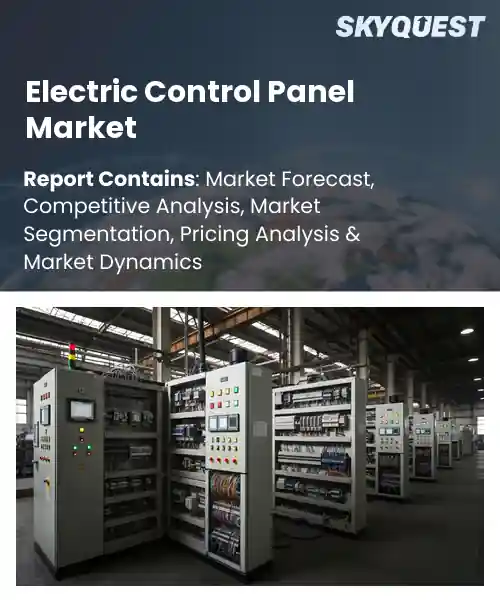
Electric Control Panel Market
Report ID: SQMIG20D2709
Report ID: SQMIG20D2709
[email protected]
USA +1 351-333-4748
Report ID:
SQMIG20D2709 |
Region:
Global |
Published Date: June, 2026
Pages:
157
|Tables:
118
|Figures:
77


Global Electric Control Panel Market size was valued at USD 82.52 Billion in 2024 and is poised to grow from USD 87.41 Billion in 2025 to USD 138.85 Billion by 2033, growing at a CAGR of 5.92% during the forecast period (2026-2033).
The global electric control panel market comprises systems that regulate, monitor, and protect electrical equipment across industrial, commercial, and residential sectors. Reputable power distribution, compliance with safety regulations and energy efficiency, all of these factors are key elements of an automated system, where the importance of a well-designed panel cannot be understated. The vast growth in renewable energy installation has driven the demand for more complex panel technologies that allow for the integration of variable energy generation sources over the last decade, as shown by the global adoption of IEC 61850 standards at substations. This development shows an increased emphasis on both the exchange of data and predictive maintenance.
Building on the renewable push, digitalization emerges as the next key factor shaping the electric control panel market because interconnected panels enable remote diagnostics and adaptive load management. The impact of Industry 4.0 factories is clear; by employing modular panels from Siemens with computing modules that communicate directly with manufacturing execution systems, they are able to reduce downtime by up to 15%. At the same time, utility companies use these same advanced panels to run demand-response programs where the load is automatically reduced during peak times, this both improves the stability of the grid and lowers the bills that consumers pay. The demand for panels with built-in cybersecurity, modular designs and compliant communication protocols creates an abundance of opportunity for OEMs that are able to provide solutions.
How Is AI-Driven Automation Reshaping the Electric Control Panel Market?
The electric control panel industry is experiencing a shift because AI-powered automation is being embedded directly into the panel’s hardware, thus making the automation process intelligent. Predictive diagnostics, adaptive control loops, and remote monitoring have all been achieved through AI-powered automation technology, which removes the need for manual intervention on the part of operators. AI-powered panels are now able to learn how they are being used and will adapt by changing voltage and/or frequency in order to maximize overall efficiency. Manufacturers are also using machine learning models to optimize motor startups and balance load distribution in real-time; thereby reducing downtime of production equipment, reducing the time it takes to complete commissioning cycles and lessening the need for on-site engineering assistance.
In March 2025, Siemens completed its acquisition of Altair Engineering, integrating AI-powered simulation and digital twin technologies into the Siemens Xcelerator platform. The combined solution enables manufacturers to design smarter electric control panels, optimize engineering workflows, accelerate automation system development, and improve predictive maintenance through advanced industrial AI capabilities.
Market snapshot - (2026-2033)
Global Market Size
USD 82.52 Billion
Largest Segment
Power Distribution Panels
Fastest Growth
PLC Control Panels
Growth Rate
5.92% CAGR
To get more insights on this market click here to Request a Free Sample Report
Global electric control panel market is segmented by type, voltage, application, end-use and region. Based on type, the market is segmented into motor control centers (MCC), power distribution panels, PLC control panels and switchgear panels. Based on voltage, the market is segmented into low voltage, medium voltage and high voltage. Based on application, the market is segmented into industrial automation, power generation and building management. Based on end-use, the market is segmented into manufacturing, oil & gas and construction. Based on region, the market is segmented into North America, Europe, Asia Pacific, Latin America and Middle East & Africa.
Motor control centers segment dominates because they centralize motor protection, distribution and control within a single modular enclosure, simplifying wiring and maintenance for complex plant layouts. MCC's ability to scale allows for growth through the ability to accommodate a growing number of machines, as well as having built in Diagnostics help improve uptime. Manufacturers appreciate the benefits of using a standardized system because it reduces design effort, while end users benefit by having less floor space for their equipment and increased safety making MCC the preferred choice of all types of industrial facilities.
Meanwhile, switchgear panels are emerging as the key high growth area because demand for higher reliability and arc fault protection in sensitive processes is intensifying. Integration of digital protection relays and modular design enables rapid upgrades, attracting sectors that prioritize continuous operation. This momentum is opening new revenue streams and spurring innovation in panel engineering.
Industrial automation segment dominates because it requires tightly coordinated motor control, sensor integration and real time communication, all of which are facilitated by specialized panels. The quest for increased productivity and fewer errors by humans leads to the use of advanced control logic in industry. Companies are turning to the use of mechanical and electronic control panels that follow industry standards for networks. As result, these devices are now an essential part of the operation of today's factories and help them maintain a strong position in the marketplace.
Conversely, building management segment is witnessing rapid expansion because smart energy systems and IoT integration are driving demand for intelligent panels that monitor HVAC, lighting and security. Enhanced analytics and remote operability create value for commercial owners, prompting widespread retrofits. This surge is broadening the market beyond traditional industrial confines.
To get detailed segments analysis, Request a Free Sample Report
The region benefits from a robust manufacturing base that integrates advanced electronics with precision engineering, fostering high‑quality panel production. The continual innovation taking place in industrial sectors as well as infrastructure projects has been impacted due to the strong demand for these two types of industries. The fast-paced growth in the number of new technologies being developed by component suppliers and system integrators is a direct result of their close partnerships. Government policies that support both automation and energy efficiency, along with large-scale strategic investments in R&D, strengthen the competitive position of this region. A highly skilled workforce coupled with the region's vast export networks allow businesses to efficiently supply their products to both domestic and international customers; thereby solidifying Asia Pacific's position as the leading supplier of these goods within the market.
Electric control panel market in Japan is driven by a culture of continuous improvement and a focus on reliability, which appeals to high‑precision manufacturing and automotive sectors. Many domestic manufacturers are focusing on creating modular designs and their ability to be interoperable as they follow industry trends to become digitalized. The development of modular designs has been aided by strong partnerships between technology companies and research institutions, which help to drive early adoption of IoT panels. In addition, strict quality standards help build the reputation of these products as being durable, thus supporting local demand and creating opportunities for exporting their products.
Electric control panel market in South Korea thrives on a combination of fast‑paced industrial growth and a national emphasis on technology integration. By being at the forefront of electronics and heavy industry, this country nurtures a robust ecosystem for the development of advanced panel solutions that enhance automation and smart factory efforts. As the result of close relationships among different types of behemoths and specialized panel manufacturers, product development is accelerated, especially with the additional push coming from government incentives for energy-efficient systems which are motivating companies to adopt these kinds of solutions in their manufacturing and infrastructure efforts.
The market experiences strong momentum due to heightened focus on industrial automation and the modernization of legacy equipment across diverse sectors. The use of intelligent panels is encouraged by sustainability regulations (energy efficiency requirements) which provide HVAC manufacturers benefit from established supply chains and years of engineering experience for quick customization and configuration of advanced monitoring capabilities. OEMs and system integrators partner with third-party technology suppliers to form collaborative ecosystems that continuously innovate, and the presence of favorable regulatory conditions helps to facilitate capital investments in smart infrastructure. Collectively these factors are establishing an environment that drives rapid growth throughout the region.
Electric control panel market in the United States is characterized by deep integration of digital technologies within manufacturing and energy sectors. The strong desire for predictive maintenance and real-time analytics encourages the use of advanced communication protocols with equipment. There is a large pool of engineering talent, as well as an abundance of original equipment manufacturers (OEMs), which allows OEMs to quickly develop customized solutions. Moreover, renewable energy initiatives will create new opportunities for panels to facilitate distributed generation and improve reliable power management systems through grid modernization.
Electric control panel market in Canada benefits from a strategic emphasis on resource extraction and clean‑energy projects, where reliable power control is essential. As a result, several country priorities for sustainability and efficiency have harmonized in their demand for durability in extreme environments and Energy-saving benefits from product offerings. As a result, there is significant potential for this industry to grow through an established engineering sector and trade policies that support companies' ability to supply both national and foreign markets.
Europe leverages a strong legacy of engineering excellence and a cohesive regulatory framework that promotes interoperability and safety across borders. Industry 4.0 and digital twin developments encourage the production of panels for continuous data transfer (cloud-like) and remote support/diagnosis among manufacturers. Through Regional Funded Research Initiatives, Collaborative Research Projects are creating more opportunities in the use of new technologies/sensors and introducing them into new communication standards. Designing panels for higher solar power usage and energy stability is already driving development for new sustainable energy targets. With strong manufacturing and an advancement in the standardization process, Europe will remain in the forefront of the global technology marketplace.
Electric control panel market in Germany is anchored by a reputation for precise engineering and stringent quality benchmarks, serving automotive, machinery, and chemical industries. The market embraces modular architectures that facilitate rapid reconfiguration for evolving production lines. Research institutions and industries work together to help invent new ways of monitoring things intelligently and designing them to keep functioning despite a failure. The commitment by companies to develop energy-efficient solutions and use the most rigorous safety standards also supports why Germans find panels so desirable in the domestic and export markets.
Electric control panel market in the United Kingdom reflects a focus on digital transformation within manufacturing and infrastructure sectors. The collaboration between universities, start-ups and established companies to create customized solutions for particular industries is a major driving force for innovations in the development of smart panels. Furthermore, as resilience and cybersecurity issues continue to increase in importance, the deployment of smart panels will help to meet the increasing demand for critical power system infrastructure.
Electric control panel market in France is propelled by a blend of advanced aerospace, energy, and transportation industries that require high‑performance control solutions. The market has a long history of collaboration with research that drives innovation through added functionality provided by sensing technology and predictive capabilities. Large national initiatives for decarbonization and the improvement of the smart grid create demand for panels that can integrate with renewable sources of electrical energy and provide the means to distribute power efficiently.
To know more about the market opportunities by region and country, click here to
Buy The Complete Report
Increasing Automation Across Industries
Growth Of Renewable Energy Integration
High Initial Capital Expenditure
Complex Regulatory Compliance Challenges
Request Free Customization of this report to help us to meet your business objectives.
The competitive landscape is shaped by major incumbents such as ABB, Siemens, Eaton and Mitsubishi Electric, whose aggressive pursuit of digital integration and IoT‑enabled control solutions is intensifying rivalry. The expansive growth of the marketplace with several emerging alliances marks a fundamental shift toward smarter and more energy-efficient panels. Each of these leaders will take advantage of partnerships and technology in order to capitalize on an expanding market for automation in manufacturing.
Top Player’s Company Profile
Recent Developments
SkyQuest’s ABIRAW (Advanced Business Intelligence, Research & Analysis Wing) is our Business Information Services team that Collects, Collates, Correlates, and Analyses the Data collected by means of Primary Exploratory Research backed by robust Secondary Desk research.
As per SkyQuest analysis, the global electric control panel market is being propelled primarily by the surge in automation across industries, which fuels demand for modular, intelligent panels that boost efficiency and safety. A second major driver is the rapid expansion of renewable energy integration, requiring sophisticated panels to manage variable generation and support grid stability. A significant limit to adoption of this technology among small businesses is the high initial capital cost. The Asia Pacific Region dominates the market due to both its extensive manufacturing and its progressive technology policies. Furthermore, the Motor Control Center (MCC) is the dominant segment of this market due to their ability to provide an extensive range of diagnostics and a greater ease of wiring and maintaining plants through the provision of scalable solutions.
| Report Metric | Details |
|---|---|
| Market size value in 2024 | USD 82.52 Billion |
| Market size value in 2033 | USD 138.85 Billion |
| Growth Rate | 5.92% |
| Base year | 2024 |
| Forecast period | (2026-2033) |
| Forecast Unit (Value) | USD Billion |
| Segments covered |
|
| Regions covered | North America (US, Canada), Europe (Germany, France, United Kingdom, Italy, Spain, Rest of Europe), Asia Pacific (China, India, Japan, Rest of Asia-Pacific), Latin America (Brazil, Rest of Latin America), Middle East & Africa (South Africa, GCC Countries, Rest of MEA) |
| Companies covered |
|
| Customization scope | Free report customization with purchase. Customization includes:-
|
To get a free trial access to our platform which is a one stop solution for all your data requirements for quicker decision making. This platform allows you to compare markets, competitors who are prominent in the market, and mega trends that are influencing the dynamics in the market. Also, get access to detailed SkyQuest exclusive matrix.
Table Of Content
Executive Summary
Market overview
Parent Market Analysis
Market overview
Market size
KEY MARKET INSIGHTS
COVID IMPACT
MARKET DYNAMICS & OUTLOOK
Market Size by Region
KEY COMPANY PROFILES
Methodology
For the Electric Control Panel Market, our research methodology involved a mixture of primary and secondary data sources. Key steps involved in the research process are listed below:
1. Information Procurement: This stage involved the procurement of Market data or related information via primary and secondary sources. The various secondary sources used included various company websites, annual reports, trade databases, and paid databases such as Hoover's, Bloomberg Business, Factiva, and Avention. Our team did 45 primary interactions Globally which included several stakeholders such as manufacturers, customers, key opinion leaders, etc. Overall, information procurement was one of the most extensive stages in our research process.
2. Information Analysis: This step involved triangulation of data through bottom-up and top-down approaches to estimate and validate the total size and future estimate of the Electric Control Panel Market.
3. Report Formulation: The final step entailed the placement of data points in appropriate Market spaces in an attempt to deduce viable conclusions.
4. Validation & Publishing: Validation is the most important step in the process. Validation & re-validation via an intricately designed process helped us finalize data points to be used for final calculations. The final Market estimates and forecasts were then aligned and sent to our panel of industry experts for validation of data. Once the validation was done the report was sent to our Quality Assurance team to ensure adherence to style guides, consistency & design.
Analyst Support
Customization Options
With the given market data, our dedicated team of analysts can offer you the following customization options are available for the Electric Control Panel Market:
Product Analysis: Product matrix, which offers a detailed comparison of the product portfolio of companies.
Regional Analysis: Further analysis of the Electric Control Panel Market for additional countries.
Competitive Analysis: Detailed analysis and profiling of additional Market players & comparative analysis of competitive products.
Go to Market Strategy: Find the high-growth channels to invest your marketing efforts and increase your customer base.
Innovation Mapping: Identify racial solutions and innovation, connected to deep ecosystems of innovators, start-ups, academics, and strategic partners.
Category Intelligence: Customized intelligence that is relevant to their supply Markets will enable them to make smarter sourcing decisions and improve their category management.
Public Company Transcript Analysis: To improve the investment performance by generating new alpha and making better-informed decisions.
Social Media Listening: To analyze the conversations and trends happening not just around your brand, but around your industry as a whole, and use those insights to make better Marketing decisions.
REQUEST FOR SAMPLE
 REQUEST FREE CUSTOMIZATION
Global Electric Control Panel Market size was valued at USD 82.52 Billion in 2024 and is poised to grow from USD 87.41 Billion in 2025 to USD 138.85 Billion by 2033, growing at a CAGR of 5.92% during the forecast period (2026-2033).
The competitive landscape is shaped by major incumbents such as ABB, Siemens, Eaton and Mitsubishi Electric, whose aggressive pursuit of digital integration and IoT‑enabled control solutions is intensifying rivalry; recent market expansions and strategic collaborations underscore a shift toward smarter, energy‑efficient panels, while each leader leverages partnerships and technology upgrades to capture growing demand in industrial automation. 'Schneider Electric', 'Siemens AG', 'ABB Ltd.', 'Eaton Corporation', 'Rockwell Automation', 'General Electric', 'Mitsubishi Electric', 'Honeywell International', 'Larsen & Toubro', 'Crompton Greaves', 'Legrand SA', 'Hubbell Inc.', 'WEG SA', 'Toshiba International', 'Bharat Heavy Electricals', 'Havells India', 'Schneider Toshiba Inverter', 'Lenze SE', 'Phoenix Contact', 'Vacon (Danfoss)'
Manufacturers are integrating electric control panels to streamline processes, improve precision, and reduce manual intervention, which enhances overall operational efficiency. The ability of these panels to enable seamless communication among equipment encourages broader adoption of automated solutions, fostering productivity gains and cost reductions. As companies prioritize smart factory initiatives, the demand for reliable, configurable control systems rises, driving sustained market expansion and encouraging continuous innovation in panel design and functionality. These improvements also satisfy tighter safety regulations and provide real-time data insights, enhancing overall operational confidence.
Smart Grid Integration Expansion: The rise of decentralized energy generation and advanced communication protocols is prompting manufacturers to embed connectivity and monitoring into electric control panels. Customers demand panels that can seamlessly exchange data with grid management systems, support dynamic load balancing, and adapt to variable renewable inputs. This shift drives a focus on open architecture designs, modular firmware upgrades, and cybersecurity provisions, positioning control panels as participants in the evolving smart grid ecosystem rather than mere passive devices.
Why does Asia Pacific Dominate the Global Electric Control Panel Market? |@12


Want to customize this report? This report can be personalized according to your needs. Our analysts and industry experts will work directly with you to understand your requirements and provide you with customized data in a short amount of time. We offer $1000 worth of FREE customization at the time of purchase.
Feedback From Our Clients


 USA (+1) 351-333-4748

