
Electric Commercial Vehicle Market
Report ID: SQMIG25A2475
Report ID: SQMIG25A2475
[email protected]
USA +1 351-333-4748
Report ID:
SQMIG25A2475 |
Region:
Global |
Published Date: July, 2025
Pages:
177
|Tables:
257
|Figures:
74


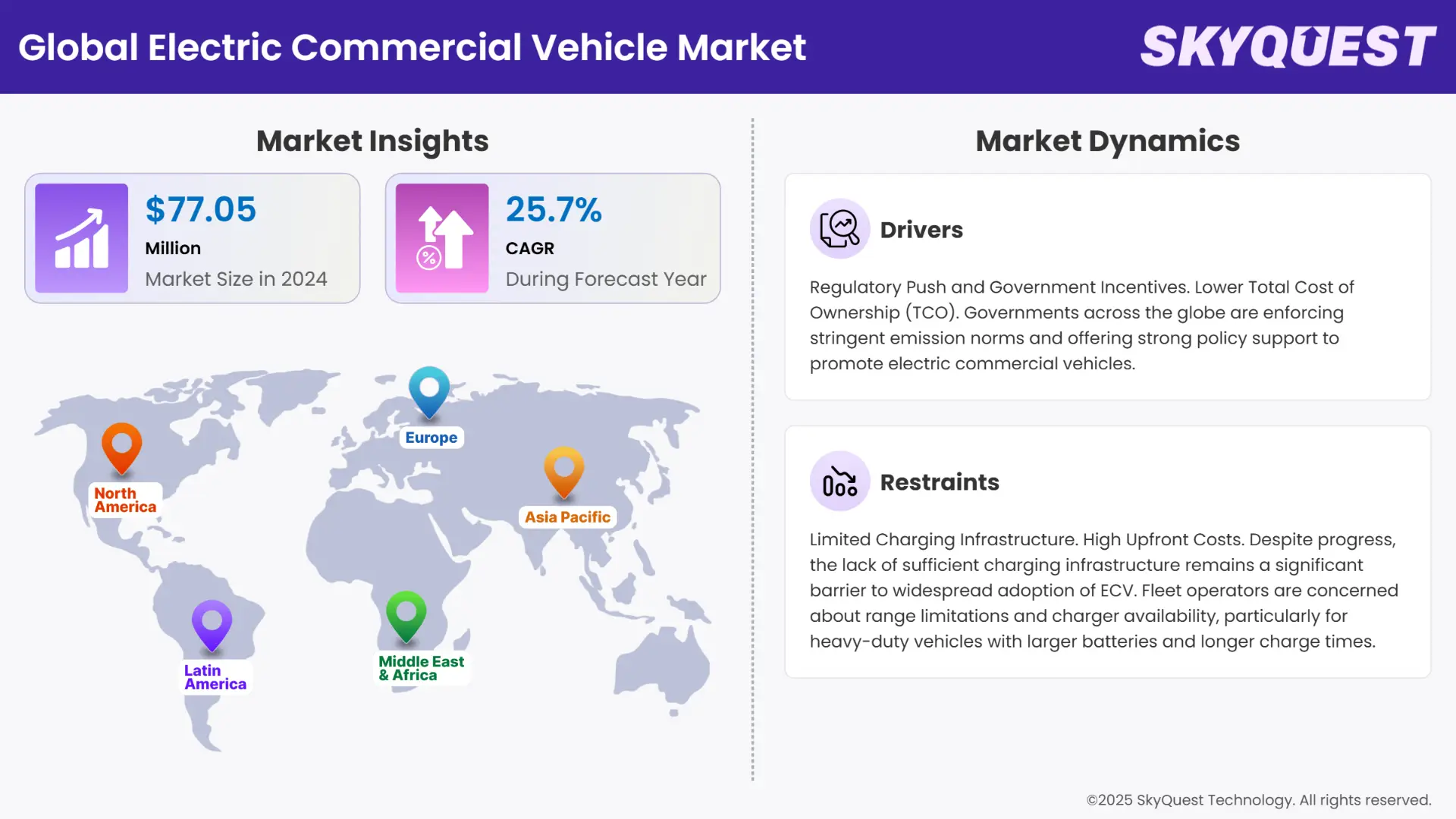
Electric Commercial Vehicle Market size was valued at USD 77.05 Billion in 2024 and is poised to grow from USD 96.85 Billion in 2025 to USD 603.66 Billion by 2033, growing at a CAGR of 25.7% in the forecast period (2026–2033).
The electric commercial vehicle market is experiencing rapid evolution as global emphasis on reducing carbon emissions and transitioning to clean mobility gains momentum. Commercial fleets across logistics, municipal, and transit applications are increasingly adopting electric buses, trucks, and vans. This shift is fueled by the dual goals of environmental sustainability and operational cost efficiency. Regulatory pressure, especially in urban centers, is pushing fleet operators to invest in zero-emission alternatives.
Public transportation systems are rapidly shifting towards electrification, with many cities around the world adopting electric buses to reduce air pollution and noise. For instance, BYD has delivered electric buses to various cities, enabling public transit systems to transition to cleaner energy solutions supported by government initiatives.
The electric commercial vehicle industry is heavily reliant on progress in battery technology and charging infrastructure. Ongoing research and development are yielding batteries with higher energy densities, allowing ECVs to travel greater distances on a single charge. Simultaneously, the expansion of charging networks, including the deployment of high-power fast-charging stations, is reducing charging times and improving the overall convenience of ECVs. These improvements are crucial for addressing range of anxiety and operational concerns among fleet operators, thereby driving increased adoption of electric commercial vehicles across various sectors.
Government regulations and incentives play a pivotal role in shaping the electric commercial vehicle industry. Concerns about air quality and climate change are intensifying, encouraging governments to enact stricter emission standards, particularly in urban centers. These regulations, coupled with financial incentives such as subsidies, tax exemptions, and grants, are making ECVs a compelling alternative to traditional internal combustion engine vehicles for businesses. This supportive policy landscape is driving significant investment and innovation in the ECV sector, boosting market expansion.
What Role Does AI Play in Fleet Optimization and Battery Management?
Artificial Intelligence (AI) plays a transformative role in the electric commercial vehicle market, enhancing vehicle efficiency, fleet management, and overall operational intelligence. AI algorithms are integrated into ECV systems for route optimization, battery health monitoring, predictive maintenance, driver behavior analysis, and autonomous driving capabilities. These smart solutions are not only reducing downtime and energy consumption but also increasing vehicle longevity and safety. AI-driven telematics platforms help fleet operators monitor vehicle performance in real-time, allowing data-informed decisions that maximize uptime and reduce operational costs.
To get more insights on this market click here to Request a Free Sample Report
The global electric commercial vehicle market is segmented into vehicle type, propulsion, battery type, battery capacity, power output, range, end use, body construction, component and region. Based on vehicle type, the market is segmented into pickup trucks, trucks, vans and buses and coaches. Based on propulsion, the market is segmented into BEVS and FCEVS. Based on battery type, the market is segmented into NMC batteries, LFP batteries, Solid-State Batteries and Others. Based on battery capacity, the market is segmented into less than 60 KWH, 60–120 KWH, 121–200 KWH, 201–300 KWH, 301–500 KWH and 501–1,000 KWH. Based on power output, the market is segmented into less than 100 KW, 100–250 KW and Above 250 KW. Based on range, the market is segmented into less than 150 miles, 151–300 miles and above 300 miles. Based on end use, the market is segmented into last-mile delivery, field services, distribution services, long-haul transportation and refuse trucks. based on body construction, the market is segmented into integrated, semi-integrated and full-sized. Based on components, the market is segmented into battery packs, onboard chargers, electric motors, inverters, DC-DC converters and fuel-cell stacks. Based on region, the market is segmented into North America, Asia-Pacific, Europe, Latin America, and Middle East & Africa.
Why Are Battery Packs Crucial for Commercial Fleets?
Battery packs are the most dominant component in the electric commercial vehicle market. They represent the largest cost portion of an EV and directly influence critical factors such as vehicle range, performance, and charging frequency. With commercial vehicles operating on fixed schedules and long routes, fleet operators prioritize high-capacity, durable battery systems. Battery technology has also matured significantly, with widespread adoption of lithium-ion packs due to their energy density, weight efficiency, and scalability across vehicle classes. As a result, OEMs and suppliers invest heavily in battery R&D, and demand remains strong across all ECV types.
As per electric commercial vehicle market forecast, fuel-cell stacks are witnessing rapid growth, where long range, fast refueling, and payload preservation are essential. Fuel-cell electric vehicles (FCEVs) are increasingly viewed as a viable alternative for long-haul trucks and buses. Growth is driven by technological advances, government funding (especially in Europe, Japan, and South Korea), and early deployments in fleet trials for hydrogen-based logistics and public transit.
What Factors Are Driving BEVS Segment Growth?
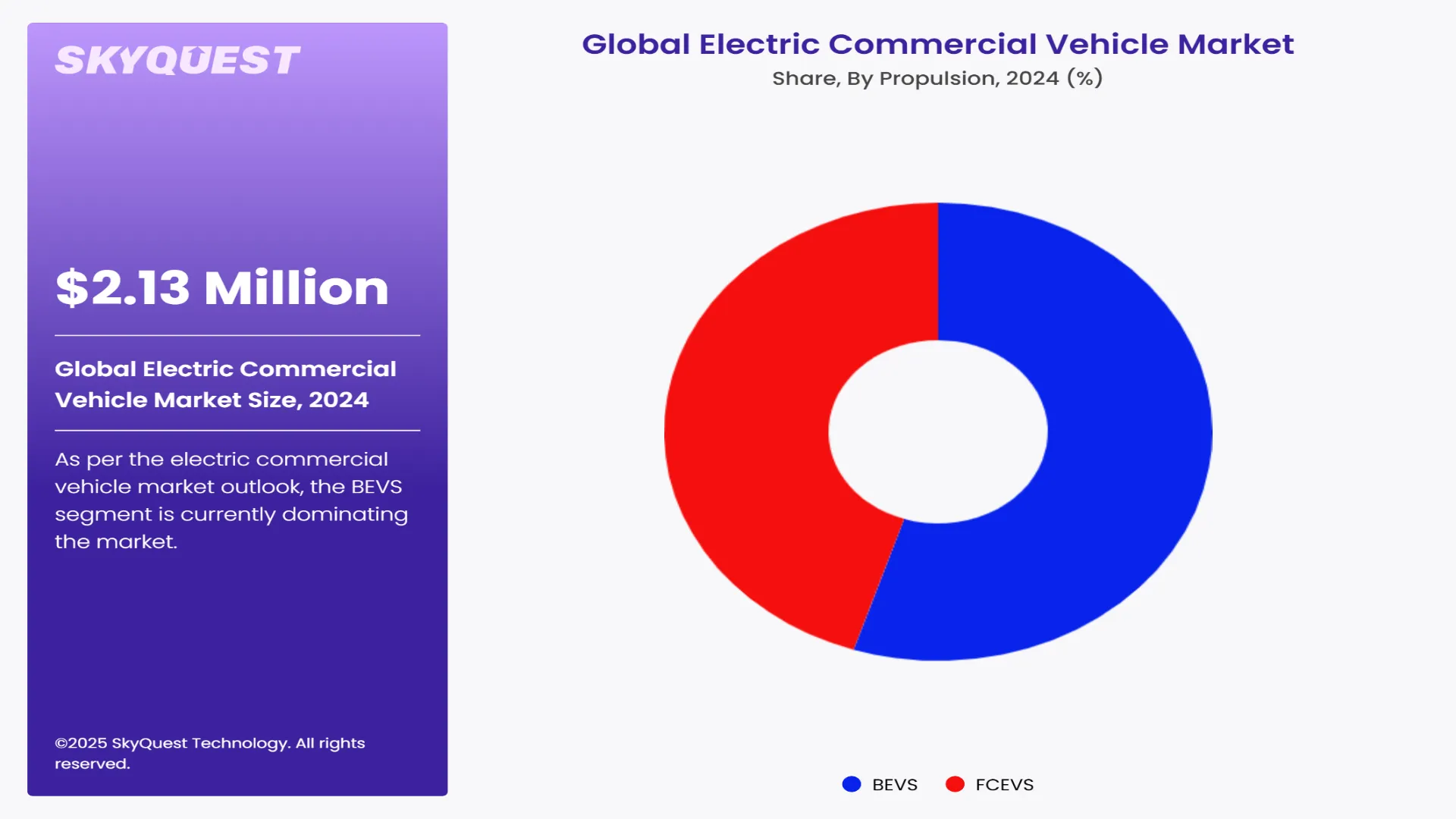
As per the electric commercial vehicle market outlook, the BEVS segment is currently dominating the market. BEVs are widely used across light, medium, and heavy-duty applications due to their relatively mature technology, lower operational costs, and increasing support infrastructure. Electric light commercial vehicles (eLCVs) such as delivery vans are leading adoption, especially in urban and last-mile logistics operations. The dominance of this segment is driven by growing e-commerce activity, stringent emission regulations in city centers, and the total cost of ownership advantages for businesses with short and predictable daily routes.
The FCEVS segment is experiencing the fastest growth in the market. Although adoption has been slower historically due to range limitations, high battery costs, and payload constraints, recent advances in battery density, charging infrastructure, and powertrain efficiency are making electric trucks more viable. Growth is particularly strong in short-haul freight, regional distribution, and urban construction sectors where routes are more predictable.
To get detailed segments analysis, Request a Free Sample Report
What are the Key ECV Trends in the Asia-Pacific Region?
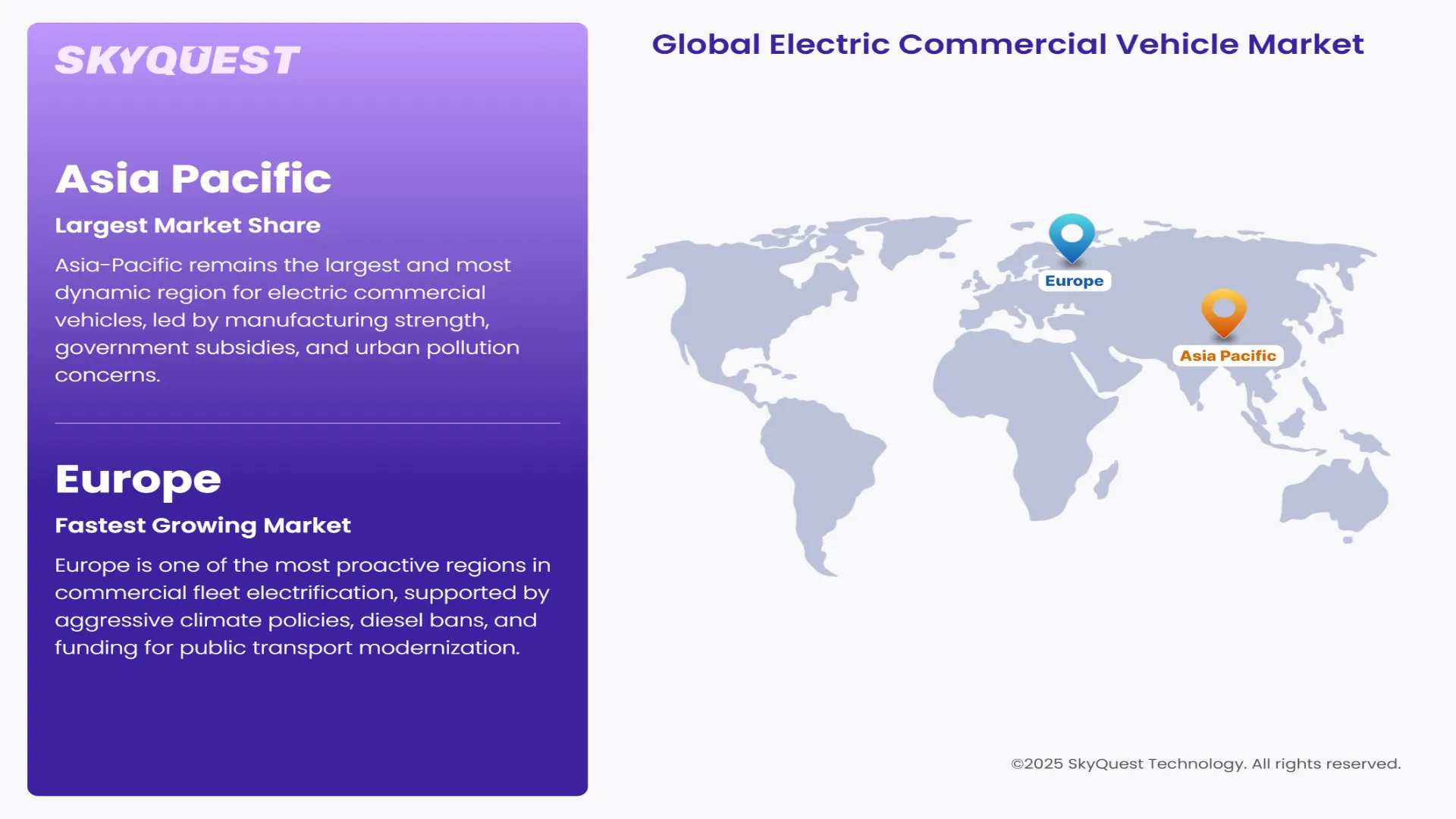
Asia-Pacific remains the largest and most dynamic region for electric commercial vehicles, led by manufacturing strength, government subsidies, and urban pollution concerns. Countries across the region are aggressively electrifying public transport and delivery networks. Domestic OEMs are expanding production, while export demand for electric buses and trucks is also rising.
Electric Commercial Vehicle Market in Japan
As per regional outlook, Japan’s electric commercial vehicle market is driven by advanced technology integration, particularly in battery development and vehicle design. Japanese automakers are focusing on lightweight, compact electric trucks and vans suitable for city logistics. Government incentives, combined with urban zero-emission zone initiatives, are encouraging last-mile operators to electrify their fleets. Additionally, Japan is exploring hydrogen fuel cell vehicles for heavy-duty applications.
Electric Commercial Vehicle Market in South Korea
South Korea is strengthening its position in the ECV space through its leading battery and EV component ecosystem. Companies are developing electric trucks and buses for both domestic and export markets. The Korean government supports ECV adoption through subsidies and green mobility targets, while local automakers are launching electric vans and mid-duty trucks tailored for commercial users. Partnerships with logistics firms drive early adoption.
How is the Electric Commercial Vehicle Market Progressing in North America?
As per industry analysis, North America is witnessing robust growth in the electric commercial vehicle segment, driven by strong regulatory backing, decarbonization commitments from corporations, and investments in charging infrastructure. Fleet electrification is a key focus area, especially among logistics, utility, and last-mile delivery operators. Public and private funding, along with tightening emissions standards, are accelerating the shift toward electric trucks and vans.
Electric Commercial Vehicle in United States
The United States is at the forefront of the North America region. Federal initiatives like the Inflation Reduction Act provide substantial tax credits and manufacturing incentives, supporting both vehicle production and fleet electrification. Major logistics firms, retail giants, and municipalities are investing in electric vans, buses, and heavy-duty trucks. Companies such as Rivian, Ford, and Tesla are launching commercial EVs, while public transit authorities are adopting electric buses to meet clean air targets.
Electric Commercial Vehicle in Canada
As per regional forecast, Canada is expanding its electric commercial vehicle footprint through national climate strategies, zero-emission vehicle mandates, and investment in green transportation corridors. Programs such as the iMHZEV (Incentives for Medium- and Heavy-Duty Zero-Emission Vehicles) offer purchase incentives for fleet operators. Canadian cities are transitioning to electric buses and utility fleets, while partnerships with U.S. OEMs support vehicle imports and infrastructure development.
How is Europe Leading the ECV Market Transition?
Europe is one of the most proactive regions in commercial fleet electrification, supported by aggressive climate policies, diesel bans, and funding for public transport modernization. Electric buses, municipal trucks, and last-mile delivery vans are increasingly deployed across cities. OEMs, governments, and charging infrastructure providers are working together to scale up electrification quickly.
Electric Commercial Vehicle Market in Germany
Germany is a key driver of the European region, with strong domestic manufacturing, R&D, and policy support. Subsidies for fleet electrification, combined with urban emission restrictions, are spurring demand. German OEMs like Daimler and Volkswagen are introducing electric vans and trucks, while cities such as Berlin and Hamburg are transitioning municipal fleets to electric.
Electric Commercial Vehicle Market in United Kingdom
The UK is pushing for zero-emission vehicle deployment through regulatory mandates and clean air zones in major cities. Government programs provide grants for electric trucks and charging infrastructure, especially for fleet operators. British startups and global OEMs are partnering on electric delivery vans and e-mobility solutions, while electric bus deployment continues to expand across regional transport authorities.
Electric Commercial Vehicle Market in Italy
Italy’s market is growing steadily, supported by EU-level sustainability mandates and national incentives for fleet renewal. The country is focusing on electrifying public transport and utility vehicles, particularly in high-traffic urban areas. Italian cities are piloting electric buses and light commercial vehicles, while OEMs are collaborating with logistics firms to bring electric vans and refrigerated trucks into operation.
To know more about the market opportunities by region and country, click here to
Buy The Complete Report
Electric Commercial Vehicle Market Drivers
Regulatory Push and Government Incentives
Lower Total Cost of Ownership (TCO)
Electric Commercial Vehicle Market Restraints
Limited Charging Infrastructure
High Upfront Costs
Request Free Customization of this report to help us to meet your business objectives.
The electric commercial vehicle industry is becoming increasingly competitive, with traditional automakers, EV startups, and tech-driven mobility companies racing to capture market share. Established players like Daimler, Volvo, Ford, and BYD are expanding their electric portfolios with purpose-built vans, trucks, and buses tailored for fleet applications. These companies leverage their manufacturing scale, dealer networks, and after-sales services to maintain a strong position in both developed and emerging markets.
As per market strategies, in February 2024, a major development in the competitive landscape occurred when a leading European OEM announced a joint venture with a global logistics company to co-develop a new line of mid-duty electric trucks. The partnership includes shared R&D and integration of telematics and AI systems for real-time route optimization.
Startups are playing a pivotal role in reshaping the electric commercial vehicle market by bringing innovative technologies, flexible vehicle designs, and digital-first business models. These new entrants are focusing on niche areas like last-mile delivery, lightweight chassis systems, and integrated telematics to offer tailored solutions for urban and regional logistics. Many of them emphasize modular vehicle platforms that allow for customizable configurations depending on fleet needs. They are also pioneering software-centric approaches, embedding AI and IoT into vehicle management systems for predictive maintenance, energy optimization, and route intelligence.
Top Player’s Company Profiles
Recent Developments in Electric Commercial Vehicle Market
SkyQuest’s ABIRAW (Advanced Business Intelligence, Research & Analysis Wing) is our Business Information Services team that Collects, Collates, Correlates, and Analyses the Data collected by means of Primary Exploratory Research backed by robust Secondary Desk research.
As per SkyQuest analysis, key drivers of market growth include stringent emission regulations and policy support. The electric commercial vehicle market is experiencing strong growth, driven by global decarbonization efforts, government regulations, and the rising demand for sustainable urban transportation and logistics. Technological progress in battery efficiency, charging infrastructure, and AI-based fleet handling make ECVs more practical and cost-effective. While battery electric vehicles dominate current adoption, fuel cell electric vehicles (FCEV) are attracted by long-term applications. However, challenges such as high advance costs and inadequately charging infrastructure are major limitations. In addition, battery performance can be negatively affected by extreme weather conditions, especially in the cold climate, where low efficiency can reduce the reach of the vehicle.
| Report Metric | Details |
|---|---|
| Market size value in 2024 | USD 77.05 Billion |
| Market size value in 2033 | USD 603.66 Billion |
| Growth Rate | 25.7% |
| Base year | 2024 |
| Forecast period | 2026–2033 |
| Forecast Unit (Value) | USD Billion |
| Segments covered |
|
| Regions covered | North America (US, Canada), Europe (Germany, France, United Kingdom, Italy, Spain, Rest of Europe), Asia Pacific (China, India, Japan, Rest of Asia-Pacific), Latin America (Brazil, Rest of Latin America), Middle East & Africa (South Africa, GCC Countries, Rest of MEA) |
| Companies covered |
|
| Customization scope | Free report customization with purchase. Customization includes:-
|
To get a free trial access to our platform which is a one stop solution for all your data requirements for quicker decision making. This platform allows you to compare markets, competitors who are prominent in the market, and mega trends that are influencing the dynamics in the market. Also, get access to detailed SkyQuest exclusive matrix.
Table Of Content
Executive Summary
Market overview
Parent Market Analysis
Market overview
Market size
KEY MARKET INSIGHTS
COVID IMPACT
MARKET DYNAMICS & OUTLOOK
Market Size by Region
KEY COMPANY PROFILES
Methodology
For the Electric Commercial Vehicle Market, our research methodology involved a mixture of primary and secondary data sources. Key steps involved in the research process are listed below:
1. Information Procurement: This stage involved the procurement of Market data or related information via primary and secondary sources. The various secondary sources used included various company websites, annual reports, trade databases, and paid databases such as Hoover's, Bloomberg Business, Factiva, and Avention. Our team did 45 primary interactions Globally which included several stakeholders such as manufacturers, customers, key opinion leaders, etc. Overall, information procurement was one of the most extensive stages in our research process.
2. Information Analysis: This step involved triangulation of data through bottom-up and top-down approaches to estimate and validate the total size and future estimate of the Electric Commercial Vehicle Market.
3. Report Formulation: The final step entailed the placement of data points in appropriate Market spaces in an attempt to deduce viable conclusions.
4. Validation & Publishing: Validation is the most important step in the process. Validation & re-validation via an intricately designed process helped us finalize data points to be used for final calculations. The final Market estimates and forecasts were then aligned and sent to our panel of industry experts for validation of data. Once the validation was done the report was sent to our Quality Assurance team to ensure adherence to style guides, consistency & design.
Analyst Support
Customization Options
With the given market data, our dedicated team of analysts can offer you the following customization options are available for the Electric Commercial Vehicle Market:
Product Analysis: Product matrix, which offers a detailed comparison of the product portfolio of companies.
Regional Analysis: Further analysis of the Electric Commercial Vehicle Market for additional countries.
Competitive Analysis: Detailed analysis and profiling of additional Market players & comparative analysis of competitive products.
Go to Market Strategy: Find the high-growth channels to invest your marketing efforts and increase your customer base.
Innovation Mapping: Identify racial solutions and innovation, connected to deep ecosystems of innovators, start-ups, academics, and strategic partners.
Category Intelligence: Customized intelligence that is relevant to their supply Markets will enable them to make smarter sourcing decisions and improve their category management.
Public Company Transcript Analysis: To improve the investment performance by generating new alpha and making better-informed decisions.
Social Media Listening: To analyze the conversations and trends happening not just around your brand, but around your industry as a whole, and use those insights to make better Marketing decisions.
REQUEST FOR SAMPLE
 REQUEST FREE CUSTOMIZATION
Electric Commercial Vehicle Market size was valued at USD 77.05 Billion in 2024 and is poised to grow from USD 96.85 Billion in 2025 to USD 603.66 Billion by 2033, growing at a CAGR of 25.7% in the forecast period (2026–2033).
The electric commercial vehicle industry is becoming increasingly competitive, with traditional automakers, EV startups, and tech-driven mobility companies racing to capture market share. Established players like Daimler, Volvo, Ford, and BYD are expanding their electric portfolios with purpose-built vans, trucks, and buses tailored for fleet applications. These companies leverage their manufacturing scale, dealer networks, and after-sales services to maintain a strong position in both developed and emerging markets. 'BYD', 'Daimler Truck', 'Volvo Group', 'Ford Motor Company', 'General Motors', 'Rivian', 'Arrival', 'REE Automotive', 'Xos, Inc.', 'Canoo', 'Volta Trucks', 'Scania (part of Traton Group)'
Governments across the globe are enforcing stringent emission norms and offering strong policy support to promote electric commercial vehicles. Subsidies, tax rebates, zero-emission vehicle mandates, and low-emission zones are motivating fleet operators to accelerate adoption. In regions like Europe, India, and the U.S., public transport systems and logistics providers are receiving grants for fleet electrification, while policies such as the EU Green Deal and California’s Advanced Clean Trucks rule are pushing manufacturers and buyers toward zero-emission alternatives.
Integration of AI and Smart Fleet Technologies: Artificial intelligence is being integrated into ECV platforms and fleet management systems to enhance operational efficiency. AI helps optimize route planning, monitor battery health, predict maintenance needs, and even manage charging schedules. In 2024, several major logistics firms adopted AI-powered systems that analyze traffic patterns, cargo weight, and weather data to reduce energy use and improve delivery times. These smart technologies are reshaping the performance capabilities of commercial electric fleets.
What are the Key ECV Trends in the Asia-Pacific Region?


Want to customize this report? This report can be personalized according to your needs. Our analysts and industry experts will work directly with you to understand your requirements and provide you with customized data in a short amount of time. We offer $1000 worth of FREE customization at the time of purchase.
Feedback From Our Clients


 USA (+1) 351-333-4748

