Elderly Care Apps Market
Report ID: SQMIG45E2729
Report ID: SQMIG45E2729
[email protected]
USA +1 351-333-4748
Report ID:
SQMIG45E2729 |
Region:
Global |
Published Date: March, 2026
Pages:
157
|Tables:
118
|Figures:
77


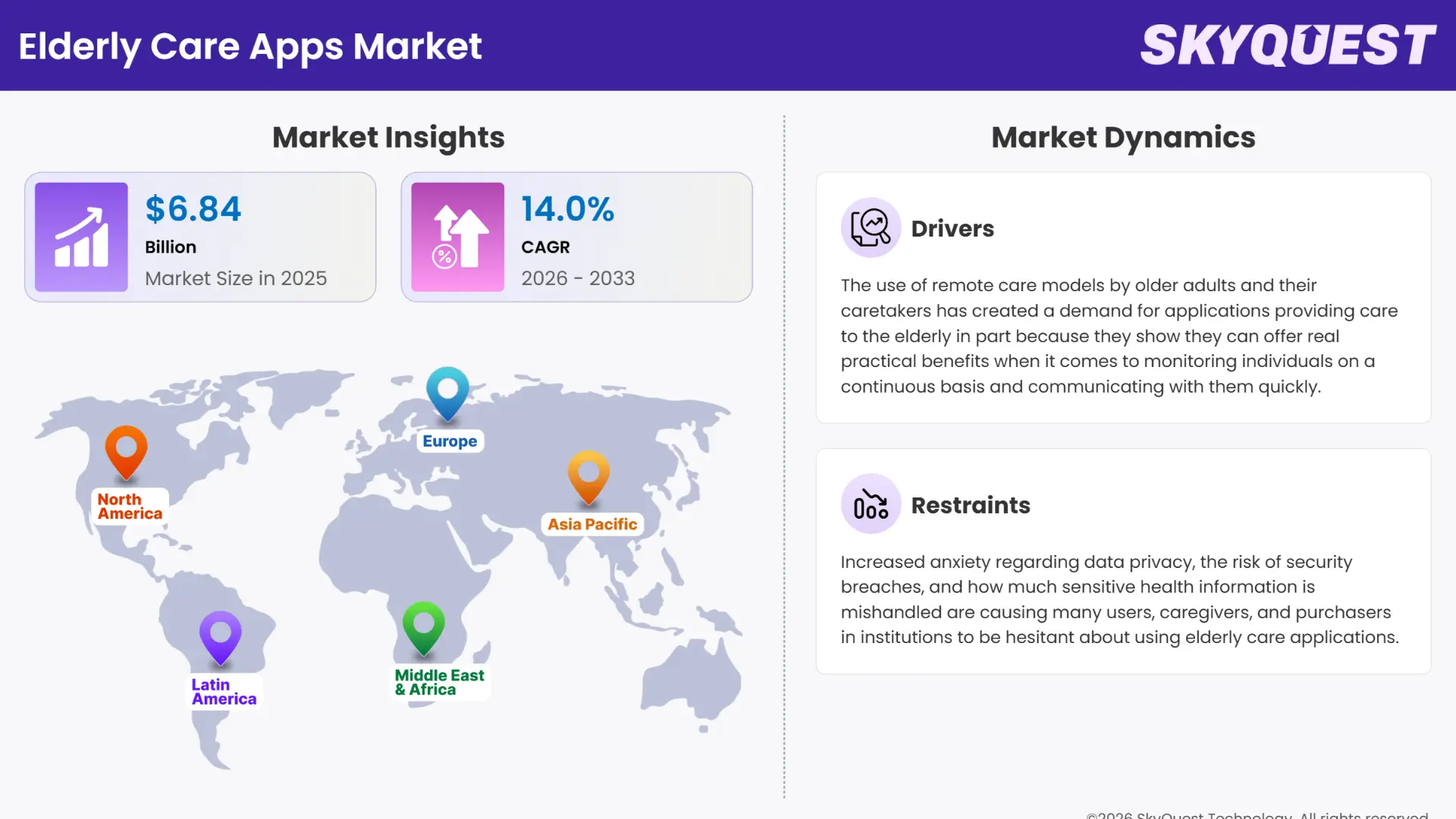
Global Elderly Care Apps Market size was valued at USD 6.0 Billion in 2024 and is poised to grow from USD 6.84 Billion in 2025 to USD 19.51 Billion by 2033, growing at a CAGR of 14.0% during the forecast period (2026-2033).
Key Takeaways: Market Trends & Insights
• North America dominated the Elderly Care Apps market with the largest market share in 2025.
• The U.S. Elderly Care Apps market is expected to grow significantly over the forecast period.
• By App Functionality, the Health Monitoring segment held the largest Elderly Care Apps market share in 2024.
• The Emergency Response segment is projected to be the fastest-growing segment over the forecast period.
• North America: Largest Market in 2025.
• Asia Pacific: Fastest Growing Market.
• 2025 Market Size: USD 6.84 Billion.
• 2026 Projected Market Size: USD 7.80 Billion (estimated based on forecast growth trajectory).
• 2033 Projected Market Size: USD 19.51 Billion.
• CAGR (2026–2033): 14.0%.
The most significant factor responsible for the rapidly rising elderly care apps market is the increased number of people over the age of sixty-five which is resulting in an increased need for technology solutions that are designed to help individuals remain as independent as possible and to maintain clinical supervision. The types of technologies available in this market include multi-media reminders for medication adherence, teleconsultations, remote monitoring of vital signs, and fall detection systems, all of which are important to provide economic solutions to the issues relating to reduced hospital readmissions; mitigating caregiver stress and reducing long-term care costs to health systems. Throughout the past decade Elderly Care Apps have evolved from simple reminder applications to comprehensive, integrated systems that utilize combinations of wearable sensors; artificial intelligence (AI) enabled decisions based on data collected through use of the wearable sensors.
Another important trend that supports the elderly care apps market growth globally is that the convergence of technology occurs as a result of the rapid adoption of smartphones, affordable wearables, and data analytics, all of which create actionable data for predicting and delivering individualized, predictive-based outcomes. Machine learning models utilize streams of sensor data and remotely measured vital signs to enable care teams to detect clinical decline early enough to prevent emergency visits and to encourage health insurers to reimburse for delivering telehealth services.
The cause-and-effect relationship between the early detection of clinical decline and the reduction in emergency physician visits creates opportunities for developing integrated technology platforms that connect the processes associated with medication adherence; teleconsultations; and fall detection together within care pathways. The success of the aforementioned technology-driven integrated platforms is exemplified by the positive outcomes achieved through multiple remote patient monitoring pilot programs that were designed with the specific intent of reducing hospital readmissions.
How is AI Improving Personalised Care In The Elderly Care Apps Market?
AI enhances personalized care by integrating real-time monitoring into the elderly app market through predictive analytics and conversational user interfaces. Additionally, passive monitoring by wearable devices and home-based sensor systems is integrated into the overall structure of the application to allow AI algorithms to help identify behavioural changes through data collected by these devices. The shift from 'alarm' apps to an integrated relationship-based model of care for the older adult is being facilitated by actionable data that allows for connection with family members and clinicians through timely insight. Examples are available showing that Elders will have access to remote monitoring applications used to identify early onset of dementia in the user, and using empathetic companion applications users will be part of an emotional attachment with their device while being encouraged to participate in activities that support healthy behaviours.
Intuition Robotics reported a Strategic investment in September 2025, with the announcement of a strategic partnership with Kanematsu to deliver its ElliQ AI companion to Japan, reflecting a tangible shift in market development for AI influenced personalization via the ElliQ product. The transition will help increase engagement, provide adherence to medication programs and provide health providers with more efficient, tailored forms of care delivery for the elderly population.
To get more insights on this market click here to Request a Free Sample Report
Global elderly care apps market is segmented into app functionality, platform type, business model, end-user/caregiver type and region. Based on app functionality, the market is segmented into health monitoring, medication management & reminders, safety & emergency response, cognitive & mental health and social connectivity & communication. Based on platform type, the market is segmented into android and ios. Based on business model, the market is segmented into subscription-based, one-time license fee and freemium model. Based on end-user/caregiver type, the market is segmented into family caregivers, professional caregivers and independent seniors. Based on region, the market is segmented into North America, Europe, Asia Pacific, Latin America and Middle East & Africa.
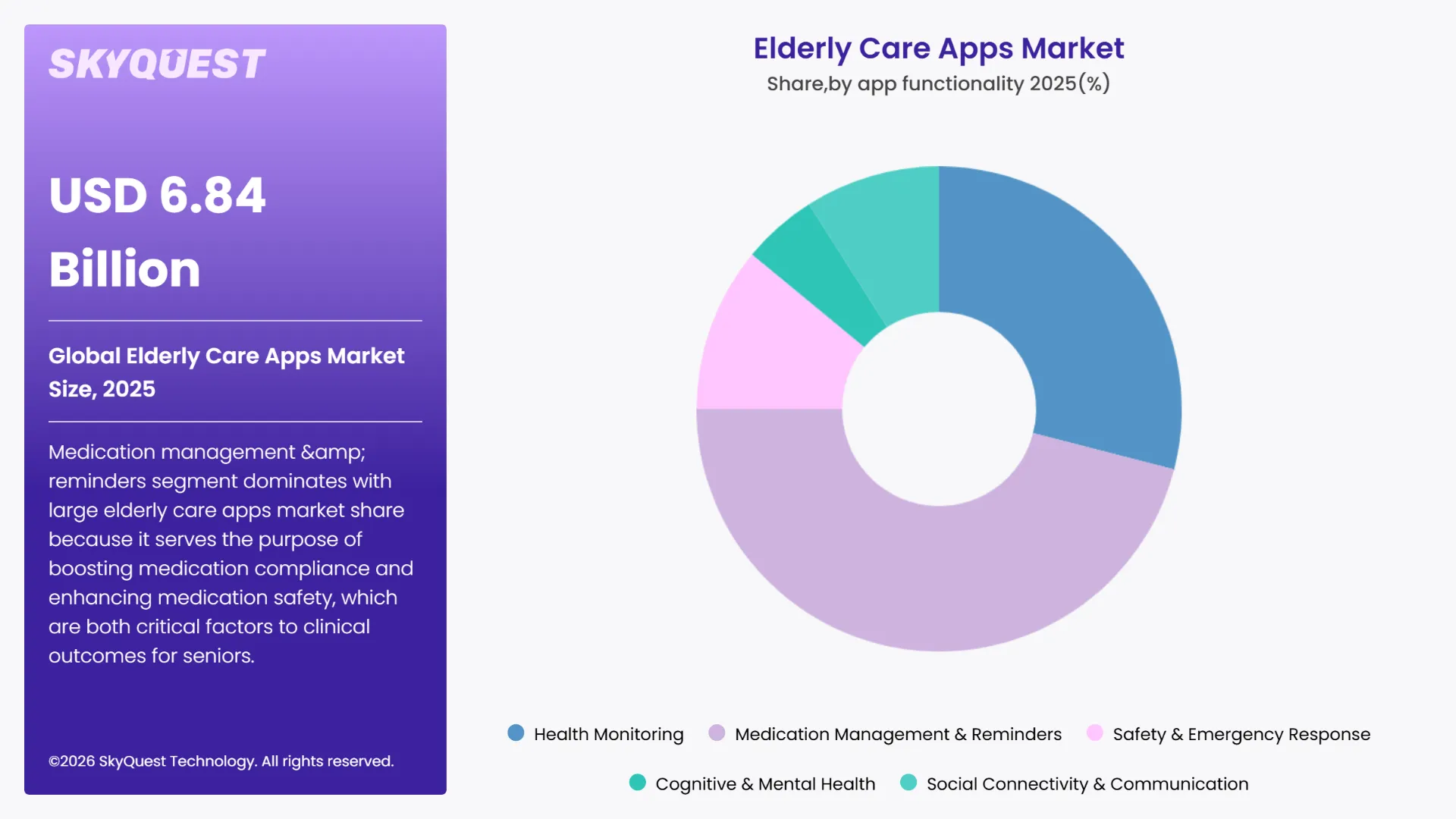
Medication management & reminders segment dominates with large elderly care apps market share because it serves the purpose of boosting medication compliance and enhancing medication safety, which are both critical factors to clinical outcomes for seniors. Medication management & reminders provide substantial consumer value by providing less opportunity for error in medication dosing, simplifying the management of their medication regimen, and providing motivation for other caregivers and service providers to use the product as well. Integration with pharmacy workflows, electronic health records and notifications to caregivers creates a virtuous cycle of confidence and acceptance of medication management & reminders, thereby increasing the amount of investment in developing new features for seniors using medication management & reminders.
As per global elderly care apps market analysis, safety & emergency response is becoming the fastest growing segment. Market demand for fall detection, wearables to connect to services, and the creation of pathways for an immediate responder drives innovation in products. New technological advances in integration with sensors and partnerships at the service level enables real-time interventions in response to a fall event, resulting in the creation of new service models and subscription models.
As per global elderly care apps market outlook, android's extensive ecosystem of available devices and flexibility provide lower barriers to entry for developers and elderly users; therefore, there is a very wide distribution of elderly care apps. The android platform supports an array of hardware and highly customizable interfaces, enabling diverse levels of ability to use the platform. Additionally, flexible policies in the android segment and original equipment manufacturer (OEM) partnerships facilitate rapid development and local customization. These features lead to acceptance of Android by caregivers, service providers, and low-cost device channels that are looking for scalable, adaptable solutions.
As per global elderly care apps market forecast, iOS is currently experiencing the fastest growing market momentum for the development and deployment of elderly care apps. The commonality of hardware between iOS devices, combined with the sophistication of Apple OEM manufactured sensors and hardware and the strength of Apple's privacy framework, enable developers to build higher-value features for clinicians. Developers are attracted to Apple iOS because of the integration of numerous health care related APIs into the iOS platform and because of the availability of various apple wearable technologies for the development of secure mobile telehealth, telemonitoring, and data sharing applications. All these factors support premium app models and partnerships between developers and manufacturers that will enable accelerated monetization and expansion of services for the elderly in the future.
To get detailed segments analysis, Request a Free Sample Report
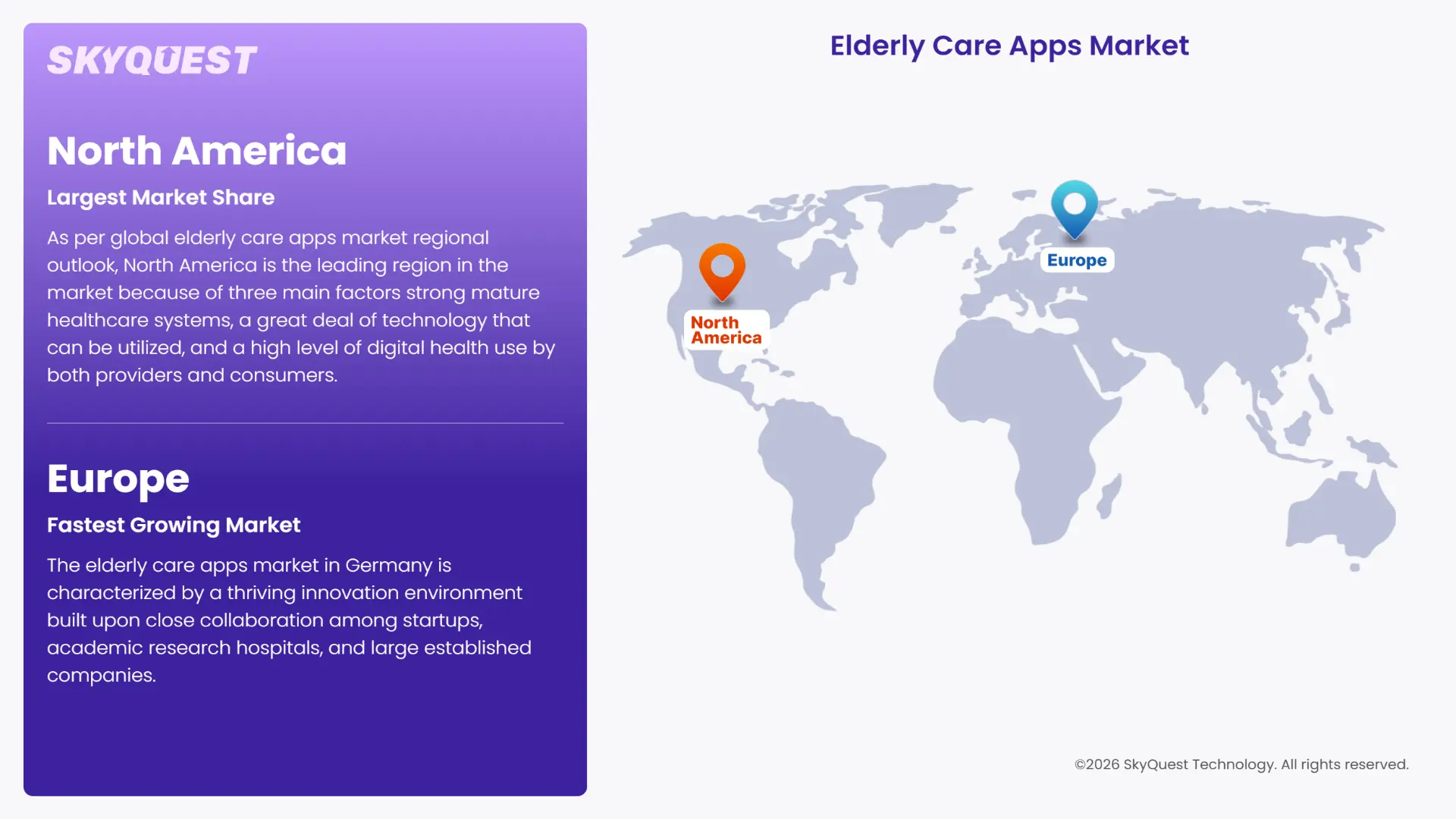
As per global elderly care apps market regional outlook, North America is the leading region in the market because of three main factors strong mature healthcare systems, a great deal of technology that can be utilized, and a high level of digital health use by both providers and consumers. There are substantial VC funding and corporate investment in the elderly care apps market, which supports ongoing innovation in the market. Integrated models of care delivery foster the acceptance of remote monitoring and telecare, as well. Finally, there are favorable regulatory and reimbursement environments that support commercializing elderly care apps.
As per global elderly care apps market regional forecast, United States market consists of a unique, dense ecosystem of technology vendors, healthcare providers, and payers that create rapid iterations of products and useful integration into clinical care. Much of the development focus is influenced by high expectations for usability and regulatory compliance, and therefore the relationship between academia and the industry creates an opportunity to generate an evidence base for elderly care app products.
The Canada elderly care apps market is unique in that it operates within a bilingual environment and a geographic area that prioritizes remote care and accessibility for a widely dispersed population. The provincial health systems, along with a collaborative procurement environment for public sector actors, create opportunities for tailored solutions that meet the needs of the public sector. There is a focus on privacy and cultural sensitivity in the way vendors design solutions, and partnerships that develop between technology vendors, community based organizations, and caregiver support organizations all support localized adoption of elderly care apps.
The growth of the elderly care apps market in Europe is largely driven by strong public health objectives, solid primary care setups, and active government support for bringing digital health into mainstream care. National and regional initiatives are now centred on telecare, remote monitoring, and chronic disease management as part of established care pathways, which creates the need for real-world solutions. Funding sources and contracts encourage partnerships between startups, tech vendors and public health service providers. Strict data and privacy laws help build trust among older adults and caregivers. Internationally based research networks and partnerships provide opportunities for knowledge sharing and help create standard processes that will allow for scalable solutions in multiple languages and cultures. Focus on access, clinical validation and the interoperability of electronic health record systems is setting Europe up to be an exciting market for the growing number of public sector and social care networks that are driving up usage in this space.
The elderly care apps market in Germany is characterized by a thriving innovation environment built upon close collaboration among startups, academic research hospitals, and large established companies. Changes to regulatory frameworks and pilot reimbursement pathways have reduced barriers that previously kept many innovation companies from taking their products to the market. The emphasis on interoperability with their respective providers will also enable greater adoption of these products. Demand care organizations have driven improved product design features, and culturally tailored user experiences enhance the level of acceptance among older consumers. The use of strategic public procurement and the establishment of local partnerships are accelerating the scale of operations across various regions in Germany.
Taking into consideration the strong national healthcare infrastructure and coordinated digital health strategies to support the integration of digital tools to test their use in health services, the United Kingdom's elderly care applications market is expected to grow. There are several factors driving user adoption, including the development of technology vendor/care provider/non-profit organization partnerships that promote user-centered design and outreach, as well as a significant amount of emphasis being placed on clinical validation to encourage provider confidence.
As per global elderly care apps industry analysis, France is one of the fastest growing markets for elderly care application products due to the increased interest among the public in using digital solutions for their aging population and the close collaboration between various municipal service agencies and healthcare providers to develop these products. In addition to traditional software vendors, many of the currently available products were developed by successful startup companies who have focused their resources on providing quality, elderly care solutions with a socially inclusive approach, while adapting product interfaces to accommodate cultural differences and various language requirements. Many pilot programs in regional health networks have also been initiated as part of ongoing efforts to evaluate the integration of elderly-specific applications into their care delivery models. Publicly funded procurement programs and ongoing partnerships with non-profit organizations have also played a vital role in encouraging local firms to develop scalable and culturally appropriate applications that can be utilized across the entire elderly care sector.
Asia Pacific has become more prominent within the elderly care apps sector due to a combination of technological capabilities, focus on the implementation of targeted public initiatives, and the provision of service models that reflect culture. The major economies in the Asia-Pacific region use advanced consumer electronics and mobile ecosystems as a means to provide integrated solutions to customers via integrated monitoring, medication management, and social interaction functionally integrated together into an overall solution.
The Japan elderly care apps market is driven by the technology that integrates with consumer electronics, and there is a heavy emphasis on providing technologies that facilitate independent living and remote care. Japanese vendors work with device manufacturers in addition to providing integrated service offerings to consumers. By taking the time to design for usability for seniors, and providing local language support, the adoption of elderly care apps in Japan has increased. The establishment of partnerships with government-sponsored care programs and health insurers facilitate the implementation of care programs throughout Japan's entire community and the home.
The South Korea elderly care apps market utilizes an established and mature mobile ecosystem and a highly active startup environment in creating fully featured elderly care services that include monitoring capabilities, medication adherence solutions, and social connectivity. There is also an emphasis placed on working collaboratively with other stakeholders in the healthcare system to enable the development and scaling of solutions for the elderly that will benefit all members of Korean society.
To know more about the market opportunities by region and country, click here to
Buy The Complete Report
Growing Acceptance of Remote Care
The use of remote care models by older adults and their caretakers has created a demand for applications providing care to the elderly in part because they show they can offer real practical benefits when it comes to monitoring individuals on a continuous basis and communicating with them quickly. This elderly care apps market trend has encouraged companies that provide care to the elderly and their families to start relying on digital methods to help them tend to the needs of seniors. As the trust in the reliability of these types of applications grows the willingness for providers and families to adopt them as part of their day-to-day care processes will increase, encouraging application developers to develop products with real-world value and thereby they have made the acceptance of their products in the elderly care market increase rapidly.
Utilizing AI/sensor Integration
Improvements in sensor technology and Artificial Intelligence (AI) allow applications that provide care for the elderly to be more personalized and to provide context-aware services. This means users and their caregivers perceive the value of the application is increasing due to integrated technologies such as passive continuous monitoring, pattern recognition, and adaptive alerts; which all help with solving daily safety issues and health maintenance issues associated with older adults. This added value encourages providers of care to utilize digital applications and creates increased motivation for developers to create more robust user experiences to enhance their product offerings and create more distinction from products offered by competitors.
Data Privacy and Security Concerns
Increased anxiety regarding data privacy, the risk of security breaches, and how much sensitive health information is mishandled are causing many users, caregivers, and purchasers in institutions to be hesitant about using elderly care applications. Developing applications to meet the rigorous requirements in place to ensure compliance with privacy expectations and to establish strong safeguards will add complexity to the development process. This can push timelines for deployment; trust issues that remain unresolved will limit usage and lead to less recommendations from current users. Thus, procurement practices of potential customers will be overly cautious and will lead to longer Validation cycles, making it necessary for vendors to first emphasize compliance and transparency to an even wider audience before greater acceptance can occur.
Barriers Related to Digital Literacy and Accessibility
The older demographic encompasses many “low digital literacy” individuals; therefore, issues with accessibility and inconsistent user interface (UI) design, will continue to prevent most older adults from using elderly care applications on an ongoing basis. When applications are not designed to be user-friendly or require substantial assistance from a caregiver in order for a person to complete application steps, their adoption will be low, and will lead to increased reliance on human assistance which will create barriers to the high volume of applications that can ultimately be deployed at scale. As they need to invest in training, customization, and support providers, these barriers will slow market growth by reducing the speed of adoption and delaying the widespread use of eldercare applications.
Request Free Customization of this report to help us to meet your business objectives.
The global competitive landscape for elderly care apps industry, driven by integration/consolidation of vendors, as well as partnerships with providers and payors in senior-living facilities, is rapidly evolving based on differentiation through an AI lens. M&A activity, combined with vendor integrations, is the most significant factor in scaling and providing interoperable platforms for elderly care. Two noteworthy examples include a recent acquisition of a B2B company which expanded channel access to more users and an AgeTech start-up utilizing an AI SMS coach to facilitate digital inclusion and greater adoption of services for seniors through partnerships with payors.
SkyQuest’s ABIRAW (Advanced Business Intelligence, Research & Analysis Wing) is our Business Information Services team that Collects, Collates, Correlates, and Analyses the Data collected by means of Primary Exploratory Research backed by robust Secondary Desk research.
As per SkyQuest analysis, rapid demographic aging is a key driver fueling demand for elderly care apps that support independent living and reduce care costs, while technology convergence through smartphones, affordable wearables and AI analytics acts as a second driver enabling predictive, personalized interventions. Growth is tempered by data privacy and security concerns that can slow adoption and complicate deployment. North America remains the dominating region due to mature healthcare systems, funding, and strong digital health uptake, and the medication management and reminders segment dominates by improving adherence and integrating with provider and pharmacy workflows. Vendors addressing trust and usability are best positioned to capture market opportunities.
| Report Metric | Details |
|---|---|
| Market size value in 2024 | USD 6.0 Billion |
| Market size value in 2033 | USD 19.51 Billion |
| Growth Rate | 14.0% |
| Base year | 2024 |
| Forecast period | 2026-2033 |
| Forecast Unit (Value) | USD Billion |
| Segments covered |
|
| Regions covered | North America (US, Canada), Europe (Germany, France, United Kingdom, Italy, Spain, Rest of Europe), Asia Pacific (China, India, Japan, Rest of Asia-Pacific), Latin America (Brazil, Rest of Latin America), Middle East & Africa (South Africa, GCC Countries, Rest of MEA) |
| Companies covered |
|
| Customization scope | Free report customization with purchase. Customization includes:-
|
To get a free trial access to our platform which is a one stop solution for all your data requirements for quicker decision making. This platform allows you to compare markets, competitors who are prominent in the market, and mega trends that are influencing the dynamics in the market. Also, get access to detailed SkyQuest exclusive matrix.
Table Of Content
Executive Summary
Market overview
Parent Market Analysis
Market overview
Market size
KEY MARKET INSIGHTS
COVID IMPACT
MARKET DYNAMICS & OUTLOOK
Market Size by Region
KEY COMPANY PROFILES
Methodology
For the Elderly Care Apps Market, our research methodology involved a mixture of primary and secondary data sources. Key steps involved in the research process are listed below:
1. Information Procurement: This stage involved the procurement of Market data or related information via primary and secondary sources. The various secondary sources used included various company websites, annual reports, trade databases, and paid databases such as Hoover's, Bloomberg Business, Factiva, and Avention. Our team did 45 primary interactions Globally which included several stakeholders such as manufacturers, customers, key opinion leaders, etc. Overall, information procurement was one of the most extensive stages in our research process.
2. Information Analysis: This step involved triangulation of data through bottom-up and top-down approaches to estimate and validate the total size and future estimate of the Elderly Care Apps Market.
3. Report Formulation: The final step entailed the placement of data points in appropriate Market spaces in an attempt to deduce viable conclusions.
4. Validation & Publishing: Validation is the most important step in the process. Validation & re-validation via an intricately designed process helped us finalize data points to be used for final calculations. The final Market estimates and forecasts were then aligned and sent to our panel of industry experts for validation of data. Once the validation was done the report was sent to our Quality Assurance team to ensure adherence to style guides, consistency & design.
Analyst Support
Customization Options
With the given market data, our dedicated team of analysts can offer you the following customization options are available for the Elderly Care Apps Market:
Product Analysis: Product matrix, which offers a detailed comparison of the product portfolio of companies.
Regional Analysis: Further analysis of the Elderly Care Apps Market for additional countries.
Competitive Analysis: Detailed analysis and profiling of additional Market players & comparative analysis of competitive products.
Go to Market Strategy: Find the high-growth channels to invest your marketing efforts and increase your customer base.
Innovation Mapping: Identify racial solutions and innovation, connected to deep ecosystems of innovators, start-ups, academics, and strategic partners.
Category Intelligence: Customized intelligence that is relevant to their supply Markets will enable them to make smarter sourcing decisions and improve their category management.
Public Company Transcript Analysis: To improve the investment performance by generating new alpha and making better-informed decisions.
Social Media Listening: To analyze the conversations and trends happening not just around your brand, but around your industry as a whole, and use those insights to make better Marketing decisions.
REQUEST FOR SAMPLE
 REQUEST FREE CUSTOMIZATION
Global Elderly Care Apps Market size was valued at USD 6.0 Billion in 2024 and is poised to grow from USD 6.84 Billion in 2025 to USD 19.51 Billion by 2033, growing at a CAGR of 14.0% during the forecast period (2026-2033).
The competitive landscape for global elderly care apps is being reshaped by consolidation, payor and senior-living partnerships, and AI-led differentiation, with M&A and vendor integrations driving platform scale and interoperability. Recent examples include a B2B acquisition that broadened channel access and an AgeTech startup using an AI SMS coach to partner with payors to boost adoption and digital inclusion. 'Life360', 'CaringVillage', 'CareZone', 'Medisafe', 'Almerys', 'Honor Technology', 'Home Instead', 'AARP Services', 'Care.com', 'Right at Home', 'Elderly Care Systems', 'Sanitas', 'Birdie', 'Cera Care', 'GrandCare Systems', 'Karantis24', 'Safe365', 'Oscar Senior', 'Familoop', 'VitalTech'
Adoption of remote care models among older adults and care providers has fostered demand for elderly care apps by demonstrating practical benefits in convenience, continuous monitoring and timely communication, which encourages service providers and families to rely on digital solutions. As perceptions of reliability and usefulness strengthen, there is increased willingness to adopt app-based care workflows and to integrate these tools into existing care routines, prompting developers to prioritize features that meet real-world needs and sustainably accelerating broader market acceptance.
Ai Enabled Predictive Care: Applications are leveraging artificial intelligence to anticipate health declines, tailor interventions, and optimize medication and appointment schedules. By analyzing behavior patterns, symptom reports, and passive sensor inputs, platforms enable proactive care plans and timely alerts that support early intervention and reduce care escalation. This trend encourages collaboration among clinicians, caregivers, and technology vendors to create interoperable, clinically validated workflows that enhance decision support and personalize long term health management, improving outcomes and satisfaction for elderly users and their families.
North America Dominate the Global Elderly Care Apps Market?


Want to customize this report? This report can be personalized according to your needs. Our analysts and industry experts will work directly with you to understand your requirements and provide you with customized data in a short amount of time. We offer $1000 worth of FREE customization at the time of purchase.
Feedback From Our Clients


 USA (+1) 351-333-4748

