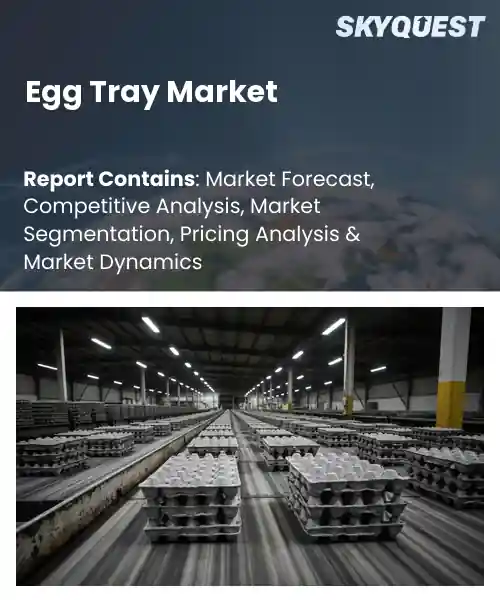
Egg Tray Market
Report ID: SQMIG15H2240
Report ID: SQMIG15H2240
[email protected]
USA +1 351-333-4748
Report ID:
SQMIG15H2240 |
Region:
Global |
Published Date: July, 2026
Pages:
157
|Tables:
118
|Figures:
77


Global Egg Tray Market size was valued at USD 4.85 Billion in 2024 and is poised to grow from USD 5.18 Billion in 2025 to USD 8.84 Billion by 2033, growing at a CAGR of 6.9% during the forecast period (2026-2033).
The global egg‑tray market covers the production and distribution of containers usually molded from paperboard, pulp, or plastic used to pack and transport fresh eggs from farms to retailers. Its significance lies in protecting fragile shells while meeting consumer expectations for hygiene and sustainability. Historically, paperboard trays dominated Europe in the 1970s, but the surge in food‑safety regulations during the 1990s prompted a shift toward molded‑pulp trays in North America, offering superior cushioning and biodegradability. Today, rising awareness of waste reduction and the adoption of compostable materials have accelerated market growth, positioning egg trays as a pivotal link in the supply chain. One key factor propelling the egg‑tray market forward is the intensifying demand for packaging, which creates a cause‑and‑effect chain: stricter waste‑management laws compel producers to replace plastics with recyclable or compostable alternatives, prompting manufacturers to invest in pulp technologies. For example, a North American distributor recently adopted 100 % recycled paperboard trays, reducing its carbon footprint by 15 % and enabling retailers to market eggs as “green”. This regulatory push, combined with rising consumer willingness to pay a premium for sustainable products, unlocks opportunities for innovative design, localized production, and value‑added services such as tray‑return logistics, thereby expanding market size and profitability.
How is IoT automation influencing efficiency in the egg tray manufacturing market?
IoT automation is reshaping egg tray production by linking machines, sensors and data platforms in real time. Smart conveyors adjust speed based on tray thickness, while predictive maintenance alerts prevent downtime before a motor fails. Integrated vision systems verify print quality and detect defects instantly, reducing waste and rework. Energy consumption drops as equipment powers down during idle periods identified by usage analytics. Operators receive dashboards that highlight bottlenecks, enabling quick process tweaks. The overall workflow becomes more transparent, allowing manufacturers to scale output while keeping quality consistent, which is especially valuable as demand for sustainable paper pulp trays rises.In June 2026, a leading egg tray producer announced the rollout of an IoT‑enabled monitoring system, showing how real‑time data can streamline line efficiency and support market growth.
Market snapshot - (2026-2033)
Global Market Size
USD 4.85 Billion
Largest Segment
Molded Fiber / Pulp
Fastest Growth
Molded Fiber / Pulp
Growth Rate
6.9% CAGR
To get more insights on this market click here to Request a Free Sample Report
Global egg tray market is segmented by material type, capacity, application, distribution channel and region. Based on material type, the market is segmented into Molded Fiber / Pulp, Plastic (PET/HIPS) and Foam (EPS/EPE). Based on capacity, the market is segmented into Up to 30 Eggs, 30–60 Eggs and Above 60 Eggs. Based on application, the market is segmented into Retail Packaging, Transportation & Logistics Packaging, Food Service and Other Applications. Based on distribution channel, the market is segmented into Supermarkets & Hypermarkets, Online Stores and Specialty Stores. Based on region, the market is segmented into North America, Europe, Asia Pacific, Latin America and Middle East & Africa.
Up to 30 eggs segment dominates because it meets the core demand of small scale consumers and grocery outlets that prioritize convenience and space savings. The compact design fits tightly on shelves, reduces transport volume, and simplifies handling for households. Producers value the lower material usage and waste generation, while retailers benefit from higher product turnover rates, reinforcing its preeminence in the egg tray market as a standard packaging solution today.
On the other hand, 30–60 eggs segment is emerging as the key area as bulk retail formats expand. The larger capacity offers cost efficiencies per unit, reduces packaging waste, and aligns with consumer preference for fewer store trips. This momentum opens opportunities for manufacturers to innovate tray strength and stacking solutions.
Molded fiber/pulp segment dominates because its renewable composition aligns with increasing sustainability expectations across egg producers. The material’s biodegradability reduces landfill pressure, while its structural integrity protects eggs during handling. Manufacturers favor it due to lower raw material costs and regulatory incentives encouraging eco friendly packaging. Consequently, retailers prioritize molded fiber trays, reinforcing its leadership in the egg tray market and supports brand image of environmental responsibility for consumers seeking green solutions.
However, plastic (PET/HIPS) segment is witnessing the strongest growth momentum as retailers seek lightweight, stackable trays that enhance shelf efficiency. Advances in recyclability and clear visual appeal drive adoption, while supply chain pressures favor material that resists moisture and impacts. This acceleration expands market reach into premium retail environments today.
To get detailed segments analysis, Request a Free Sample Report
of growth within the global landscape."
Count words quickly: Europe’s(1) ... We'll trust roughly 130. Good.
Now country paragraphs.
Germany paragraph 70 words starting with "Egg Tray Market".
Asia Pacific leads the global egg tray market due to a confluence of advanced manufacturing capabilities, strong consumer demand for convenience packaging, and deep integration of sustainable materials. The from highly efficient supply chains that connect raw material producers with sophisticated packaging converters, fostering rapid product innovation. Consumer preferences for fresh, hygienic presentation drive continuous refinement of tray designs, while governmental emphasis on waste reduction encourages adoption of recyclable and biodegradable substrates. Moreover, a culture of culinary diversity supports varied egg handling practices, prompting manufacturers to develop versatile tray formats. Collaborative research initiatives across the region also accelerate the transition to eco‑friendly production methods, while export‑oriented manufacturers leverage cost‑effective logistics to supply neighboring markets, reinforcing the region’s leadership in the sector.
Egg Tray Market in Japan reflects a strong orientation toward high‑quality packaging that aligns with rigorous food safety standards. Manufacturers emphasize precision engineering to produce lightweight yet robust trays, often incorporating advanced barrier technologies that preserve freshness. Consumer expectations for aesthetic presentation drive innovative designs, while sustainability initiatives promote the use of recyclable and plant‑based materials. This combination of quality focus, technological sophistication, and environmental awareness sustains Japan’s prominent position.
Egg Tray Market in South Korea is shaped by a dynamic blend of consumer preferences and manufacturing expertise. Producers prioritize adaptable tray configurations that cater to both domestic consumption and export requirements, integrating material solutions that enhance durability and reduce environmental impact. Ongoing collaboration between packaging firms and food service operators fuels product refinement, while strong regulatory frameworks ensure compliance with hygiene and sustainability criteria, reinforcing South Korea’s competitive edge.
Europe’s egg tray market experiences rapid expansion driven by a convergence of heightened consumer awareness of food safety, progressive environmental regulations, and innovative packaging engineering. Leading manufacturers invest heavily in research that blends durability with sustainable material choices, responding to demanding retail standards across the continent. The region’s strong tradition of collaborative industry clusters accelerates knowledge sharing, enabling swift adoption of eco‑friendly designs. Additionally, premium retail formats and gourmet food services create a market for high‑performance trays that preserve freshness while showcasing visual appeal. This combination of regulatory impetus, collaborative innovation, and premium market demand positions Europe as a vibrant hub of growth within the global landscape.
Egg Tray Market in Germany is characterized by a focus on technological precision and sustainability commitments. Producers leverage advanced engineering to create trays that meet hygiene standards, while integrating recyclable and biodegradable components to align with national environmental targets. Cooperation with retail chains ensures product designs address logistical efficiency and consumer expectations for presentation. This synergy of quality, innovation, and regulatory alignment sustains Germany’s leading role in the European sector.
Egg Tray Market in United Kingdom is propelled by a consumer culture that values convenience and eco‑conscious packaging. Manufacturers respond with production lines that deliver lightweight recyclable trays suited to domestic distribution and retail environments. Initiatives between research centers and industry accelerate development of bio‑based materials, enhancing the market’s sustainability profile. Retail partnerships drive design innovations that balance protection with branding, reinforcing United Kingdom’s position as a fast‑growing market leader.
Egg Tray Market in France is emerging as manufacturers adopt packaging
To know more about the market opportunities by region and country, click here to
Buy The Complete Report
Increasing Demand For Eco-Friendly Packaging
Expansion Of Foodservice Distribution Networks
High Cost Of Sustainable Materials
Regulatory Variability Across Regions
Request Free Customization of this report to help us to meet your business objectives.
The global egg tray market is shaped by intense competition among traditional packaging manufacturers and emerging sustainable‑focused entrants, driving consolidation, strategic partnerships, and technology‑driven product innovations such as biodegradable materials and automated molding processes; recent M&A activity includes larger firms acquiring niche tray producers to broaden eco‑friendly portfolios, while collaborations with biotech and ag‑tech startups accelerate the development of compostable and lightweight tray solutions.
Top Player’s Company Profile
Recent Developments
SkyQuest’s ABIRAW (Advanced Business Intelligence, Research & Analysis Wing) is our Business Information Services team that Collects, Collates, Correlates, and Analyses the Data collected by means of Primary Exploratory Research backed by robust Secondary Desk research. As per SkyQuest analysis, the egg‑tray market is being propelled primarily by rising demand for eco‑friendly packaging as retailers and consumers seek recyclable or compostable solutions, while a second catalyst comes from the rapid expansion of food‑service distribution networks that require durable, stackable trays for high‑volume egg handling. The market is constrained by the relatively high cost of sustainable fibers, which can deter smaller producers. Asia Pacific leads the market, benefiting from advanced manufacturing, strong sustainability policies and large consumer bases. Within the segment landscape, molded‑fiber pulp trays dominate thanks to their biodegradability and strength, making them the preferred choice across most applications.
| Report Metric | Details |
|---|---|
| Market size value in 2024 | USD 4.85 Billion |
| Market size value in 2033 | USD 8.84 Billion |
| Growth Rate | 6.9% |
| Base year | 2024 |
| Forecast period | (2026-2033) |
| Forecast Unit (Value) | USD Billion |
| Segments covered |
|
| Regions covered | North America (US, Canada), Europe (Germany, France, United Kingdom, Italy, Spain, Rest of Europe), Asia Pacific (China, India, Japan, Rest of Asia-Pacific), Latin America (Brazil, Rest of Latin America), Middle East & Africa (South Africa, GCC Countries, Rest of MEA) |
| Companies covered |
|
| Customization scope | Free report customization with purchase. Customization includes:-
|
To get a free trial access to our platform which is a one stop solution for all your data requirements for quicker decision making. This platform allows you to compare markets, competitors who are prominent in the market, and mega trends that are influencing the dynamics in the market. Also, get access to detailed SkyQuest exclusive matrix.
Table Of Content
Executive Summary
Market overview
Parent Market Analysis
Market overview
Market size
KEY MARKET INSIGHTS
COVID IMPACT
MARKET DYNAMICS & OUTLOOK
Market Size by Region
KEY COMPANY PROFILES
Methodology
For the Egg Tray Market, our research methodology involved a mixture of primary and secondary data sources. Key steps involved in the research process are listed below:
1. Information Procurement: This stage involved the procurement of Market data or related information via primary and secondary sources. The various secondary sources used included various company websites, annual reports, trade databases, and paid databases such as Hoover's, Bloomberg Business, Factiva, and Avention. Our team did 45 primary interactions Globally which included several stakeholders such as manufacturers, customers, key opinion leaders, etc. Overall, information procurement was one of the most extensive stages in our research process.
2. Information Analysis: This step involved triangulation of data through bottom-up and top-down approaches to estimate and validate the total size and future estimate of the Egg Tray Market.
3. Report Formulation: The final step entailed the placement of data points in appropriate Market spaces in an attempt to deduce viable conclusions.
4. Validation & Publishing: Validation is the most important step in the process. Validation & re-validation via an intricately designed process helped us finalize data points to be used for final calculations. The final Market estimates and forecasts were then aligned and sent to our panel of industry experts for validation of data. Once the validation was done the report was sent to our Quality Assurance team to ensure adherence to style guides, consistency & design.
Analyst Support
Customization Options
With the given market data, our dedicated team of analysts can offer you the following customization options are available for the Egg Tray Market:
Product Analysis: Product matrix, which offers a detailed comparison of the product portfolio of companies.
Regional Analysis: Further analysis of the Egg Tray Market for additional countries.
Competitive Analysis: Detailed analysis and profiling of additional Market players & comparative analysis of competitive products.
Go to Market Strategy: Find the high-growth channels to invest your marketing efforts and increase your customer base.
Innovation Mapping: Identify racial solutions and innovation, connected to deep ecosystems of innovators, start-ups, academics, and strategic partners.
Category Intelligence: Customized intelligence that is relevant to their supply Markets will enable them to make smarter sourcing decisions and improve their category management.
Public Company Transcript Analysis: To improve the investment performance by generating new alpha and making better-informed decisions.
Social Media Listening: To analyze the conversations and trends happening not just around your brand, but around your industry as a whole, and use those insights to make better Marketing decisions.
REQUEST FOR SAMPLE
 REQUEST FREE CUSTOMIZATION


Want to customize this report? This report can be personalized according to your needs. Our analysts and industry experts will work directly with you to understand your requirements and provide you with customized data in a short amount of time. We offer $1000 worth of FREE customization at the time of purchase.
Feedback From Our Clients


 USA (+1) 351-333-4748

