
Edge Artificial Intelligence (AI) Market
Report ID: SQMIG45D2165
Report ID: SQMIG45D2165
[email protected]
USA +1 351-333-4748
Report ID:
SQMIG45D2165 |
Region:
Global |
Published Date: August, 2025
Pages:
189
|Tables:
97
|Figures:
71


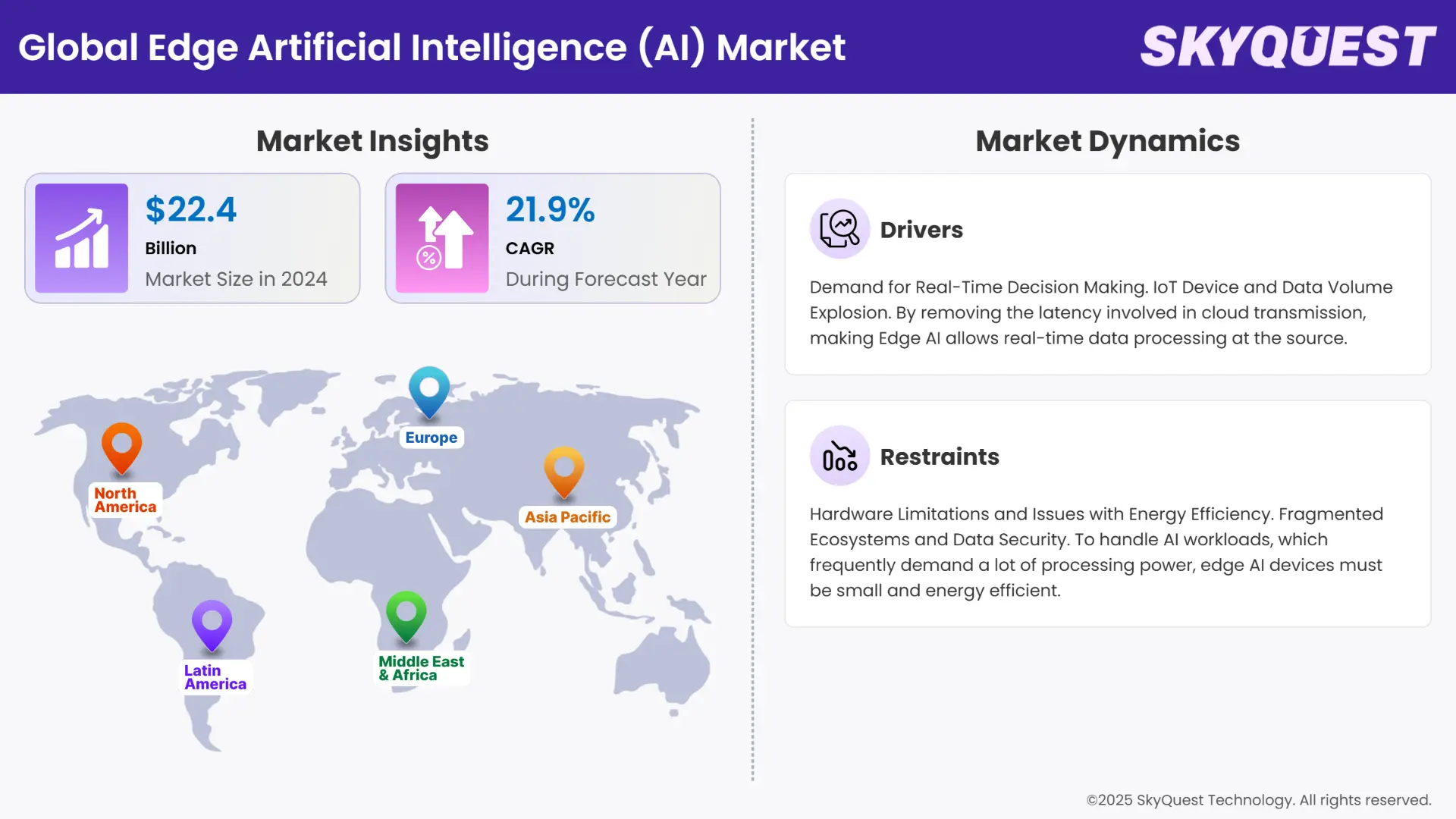
Global Edge Artificial Intelligence (AI) Market size was valued at USD 24.26 Billion in 2024 and is poised to grow from USD 29.57 Billion in 2025 to USD 144.18 Billion by 2033, growing at a CAGR of 21.9% during the forecast period (2026–2033).
The global edge artificial intelligence (AI) market growth is driven significantly due to the increasing demand for real-time data processing and analysis at the network edge. The desire to process data closer to its source in order to increase operational efficiency and reduce latency is what is driving this surge in sectors like healthcare, manufacturing, and telecommunications.
Real-time data communication to the cloud is necessary for self-driving cars to operate efficiently. These autonomous driving systems use state-of-the-art artificial intelligence and machine learning technologies to make decisions. Autonomous vehicles connect to the edge to improve safety, reduce accidents, boost productivity, and reduce traffic congestion. In addition, these robotics applications are growing in popularity due to their lower bandwidth and latency requirements. Applications for this type of technologically advanced robotics include AI-based robot systems, smart ports, smart factories, and drones. For instance,
How do Edge AI Innovations Improve Speed, Accuracy, and Security?
AI is changing the global edge artificial intelligence (AI) market outlook through real-time processing, increased privacy, and low-latency decision-making at the device level. For example, NVIDIA's Jetson Orin Nano modules released in 2024 enabled smart cameras in Bosch automotive plants to detect irregularities on an assembly line in real-time without cloud processing, which reduced defect reaction time by 45%. Another example is witnessing Hyundai Mobis introduce innovative AI vision systems in the testing of brake components at their South Korean factory in 2025. This test reduced defect rates and inspection time by 30% and 40%, respectively. These two examples from the real world illustrate evidence of AI at the edge revolutionizing the industry with increased speed, safety, and efficiency.
To get more insights on this market click here to Request a Free Sample Report
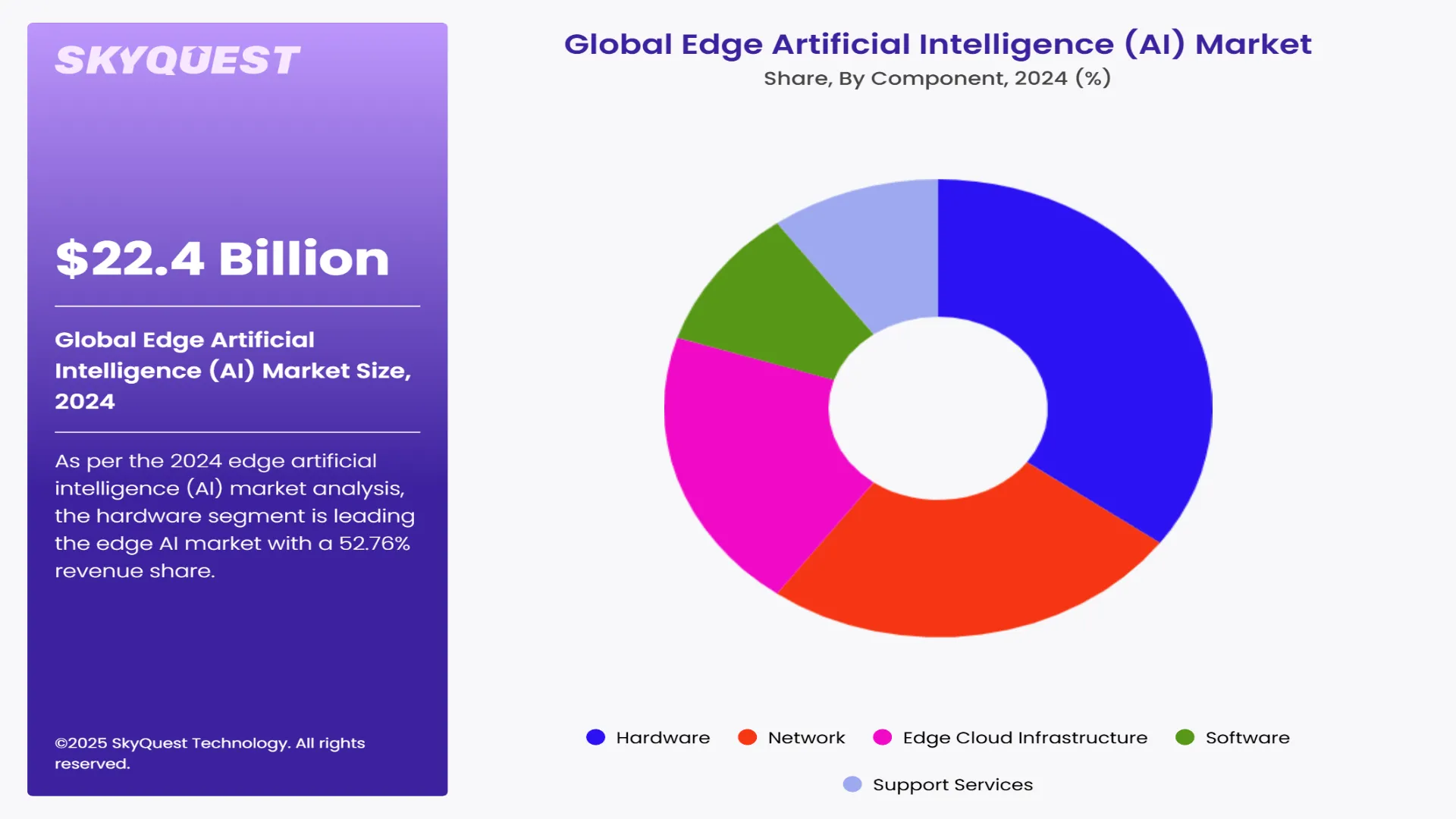
The global edge artificial intelligence (AI) market is segmented into component, processor type, end-use industry, and region. By component, the market is classified into hardware, network, edge cloud infrastructure, software, and support services. Depending on processor type, it is divided into central processing unit (CPU), graphics processing unit (GPU), application-specific integrated circuit (ASIC), and field programmable gate array (FPGA). According to end-use industry, the market is categorized into consumer electronics, smart cities, IT & telecom, automotive, healthcare, manufacturing, retail, and energy & utilities. Regionally, it is analyzed across North America, Europe, Asia-Pacific, Latin America, and the Middle East and Africa.
Why are Telecom Giants Investing in Edge AI Hardware Solutions?
As per the 2024 edge artificial intelligence (AI) market analysis, the hardware segment is leading the edge AI market with a 52.76% revenue share. The increasing need for IoT-based edge computing solutions to link telecom and IT, as well as the expanding use of 5G networks, are the main drivers of the hardware segment's growth. IoT devices mainly depend on specialized AI processors for on-device image analytics. An important example is Qualcomm's 2024 release of the AI-enabled Snapdragon X75 modem, which integrates edge AI for real-time signal optimization in 5G devices.
The software segment is expected to expand at a compound annual growth rate (CAGR) of 24.5% during the forecast period. The 5G network enables the establishment of data centers at the edge and the deployment of industry-specific networks within a single framework through the use of software-defined networking principles. Additionally, it is expected that more data will be sent to data centers as 5G networks spread across a variety of applications, making the use of edge networks or intermediary servers necessary.
Why is the IT & Telecom Sector Leading Edge AI Adoption in 2024?
As per the 2024 edge artificial intelligence (AI) market forecast, the IT & telecom category led the market with a 21.1% revenue share. The primary forces behind this growth are the rapid expansion of IoT devices and the global switch to 5G networks, which call for localized, low-latency data processing. By deploying edge AI analytics at a few 5G cell towers across the US to optimize bandwidth allocation in real time, AT&T was able to successfully reduce network congestion by 35% during periods of peak usage in 2024.
Throughout the forecast period, the growing popularity of smart wearables, smart speakers, and other digital devices is anticipated to grow the edge artificial intelligence (AI) market share of fuel consumer electronics. The consumer electronics industry has made AI chipsets widely available and affordable. Furthermore, data processing on edge AI chips improves consumer devices' security and privacy. The consumer electronics market is anticipated to change significantly as a result of new concepts and innovations.
To get detailed segments analysis, Request a Free Sample Report
How is North America Leading the Edge AI Revolution Through 5G and IoT?
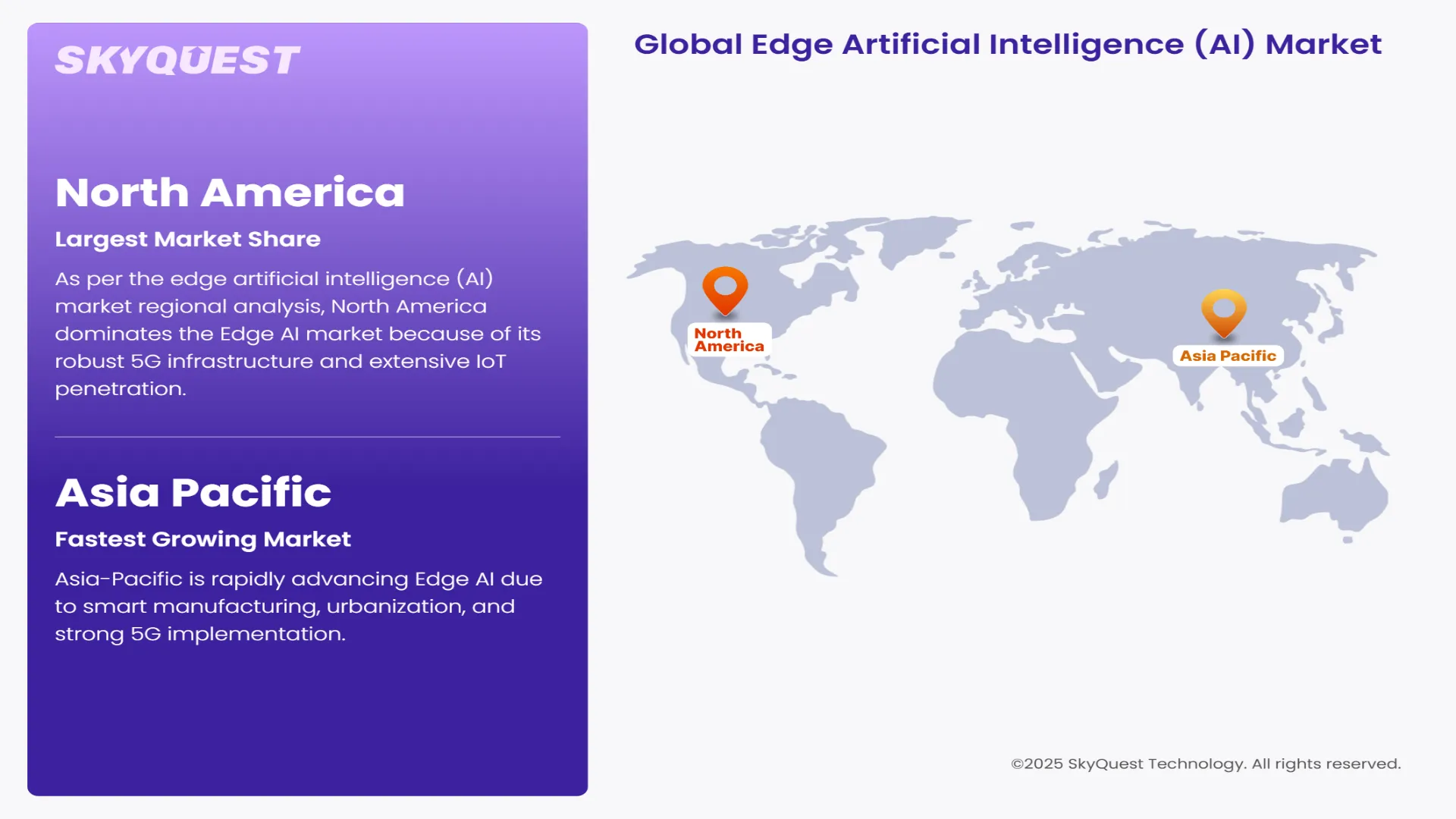
As per the edge artificial intelligence (AI) market regional analysis, North America dominates the Edge AI market because of its robust 5G infrastructure and extensive IoT penetration. Initiatives for industrial automation and smart cities led to a 28% increase in the deployment of edge AI in 2024. Cutting-edge AI chipsets for robotics and retail were unveiled by top companies like NVIDIA and Qualcomm. Adoption in the manufacturing, telecommunications, and defense industries is further accelerated by government support for data localization and AI security.
Edge Artificial Intelligence (AI) Market in the US
The US leads the North American edge artificial intelligence (AI) sector, with early adoption in the telecom and automobile sectors. Verizon installed edge AI-powered routers in strategic cities in 2024 to reduce latency by 35% and control network traffic instantly. AI-enabled cameras for driver assistance systems were also embraced by the automotive industry. The demand for localized, real-time AI computing is still being driven by federal initiatives that support AI innovation and private investment.
Edge Artificial Intelligence (AI) Market in Canada
Investments in digital health and smart infrastructure are fueling the edge AI market's steady growth in Canada. TELUS reduced processing time by 40% in 2025 by deploying edge AI modules to monitor environmental data in urban areas. Programs for government-backed AI strategies encourage ethical AI development and privacy observance. Lightweight inference engines for edge devices used in remote industrial and agricultural monitoring are also being developed by Canadian startups.
What is Driving the Rapid Expansion of Edge AI Across Asia-Pacific?
Asia-Pacific is rapidly advancing Edge AI due to smart manufacturing, urbanization, and strong 5G implementation. The use of edge AI increased by 30% in the region in 2024. In nations like China and India, real-time AI is widely used in robotics, surveillance, and transportation. In industries like public safety, energy, and logistics, multinational IT companies are collaborating with regional operators to offer scalable, affordable edge solutions.
Edge Artificial Intelligence (AI) Market in China
China's aggressive industrial digitization and AI policies have made it a major player in the edge artificial intelligence (AI) industry. Alibaba Cloud implemented edge AI chips for logistics hubs in 2024, which increased package sorting speed by 50%. Government programs such as "AI + Manufacturing" promoted localized processing in smart factories. China's extensive IoT infrastructure and focus on creating AI hardware further solidified its dominance in edge computing applications.
Edge Artificial Intelligence (AI) Market in India
Initiatives for smart city development, telecom expansion, and real-time monitoring are driving growth in India's edge AI sector. Reliance Jio improved streaming performance by 33% in 2025 by incorporating edge AI-based analytics into its 5G networks to dynamically manage user traffic. As a result of more rural connections and digital payments, edge AI is gaining traction in industries like public services, finance, and agriculture with the support of national AI and data laws.
How is Europe Balancing Innovation and Regulation in the Edge AI Market?
Concerns about data sovereignty, industrial automation, and adherence to AI regulations are the main factors propelling the European edge AI market. The use of edge AI in industries like healthcare, automotive, and energy exploded in 2024. Implementation was accelerated by the EU's support of edge computing and sovereign cloud as part of its Digital Decade agenda. To boost efficiency and regulatory transparency, businesses such as Siemens and Bosch are integrating edge AI into their industrial systems.
Edge Artificial Intelligence (AI) Market in UK
The rollout of 5G and government-sponsored digital innovation initiatives are driving growth in the UK's edge AI market. In 2024, BT Group and AWS Wavelength will launch edge AI services for enterprise clients, aiming to cut data latency by 40%. Two important areas for growth are smart healthcare and transportation systems. The UK's edge deployment strategy across industries is still influenced by its emphasis on responsible AI and cybersecurity requirements.
Edge Artificial Intelligence (AI) Market in France
Edge AI is highly regarded in France for data control and industrial performance. In 2025, Thales achieved a 25% improvement in reaction times by incorporating edge AI into military systems for situational awareness in real time. Localized AI processing in smart mobility, energy, and public safety is supported by the French government's emphasis on AI sovereignty through programs like the "France 2030" investment plan. Innovation in domestic edge AI is also supported by a robust R&D infrastructure.
Edge Artificial Intelligence (AI) Market in Germany
Germany is a powerful force in Edge AI due to its dominance in Industry 4.0. By installing edge AI modules in its smart factories in 2024, Bosch was able to implement predictive maintenance, which resulted in a 30% reduction in machine downtime. Germany places a high value on decentralized, secure processing for data security and industrial efficiency. The application of edge AI in robots, heavy machinery, and automobiles is still growing due to government programs and partnerships with the private sector.
To know more about the market opportunities by region and country, click here to
Buy The Complete Report
Edge Artificial Intelligence (AI) Market Drivers
Demand for Real-Time Decision Making
IoT Device and Data Volume Explosion
Edge Artificial Intelligence (AI) Market Restraints
Hardware Limitations and Issues with Energy Efficiency
Fragmented Ecosystems and Data Security
Request Free Customization of this report to help us to meet your business objectives.
Chipmakers and corporate giants are investing in AI hardware and software integration, making the edge AI market extremely competitive. Low-power AI hardware and SDKs for on-device learning are the main priorities of NVIDIA and Intel. Google and Microsoft use AI toolkits to improve edge cloud ecosystems. Startups use edge inference engines and specialized platforms to compete. Custom silicon design, federated learning integrations, edge-cloud orchestration, and strategic acquisitions are important tactics.
Top Player’s Company Profile
Recent Developments in Edge Artificial Intelligence (AI) Market
SkyQuest’s ABIRAW (Advanced Business Intelligence, Research & Analysis Wing) is our Business Information Services team that Collects, Collates, Correlates, and Analyses the Data collected by means of Primary Exploratory Research backed by robust Secondary Desk research.
As per SkyQuest analysis, the global edge artificial intelligence (AI) market outlook is increasing at an extremely high rate as organizations seek solutions for processing data that are faster, smarter, and more private than ever. Edge AI provides greater immediacy, less latency, and reduced dependency on centralized cloud architecture by bringing intelligence nearer to devices. It is already disrupting areas such as manufacturing, healthcare, automobiles, and smart cities. Indeed, established IT companies and start-ups alike are investing in federated learning frameworks, software platforms, and chips that are specifically designed for the edge. There are still many challenges regarding energy, integration, and fractured ecosystems that are further hindered because of disparate vendors. Edge computing and AI will converge to create new opportunities related to new forms of distributed intelligence, automation, and real-time analytics.
| Report Metric | Details |
|---|---|
| Market size value in 2024 | USD 24.26 Billion |
| Market size value in 2033 | USD 144.18 Billion |
| Growth Rate | 21.9% |
| Base year | 2024 |
| Forecast period | 2026-2033 |
| Forecast Unit (Value) | USD Billion |
| Segments covered |
|
| Regions covered | North America (US, Canada), Europe (Germany, France, United Kingdom, Italy, Spain, Rest of Europe), Asia Pacific (China, India, Japan, Rest of Asia-Pacific), Latin America (Brazil, Rest of Latin America), Middle East & Africa (South Africa, GCC Countries, Rest of MEA) |
| Companies covered |
|
| Customization scope | Free report customization with purchase. Customization includes:-
|
To get a free trial access to our platform which is a one stop solution for all your data requirements for quicker decision making. This platform allows you to compare markets, competitors who are prominent in the market, and mega trends that are influencing the dynamics in the market. Also, get access to detailed SkyQuest exclusive matrix.
Table Of Content
Executive Summary
Market overview
Parent Market Analysis
Market overview
Market size
KEY MARKET INSIGHTS
COVID IMPACT
MARKET DYNAMICS & OUTLOOK
Market Size by Region
KEY COMPANY PROFILES
Methodology
For the Edge Artificial Intelligence (AI) Market, our research methodology involved a mixture of primary and secondary data sources. Key steps involved in the research process are listed below:
1. Information Procurement: This stage involved the procurement of Market data or related information via primary and secondary sources. The various secondary sources used included various company websites, annual reports, trade databases, and paid databases such as Hoover's, Bloomberg Business, Factiva, and Avention. Our team did 45 primary interactions Globally which included several stakeholders such as manufacturers, customers, key opinion leaders, etc. Overall, information procurement was one of the most extensive stages in our research process.
2. Information Analysis: This step involved triangulation of data through bottom-up and top-down approaches to estimate and validate the total size and future estimate of the Edge Artificial Intelligence (AI) Market.
3. Report Formulation: The final step entailed the placement of data points in appropriate Market spaces in an attempt to deduce viable conclusions.
4. Validation & Publishing: Validation is the most important step in the process. Validation & re-validation via an intricately designed process helped us finalize data points to be used for final calculations. The final Market estimates and forecasts were then aligned and sent to our panel of industry experts for validation of data. Once the validation was done the report was sent to our Quality Assurance team to ensure adherence to style guides, consistency & design.
Analyst Support
Customization Options
With the given market data, our dedicated team of analysts can offer you the following customization options are available for the Edge Artificial Intelligence (AI) Market:
Product Analysis: Product matrix, which offers a detailed comparison of the product portfolio of companies.
Regional Analysis: Further analysis of the Edge Artificial Intelligence (AI) Market for additional countries.
Competitive Analysis: Detailed analysis and profiling of additional Market players & comparative analysis of competitive products.
Go to Market Strategy: Find the high-growth channels to invest your marketing efforts and increase your customer base.
Innovation Mapping: Identify racial solutions and innovation, connected to deep ecosystems of innovators, start-ups, academics, and strategic partners.
Category Intelligence: Customized intelligence that is relevant to their supply Markets will enable them to make smarter sourcing decisions and improve their category management.
Public Company Transcript Analysis: To improve the investment performance by generating new alpha and making better-informed decisions.
Social Media Listening: To analyze the conversations and trends happening not just around your brand, but around your industry as a whole, and use those insights to make better Marketing decisions.
REQUEST FOR SAMPLE
 REQUEST FREE CUSTOMIZATION


Want to customize this report? This report can be personalized according to your needs. Our analysts and industry experts will work directly with you to understand your requirements and provide you with customized data in a short amount of time. We offer $1000 worth of FREE customization at the time of purchase.
Feedback From Our Clients


 USA (+1) 351-333-4748

