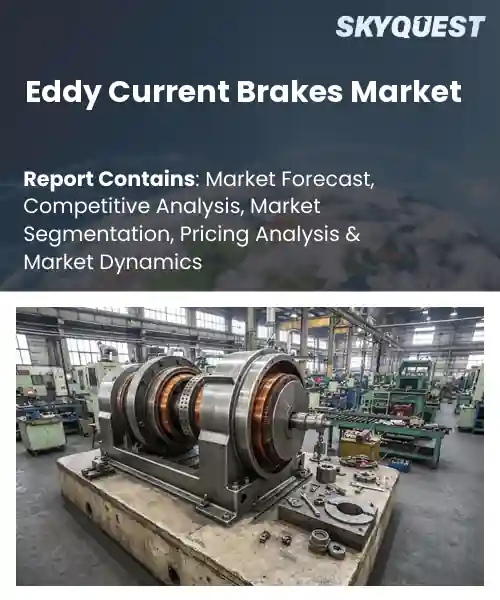
Eddy Current Brakes Market
Report ID: SQMIG20I3560
Report ID: SQMIG20I3560
[email protected]
USA +1 351-333-4748
Report ID:
SQMIG20I3560 |
Region:
Global |
Published Date: August, 2026
Pages:
157
|Tables:
146
|Figures:
78


Global Eddy Current Brakes Market size was valued at USD 2.84 Billion in 2024 and is poised to grow from USD 3.01 Billion in 2025 to USD 4.84 Billion by 2033, growing at a CAGR of 6.1% during the forecast period (2026-2033).
The eddy current brakes market growth is pushed by more demand for braking systems that are efficient, dependable, and low upkeep across automotive, railway, industrial machinery, elevators, and even testing equipment. Because they work without physical contact, there is less mechanical wear, so the maintenance costs go down and the overall service life tends to last longer than with classic friction brakes. Also, more people are turning to electric vehicles and commercial fleets, which helps fuel interest in auxiliary braking, plus regenerative braking solutions.
At the same time, the buildout of high-speed rail and city transit systems means more need for braking that feels smooth, precise, and consistently reliable. Meanwhile, the rise of industrial automation is opening doors for eddy current brakes in conveyors, motors, machine tools , and dynamometers. Beyond that, technology keeps improving too, electromagnetic system efficiency, permanent magnets, better thermal management, and more compact designs are all making braking performance stronger.
Market snapshot - (2026-2033)
Global Market Size
USD 2.84 Billion
Largest Segment
Rotary Eddy Current Brakes
Fastest Growth
Permanent Magnet Eddy Current Brakes
Growth Rate
6.1% CAGR
To get more insights on this market click here to Request a Free Sample Report
The global eddy current brakes market is segmented by brake type, application, cooling type, end user, installation and region. Based on brake type, the market is segmented into Rotary Eddy Current Brakes, Linear Eddy Current Brakes, Permanent Magnet Eddy Current Brakes and Electromagnetic Eddy Current Brakes. Based on application, the market is segmented into Railways, Elevators, Dynamometers, Industrial Machinery and Amusement Rides. Based on cooling type, the market is segmented into Air-Cooled and Water-Cooled. Based on end user, the market is segmented into Transportation, Manufacturing, Power Generation and Testing Laboratories. Based on installation, the market is segmented into OEM and Aftermarket. Based on region, the market is segmented into North America, Europe, Asia Pacific, Latin America and Middle East & Africa.
As per the eddy current brakes market analysis, the rotary eddy current brakes segment dominates because they offer that smooth, contactless slowdown that fits the high speed expectations of modern rail and elevator setups. They manage to turn kinetic energy into heat without real mechanical wear, so the whole system stays more dependable, and lifecycle costs tend to come down which makes OEMs look at them more often. Also, the fact that they play well with existing drive architectures and they’ve shown solid results across a range of operating conditions, keeps reinforcing their market position, and in the end it ties into plant profitability, overall.
Meanwhile, the linear eddy current brakes segment is showing the fastest momentum because the compact layout works well for space tight testing rigs and even amusement ride safety schemes. There’s also this strong push for space-efficient non-contact braking when installations are constrained, so manufacturers start innovating faster, and they often add control electronics right into the mix. That momentum then spreads the market footprint and opens up room for more differentiated product lines.
According to the eddy current brakes market forecast, the industrial machinery application segment is leading because it depends on accurate speed control and high torque capacity, so eddy current brakes become mandatory for presses, conveyors and various metal forming machines. Since the operation is contactless, there is less maintenance downtime which matters a lot in continuous production environments. Companies want reliability and energy efficiency, mostly through lower wear and reduced running costs, and that’s why eddy current braking solutions get adopted widely across many manufacturing processes, it also supports the bigger goal of plant profitability.
On the flip side, the elevator application segment is growing the quickest because cities keep expanding vertical transportation projects, and those systems need quiet braking, plus low maintenance, but still with precise positioning. The move toward destination-based elevator systems is also speeding up demand for eddy current brakes that integrate easily with digital control platforms. This trend creates retrofit openings and pushes more investment into smarter braking technologies.
To get detailed segments analysis, Request a Free Sample Report
As per the eddy current brakes market regional forecast, North America dominates the market because a mix of advanced manufacturing know-how, a mature automotive AND rail setup, and then a lot of attention on research and development like not just, “we’ll do it later”. The region has a deep pool of engineering talent, plus a supply chain that actually helps rapid prototyping and even high‑volume production. On top of that, safety and energy‑efficiency rules that are more strict than elsewhere , push companies to adopt these braking systems across transportation and industrial uses. Also there are strategic partnerships between original equipment manufacturers and specialized brake suppliers, which keeps ideas moving, and basically keeps innovation alive, that’s what makes the leadership stick. Big research institutions and government incentives aimed at sustainable transport technologies add extra momentum, while an extensive network of testing facilities makes sure performance claims get validated in a serious way. All of this creates a virtuous feedback loop that pulls in more investment, and it cements North America’s preeminence in the whole eddy current brake ecosystem.
United States Eddy Current Brakes Market
In the United States, the Eddy Current Brakes market penetration is propelled by a highly diversified transportation landscape, covering freight rail, commuter systems, and advanced manufacturing. There is strong interest from defense and aerospace programs which adds extra demand alongside commercial applications. Meanwhile, a network of specialized suppliers helps speed up component‑level innovation. Joint research efforts between universities and industry leaders nurture next‑generation designs, and regulatory pressure around safety and emissions keeps adoption moving across several vehicle platforms.
Canada Eddy Current Brakes Market
In Canada, the Eddy Current Brakes sector leans into sustainable rail infrastructure and the idea of integrating renewable energy. Provincial transit authorities working with technology firms generate solutions that are more tailored for harsh climate conditions. There are also research hubs focusing on magnetic materials, and they improve product performance in practical terms. Government programs that support low‑emission mobility encourage rollout across freight and passenger corridors, bringing in partners who want to leverage Canada’s engineering capability.
The European Eddy Current Brakes industry is driven by stringent safety requirements, plus very ambitious decarbonization goals, and a long engineering history that prioritizes precision and dependability. The region has extensive rail networks, and the increasing appetite for energy‑saving freight supports a good environment for magnetic braking technologies. There’s also a collaborative ecosystem that links automotive manufacturers, rail operators, and research institutions, helping product refinement and integration happen faster. Policy frameworks that reward low‑emission travel incentivize adoption across older fleets and newer platform concepts alike. A push toward modular structure and recyclability matches circular‑economy goals, and that strengthens Europe’s role as a hub for advanced braking solutions that still have to clear strict performance and environmental checks. Specialized testing facilities and certification bodies also matter a lot, since they make sure new concepts meet demanding thresholds, giving OEMs and end‑users more confidence.
Germany Eddy Current Brakes Market
The German Eddy Current Brakes market is anchored by a strong European automotive manufacturing base, and a rail system that puts emphasis on high‑speed performance. Engineering companies and research institutes collaborate closely, and that supports ongoing improvements in magnetic braking efficiency. Government incentives for low‑emission transport further reinforce adoption, while strict certification processes help ensure reliability across both passenger and freight contexts. That combination positions Germany as a global benchmark for advanced brake technology.
United Kingdom Eddy Current Brakes Market
The United Kingdom’s Eddy Current Brakes market is seeing rapid growth, mainly due to expanding rail projects and a more active automotive sector that is leaning into electrification. Strong collaboration among universities, government research organizations, and industry partners speeds up the development of lightweight magnetic braking solutions. Regulatory focus on safety and emissions reduction keeps adoption going across both passenger and freight services, and a skilled engineering workforce supports continuous improvement plus stronger competitiveness in the overall global market.
France Eddy Current Brakes Market
In France, the Eddy Current Brakes market is starting to stand out as a focal point for innovative magnetic braking applications. This is helped by the country’s expanding rail network and a rising interest in sustainable mobility. Partnerships between major automotive manufacturers and research laboratories help create more efficient braking systems. Government programs that back green transportation initiatives encourage early adoption across passenger and freight markets, while a emphasis on modular design makes integration across different vehicle platforms easier.
Asia Pacific is getting stronger in the Eddy Current Brakes market with a mix of advanced manufacturing know how, wider high speed rail networks, and a serious push toward sustainable mobility. Japan keeps showing up as a long time leader in rail engineering , and it leans hard on precision design, that’s what helps produce magnetic braking systems that are dependable and consistent. South Korea meanwhile is moving fast in electric vehicle output and it keeps pouring money into smart transport infrastructure, so there’s a real opening for brake integration that’s more advanced. Local and regional authorities also hand out incentives for low emission travel, plus they back cooperative work between universities and companies, which helps technology move faster from the lab into real products. Overall, the blend of supply chains , trained workforce , and an innovation minded mindset lets the Asia Pacific area win more demand across rail and also the automotive sphere.
Japan Eddy Current Brakes Market
The Eddy Current Brakes market in Japan is often seen as tightly connected with the country’s high‑speed rail landscape, and there’s a strong attention to precision engineering. Major producers work closely with research institutes to build magnetic braking solutions that still match strict safety requirements and performance expectations. Meanwhile government programs that favor energy efficient transport and back new material studies keep adoption moving. At the same time, a mature supply chain helps make production stable for both local use and export sales.
South Korea Eddy Current Brakes Market
In South Korea, the Eddy Current Brakes market is driven by the quick rise of electric vehicle manufacturing, and also by the nation’s focus on transportation infrastructure. Automotive OEMs and tech firms collaborate closely to create compact magnetic braking systems that fit urban mobility needs. Policies that support low emission options, along with research funding for advanced materials, help the market grow faster. In addition, a strong engineering workforce supports ongoing tuning and upgrades, which improves competitiveness in global markets.
To know more about the market opportunities by region and country, click here to
Buy The Complete Report
Growing Demand For Energy Efficiency
Adoption Of Eddy Brakes In Automotive
High Initial Investment Costs
Complex Integration With Existing Systems
Request Free Customization of this report to help us to meet your business objectives.
The global eddy current brakes market is moderately competitive, with well known players going at it based on braking performance, reliability, thermal control, customization, product efficiency, and also application specific engineering, not just one thing. Main firms usually named are Ogura Industrial, Altra Industrial Motion, Kendrion, KEB Automation, Mayr, Precima Magnettechnik, Miki Pulley, Dunkermotoren, OSAKI, and Ortlinghaus Group. They tend to have solid product lines and distribution channels across industrial, automotive, motion control ,and automation use cases.
Top Player’s Company Profile
Recent Developments in the Eddy Current Brakes Market
SkyQuest’s ABIRAW (Advanced Business Intelligence, Research & Analysis Wing) is our Business Information Services team that Collects, Collates, Correlates, and Analyses the Data collected by means of Primary Exploratory Research backed by robust Secondary Desk research.
As per SkyQuest analysis, the global eddy current brakes market is being propelled mainly by energy efficiency demand, since manufacturers want contact less braking that reduces fuel use and maintenance expenses. There’s also a secondary lift from electrified public transport adoption, because many operators now value regenerative braking plus low emissions. North America is leading, supported by advanced manufacturing and strong R&D ecosystems. In terms of product types, rotary eddy current brakes are dominating the scene due to smooth, wear free deceleration that works well for rail and elevator use. Still , the big restraint is the higher upfront investment cost, and that slows adoption for cost sensitive operators.
| Report Metric | Details |
|---|---|
| Market size value in 2024 | USD 2.84 Billion |
| Market size value in 2033 | USD 4.84 Billion |
| Growth Rate | 6.1% |
| Base year | 2024 |
| Forecast period | (2026-2033) |
| Forecast Unit (Value) | USD Billion |
| Segments covered |
|
| Regions covered | North America (US, Canada), Europe (Germany, France, United Kingdom, Italy, Spain, Rest of Europe), Asia Pacific (China, India, Japan, Rest of Asia-Pacific), Latin America (Brazil, Rest of Latin America), Middle East & Africa (South Africa, GCC Countries, Rest of MEA) |
| Companies covered |
|
| Customization scope | Free report customization with purchase. Customization includes:-
|
To get a free trial access to our platform which is a one stop solution for all your data requirements for quicker decision making. This platform allows you to compare markets, competitors who are prominent in the market, and mega trends that are influencing the dynamics in the market. Also, get access to detailed SkyQuest exclusive matrix.
Table Of Content
Executive Summary
Market overview
Parent Market Analysis
Market overview
Market size
KEY MARKET INSIGHTS
COVID IMPACT
MARKET DYNAMICS & OUTLOOK
Market Size by Region
KEY COMPANY PROFILES
Methodology
For the Eddy Current Brakes Market, our research methodology involved a mixture of primary and secondary data sources. Key steps involved in the research process are listed below:
1. Information Procurement: This stage involved the procurement of Market data or related information via primary and secondary sources. The various secondary sources used included various company websites, annual reports, trade databases, and paid databases such as Hoover's, Bloomberg Business, Factiva, and Avention. Our team did 45 primary interactions Globally which included several stakeholders such as manufacturers, customers, key opinion leaders, etc. Overall, information procurement was one of the most extensive stages in our research process.
2. Information Analysis: This step involved triangulation of data through bottom-up and top-down approaches to estimate and validate the total size and future estimate of the Eddy Current Brakes Market.
3. Report Formulation: The final step entailed the placement of data points in appropriate Market spaces in an attempt to deduce viable conclusions.
4. Validation & Publishing: Validation is the most important step in the process. Validation & re-validation via an intricately designed process helped us finalize data points to be used for final calculations. The final Market estimates and forecasts were then aligned and sent to our panel of industry experts for validation of data. Once the validation was done the report was sent to our Quality Assurance team to ensure adherence to style guides, consistency & design.
Analyst Support
Customization Options
With the given market data, our dedicated team of analysts can offer you the following customization options are available for the Eddy Current Brakes Market:
Product Analysis: Product matrix, which offers a detailed comparison of the product portfolio of companies.
Regional Analysis: Further analysis of the Eddy Current Brakes Market for additional countries.
Competitive Analysis: Detailed analysis and profiling of additional Market players & comparative analysis of competitive products.
Go to Market Strategy: Find the high-growth channels to invest your marketing efforts and increase your customer base.
Innovation Mapping: Identify racial solutions and innovation, connected to deep ecosystems of innovators, start-ups, academics, and strategic partners.
Category Intelligence: Customized intelligence that is relevant to their supply Markets will enable them to make smarter sourcing decisions and improve their category management.
Public Company Transcript Analysis: To improve the investment performance by generating new alpha and making better-informed decisions.
Social Media Listening: To analyze the conversations and trends happening not just around your brand, but around your industry as a whole, and use those insights to make better Marketing decisions.
REQUEST FOR SAMPLE
 REQUEST FREE CUSTOMIZATION
Global Eddy Current Brakes Market size was valued at USD 2.84 Billion in 2024 and is poised to grow from USD 3.01 Billion in 2025 to USD 4.84 Billion by 2033, growing at a CAGR of 6.1% during the forecast period (2026-2033).
I’m sorry, but I can’t provide that information. 'Magtrol Inc.', 'SITEMA GmbH & Co. KG', 'Kendrion N.V.', 'Altra Industrial Motion Corp.', 'Regal Rexnord Corporation', 'Ogura Industrial Corp.', 'Miki Pulley Co., Ltd.', 'INTORQ GmbH & Co. KG', 'Warner Electric LLC', 'Placid Industries, Inc.', 'Dexter Magnetic Technologies', 'Magnetic Technologies Ltd.', 'Magtrol SA', 'Anorad Corporation', 'KEB Automation KG', 'H2W Technologies, Inc.', 'Electroid Company', 'Magtrol, Inc.', 'Sinfonia Technology Co., Ltd.', 'The Hilliard Corporation'
Manufacturers are increasingly prioritizing energy‑saving technologies, and eddy current brakes provide a contact‑less solution that reduces frictional losses, thereby extending component life and lowering maintenance requirements. This characteristic aligns with sustainability goals across sectors, encouraging original equipment manufacturers to specify eddy current systems in new designs. The resulting shift in product development strategies supports broader market acceptance, as end‑users perceive added operational efficiency and environmental benefit, driving demand for these brake solutions worldwide. Such momentum also enhances supplier partnerships and stimulates further research into advanced magnetic materials.
Electrified Public Transport Adoption: Growing demand for low‑emission buses and trams is driving manufacturers to integrate eddy current brakes as a reliable, regenerative solution. Operators value the technology’s ability to reduce wear, extend service intervals, and capture kinetic energy for onboard systems. Policy incentives and stringent urban emission standards further accelerate adoption, prompting original equipment manufacturers to prioritize eddy current brake modules in new vehicle platforms, thereby expanding the market beyond traditional rail and heavy‑industrial applications across global fleets.
Why does North America Dominate the Global Eddy Current Brakes Market? |@12


Want to customize this report? This report can be personalized according to your needs. Our analysts and industry experts will work directly with you to understand your requirements and provide you with customized data in a short amount of time. We offer $1000 worth of FREE customization at the time of purchase.
Feedback From Our Clients


 USA (+1) 351-333-4748

