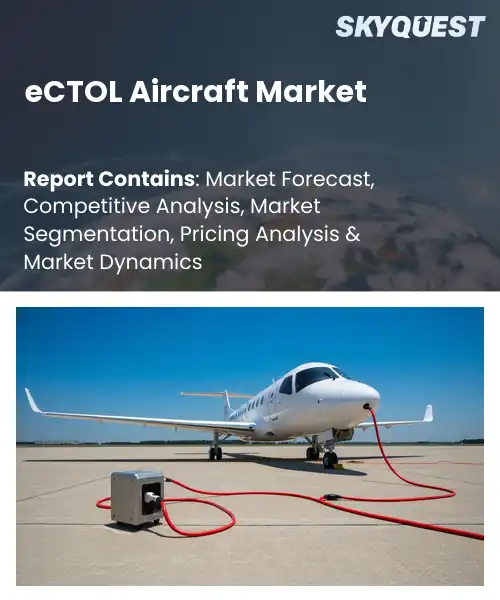
eCTOL Aircraft Market
Report ID: SQMIG20S2033
Report ID: SQMIG20S2033
[email protected]
USA +1 351-333-4748
Report ID:
SQMIG20S2033 |
Region:
Global |
Published Date: February, 2026
Pages:
157
|Tables:
173
|Figures:
79


Global eCTOL Aircraft Market size was valued at USD 4.5 Billion in 2024 and is poised to grow from USD 4.98 Billion in 2025 to USD 11.14 Billion by 2033, growing at a CAGR of 10.6% during the forecast period (2026-2033).
The main factor that drives the global eCTOL aircraft market growth is advances in battery energy density and powertrain system linking which enables researchers to move from testing theories to building aircraft that demonstrate their capabilities. Manufacturers shifted their development from concepts to prototypes during the last ten years, which included Pipistrel obtaining Velis Electro certification as a light trainer and Ampaire showing their hybrid-electric system for regional aircraft.
Moreover, the global eCTOL aircraft market outlook changes from these developments because they enable lower operational expenses while establishing worldwide accessible entry points to electrified aviation technologies. eCTOL worldwide acceptance depends on both aircraft propulsion developments and operational infrastructure and regulatory system which provides vital elements needed to satisfy aircraft economic requirements through accessible charging points and certification processes and airport operation protocols. Airline companies can create efficient short-haul service routes once authorities establish certification standards and airports build out their charging and maintenance facilities which enable predictable aircraft turnaround times and decreased operating expenses.
Hybrid-electric flight testing between regional airlines who operate between islands has led to their discovery of lower per-seat expenses and improved quietness which allows them to extend their flight schedule into morning and evening times. The combination of targeted investment and coordinated policy will work to increase market expansion while creating fresh international flight paths for development.
How is AI Enhancing Safety in the ECTOL Aircraft Market?
The eCTOL aircraft sector gains enhanced safety through AI programs which improve three core areas: maintenance prediction and design testing efforts. Machine learning uses camera and radar and health sensor data to create alerts that notify pilots about dangerous situations while it also automatically initiates protective measures. The system uses predictive algorithms to identify component degradation before it leads to failures which results in better operational performance. The engineers use digital twins and high-fidelity simulation tools to practice emergency procedures and develop control laws before actual flight testing. The capabilities support manufacturing processes from product development through initial operational stages while helping companies achieve certification requirements and construction of eCTOL services.
Beta Technologies, in December 2025, established a partnership which will combine autonomous flight control systems with Near Earth Autonomy technologies to demonstrate how AI based systems reduce crew operational demands while enhancing safety and efficiency for eCTOL flights.
Market snapshot - (2026-2033)
Global Market Size
USD 4.5 Billion
Largest Segment
eCTOL Fixed-Wing Aircraft
Fastest Growth
Hybrid eCTOL Aircraft
Growth Rate
10.6% CAGR
To get more insights on this market click here to Request a Free Sample Report
The global eCTOL aircraft market is segmented based on aircraft type, lift and propulsion technology, maximum take-off weight (MTOW), range, application, end user, and region. By aircraft type, the market is categorized into eCTOL fixed-wing aircraft and hybrid eCTOL aircraft. Based on lift and propulsion technology, it is segmented into battery-electric propulsion, hybrid-electric propulsion, and other propulsion types. In terms of maximum take-off weight (MTOW), the market is divided into less than 250 kg, 250–500 kg, 500–1500 kg, and above 1500 kg.
Based on range, it includes 0–200 km, 200–500 km, and above 500 km. By application, the market is segmented into passenger transport (regional/commuter), cargo transport and logistics, emergency and medical services, and other commercial services. Based on end user, it is classified into commercial operators, government and defense, private or charter operators, and special mission services. Geographically, the market is segmented into North America, Europe, Asia Pacific, Latin America, and the Middle East & Africa.
According to the global eCTOL aircraft market analysis, the eCTOL Fixed-Wing Aircraft segment leads the market because its proven aerodynamic efficiency and developed airframe designs deliver consistent energy-saving cruise performance which operators use to create dependable region-based passenger service and cargo transport routes and airlines use to establish cost-efficient operations through precise scheduled service patterns. The industry prefers this design because it enables gradual electrification which makes certification work easier and connection with existing airspace operations more straightforward while it helps build trust among stakeholders who use this to launch their first commercial flights that become industry standards.
eCTOL commercial aircraft are most rapidly expanding because Hybrid eCTOL Aircraft create new operational boundaries through their hybrid power systems which enable greater payload capacity; this reduces their necessity for dense charging infrastructure which supports them to fly through uncharted airspace. The dual push for ongoing propulsion development together with investor interest is driving forward prototype commercial launch which will introduce fresh operational pathways for existing suppliers and operators.
As per the global eCTOL aircraft market forecast, the Battery-Electric Propulsion segment leads the market because its straightforward powertrain design and proven battery system create a sustainable quiet and low-maintenance solution which matches the requirements of eCTOL short-distance flights. The regulatory focuses on zero-emission urban and regional mobility together with operators wanting stable energy expenses to have made battery-electric technology the primary choice for initial system deployments and procurement methods.
Whereas the eCTOL aircraft market share is achieved mostly through Hybrid-Electric Propulsion because it provides operational flexibility at high energy capacity which enables aircraft to cross long distances while carrying heavy loads and requires lower infrastructure support. The fast growth of hybrid power management combined with strong funding support has created two results: organizations are now capable of delivering certified systems together with new commercial and special mission opportunities.
To get detailed segments analysis, Request a Free Sample Report
As per the eCTOL aircraft market regional forecast, North America leads the eCTOL aircraft sales because it has established an industry network which includes advanced aerospace companies along with extensive venture capital and institutional funding streams and regulatory systems which have started to approve new air mobility technologies. Established supply chains together with research institutions enable organizations to create prototypes within a short time frame and to develop production systems which can handle large-scale operations.
The demand validation process emerges from the existence of substantial early adopter markets which commercial operators and urban mobility planners create. The industry clusters which operate through collaborative partnerships establish testing corridors that enable certification discussions between industry leaders and governmental organizations, thus reducing the time needed for commercial product launch.
The United States eCTOL Aircraft sector contains an innovation ecosystem where established OEMs work together with research centers and startups to develop new vehicle designs and propulsion systems and battery technologies. The urban mobility initiatives together with cargo operators drive the creation of new application solutions. The services sector provides extensive support for the three areas of certification and pilot training and infrastructure deployment. The combination of strong investor interest and active test programs creates pathways for commercialization, while public agencies manage airspace integration and safety framework development.
The Canadian eCTOL Aircraft industry develops lightweight structural systems and battery integration solutions through regional industrial clusters and collaborative research networks. The provincial transportation planners test their regional connectivity and remote access solutions through vendor partnerships. The public funding mechanisms and certification dialogues support the growth of demonstrator programs, which proceed from their initial development stage. The cold climate operations combined with versatile infrastructure solutions create market advantages, while academic institution partnerships develop educational talent pipelines and system validation capabilities and comprehensive operational testing capabilities.
The European region experiences rapid growth because its policy framework supports sustainable mobility while public funding supports emission-free aviation concepts, and its regulatory system moves towards developing standard certification processes. The varied ecosystem of specialized manufacturers and research centers and aerospace suppliers enable technology to advance and supply chains to become stronger. The municipal pilot projects and cross-border collaboration between transport authorities create opportunities for real-world testing, which helps to gain acceptance from the public.
The automotive and aerospace industries maintain strong connections, which allow both sectors to share their expertise about electrification and systems integration. The design priorities for the project focus on reducing noise levels and promoting community participation, while the pan-regional infrastructure planning and investment programs create pathways which enable early system deployments and the development of operational systems for both urban and regional transportation systems.
The German eCTOL Aircraft Market penetration relies on its engineering tradition and its industry base which specializes in manufacturing propulsion systems and precision components. The automotive industry cooperation enables the development of battery systems and control solutions. The regional initiatives establish testing centers, which enable smaller manufacturers to validate their product ideas through actual testing. Industrial partnerships together with environmental standards create a framework which supports the development of modular design solutions. The skilled workforce together with supplier networks enables Germany to create specialized capabilities, which operate within the larger European market system.
The United Kingdom eCTOL Aircraft Market combines active public regulatory engagement with private sector investment and demonstration projects to support commercial market development. The three organizations which connect universities and startups with aviation firms enable fast technology transfer between different applications. The city authorities and transport planners work to implement vertical lift solutions that produce no emissions to their urban mobility plans. The certification sector together with training and maintenance services provides operators with their necessary support while infrastructure trials test operational methods throughout the public corridors that connect to regional areas.
The French eCTOL Aircraft Market leverages its strong aerospace design knowledge and established manufacturers to develop systems integration solutions which achieve certification readiness. The national clusters connect research institutes with suppliers and operators, who work together to develop advanced prototype systems. The urban mobility programs and regional coordination enable the creation of demonstration corridors and infrastructure planning. The design choices for the project depend on three aspects, including noise reduction and public acceptance and sustainable energy system integration. The support institutions and supply chains position France as a leading hub for European deployment.
Asia Pacific enhances its competitive advantage through strategic methods that combine manufacturing capacity with specialized electronics and battery supply chains and government programs for advanced air mobility development. The industrial clusters in the area create a production system that reduces costs by enabling fast prototyping of vehicle subsystems, which transport authorities use to test their operational systems in urban areas. The technology partnerships between companies and traditional aerospace organizations enable faster development of control software and systems integration. The design process creates solutions that meet local requirements through its focus on compact designs and energy-efficient systems and resilient systems that function in diverse climate conditions.
The region becomes a more competitive environment for eCTOL deployment because of its cross-border partnerships and expanding service ecosystems, which provide maintenance and training and infrastructure development services. Research and development investment together with manufacturing automation and customized certification paths build an operational bridge that enables technology to move from research stage to active usage, which creates an environment that allows service expansion across city and regional markets.
The eCTOL Aircraft Market in Japan operates through its combination of advanced manufacturing facilities and its robust electronics and battery production sector and its research partnership programs that link companies with academic institutions. The demonstration projects which urban planning authorities and operators run focus on safety and community acceptance, which they use to test new methods of operation. The design process creates solutions that meet local requirements through its focus on compact designs and energy-efficient systems and resilient systems that function in diverse climate conditions. Japan builds its capability to deliver advanced systems through its research activities that connect with ongoing development projects and certification programs.
The eCTOL Aircraft Market in South Korea operates through its combination of electronic and battery manufacturing resources and its system of industrial groups and its system of joint research activities between technology companies and aviation researchers. Government programs together with city pilot projects create adoption models that match the requirements of smart city development plans. The system design enables vehicles to connect through software-based control systems, which support advanced operational concepts. South Korea achieves supply chain synchronization, which enables its transition from developing prototypes to forming partnerships for large-scale production.
To know more about the market opportunities by region and country, click here to
Buy The Complete Report
Advancements In Electric Propulsion
The development of electric propulsion systems results in lighter systems that operate more efficiently, which enables eCTOL designs to achieve longer operational periods with reduced operational needs. The technical advancements make aircraft more appealing to operators because they enable simpler powertrain setup and reduced lifecycle risk and expanded operational possibilities. The more compact and modular propulsion systems enable manufacturers to develop products faster because they improve product reliability and maintenance, which results in higher acceptance levels across the industry that drives global market acceptance.
Integration Of Urban Air Mobility
The urban air mobility systems need to be integrated into transportation planning, so that their implementation will foster ecosystem growth, which provides signals for demand and enables infrastructure development. The vehicle design functions should match the city's mobility guidelines, so that stakeholders can allocate resources for routes and charging stations and vertiport locations, which will make it easier for manufacturers and operators to know what to expect. The public agencies together with service providers and investors will establish their partnerships, which will accelerate pilot study development and commercial success, which will lead to increased investment in production and market acceptance.
Certification And Regulatory Complexity
The eCTOL aircraft market expansion challenges because certification processes and scattered regulatory frameworks lead to prolonged approval times and create uncertainty. The program needs to fulfill three conditions because it must meet multiple requirements and balance different aviation standards against new technology requirements and prove safe performance at all flight profiles. The extended approval periods and high compliance costs will impact manufacturers and service providers, because they will lead to decreased investor confidence and slower market entry. The combination of regulatory burdens will create three negative effects by making it harder to enter service while limiting fleet expansion and discouraging new market participants, which will result in decreased market development momentum.
Infrastructure And Charging Limitations
The eCTOL aircraft operational capacity faces limitations because essential ground support facilities and charging systems are inadequate, which particularly affects areas without vertiport networks and standardized connectors. The lack of coordinated energy supply planning, combined with high-capacity electrical distribution and maintenance facility development, creates operational challenges that operators perceive as increased risk. The existing infrastructure gaps create a need for extra capital investments in pilot projects to verify operational concepts, which will create obstacles for fleet growth and service deployment advancements. The existing support systems limit routing options and cost efficiency, which hinders market acceptance.
Request Free Customization of this report to help us to meet your business objectives.
The global eCTOL aircraft market experiences competitive dynamics through technology differentiation and certification strategy and operator access because companies need to establish acquisitions and supplier partnerships and demonstrator projects to acquire regional routes and logistics contracts. Electra acquired Airflow to consolidate eSTOL expertise and stage public demonstrations with Surf Air Mobility to validate short field operations.
SkyQuest’s ABIRAW (Advanced Business Intelligence, Research & Analysis Wing) is our Business Information Services team that Collects, Collates, Correlates, and Analyses the Data collected by means of Primary Exploratory Research backed by robust Secondary Desk research.
As per SkyQuest analysis, electric propulsion systems became commercially viable because battery energy density improvements and integrated powertrain systems introduced advanced technologies. eCTOL systems function as an urban air mobility component because they handle coordinated passenger load and increase infrastructure requirements through their operational impact. The certification process becomes more complex because it requires different licenses from various jurisdictions, which leads to longer certification durations and higher operational expenses. North America dominates the market through its innovation ecosystem and funding networks while eCTOL fixed-wing aircraft lead as the dominating segment because proven aerodynamic efficiency and smoother certification pathways appeal to operators and manufacturers which support initial commercial deployments and enlarged vehicle fleets.
| Report Metric | Details |
|---|---|
| Market size value in 2024 | USD 4.5 Billion |
| Market size value in 2033 | USD 11.14 Billion |
| Growth Rate | 10.6% |
| Base year | 2024 |
| Forecast period | (2026-2033) |
| Forecast Unit (Value) | USD Billion |
| Segments covered |
|
| Regions covered | North America (US, Canada), Europe (Germany, France, United Kingdom, Italy, Spain, Rest of Europe), Asia Pacific (China, India, Japan, Rest of Asia-Pacific), Latin America (Brazil, Rest of Latin America), Middle East & Africa (South Africa, GCC Countries, Rest of MEA) |
| Companies covered |
|
| Customization scope | Free report customization with purchase. Customization includes:-
|
To get a free trial access to our platform which is a one stop solution for all your data requirements for quicker decision making. This platform allows you to compare markets, competitors who are prominent in the market, and mega trends that are influencing the dynamics in the market. Also, get access to detailed SkyQuest exclusive matrix.
Table Of Content
Executive Summary
Market overview
Parent Market Analysis
Market overview
Market size
KEY MARKET INSIGHTS
COVID IMPACT
MARKET DYNAMICS & OUTLOOK
Market Size by Region
KEY COMPANY PROFILES
Methodology
For the eCTOL Aircraft Market, our research methodology involved a mixture of primary and secondary data sources. Key steps involved in the research process are listed below:
1. Information Procurement: This stage involved the procurement of Market data or related information via primary and secondary sources. The various secondary sources used included various company websites, annual reports, trade databases, and paid databases such as Hoover's, Bloomberg Business, Factiva, and Avention. Our team did 45 primary interactions Globally which included several stakeholders such as manufacturers, customers, key opinion leaders, etc. Overall, information procurement was one of the most extensive stages in our research process.
2. Information Analysis: This step involved triangulation of data through bottom-up and top-down approaches to estimate and validate the total size and future estimate of the eCTOL Aircraft Market.
3. Report Formulation: The final step entailed the placement of data points in appropriate Market spaces in an attempt to deduce viable conclusions.
4. Validation & Publishing: Validation is the most important step in the process. Validation & re-validation via an intricately designed process helped us finalize data points to be used for final calculations. The final Market estimates and forecasts were then aligned and sent to our panel of industry experts for validation of data. Once the validation was done the report was sent to our Quality Assurance team to ensure adherence to style guides, consistency & design.
Analyst Support
Customization Options
With the given market data, our dedicated team of analysts can offer you the following customization options are available for the eCTOL Aircraft Market:
Product Analysis: Product matrix, which offers a detailed comparison of the product portfolio of companies.
Regional Analysis: Further analysis of the eCTOL Aircraft Market for additional countries.
Competitive Analysis: Detailed analysis and profiling of additional Market players & comparative analysis of competitive products.
Go to Market Strategy: Find the high-growth channels to invest your marketing efforts and increase your customer base.
Innovation Mapping: Identify racial solutions and innovation, connected to deep ecosystems of innovators, start-ups, academics, and strategic partners.
Category Intelligence: Customized intelligence that is relevant to their supply Markets will enable them to make smarter sourcing decisions and improve their category management.
Public Company Transcript Analysis: To improve the investment performance by generating new alpha and making better-informed decisions.
Social Media Listening: To analyze the conversations and trends happening not just around your brand, but around your industry as a whole, and use those insights to make better Marketing decisions.
REQUEST FOR SAMPLE
 REQUEST FREE CUSTOMIZATION
Global Ectol Aircraft Market size was valued at USD 4.5 Billion in 2024 and is poised to grow from USD 4.98 Billion in 2025 to USD 11.14 Billion by 2033, growing at a CAGR of 10.6% during the forecast period (2026-2033).
Competition in the global eCTOL aircraft market is shaped by technology differentiation, certification strategy and operator access, driving firms to pursue acquisitions, supplier alliances and demonstrator programs to capture regional routes and logistics contracts; for example Electra acquired Airflow to consolidate eSTOL expertise and staged public demonstrations with Surf Air Mobility to validate short field operations. 'Joby Aviation', 'Archer Aviation', 'Beta Technologies', 'Lilium', 'Vertical Aerospace', 'Volocopter', 'Airspace Experience Technologies', 'Terrafugia', 'Jaunt Air Mobility', 'Griffin Aerospace', 'Pipistrel', 'Ehang', 'Aurora Flight Sciences', 'Electra.aero', 'Zuri Aircraft', 'Bell Textron', 'Textron Aviation', 'Ampaire', 'DronOffset', 'Pipistrel Vertical Solutions'
Advancements in electric propulsion technologies have reduced system weight and improved efficiency, enabling longer useful mission profiles and lower operational complexity for eCTOL designs. These technical improvements make aircraft more attractive to operators by simplifying powertrain integration, lowering perceived lifecycle risks, and expanding viable use cases. By improving reliability and maintainability through more compact, modular propulsion systems, manufacturers can accelerate product development cycles and secure greater industry investment and acceptance, thereby directly supporting broader market adoption and commercial deployment worldwide.
Urban Air Mobility Integration: The emergence of eCTOL platforms is accelerating their incorporation into broader urban mobility ecosystems, enabling point to point and regional services that complement ground transit. Operators, city planners and mobility providers are collaborating to design seamless passenger and cargo links, integrated ticketing, and first/last mile solutions. This trend fosters new commercial models, increases demand for multimodal coordination, and encourages fleet diversification to serve short hops, feeder routes and specialized missions such as emergency response and time sensitive logistics operations.
As per the eCTOL aircraft market regional forecast, North America leads the eCTOL aircraft sales because it has established an industry network which includes advanced aerospace companies along with extensive venture capital and institutional funding streams and regulatory systems which have started to approve new air mobility technologies.


Want to customize this report? This report can be personalized according to your needs. Our analysts and industry experts will work directly with you to understand your requirements and provide you with customized data in a short amount of time. We offer $1000 worth of FREE customization at the time of purchase.
Feedback From Our Clients


 USA (+1) 351-333-4748

