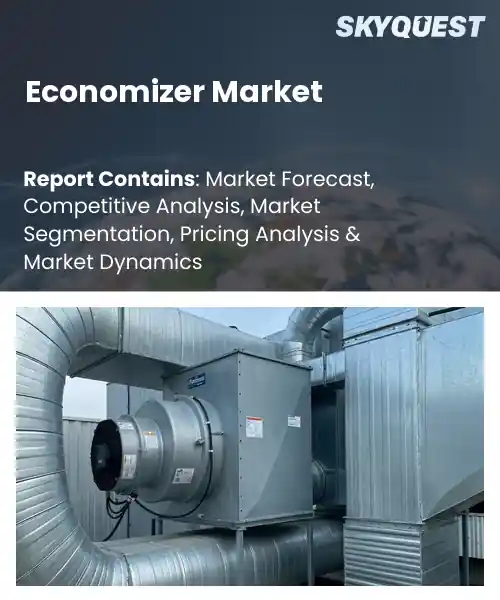
Economizer Market
Report ID: SQMIG20D2707
Report ID: SQMIG20D2707
[email protected]
USA +1 351-333-4748
Report ID:
SQMIG20D2707 |
Region:
Global |
Published Date: June, 2026
Pages:
157
|Tables:
114
|Figures:
77


Global Economizer Market size was valued at USD 15.58 Billion in 2024 and is poised to grow from USD 16.8 Billion in 2025 to USD 30.63 Billion by 2033, growing at a CAGR of 7.8% during the forecast period (2026-2033).
The economizer market is driven by the rising demand for better heating ventilation and air conditioning efficiency. Buildings and industrial facilities are seeking to cut energy costs and emissions. Economizers use outdoor air or waste heat to reduce the need for mechanical cooling or heating, reducing utility bills and carbon footprints which may be important to facility owners, regulators and sustainability programs. In the last few decades, technologies in commercial HVAC have become more sophisticated with simple dampers and controls being adopted in the late twentieth century to applications such as variable air volume systems with smart sensors for example in university campuses with enthalpy control and data centers with air economizers to reduce cooling loads.
The major factors responsible for the growth of the global economizer market are the rising regulatory standards and corporate sustainability commitments, due to which energy efficiency and carbon targets are the main factors to drive adoption. Incentives to reduce payback times and tighter codes are needed for retrofit and new install projects. This regulation increases demand for advanced control and monitoring, creating opportunities for companies offering IoT enabled optimisation services and predictive maintenance contracts. And hospitals and manufacturing plants are using sensor-driven economizers to shave peak demand charges, and cloud-connected analytics help operators verify savings. Vendors can provide performance assurances, and increase market penetration across regions.
How is IoT enhancing performance and monitoring in the economizer market?
IoT is a game changer for economizer performance and monitoring with ubiquitous sensors, constant telemetry and cloud analytics that transform passive free cooling systems into actively managed assets. Real time airflow and temperature sensing, adaptive control logic and remote diagnostics allowing for better use of outdoor air for cooling and reducing unnecessary mechanical cooling are key features. The state today is a sign of increasing integration with building automation and chiller controls to meet owners’ desire for better reliability and less risk of operation. This means faster fault detection and easier commissioning and control strategies that adapt to weather and occupancy, so that economizers perform better in buildings and data centers.
Johnson Controls announced YORK chillers with factory-installed connectivity to deliver real-time insight into performance and integrated economized chiller control. This helps to drive wider adoption and greater operational efficiency in the economizer market by reducing commissioning time, enabling remote diagnostics and supporting data driven optimization.
Market snapshot - (2026-2033)
Global Market Size
USD 15.58 Billion
Largest Segment
Air Economizers
Fastest Growth
Fluid Economizers
Growth Rate
7.8% CAGR
To get more insights on this market click here to Request a Free Sample Report
Global economizer market is segmented by product configuration type, application design, end-use industry, distribution channel and region. Based on product configuration type, the market is segmented into Fluid Economizers and Air Economizers. Based on application design, the market is segmented into Non-Condensing Economizers and Condensing Economizers. Based on end-use industry, the market is segmented into Energy & Utilities, Manufacturing & Industrial and Construction & HVAC Infrastructure. Based on distribution channel, the market is segmented into Direct and Indirect. Based on region, the market is segmented into North America, Europe, Asia Pacific, Latin America and Middle East & Africa.
Fluid Economizers segment holds the largest share owing to the uniform and high capacity heat recovery by fluid based heat exchangers in various thermal systems and being the preferred option for heavy duty process and utility applications. They are capable of accepting a broad spectrum of flow rates and temperatures and can be integrated into existing piping and control architectures, thereby reducing retrofit friction and operational risk. These features are a factor in specification by engineers and OEMs and, along with their reliability, serviceability and strong vendor relationships, generate sustained demand.
However, Air Economizers are gaining the most momentum as lightweight, lower cost air side solutions allow for easy retrofits in commercial HVAC and modular systems. Advances in controls and sensors, a focus on better indoor air quality, and the need for easier, lower-maintenance fresh air strategies are driving faster deployment, creating new retrofit and OEM integration opportunities that expand the overall market.
Non Condensing Economizers is the dominant segment owing to the simpler thermal control which prevents flue gas condensation, minimizing risks of corrosion and compatibility with a wide range of combustion equipment. That reliability lowers maintenance cycles and risk for facility operators and drives preference in industrial and commercial specifications. predictable performance and lower lifecycle complexity drive procurement, and support widespread aftermarket services and established supply chains reinforcing market leadership.
Condensing Economizers are the fastest growing segment however, due to better energy recovery from latent heat and tightening efficiency standards. Improved corrosion resistance materials and modular designs reduce operating barriers and enable retrofits and new installations that enable deeper fuel savings and compelling business cases for wider market adoption.
To get detailed segments analysis, Request a Free Sample Report
North America is well positioned, thanks to a mix of market maturity, integrated industry capabilities, and solid institutional support for energy efficiency. Economizer solutions offer rapid deployment and operational effectiveness, thanks to a wide-ranging original equipment manufacturer, an experienced installation and service network and deep expertise in building automation. The robust demand is fueled by commercial buildings, data centers and industrial facilities, all seeking to cut operational costs and enhance the quality of the indoor environment. Policy frameworks, voluntary programs and accessible financing channels further lower the barriers to adoption and drive retrofit activity. The region also has extensive R&D and pilot initiatives that help refine control strategies and system integration, creating a virtuous cycle of innovation, proven performance, and wider market acceptance across a variety of climate zones and facility types.
The US Economizer Market has a large installed base of commercial & industrial HVAC systems and a sophisticated ecosystem of OEMs, controls manufacturers and service providers. Stringent building codes, high demand for data center efficiency and an active retrofit market looking for fast operational savings support market uptake. Integration with advanced building management systems and energy performance contracting models removes installation complexity. Technical know-how as well as the availability of financing options enable the constant replacement and optimization of existing systems.
The Economizer Market in Canada reflects the focus on adaptability to cold climate operations and optimizing year round system performance. Interest exists in energy efficiency targets for commercial and institutional buildings, and for industrial process applications where air economization can reduce the mechanical load. Federal and provincial programs support pilot projects and targeted incentives for retrofits. Service firms and local suppliers are developing solutions for mixed heating and ventilation needs, encouraging measured adoption in upgrade programs as well as new construction.
Rapid expansion in Europe is driven by an ambitious policy environment, extensive renovation needs of aging building stock, and a growing focus on reducing operational emissions. Investment in high performance HVAC components and systems integration is being driven by national and regional policies and certification schemes and performance mandates are raising market expectations for energy efficient solutions. Additionally, market dynamics are further shaped by incentives that de-risk retrofit projects for building owners, and strong engineering and manufacturing capabilities that enable advanced control integration. The intersection of public sector leadership, demand for lower operating costs in commercial property and innovation in smart building technologies, accelerates adoption across markets with varying levels of maturity, reinforcing cross border knowledge transfer and standardization of best practices.
The Germany Economizer Market is driven by a deep industrial base and strong engineering competence supporting sophisticated system design and integration. Demand is coming from energy intensive manufacturing facilities, commercial real estate looking for operational efficiencies and a culture of technical specialization among suppliers. Performance is the regulatory focus and there are channels for retrofit implementation, which drive the uptake of comprehensive economizer packages. The close collaboration between equipment manufacturers and building operators allows tailored solutions, compatible with district energy infrastructure and combined heat and power infrastructure.
The UK Economizer Market is projected to witness a robust growth driven by aggressive retrofit programs and rising corporate commitments towards decarbonization. Commercial landlords and institutional owners are seeking upgrades that provide measurable energy savings and improved indoor air quality. New financing mechanisms and energy performance contracting eliminate the barrier of upfront costs, and, coupled with state-of-the-art monitoring and controls, enhance the assurance of performance. In the Regions and in central London, specification and deployment are being driven by the competitive vendor landscape and the active consultancy sector.
As renovation activities and regulatory expectations evolve to incorporate air economization solutions in a more comprehensive manner, the French economizer market is gaining momentum. There is growing interest from building owners who want to improve occupant comfort and meet energy performance targets and project teams looking for synergies with heat pumps and ventilation upgrades. Pilot projects and targeted offerings are assisting local manufacturers and service providers to build capacity to translate policy signals into actionable pathways to procurement and installation of public and private sector buildings.
Asia Pacific is cementing its role with modernization of urban infrastructure at a rapid pace, increasing industrial and commercial energy demand and a renewed focus on system efficiency. Regional momentum is being built by local manufacturing investment, the adaptation of global technologies to regional climatic conditions, and an increasing pool of technical expertise in controls and system integration. The growing roll-out of data centres and commercial developments is generating significant pockets of demand, backed by policy measures and corporate sustainability commitments for long-term uptake. Partnerships with local and multinational partners fast track technology transfer and customization. Advanced use cases of IoT based controls improve operational reliability and performance validation and shift the region from nascent adoption to deeper integration.
The Japan economizer market is driven by the focus on precision engineering and high quality control systems providing reliable integration in small urban buildings. This demand is driven by a culture of careful building management and a focus on the continuous improvement of energy performance. Local OEMs and systems integrators are working on durability and fine tuned control strategies, adapting economizer technologies for mixed ventilation and space constrained installations. Service networks enable continuous optimization and adherence to rigorous building codes.
South Korea’s advanced electronics, automation skills, and its strong industrial base are helping to speed up the adoption of economizer market. Commercial and industrial operators need integrated solutions to connect economizers to building automation and smart grid initiatives. Rapid upscaling and local adaptation is enabled by a strong local manufacturing base and retrofit activity is driven by government incentives for energy efficiency and corporate sustainability plans. Close collaboration between technology suppliers and facility managers assists in practical deployment and performance verification.
To know more about the market opportunities by region and country, click here to
Buy The Complete Report
Energy Efficiency Regulations
Rising Commercial Construction Demand
High Initial Capital Costs
Maintenance And Operational Complexity
Request Free Customization of this report to help us to meet your business objectives.
The global economizer market is facing consolidation among legacy HVAC suppliers, targeted acquisitions and technology partnerships that accelerate digital and heat recovery offerings. Regulatory energy efficiency requirements and corporate decarbonisation commitments are driving competition and forcing companies to look for M&A, strategic OEM partnerships and specialist order wins. Recent strategic moves include Rheem’s announced intention to acquire Nortek, Daikin’s minority stake in an IoT based heat recovery startup and order wins by specialist heat recovery firms.
SkyQuest’s ABIRAW (Advanced Business Intelligence, Research & Analysis Wing) is our Business Information Services team that Collects, Collates, Correlates, and Analyses the Data collected by means of Primary Exploratory Research backed by robust Secondary Desk research.
As per SkyQuest analysis, the global economizer market is expected to expand as a key driver is stringent energy efficiency regulations that accelerate retrofits and new installations. A second driver is growing integration with IoT and smart building controls that improve monitoring, fault detection, and performance validation. A restraint is high initial capital costs which can delay projects despite attractive life cycle savings. North America is the dominating region owing to mature OEM ecosystems, supportive policies and large commercial and data center demand. Fluid Economizers are the dominating segment due to reliable high-capacity heat recovery preferred in heavy process and utility applications, sustaining demand across industrial and commercial installations.
| Report Metric | Details |
|---|---|
| Market size value in 2024 | USD 15.58 Billion |
| Market size value in 2033 | USD 30.63 Billion |
| Growth Rate | 7.8% |
| Base year | 2024 |
| Forecast period | (2026-2033) |
| Forecast Unit (Value) | USD Billion |
| Segments covered |
|
| Regions covered | North America (US, Canada), Europe (Germany, France, United Kingdom, Italy, Spain, Rest of Europe), Asia Pacific (China, India, Japan, Rest of Asia-Pacific), Latin America (Brazil, Rest of Latin America), Middle East & Africa (South Africa, GCC Countries, Rest of MEA) |
| Companies covered |
|
| Customization scope | Free report customization with purchase. Customization includes:-
|
To get a free trial access to our platform which is a one stop solution for all your data requirements for quicker decision making. This platform allows you to compare markets, competitors who are prominent in the market, and mega trends that are influencing the dynamics in the market. Also, get access to detailed SkyQuest exclusive matrix.
Table Of Content
Executive Summary
Market overview
Parent Market Analysis
Market overview
Market size
KEY MARKET INSIGHTS
COVID IMPACT
MARKET DYNAMICS & OUTLOOK
Market Size by Region
KEY COMPANY PROFILES
Methodology
For the Economizer Market, our research methodology involved a mixture of primary and secondary data sources. Key steps involved in the research process are listed below:
1. Information Procurement: This stage involved the procurement of Market data or related information via primary and secondary sources. The various secondary sources used included various company websites, annual reports, trade databases, and paid databases such as Hoover's, Bloomberg Business, Factiva, and Avention. Our team did 45 primary interactions Globally which included several stakeholders such as manufacturers, customers, key opinion leaders, etc. Overall, information procurement was one of the most extensive stages in our research process.
2. Information Analysis: This step involved triangulation of data through bottom-up and top-down approaches to estimate and validate the total size and future estimate of the Economizer Market.
3. Report Formulation: The final step entailed the placement of data points in appropriate Market spaces in an attempt to deduce viable conclusions.
4. Validation & Publishing: Validation is the most important step in the process. Validation & re-validation via an intricately designed process helped us finalize data points to be used for final calculations. The final Market estimates and forecasts were then aligned and sent to our panel of industry experts for validation of data. Once the validation was done the report was sent to our Quality Assurance team to ensure adherence to style guides, consistency & design.
Analyst Support
Customization Options
With the given market data, our dedicated team of analysts can offer you the following customization options are available for the Economizer Market:
Product Analysis: Product matrix, which offers a detailed comparison of the product portfolio of companies.
Regional Analysis: Further analysis of the Economizer Market for additional countries.
Competitive Analysis: Detailed analysis and profiling of additional Market players & comparative analysis of competitive products.
Go to Market Strategy: Find the high-growth channels to invest your marketing efforts and increase your customer base.
Innovation Mapping: Identify racial solutions and innovation, connected to deep ecosystems of innovators, start-ups, academics, and strategic partners.
Category Intelligence: Customized intelligence that is relevant to their supply Markets will enable them to make smarter sourcing decisions and improve their category management.
Public Company Transcript Analysis: To improve the investment performance by generating new alpha and making better-informed decisions.
Social Media Listening: To analyze the conversations and trends happening not just around your brand, but around your industry as a whole, and use those insights to make better Marketing decisions.
REQUEST FOR SAMPLE
 REQUEST FREE CUSTOMIZATION
Global Economizer Market size was valued at USD 15.58 Billion in 2024 and is poised to grow from USD 16.8 Billion in 2025 to USD 30.63 Billion by 2033, growing at a CAGR of 7.8% during the forecast period (2026-2033).
Competitive landscape in the global economizer market is defined by consolidation among legacy HVAC suppliers, targeted acquisitions, and technology partnerships that accelerate digital and heat recovery offerings. Regulatory energy efficiency mandates and corporate decarbonization commitments intensify rivalries and push firms to pursue M&A, strategic OEM collaborations, and specialist order wins. Recent strategic moves include Rheem's announced intent to acquire Nortek, Daikin's minority stake in an IoT based heat recovery startup, and order wins by specialist heat recovery firms. 'Alfa Laval', 'Sulzer', 'GEA Group', 'Andritz AG', 'Babcock & Wilcox Enterprises', 'Thermax Limited', 'Cabcock Power', 'Foster Wheeler', 'Thermodyn', 'Stork', 'Kelvion Holding', 'Secespol', 'Spirax-Sarco Engineering', 'Armstrong International', 'Schneider Electric', 'Siemens AG', 'ABB Ltd', 'Eaton Corporation', 'Honeywell International', 'Emerson Electric'
Stringent energy efficiency standards and building codes have compelled facility operators and designers to prioritize HVAC solutions that reduce energy consumption, thereby increasing demand for economizers. By mandating or incentivizing improved seasonal efficiency and ventilation performance, regulations drive retrofits and specification of more efficient air handling components. Manufacturers and consultants respond by promoting economizer integration as a practical compliance pathway, creating sustained procurement cycles and product development that align with policy objectives, which in turn supports steady expansion of the global economizer market.
Smart Building Integration: Economizers are increasingly integrated with smart building controls and Internet of Things platforms, enabling real-time coordination with HVAC systems and occupancy sensors. This trend emphasizes interoperability, data-driven optimization and adaptive ventilation strategies that enhance indoor air quality while minimizing energy use. Vendors collaborate with platform providers to deliver seamless control, analytics and predictive maintenance workflows. For building owners, integrated economizers offer improved operational visibility, simplified retrofits and stronger alignment with sustainability goals and corporate environmental policies and resilience across portfolios.
Why does North America Dominate the Global Economizer Market? |@12


Want to customize this report? This report can be personalized according to your needs. Our analysts and industry experts will work directly with you to understand your requirements and provide you with customized data in a short amount of time. We offer $1000 worth of FREE customization at the time of purchase.
Feedback From Our Clients


 USA (+1) 351-333-4748

