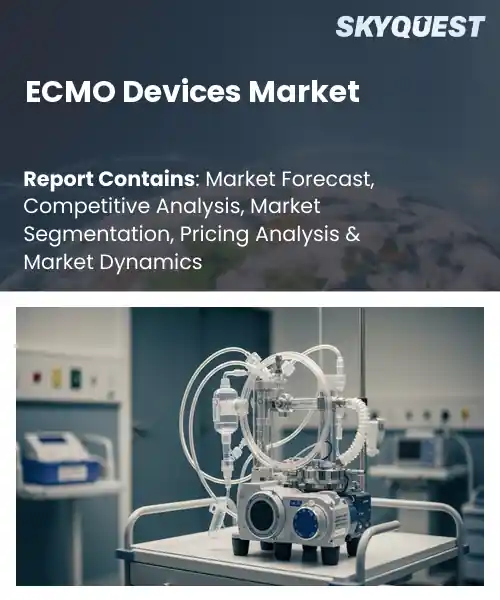
ECMO Devices Market
Report ID: SQMIG35A3246
Report ID: SQMIG35A3246
[email protected]
USA +1 351-333-4748
Report ID:
SQMIG35A3246 |
Region:
Global |
Published Date: February, 2026
Pages:
157
|Tables:
149
|Figures:
78


Global ECMO Devices Market size was valued at USD 2.80 Billion in 2024 and is poised to grow from USD 2.94 Billion in 2025 to USD 4.31 Billion by 2033, growing at a CAGR of 4.9% during the forecast period (2026-2033).
The primary driver of the ECMO devices market has been the growing burden of severe respiratory and cardiac failure, a trend that gained global attention during the COVID-19 pandemic, and earlier influenza outbreaks. ECMO, or extracorporeal membrane oxygenation, provides life-sustaining cardiopulmonary support when conventional therapies fail, recovery or transplantation while demanding specialized consumables, consoles, and trained teams. Over time adoption moved from neonatal intensive care into adult critical care as clinical evidence, trials, and improved device portability expanded indications, and examples of high-profile pandemic deployments illustrate rapid capacity scaling and investment.
A key trend driving the global ECMO devices sector is rapid technological innovation that has reduced device complexity and improved safety, which in turn enabled more hospitals to implement ECMO programs and created scalable demand for disposables and training. As manufacturers introduced compact consoles, heparin-coated circuits, and integrated pump-monitoring, clinicians could deploy ECMO beyond tertiary centers into regional hospitals, producing real-world outcomes such as mobile retrieval teams stabilizing ARDS patients for transfer and shorter setup times in emergency cardiac arrests. As a result of this there are new opportunities arising within the marketplace for Service Contracts, Simulation-based Training, and Single Use Components. In addition, with regulatory approval, and reimbursement focused contracts those will assist both accelerate the acceptance and investment into the marketplace.
AI is improving patient outcomes in ECMO by adding continuous data analytics and clinical decision support to extracorporeal therapy. These systems synthesize sensor signals and bedside monitors to detect early signs of clotting oxygenator failure and hemodynamic instability. The current state is one of rapid integration in tertiary centers where AI assists clinicians with timely alerts and suggested adjustments to flow and oxygenation. This reduces avoidable complications and eases staff workload while making ECMO more accessible beyond specialized units. Real world pilots and industry roadmaps show growing emphasis on predictive maintenance and smarter monitoring in ECMO product development.
In July 2025, Medtronic announced the VitalFlow ECMO system with integrated real time monitoring and an architecture that supports advanced analytics. This platform creates a foundation for AI driven decision support which can improve bedside efficiency and support wider adoption of ECMO in critical care.
Market snapshot - (2026-2033)
Global Market Size
USD 2.8 Billion
Largest Segment
Stationary ECMO Systems
Fastest Growth
Portable ECMO Devices
Growth Rate
4.9% CAGR
To get more insights on this market click here to Request a Free Sample Report
Global ECMO devices market is segmented by product type, technology, application, end-user, distribution channel and region. Based on product type, the market is segmented into portable ECMO devices, stationary ECMO systems, and ECMO consumables & accessories. Based on technology, the market is segmented into venoarterial (VA) ECMO, venovenous (VV) ECMO and hybrid ECMO technologies. Based on application, the market is segmented into cardiac support, respiratory support, combined cardiorespiratory support, neonatal ECMO, pediatric ECMO, and adult ECMO.
Based on end-user, the market is segmented into hospitals, cardiac centers, specialty clinics, ambulatory care centers and research & academic institutions. Based on distribution channel, the market is segmented into direct OEM sales, distributors & dealers and online sales. Based on region, the market is segmented into North America, Europe, Asia Pacific, Latin America and Middle East & Africa.
Based on the global ECMO devices market share, portable ECMO devices segment dominates because their mobility and simplified designs enable timely initiation of extracorporeal support outside conventional operating rooms, driving clinician preference for point-of-care therapy. The ability to miniaturize and integrate pumps/oxygenators with battery-enable units is decreasing logistical barriers and shortening the time needed to support these units, thus increasing the level of uptake by both Transport and Emergency teams. As a result of this, manufacturers are emphasizing a highly portable platform that creates significant procurement momentum as well as a clinical familiarity that enables manufacturers to maintain their lead.
However, ECMO consumables & accessories are rapidly expanding as recurring demand for single-use circuits, oxygenator cartridges and monitoring disposables creates steady procurement cycles. Improvements in connector kits and biocompatible coatings will generate additional number of aftermarket sales while making procedures safer and easier to perform. This drives manufacturers to expand their product offerings as well as develop stronger supply capabilities.
Venovenous (VV) ECMO segment dominates because it directly targets isolated respiratory failure with a clinical pathway that is less invasive in cardiac terms and aligns with established ARDS treatment protocols, making it the preferred option for lung support. Improvements in cannulation techniques, oxygenator performance and patient selection reduce complications and length of intensive respiratory interventions, prompting more centers to adopt VV systems and integrate them into critical care workflows.
Meanwhile, hybrid ECMO technologies are seeing the strongest growth as clinicians seek platforms that support combined cardiac and respiratory failure and flexible flow management. Modular pump controllers, dual-mode circuits and integrated monitoring enable rapid therapy shifts, expanding clinical applications and attracting investment in adaptable systems that accelerate market opportunity creation.
To get detailed segments analysis, Request a Free Sample Report
As per the global ECMO devices market growth, North America dominance is driven by a convergence of advanced clinical infrastructure, concentrated centers of excellence, and a strong medtech ecosystem that supports rapid translation of innovation into clinical practice. Furthermore, the cooperation between academic hospitals and manufacturers to evaluate, and improve the clinical performance of these devices reduces the time needed for introduction into practice. In addition, the existence of established reimbursement and regulatory mechanisms facilitates the incorporation of eECS into practice, and the existence of comprehensive training programs allow clinicians from various specialties to develop expertise in the use of eECS.
ECMO devices market in the United States benefits from a high concentration of specialized centers, integrated hospital networks, and significant clinical expertise across cardiothoracic and pulmonary critical care. Collaboration between industry and academia facilitates both development of devices and their evaluation after their introduction to the market, while established methods of reimbursement promote their introduction into clinical practice. A solid domestic manufacturing base combined with focused educational programs creates a dependable supply of the latest technology and experienced multi-disciplinary teams for a continued leadership position for product innovation and clinical applications.
ECMO devices market in Canada is characterized by a network of regional tertiary centers that provide concentrated clinical experience and coordinated referral pathways. The public health system's structure provides a supportive base for developing standardized care, which leads to improved ability of health systems across the provinces to provide more clinical services. For example, through clinician training and interhospital transportation capabilities, all hospitals will be able to provide extracorporeal therapies more widely by creating a collaborative research network and establishing long-term partnerships with both local suppliers and international manufacturers of technology.
Based on global ECMO devices regional forecast, expansion across Europe is propelled by increasing establishment of specialized ECMO centers, cross-border clinical collaborations, and growing emphasis on standardized care pathways for severe respiratory and cardiac failure. The national health systems and payer systems in many countries allow structured access to advanced clinical support; some regional medical technology companies and multi-national manufacturers improve the availability of products and provide clinical training. Investment in clinician education and Centralized Care transportation logistics (to enable centralized care) as well as Public Hospital adoption, are also helping to accelerate the growth of the market and thereby diversify the number of cases of use of advanced technologies within complex critical care environments.
ECMO devices market in Germany exhibits concentrated adoption across a strong network of university hospitals and high-volume cardiac centers. Integrated clinical research programs and industrial engineering strengths support development and refinement of extracorporeal technologies. Structured reimbursement practices and established referral systems foster predictable adoption, while emphasis on multidisciplinary training and regional cooperation sustains clinical expertise and consistent access to advanced ECMO therapy.
ECMO devices market in the United Kingdom is experiencing rapid expansion driven by coordinated national initiatives that support regional center development and clinician training. Centralized service models and collaborative clinical networks enable wider deployment of extracorporeal support, while emphasis on outcome monitoring and program accreditation raises quality standards. There are many ways that health service providers and their industry partners collaborate to enhance innovation in the adoption and consistency of protocols between specialty areas.
ECMO devices market in France is emerging through the growth of regional specialized units, enhanced clinician training, and collaborative research linking hospitals with device manufacturers. Improved access to extracorporeal support has been achieved by developing integrated care pathways and regional referral networks; national initiatives to standardize practice will help promote the wide scale adoption of extracorporeal support technologies. Increasing domestic participation in device development and clinical evaluation underpins a maturing market presence.
As per global ECMO devices regional outlook, Asia Pacific is strengthening its position by expanding critical care capacity, nurturing domestic manufacturing capabilities, and fostering partnerships with global medtech firms to accelerate technology transfer. A large number of regional multicenter collaborations have been created as well as adapted company technologies for use in specific regions/locations to meet local clinical needs. Manufacturing operations designed for exporting will support both domestic and international marketplaces in what will ultimately result in the development of a resilient ecosystem that supports broader adoption of these therapies, creates clinical expertise and gradually moves from dependence on imported products towards increased regional innovation and supply.
ECMO devices market in Japan is supported by mature critical care infrastructure, well established cardiac surgery programs, and domestic medical technology capabilities. Strong clinical expertise and structured hospital networks facilitate consistent use of extracorporeal systems, while local manufacturers and research institutions collaborate to refine devices for regional practice. Protocols and ongoing training for clinicians help assure that providers will deliver quality services as well as integrate new technologies into daily practice.
ECMO devices market in South Korea is bolstered by a dynamic medical device manufacturing sector and proactive adoption of advanced critical care technologies. The Government's support for healthcare innovation through partnerships with large hospitals improves access to up-to-date extracorporeal technologies, while the provision of strategic training and collaboration across borders enhances clinician competence. Production-oriented towards exports and an ability to adjust quickly to market demands enable companies to establish themselves regionally and share technology more broadly.
To know more about the market opportunities by region and country, click here to
Buy The Complete Report
Increasing Prevalence of Critical Illness
Technological Advancements In Device Design
High Procedural And Device Costs
Shortage Of Skilled Clinical Staff
Request Free Customization of this report to help us to meet your business objectives.
Competitive dynamics in the global ECMO devices market outlook are driven by consolidation, platform integration, and clinic partnerships, with major firms executing acquisitions and launches to capture hospital programs. Examples include Abiomed's 2020 acquisition of Breethe, LivaNova's 2022 acquisition of ALung, and Medtronic's 2024 acquisition of MC3 followed by the VitalFlow launch, while firms pursue technology partnerships and service agreements to expand installed bases.
SkyQuest’s ABIRAW (Advanced Business Intelligence, Research & Analysis Wing) is our Business Information Services team that Collects, Collates, Correlates, and Analyses the Data collected by means of Primary Exploratory Research backed by robust Secondary Desk research.
As per SkyQuest analysis, the global ECMO devices industry is propelled primarily by the rising burden of severe cardiopulmonary failure, a key driver that expanded clinical demand and program investment during recent pandemics, while a second driver is rapid technological innovation including portable consoles, biocompatible consumables and AI enabled monitoring that broadened hospital adoption. A major restraint remains high procedural and device costs, which limit program initiation among smaller providers. North America remains the dominating region due to concentrated centers of excellence and favorable reimbursement. Portable ECMO devices are the dominating segment as miniaturization and transport capability accelerate point of care deployment and recurring consumable demand.
| Report Metric | Details |
|---|---|
| Market size value in 2024 | USD 2.8 Billion |
| Market size value in 2033 | USD 4.31 Billion |
| Growth Rate | 4.9% |
| Base year | 2024 |
| Forecast period | (2026-2033) |
| Forecast Unit (Value) | USD Billion |
| Segments covered |
|
| Regions covered | North America (US, Canada), Europe (Germany, France, United Kingdom, Italy, Spain, Rest of Europe), Asia Pacific (China, India, Japan, Rest of Asia-Pacific), Latin America (Brazil, Rest of Latin America), Middle East & Africa (South Africa, GCC Countries, Rest of MEA) |
| Companies covered |
|
| Customization scope | Free report customization with purchase. Customization includes:-
|
To get a free trial access to our platform which is a one stop solution for all your data requirements for quicker decision making. This platform allows you to compare markets, competitors who are prominent in the market, and mega trends that are influencing the dynamics in the market. Also, get access to detailed SkyQuest exclusive matrix.
Table Of Content
Executive Summary
Market overview
Parent Market Analysis
Market overview
Market size
KEY MARKET INSIGHTS
COVID IMPACT
MARKET DYNAMICS & OUTLOOK
Market Size by Region
KEY COMPANY PROFILES
Methodology
For the ECMO Devices Market, our research methodology involved a mixture of primary and secondary data sources. Key steps involved in the research process are listed below:
1. Information Procurement: This stage involved the procurement of Market data or related information via primary and secondary sources. The various secondary sources used included various company websites, annual reports, trade databases, and paid databases such as Hoover's, Bloomberg Business, Factiva, and Avention. Our team did 45 primary interactions Globally which included several stakeholders such as manufacturers, customers, key opinion leaders, etc. Overall, information procurement was one of the most extensive stages in our research process.
2. Information Analysis: This step involved triangulation of data through bottom-up and top-down approaches to estimate and validate the total size and future estimate of the ECMO Devices Market.
3. Report Formulation: The final step entailed the placement of data points in appropriate Market spaces in an attempt to deduce viable conclusions.
4. Validation & Publishing: Validation is the most important step in the process. Validation & re-validation via an intricately designed process helped us finalize data points to be used for final calculations. The final Market estimates and forecasts were then aligned and sent to our panel of industry experts for validation of data. Once the validation was done the report was sent to our Quality Assurance team to ensure adherence to style guides, consistency & design.
Analyst Support
Customization Options
With the given market data, our dedicated team of analysts can offer you the following customization options are available for the ECMO Devices Market:
Product Analysis: Product matrix, which offers a detailed comparison of the product portfolio of companies.
Regional Analysis: Further analysis of the ECMO Devices Market for additional countries.
Competitive Analysis: Detailed analysis and profiling of additional Market players & comparative analysis of competitive products.
Go to Market Strategy: Find the high-growth channels to invest your marketing efforts and increase your customer base.
Innovation Mapping: Identify racial solutions and innovation, connected to deep ecosystems of innovators, start-ups, academics, and strategic partners.
Category Intelligence: Customized intelligence that is relevant to their supply Markets will enable them to make smarter sourcing decisions and improve their category management.
Public Company Transcript Analysis: To improve the investment performance by generating new alpha and making better-informed decisions.
Social Media Listening: To analyze the conversations and trends happening not just around your brand, but around your industry as a whole, and use those insights to make better Marketing decisions.
REQUEST FOR SAMPLE
 REQUEST FREE CUSTOMIZATION
Global Ecmo Devices Market size was valued at USD 2.8 Billion in 2024 and is poised to grow from USD 2.94 Billion in 2025 to USD 4.31 Billion by 2033, growing at a CAGR of 4.9% during the forecast period (2026-2033).
Competitive dynamics in the global ECMO devices market are driven by consolidation, platform integration, and clinic partnerships, with major firms executing acquisitions and launches to capture hospital programs. Examples include Abiomed's 2020 acquisition of Breethe, LivaNova's 2022 acquisition of ALung, and Medtronic's 2024 acquisition of MC3 followed by the VitalFlow launch, while firms pursue technology partnerships and service agreements to expand installed bases. 'Getinge AB', 'Medtronic PLC', 'Fresenius SE & Co. KGaA', 'LivaNova PLC', 'Maquet Holding B.V. & Co. KG', 'Terra Rossa Medical', 'Nipro Corporation', 'Sorin Group', 'Abiomed, Inc.', 'Xenios AG', 'Cohesion Medical', 'ELSA', 'A.L. Medical, Inc.', 'Transonic Systems, Inc.', 'Biotechnologies, Inc.', 'Edwards Lifesciences Corporation', 'Pulmonx Corporation', 'Celerion', 'Affinity Medical Technologies', 'HemoCare Technologies'
Growing rates of severe cardiopulmonary conditions and complex surgical procedures have expanded the pool of patients requiring advanced life support, directly increasing demand for ECMO systems and related disposables. As clinical teams encounter more eligible cases, hospitals prioritize procurement and service development to offer lifesaving support, which encourages manufacturers to scale product availability and service offerings. Broader clinical recognition of ECMO benefits fosters institutional investment in programs and training, reinforcing a cycle of adoption that sustains market growth through sustained clinical need and health system commitment.
Portable And Field Ecmo Systems: Manufacturers are prioritizing development of compact, robust extracorporeal support units designed for emergency, transport and austere environments. Emphasis on simplified setup, reduced weight, extended battery operation and single-use circuits addresses logistical constraints and accelerates deployment outside tertiary centers. Collaboration among device makers, emergency services and military providers is advancing ruggedization, protocol adaptation and training programs to ensure safe usage. This trend expands clinical reach, supports rapid intervention strategies and creates market opportunities centered on portability, durability and cross‑setting compatibility broadly.
As per the global ECMO devices market growth, North America dominance is driven by a convergence of advanced clinical infrastructure, concentrated centers of excellence, and a strong medtech ecosystem that supports rapid translation of innovation into clinical practice.


Want to customize this report? This report can be personalized according to your needs. Our analysts and industry experts will work directly with you to understand your requirements and provide you with customized data in a short amount of time. We offer $1000 worth of FREE customization at the time of purchase.
Feedback From Our Clients


 USA (+1) 351-333-4748

