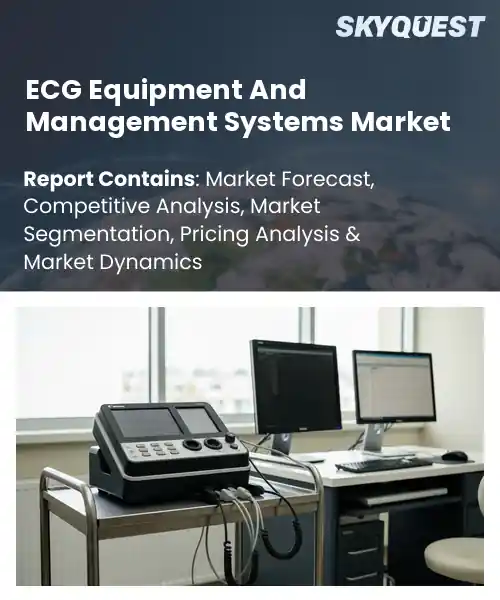
ECG Equipment And Management Systems Market
Report ID: SQMIG35A3600
Report ID: SQMIG35A3600
[email protected]
USA +1 351-333-4748
Report ID:
SQMIG35A3600 |
Region:
Global |
Published Date: May, 2026
Pages:
157
|Tables:
151
|Figures:
78


Global ECG Equipment and Management Systems Market size was valued at USD 4.20 Billion in 2024 and is poised to grow from USD 4.40 Billion in 2025 to USD 6.35 Billion by 2033, growing at a CAGR of 4.7% during the forecast period (2026-2033).
A main factor driving the worldwide ECG equipment and management systems market growth is an increase in the global burden of cardiovascular disease and, as a result, generating continuing need for accurate diagnosis and continued monitoring. This market consists of both Hardware (i.e., rest ECG machines) as well as Software Platforms for the analysis, aggregation and storage of cardiac data. The reason it matters is because if arrhythmias and their causes and the causes of ischemia can be detected early, healthcare costs and morbidity can both be significantly decreased.
Over the past several decades, the ECG equipment and management systems market trends transitioned from the use of large Analog carts for the capture of ECG recordings to portable Digital recorders, to the use of Implantable Loop Recorders, to Cloud-based Management Systems for ECGs, to Wearable ECGs for both daily living and as a tool to monitor patients over an extended period of time. For example, GE and Philips have developed and marketed hospital-based telemetry devices while Apple and AliveCor have both developed devices for consumer use (i.e., Apple Watch).
How is AI Enhancing Efficiency and Accuracy in the ECG Equipment and Management Systems Market?
AI technology has increased both efficiency and accuracy of ECG-related equipment and management systems through automatic analysis of waveforms in addition to highlighting clinically significant findings. Noise disassociation, interpretation of algorithms, and better workflows are relevant components of AI which have decreased the amount of time needed to review electrocardiograms (ECGs) and have reduced the number of times patients followed to an unnecessary end point. Vendors have utilized AI technology for the incorporation of AI in devices like bedside monitors, ambulatory recorders, cloud-based management frameworks, and APIs that permit remote assessment and continuous assessment of patients' conditions. AI was also used to widen the number of conditions detectable by ECG(s) and provide predictive assessment to clinicians focusing on the most complicated patients.
Philips’ market offering (as of July 2025) is called the ECG AI Marketplace. This solution combines third-party software (e.g., Anumana LEF algorithm) into Philips’ existing ECG framework in order to offer validated AI solutions to the medical facility in which the ECG is used, thus providing the highest operational efficiency.
Market snapshot - (2026-2033)
Global Market Size
USD 4.2 Billion
Largest Segment
ECG Equipment
Fastest Growth
ECG Management Systems
Growth Rate
4.7% CAGR
To get more insights on this market click here to Request a Free Sample Report
Global ECG equipment and management systems market is segmented by product type, lead type, deployment mode, end user, application and region. Based on product type, the market is segmented into ECG equipment and ECG management systems. Based on lead type, the market is segmented into single-lead ECG systems, 3-lead ECG systems, 5-lead ECG systems, 12-lead ECG systems and multi-lead advanced ECG systems. Based on deployment mode, the market is segmented into on-premise systems, cloud-based systems and hybrid systems. Based on end user, the market is segmented into hospitals, cardiology clinics, ambulatory surgical centers, diagnostic centers, home care settings and others. Based on application, the market is segmented into arrhythmia detection, cardiac monitoring, diagnostic testing, remote patient monitoring, preventive cardiology and others. Based on region, the market is segmented into North America, Europe, Asia Pacific, Latin America and Middle East & Africa.
The 12-lead ECG systems segment dominates because they provide clinicians with complete access to the waveforms they need for definitive diagnostic testing and a detailed assessment of the heart. There are also established clinical workflows, deep integration to hospital systems, functionality with emerging advanced diagnostic algorithms and a broad-based acceptance by clinicians which create strong preference for procurement and investment decisions which prioritize robust multi-lead diagnostic capabilities and interoperability. This will continue to create very high barriers to adoption of lower-lead alternatives in acute care environments.
However, single-lead ECG systems are the most rapidly expanding area in the market due to portability and integration with wearable devices. Rising demand for continuous, low-cost remote monitoring, coupled with miniaturized sensors and AI-driven interpretation, is accelerating adoption in home care and ambulatory monitoring and unlocking new care pathways.
The on-premise systems segment of the market has been the dominant choice for providers who want complete control of their cardiac data and need it to be integrated closely into their existing hospital systems. These factors greatly influence providers’ decisions to purchase on-premise deployments because they help ensure continuity by minimizing latency between data collection and transmission, meeting compliance requirements of the institution's governing body, and interfacing with existing monitoring devices at that institution. Over time, providers have built the infrastructure to support an in-house IT resource strategy; this way, they can fulfill existing clinical workflows through on-premise solutions deployed in the acute care setting and in large institutions.
However, cloud-based systems are the most rapidly expanding deployment approach because scalability, remote access, and seamless updates meet growing demand for telemonitoring and distributed care. Regulatory comfort with cloud security, vendor-managed analytics, and lower IT expenditure accelerate adoption, enabling faster integration of AI-driven ECG interpretation and broader remote monitoring.
To get detailed segments analysis, Request a Free Sample Report
The North American healthcare ecosystem has gained a strong position through a combination of structural elements. These include the large number of specialized hospitals and integrated health systems that require sophisticated diagnostic and enterprise management systems; the very strong medtech industry developing new devices, software analytical capabilities and integrating them into electronic medical records; well-established regulatory processes combined with reimbursement programs that encourage the use of advanced monitoring and management systems; the substantial amount of clinical research being conducted and the collaboration between the healthcare industry and school-based research institutions; the existence of service support networks for the aftermarket and skilled professionals in clinical engineering who provide reliable support over time to providers reinforce all these factors into long-term deployment and trust for the provider and contribute to market leadership in healthcare in North America.
ECG equipment and management systems market share in United States is characterized by high adoption of advanced monitoring solutions across acute care, ambulatory, and remote settings. Large integrated delivery networks and specialty cardiology centers drive demand for scalable management platforms that support interoperability and analytics. A vibrant medtech ecosystem and active clinical research environment enable rapid refinement of device capabilities and software features. Emphasis on quality metrics and patient centric pathways encourages deployment of continuous monitoring and streamlined workflow solutions across care settings.
ECG equipment and management systems market growth in Canada serves the population by providing them with equal access to healthcare services, therefore giving the population access to accessible healthcare through coordinated systems across multiple levels. The use of provincial procurement frameworks and centralized procurement greatly impacts how purchasing decisions are made by hospitals, with the use of systems that can provide service and lifecycle value becoming more common. There is a push toward using remote monitoring for those populations spread out across large geographic regions, as well as for integrating with provincial EHR systems. There are collaborative efforts being made between hospitals, academics, and suppliers to support pilot projects and gradually increase the number of innovative remote monitoring technologies across the continuum of care.
Expansion across Europe is driven by a blend of regulatory alignment, healthcare modernization, and rising emphasis on digital cardiology. Harmonized conformity assessment mechanisms facilitate cross border market entry, enabling manufacturers to scale distribution through established clinical channels. Healthcare providers are prioritizing interoperability and data integration to support continuity of care and population health programs, encouraging uptake of connected ECG technologies and centralized management systems. Public and private investments in outpatient and ambulatory care capacity, along with a growing focus on preventive cardiology, spur demand for wearable and home based monitoring solutions. Local manufacturing strength in several countries complements technology imports, while collaborative research networks accelerate clinical validation and guideline incorporation of advanced monitoring approaches.
ECG equipment and management systems market outlook in Germany having a solid domestic medtech industry as well as advanced infrastructure for hospitals, equipment and management systems for ECG are well established. These characteristics have resulted in high demand for both quality equipment and effective integration of complex information systems into hospitals' environments. As a result, there is a high demand for enterprise-level management systems that provide users with the necessary tools to manage their processes effectively. Germany's market also places a premium on technical proficiency and adherence to strict clinical standards. This encourages the creation of advanced monitoring systems that can be tailored to meet the needs of specialized cardiology facilities. There are also close connections between industry, major hospitals/clinics, and research institutes, which foster iterative product development and continued application of new diagnostic techniques and tests.
ECG equipment and management systems market forecast in United Kingdom is experiencing accelerated adoption driven by national digital health initiatives and emphasis on community based care. Healthcare organizations seek scalable solutions that support remote monitoring and virtual consultations, aligning with system level priorities to manage patient pathways outside acute settings. Active procurement of interoperable platforms that integrate with national electronic health records encourages vendor engagement and innovation. Collaboration between service providers and technology firms fosters pilots and wider implementation of connected cardiac monitoring technologies.
ECG equipment and management systems market regional outlook in France is becoming modernized through specific hospital and regional health authority modernization efforts. The increased acceptance of outpatient monitoring and continuity between primary and specialty care is what is driving adoption. There is also an increasing amount of domestic suppliers offering products that will meet local clinical workflow requirements; there will be an increasing number of programs related to public procurement and clinical evaluations that support gradual expansion of the management platform and outpatient monitoring in the long run. The emphasis on clinical quality and regional cooperation is laying the groundwork for a gradual increase in both of these areas.
Asia Pacific is enhancing its market position through a combination of domestic capability building, strategic partnerships, and rapid digital health adoption. Regional manufacturers are advancing product portfolios to meet diverse care settings, offering cost effective devices and localization features that resonate with varied provider needs. Governments and private health systems are investing in infrastructure and regulatory capacity to support digital medical technologies, while integration of mobile health and telemedicine accelerates deployment of remote monitoring. Global vendors are partnering with local firms to adapt solutions for market nuances and to expand distribution networks. Growing clinical research activity and innovation clusters are fostering validation and acceptance of new monitoring paradigms across the region.
ECG equipment and management systems market regional forecast in Japan emphasizes high-quality engineering and seamless integration into clinical information systems. Major medtech companies provide a well-developed and reliable device design for hospitals and specialty clinics. There is a strong demand for accurate diagnoses of acute coronary syndrome and devices that can become part of an integrated treatment pathway for cardiac patients. Collaboration between the medtech industry and university-based research institutions will allow for rigorous clinical investigations and the development of ECG management systems that meet current, rigorous standards for healthcare.
ECG equipment and management systems industry in South Korea benefits from a vibrant technology sector and expertise in electronics and information technology. This technical strength enables rapid development of connected devices and advanced software features, including analytics and user friendly interfaces. Strong public and private engagement in digital health initiatives promotes integration of monitoring solutions into broader telehealth offerings. Export oriented manufacturers and active collaboration with global partners support both domestic adoption and international expansion of innovative monitoring technologies.
To know more about the market opportunities by region and country, click here to
Buy The Complete Report
Rising Prevalence Of Cardiovascular Diseases
Technological Advancements And Integration
High Cost Of Advanced Solutions
Data Privacy And Security Concerns
Request Free Customization of this report to help us to meet your business objectives.
The competitive environment for worldwide ECG equipment and management systems has changed as long standing manufacturers of ECG devices have been replaced in the marketplace by many newer companies focused on providing high-quality yet low-cost consumer wearable ECG devices. The competitive landscape now consists of three major areas where competition exists between manufacturers of ECG equipment: solutions offered under vendor agnostic AI ECG platforms, device integration capabilities, and clinical partnerships. Manufacturers of ECG devices are pursuing the formation of spin-outs from their parents, collaborating with hospitals to develop and implement ECG-based solutions, securing the necessary regulatory certifications and financial assistance through grants, and developing device integration as evidenced by examples such as Cordys Analytics and myritmo.
Top Player’s Company Profile
Recent Developments in the ECG Equipment And Management Systems Market
SkyQuest’s ABIRAW (Advanced Business Intelligence, Research & Analysis Wing) is our Business Information Services team that Collects, Collates, Correlates, and Analyses the Data collected by means of Primary Exploratory Research backed by robust Secondary Desk research. As per SkyQuest analysis, the global ECG equipment and management systems market is driven by the rising prevalence of cardiovascular disease, which increases demand for timely diagnosis and continuous monitoring. A second important driver is technological advancements and improved interoperability that enable cloud platforms, wearable devices and AI-assisted interpretation. A notable restraint remains the high cost of advanced solutions, limiting adoption in resource-constrained settings. North America dominates the market thanks to advanced healthcare infrastructure, strong medtech presence and favorable reimbursement, and the 12-lead ECG systems segment remains dominant due to its clinical utility in definitive diagnostics and deep integration with hospital workflows.
| Report Metric | Details |
|---|---|
| Market size value in 2024 | USD 4.2 Billion |
| Market size value in 2033 | USD 6.35 Billion |
| Growth Rate | 4.7% |
| Base year | 2024 |
| Forecast period | (2026-2033) |
| Forecast Unit (Value) | USD Billion |
| Segments covered |
|
| Regions covered | North America (US, Canada), Europe (Germany, France, United Kingdom, Italy, Spain, Rest of Europe), Asia Pacific (China, India, Japan, Rest of Asia-Pacific), Latin America (Brazil, Rest of Latin America), Middle East & Africa (South Africa, GCC Countries, Rest of MEA) |
| Companies covered |
|
| Customization scope | Free report customization with purchase. Customization includes:-
|
To get a free trial access to our platform which is a one stop solution for all your data requirements for quicker decision making. This platform allows you to compare markets, competitors who are prominent in the market, and mega trends that are influencing the dynamics in the market. Also, get access to detailed SkyQuest exclusive matrix.
Table Of Content
Executive Summary
Market overview
Parent Market Analysis
Market overview
Market size
KEY MARKET INSIGHTS
COVID IMPACT
MARKET DYNAMICS & OUTLOOK
Market Size by Region
KEY COMPANY PROFILES
Methodology
For the ECG Equipment And Management Systems Market, our research methodology involved a mixture of primary and secondary data sources. Key steps involved in the research process are listed below:
1. Information Procurement: This stage involved the procurement of Market data or related information via primary and secondary sources. The various secondary sources used included various company websites, annual reports, trade databases, and paid databases such as Hoover's, Bloomberg Business, Factiva, and Avention. Our team did 45 primary interactions Globally which included several stakeholders such as manufacturers, customers, key opinion leaders, etc. Overall, information procurement was one of the most extensive stages in our research process.
2. Information Analysis: This step involved triangulation of data through bottom-up and top-down approaches to estimate and validate the total size and future estimate of the ECG Equipment And Management Systems Market.
3. Report Formulation: The final step entailed the placement of data points in appropriate Market spaces in an attempt to deduce viable conclusions.
4. Validation & Publishing: Validation is the most important step in the process. Validation & re-validation via an intricately designed process helped us finalize data points to be used for final calculations. The final Market estimates and forecasts were then aligned and sent to our panel of industry experts for validation of data. Once the validation was done the report was sent to our Quality Assurance team to ensure adherence to style guides, consistency & design.
Analyst Support
Customization Options
With the given market data, our dedicated team of analysts can offer you the following customization options are available for the ECG Equipment And Management Systems Market:
Product Analysis: Product matrix, which offers a detailed comparison of the product portfolio of companies.
Regional Analysis: Further analysis of the ECG Equipment And Management Systems Market for additional countries.
Competitive Analysis: Detailed analysis and profiling of additional Market players & comparative analysis of competitive products.
Go to Market Strategy: Find the high-growth channels to invest your marketing efforts and increase your customer base.
Innovation Mapping: Identify racial solutions and innovation, connected to deep ecosystems of innovators, start-ups, academics, and strategic partners.
Category Intelligence: Customized intelligence that is relevant to their supply Markets will enable them to make smarter sourcing decisions and improve their category management.
Public Company Transcript Analysis: To improve the investment performance by generating new alpha and making better-informed decisions.
Social Media Listening: To analyze the conversations and trends happening not just around your brand, but around your industry as a whole, and use those insights to make better Marketing decisions.
REQUEST FOR SAMPLE
 REQUEST FREE CUSTOMIZATION
Global Ecg Equipment And Management Systems Market size was valued at USD 4.2 Billion in 2024 and is poised to grow from USD 4.4 Billion in 2025 to USD 6.35 Billion by 2033, growing at a CAGR of 4.7% during the forecast period (2026-2033).
Competitive landscape in global ECG equipment and management systems is shifting as legacy device makers face agile AI software entrants and focused wearable Holter vendors; competition is now driven by vendor agnostic AI ECG platforms, device integrations, and clinical partnerships. Firms are pursuing spin outs and hospital collaborations, securing regulatory certifications and grant funding, and striking device integrations exemplified by Cordys Analytics and myritmo. 'GE HealthCare', 'Koninklijke Philips N.V.', 'Nihon Kohden Corporation', 'Fukuda Denshi Co., Ltd.', 'Schiller AG', 'Hillrom Holdings, Inc.', 'OSI Systems, Inc.', 'BPL Medical Technologies', 'Norav Medical Ltd.', 'Edan Instruments, Inc.', 'Cardiac Science Corporation', 'Mortara Instrument, Inc.', 'Spacelabs Healthcare', 'Cardioline S.p.A.', 'Shenzhen Mindray Bio-Medical Electronics Co., Ltd.', 'BioTelemetry, Inc.', 'CompuMed, Inc.', 'Welch Allyn, Inc.', 'AliveCor, Inc.', 'iRhythm Technologies, Inc.'
The increasing number of patients with heart conditions drives demand for reliable electrocardiography devices and management platforms, as clinicians require continuous, accurate cardiac monitoring and efficient data handling to support diagnosis, treatment planning and follow up. This clinical need encourages healthcare providers to invest in both portable ECG equipment and integrated management systems that streamline workflows, improve diagnostic confidence and facilitate remote monitoring, thereby expanding procurement activity and vendor engagement across hospitals, clinics and ambulatory services to meet rising patient expectations and regulatory emphasis on quality.
Clinical Workflow Interoperability: Healthcare providers are prioritizing seamless integration of ECG devices and management systems with electronic health records and clinical platforms to streamline workflows, reduce data entry, and accelerate decision-making. Vendors are optimizing connectivity standards and user interfaces to enable real-time waveform access across care settings, promoting care continuity and collaboration. This interoperability focus supports standardized protocols, faster escalation of cardiac events, and improved clinical adoption by aligning with hospital IT strategies, enhancing operational efficiency and clinician satisfaction within cardiac diagnostic pathways.
Why does North America Dominate the Global ECG Equipment And Management Systems Market? |@12


Want to customize this report? This report can be personalized according to your needs. Our analysts and industry experts will work directly with you to understand your requirements and provide you with customized data in a short amount of time. We offer $1000 worth of FREE customization at the time of purchase.
Feedback From Our Clients


 USA (+1) 351-333-4748

