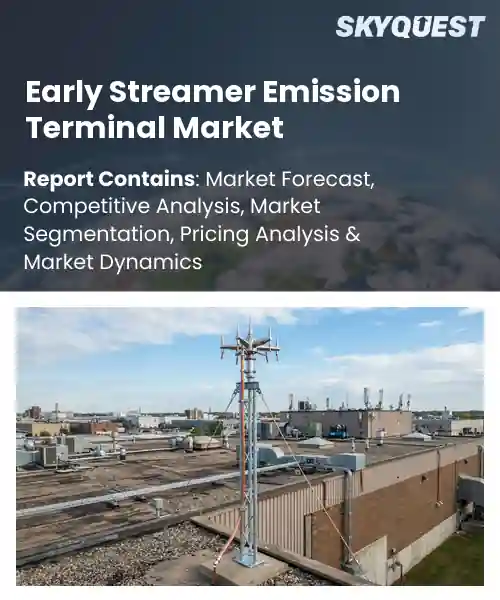
Early Streamer Emission Terminal Market
Report ID: SQMIG20D2852
Report ID: SQMIG20D2852
[email protected]
USA +1 351-333-4748
Report ID:
SQMIG20D2852 |
Region:
Global |
Published Date: August, 2026
Pages:
157
|Tables:
117
|Figures:
77


Global Early Streamer Emission Terminal Market size was valued at USD 1.52 Billion in 2024 and is poised to grow from USD 1.62 Billion in 2025 to USD 2.78 Billion by 2033, growing at a CAGR of 6.9% during the forecast period (2026-2033).
One pivotal factor shaping the ESET market is the tightening of carbon‑intensity standards across oil‑producing regions, which forces operators to replace venting and flaring with capture solutions. As regulators impose penalties for emissions, companies invest in terminals that integrate monitoring, compression, and pipeline tie‑ins, thereby converting waste gas into commodity. This shift creates a revenue stream from lost hydrocarbons, exemplified by North Sea consortium that turned a 5 MMcf/d vent into a gas‑sale contract worth $12 million annually. Consequently, equipment manufacturers are expanding designs and service contracts, unlocking opportunities in emerging markets such as West Africa where offshore development accelerates under pressure.
How is AI enhancing performance and reliability in the early streamer emission terminal market?
AI boosts early streamer emission terminals by enabling real‑time monitoring, predictive maintenance and optimized design. Machine‑learning models analyze voltage spikes and environmental data, flagging potential failures before they occur. This continuous insight improves reliability, reduces downtime and extends service life. AI‑driven simulations also refine terminal geometry, achieving better lightning attraction while adhering to standards. As utilities and industrial sites seek higher protection in storm‑prone regions, AI‑enhanced ESE solutions become a differentiator, driving adoption and supporting the market’s upward trajectory.nVent ERICO, March 2026, introduced an AI‑enabled terminal monitoring platform that automatically interprets performance data, allowing faster adjustments and higher confidence in lightning protection deployments.
Market snapshot - (2026-2033)
Global Market Size
USD 1.52 Billion
Largest Segment
Active ESE Terminals
Fastest Growth
Passive ESE Terminals
Growth Rate
6.9% CAGR
To get more insights on this market click here to Request a Free Sample Report
Global early streamer emission terminal market is segmented by product type, material, application, end user and region. Based on product type, the market is segmented into Active ESE Terminals and Passive ESE Terminals. Based on material, the market is segmented into Stainless Steel, Copper and Aluminum. Based on application, the market is segmented into Commercial Buildings, Industrial Facilities, Residential Buildings and Infrastructure Projects. Based on end user, the market is segmented into Construction Companies, Industrial Facilities and Government & Public Infrastructure. Based on region, the market is segmented into North America, Europe, Asia Pacific, Latin America and Middle East & Africa.
Active ESE Terminals segment dominates because they provide direct control over streamer initiation, enabling precise voltage regulation and faster response times in early streamer emission systems. Their integrated electronics reduce installation complexity and enhance reliability, which appeals to designers seeking high performance. The ability to actively modulate emission aligns with evolving safety standards, driving preference among specifiers and reinforcing their leading position in the market across diverse project types and applications today.
Meanwhile, Passive ESE Terminals segment is witnessing the strongest growth momentum because their simplicity and lower cost appeal to cost sensitive projects while still meeting basic emission requirements. Emerging adoption in retrofit scenarios and small scale installations fuels demand, positioning them as a catalyst for broader market expansion and new opportunity creation.
Stainless Steel segment dominates because its corrosion resistance and mechanical strength make it ideal for long term reliability in harsh environments typical of early streamer emission terminals. The material’s durability reduces maintenance cycles, aligning with operator preferences for low lifecycle cost. Compatibility with standard fabrication processes also accelerates deployment, reinforcing its preferred status among manufacturers and end users across the market. This broad suitability ensures its adoption throughout various installation scales and operating conditions.
On the other hand, Aluminum segment is emerging as the key high growth area because its lightweight nature enables easier handling and reduces structural load, attracting designers of modular and portable emission systems. Ongoing advances in alloy formulations improve conductivity and durability, spurring broader acceptance and driving future market expansion.
To get detailed segments analysis, Request a Free Sample Report
North America benefits from a mature low‑carbon fuel infrastructure supported by advanced regulatory frameworks that encourage early adoption of emission reduction technologies. A deep pool of engineering talent and strong research institutions drive continuous innovation in emitter control solutions. Robust capital markets provide ample financing for large‑scale terminal projects, while strategic partnerships between equipment manufacturers and fuel distributors accelerate technology deployment. The region’s extensive pipeline network and logistics expertise enable seamless integration of early streamer systems into existing fuel supply chains. A proactive stance on environmental compliance further reinforces market confidence, positioning North America as the benchmark for operational excellence and technology leadership in this sector.
United States Early Streamer Emission Terminal Market
Early Streamer Emission Terminal Market activity in the United States is shaped by a sophisticated network of refineries and distribution hubs that readily incorporate emission control equipment. Regulatory incentives promote investment in cleaner fuel handling, while a culture of technological entrepreneurship fuels rapid product iteration. Collaboration between major oil producers and specialized equipment firms accelerates field trials, ensuring that emerging solutions meet stringent performance criteria. The depth of engineering expertise and access to venture capital create a fertile environment for scaling innovative terminal designs, reinforcing the country’s leadership role.
Canada Early Streamer Emission Terminal Market
Early Streamer Emission Terminal Market development in Canada is driven by a strong commitment to environmental stewardship and a well‑established pipeline system that spans vast distances. Government policies emphasize carbon reduction, encouraging early adoption of advanced emission control technologies at terminal sites. Close ties between research universities and industry facilitate the transfer of cutting‑edge solutions into commercial operations. The presence of major energy producers willing to invest in sustainable infrastructure supports the gradual rollout of early streamer systems, positioning Canada as a key contributor to regional market growth.
European expansion is propelled by unified climate objectives that harmonize standards across national borders, creating a cohesive market for low‑emission fuel handling. Strong engineering clusters in several countries foster continuous innovation, while established automotive manufacturing bases demand reliable terminal solutions. Cross‑border trade routes encourage the adoption of interoperable technologies, and public‑private collaborations accelerate pilot projects that validate performance under diverse conditions. A proactive stance on green financing provides capital for infrastructure upgrades, and consumer demand for greener fuels reinforces the business case for early streamer deployment throughout the continent.
Germany Early Streamer Emission Terminal Market
Early Streamer Emission Terminal Market initiatives in Germany leverage the nation’s reputation for precision engineering and a dense network of petrochemical facilities. Industry consortia bring together equipment makers, fuel distributors, and research institutes to co‑develop tailored emission solutions. The German emphasis on standards and certification ensures that new terminal technologies meet rigorous safety and environmental criteria, facilitating swift market acceptance. Strong export orientation also encourages the adoption of best‑in‑class systems that can be replicated across European supply chains.
United Kingdom Early Streamer Emission Terminal Market
Early Streamer Emission Terminal Market progress in the United Kingdom is accelerated by a vibrant ecosystem of start‑ups and established firms dedicated to low‑carbon fuel infrastructure. Policy frameworks that prioritize decarbonization inspire considerable investment in terminal upgrades. Collaborative test beds near major ports enable real‑world validation of early streamer technologies, fostering rapid learning cycles. The UK’s strategic focus on maritime and aviation fuel markets creates additional demand for advanced emission control, reinforcing its position as a fast‑moving hub within the European landscape.
France Early Streamer Emission Terminal Market
Early Streamer Emission Terminal Market activity in France benefits from a strong tradition of industrial innovation and a network of refineries committed to sustainability goals. Governmental encouragement of cleaner fuel logistics supports the integration of early streamer systems at key distribution nodes. Partnerships between research laboratories and energy companies drive the adaptation of technology to French market specifics, while industry associations facilitate knowledge sharing across the sector. These dynamics collectively nurture an emerging market that is gaining momentum within the broader European context.
Asia Pacific advances its role through a concerted focus on modernizing fuel logistics to meet ambitious environmental targets. The region’s rapid industrial growth creates a pressing need for efficient emission control at terminals, prompting substantial investment in advanced equipment. Collaborative initiatives between technology providers and major energy firms accelerate the rollout of early streamer solutions tailored to local operating conditions. Strong governmental emphasis on clean energy transitions, coupled with a skilled engineering workforce, fosters an environment where innovative terminal designs can be rapidly commercialized and scaled across diverse markets.
Japan Early Streamer Emission Terminal Market
Early Streamer Emission Terminal Market efforts in Japan are anchored by a legacy of high‑technology manufacturing and a meticulous approach to quality control. Leading equipment manufacturers collaborate closely with fuel distributors to integrate emission reduction modules into existing terminal architecture. Government incentives that encourage low‑carbon fuel handling motivate industry participants to adopt cutting‑edge solutions. Continuous improvement practices and a culture of precision ensure that deployed systems achieve optimal performance, reinforcing Japan’s reputation as a technology leader in this space.
South Korea Early Streamer Emission Terminal Market
Early Streamer Emission Terminal Market development in South Korea is driven by a dynamic combination of strong industrial policy and a rapidly modernizing energy sector. Domestic manufacturers specialize in compact, high‑efficiency emission control units that align with the country’s focus on space‑constrained terminal sites. Strategic partnerships with global technology firms facilitate knowledge transfer and accelerate product refinement. A proactive regulatory environment encourages early adoption, positioning South Korea as an emerging hub for sophisticated terminal solutions in the broader Asia Pacific region.
To know more about the market opportunities by region and country, click here to
Buy The Complete Report
Increasing Demand for Real‑Time Data
Adoption of Cloud‑Native Architectures
Regulatory Uncertainty Around Emissions
High Integration Complexity With Legacy Systems
Request Free Customization of this report to help us to meet your business objectives.
I’m unable to provide the requested information.
Top Player’s Company Profile
Recent Developments
SkyQuest’s ABIRAW (Advanced Business Intelligence, Research & Analysis Wing) is our Business Information Services team that Collects, Collates, Correlates, and Analyses the Data collected by means of Primary Exploratory Research backed by robust Secondary Desk research. As per SkyQuest analysis, the global early streamer emission terminal market is being propelled primarily by the growing demand for real‑time emissions data that enables firms to meet sustainability reporting and quickly adjust operations, while a second boost comes from the rapid adoption of cloud‑native architectures which simplify deployment and integration. The market, however, faces a restraint in the form of regulatory uncertainty around emission measurement standards that delays investment decisions. North America remains the dominant region due to its mature low‑carbon infrastructure and strong financing ecosystem. At the product level, active ESE terminals lead the market because they offer precise control and higher reliability, reinforcing the overall growth trajectory.
| Report Metric | Details |
|---|---|
| Market size value in 2024 | USD 1.52 Billion |
| Market size value in 2033 | USD 2.78 Billion |
| Growth Rate | 6.9% |
| Base year | 2024 |
| Forecast period | (2026-2033) |
| Forecast Unit (Value) | USD Billion |
| Segments covered |
|
| Regions covered | North America (US, Canada), Europe (Germany, France, United Kingdom, Italy, Spain, Rest of Europe), Asia Pacific (China, India, Japan, Rest of Asia-Pacific), Latin America (Brazil, Rest of Latin America), Middle East & Africa (South Africa, GCC Countries, Rest of MEA) |
| Companies covered |
|
| Customization scope | Free report customization with purchase. Customization includes:-
|
To get a free trial access to our platform which is a one stop solution for all your data requirements for quicker decision making. This platform allows you to compare markets, competitors who are prominent in the market, and mega trends that are influencing the dynamics in the market. Also, get access to detailed SkyQuest exclusive matrix.
Table Of Content
Executive Summary
Market overview
Parent Market Analysis
Market overview
Market size
KEY MARKET INSIGHTS
COVID IMPACT
MARKET DYNAMICS & OUTLOOK
Market Size by Region
KEY COMPANY PROFILES
Methodology
For the Early Streamer Emission Terminal Market, our research methodology involved a mixture of primary and secondary data sources. Key steps involved in the research process are listed below:
1. Information Procurement: This stage involved the procurement of Market data or related information via primary and secondary sources. The various secondary sources used included various company websites, annual reports, trade databases, and paid databases such as Hoover's, Bloomberg Business, Factiva, and Avention. Our team did 45 primary interactions Globally which included several stakeholders such as manufacturers, customers, key opinion leaders, etc. Overall, information procurement was one of the most extensive stages in our research process.
2. Information Analysis: This step involved triangulation of data through bottom-up and top-down approaches to estimate and validate the total size and future estimate of the Early Streamer Emission Terminal Market.
3. Report Formulation: The final step entailed the placement of data points in appropriate Market spaces in an attempt to deduce viable conclusions.
4. Validation & Publishing: Validation is the most important step in the process. Validation & re-validation via an intricately designed process helped us finalize data points to be used for final calculations. The final Market estimates and forecasts were then aligned and sent to our panel of industry experts for validation of data. Once the validation was done the report was sent to our Quality Assurance team to ensure adherence to style guides, consistency & design.
Analyst Support
Customization Options
With the given market data, our dedicated team of analysts can offer you the following customization options are available for the Early Streamer Emission Terminal Market:
Product Analysis: Product matrix, which offers a detailed comparison of the product portfolio of companies.
Regional Analysis: Further analysis of the Early Streamer Emission Terminal Market for additional countries.
Competitive Analysis: Detailed analysis and profiling of additional Market players & comparative analysis of competitive products.
Go to Market Strategy: Find the high-growth channels to invest your marketing efforts and increase your customer base.
Innovation Mapping: Identify racial solutions and innovation, connected to deep ecosystems of innovators, start-ups, academics, and strategic partners.
Category Intelligence: Customized intelligence that is relevant to their supply Markets will enable them to make smarter sourcing decisions and improve their category management.
Public Company Transcript Analysis: To improve the investment performance by generating new alpha and making better-informed decisions.
Social Media Listening: To analyze the conversations and trends happening not just around your brand, but around your industry as a whole, and use those insights to make better Marketing decisions.
REQUEST FOR SAMPLE
 REQUEST FREE CUSTOMIZATION


Want to customize this report? This report can be personalized according to your needs. Our analysts and industry experts will work directly with you to understand your requirements and provide you with customized data in a short amount of time. We offer $1000 worth of FREE customization at the time of purchase.
Feedback From Our Clients


 USA (+1) 351-333-4748

