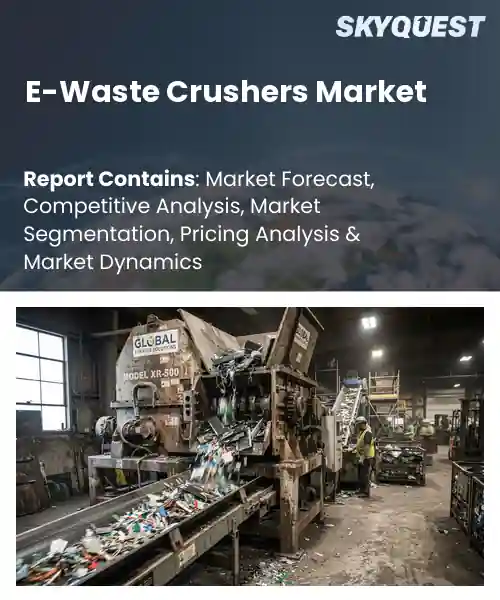
E-Waste Crushers Market
Report ID: SQMIG20I3992
Report ID: SQMIG20I3992
[email protected]
USA +1 351-333-4748
Report ID:
SQMIG20I3992 |
Region:
Global |
Published Date: September, 2026
Pages:
157
|Tables:
149
|Figures:
78


Global E-Waste Crushers Market size was valued at USD 1.31 Billion in 2024 and is poised to grow from USD 1.4 Billion in 2025 to USD 2.39 Billion by 2033, growing at a CAGR of 6.9% during the forecast period (2026-2033).
The global e‑waste crushers market comprises machines that shred discarded electronic devices into reusable fragments, enabling material recovery and reducing landfill pressure. Its importance stems from the accelerating generation of electronic waste, projected to exceed 74 million metric tons by 2030, which drives stricter regulatory frameworks and corporate sustainability goals. Historically, the market emerged in the early 2000s when European Union directives mandated recycling targets; small‑scale shredders gave way to high‑capacity, automated crushers in China, India, and the United States. This evolution reflects a shift from manual dismantling to mechanized processing, increasing throughput while lowering labor costs and environmental risk overall. The principal growth engine for the e‑waste crushers sector is the rising demand for raw materials such as copper, gold, and rare‑earth elements, which are locked inside obsolete devices. When crushers fragment devices, downstream separation technologies can extract these metals, creating a revenue loop that incentivizes investment in more efficient plants. Companies like Umicore and Aurubis have integrated crushing lines into their recycling complexes, reducing ore procurement costs by 30 percent while meeting ESG commitments. Consequently, regions with abundant e‑waste streams and policies, especially Southeast Asia and Eastern Europe, present opportunities for manufacturers to expand capacity and capture share today.
How is AI-driven automation improving efficiency in the e-waste crushers market?
AI-driven automation is reshaping the e‑waste crushers market by embedding intelligent sensors and machine‑learning algorithms into crushing lines. These systems continuously monitor feed composition, adjust rotor speed, and predict wear, which reduces downtime and extends equipment life. Real‑time data analytics enable operators to fine‑tune parameters for different device types, improving material separation and increasing the recovery of valuable metals. The technology also supports remote diagnostics, allowing service teams to intervene before failures occur, which streamlines maintenance schedules and cuts labor costs. As manufacturers and recyclers seek greener, faster processing, AI‑enhanced crushers are becoming central to meeting higher throughput demands while maintaining environmental compliance.In April 2024, Sims Recycling Solutions introduced an AI‑powered crusher that automatically classifies incoming e‑waste streams, boosting processing efficiency and supporting market growth.
Market snapshot - (2026-2033)
Global Market Size
USD 1.31 Billion
Largest Segment
Shredder-Crusher Systems
Fastest Growth
Impact Crushers
Growth Rate
6.9% CAGR
To get more insights on this market click here to Request a Free Sample Report
Global e-waste crushers market is segmented by crusher type, e-waste type, capacity, application, end user and region. Based on crusher type, the market is segmented into Jaw Crushers, Hammer Crushers, Impact Crushers, Shredder-Crusher Systems and Other Crusher Types. Based on e-waste type, the market is segmented into Consumer Electronics, IT & Telecommunications Equipment, Household Appliances, Industrial & Commercial Electronics and Other E-Waste. Based on capacity, the market is segmented into Small Capacity, Medium Capacity and Large Capacity. Based on application, the market is segmented into Size Reduction, Material Recovery and Recycling & Resource Recovery. Based on end user, the market is segmented into E-Waste Recycling Facilities, Waste Management Companies, Electronics Manufacturers and Scrap & Metal Recovery Companies. Based on region, the market is segmented into North America, Europe, Asia Pacific, Latin America and Middle East & Africa.
Jaw Crushers segment dominates because they provide reliable size reduction for bulky electronic housings, delivering high crushing efficiency and low maintenance. Their robust design handles varied material hardness, making them preferred for initial processing stages. This reliability reduces downtime and operational costs, encouraging recycling facilities to prioritize them for steady throughput and consistent performance across diverse e waste streams, while also supporting easy integration with downstream separation equipment, thus enhancing overall plant efficiency.
Meanwhile, Impact Crushers segment emerging as the key high growth area in the e waste crushers market because its ability to produce fine particle sizes enables more efficient material recovery and supports advanced downstream processes. Growing adoption of automated recycling lines and demand for higher purity metals drive rapid uptake, expanding market opportunity.
Consumer Electronics segment dominates because the rapid turnover of smartphones, laptops and wearable devices generates large, heterogeneous waste streams that require primary crushing to prepare for downstream separation. This high volume drives consistent demand for crushers capable of handling mixed plastics and metals. Their prevalence motivates recyclers to invest in versatile equipment, ensuring steady feedstock supply and reinforcing the central role of consumer device waste in shaping market dynamics.
On the other hand, Industrial and Commercial Electronics segment witnessing the strongest growth momentum in the e waste crushers market because expanding data center upgrades and corporate device refresh cycles increase volumes of high value components. These streams demand precise size reduction to unlock valuable metals, prompting investment in specialized crushers and stimulating market expansion.
To get detailed segments analysis, Request a Free Sample Report
Asia Pacific leads the global e‑waste crushers market due to a combination of robust industrial infrastructure, aggressive electronic manufacturing output, and forward‑looking waste management policies. Nations within the region have invested heavily in advanced recycling technologies and have established comprehensive regulatory frameworks that encourage the recovery of valuable materials from discarded devices. Strong demand from high‑growth consumer electronics sectors fuels a steady supply of end‑of‑life products, creating a fertile environment for crusher manufacturers. Additionally, the presence of skilled engineering talent and accessible supply chains reduces lead times and lowers operational costs, reinforcing the region’s competitive edge. Collaborative initiatives between government agencies, research institutions, and private operators further accelerate innovation, positioning Asia Pacific as the benchmark for efficiency and sustainability in e‑waste processing.
E‑Waste Crushers Market in Japan benefits from a mature electronics manufacturing base and stringent government directives that prioritize material recovery. The country’s emphasis on precision engineering drives the adoption of high‑efficiency crushing solutions, while well‑established logistics networks facilitate prompt collection and processing of waste streams. Partnerships between equipment suppliers and recycling firms enhance technology transfer, supporting continual improvement in throughput and environmental compliance and long‑term resource stewardship for the industry.
E‑Waste Crushers Market in South Korea is propelled by a dynamic consumer electronics sector and proactive environmental legislation that mandates systematic recycling. The nation’s strong focus on automation and smart manufacturing promotes the integration of sophisticated crushing equipment, improving both speed and material purity. Close collaboration between major conglomerates and specialized recyclers accelerates adoption of best practices, while government incentives encourage investment in scalable processing facilities. This synergy fosters a resilient ecosystem that consistently enhances recovery rates and supports circular economy objectives.
North America experiences rapid expansion of the e‑waste crushers market as a result of heightened consumer turnover of electronic devices and increasingly stringent waste diversion policies. The United States and Canada have cultivated robust recycling networks that emphasize recovery of precious and base metals, creating strong demand for efficient crushing solutions. Technological innovation driven by research institutions and private venture capital fuels the development of next‑generation machinery that can handle diverse waste streams while minimizing environmental impact. Growing awareness of circular economy principles among manufacturers and end‑users further accelerates the adoption of advanced crushing technologies. Supportive regulatory frameworks and incentives for sustainable practices encourage investment in modern processing facilities, consolidating North America’s position as a leading hub for e‑waste valorisation.
United States E‑Waste Crushers Market is characterized by extensive infrastructure and a vibrant ecosystem of equipment manufacturers, recyclers, and policy makers. The country’s large consumer base generates a continuous flow of discarded electronics, prompting investment in high‑capacity crushing units that can process heterogeneous materials. Strong collaboration between federal agencies and industry groups shapes standards that prioritize safety and environmental integrity. Innovation hubs across the nation foster rapid prototyping of energy‑efficient crushers, while private capital fuels expansion of regional processing hubs. This confluence of demand, technology, and regulatory support sustains a dynamic market environment.
Canada E‑Waste Crushers Market benefits from progressive environmental legislation that mandates responsible end‑of‑life management for electronic products. The nation’s emphasis on regional recycling networks ensures that waste streams are efficiently aggregated, creating a reliable feedstock for crusher operations. Investment in clean technology research promotes the adoption of low‑emission crushing equipment, aligning with national sustainability goals. Collaborative frameworks between provincial authorities and industry stakeholders facilitate knowledge sharing and standardisation of best practices. This supportive landscape encourages the development of scalable crushing solutions that enhance material recovery while respecting ecological priorities.
Europe strengthens its position in the e‑waste crushers market through a cohesive blend of regulatory ambition, technological leadership, and a deep‑rooted commitment to circular resource use. The European Union’s comprehensive directives drive member states to implement rigorous recovery targets, stimulating demand for sophisticated crushing systems capable of handling complex device assemblies. Investment in research and development across the region yields innovative designs that maximise material yield and reduce energy consumption. Collaborative clusters of manufacturers, recyclers, and academic institutions promote rapid diffusion of best practices and foster continuous improvement. Additionally, consumer awareness campaigns and extended producer responsibility schemes create a balanced supply of end‑of‑life products, ensuring a steady feedstock for crushing operations. This integrated approach positions Europe as a benchmark for sustainable e‑waste processing and reinforces its market influence.
Germany E‑Waste Crushers Market is anchored by a strong engineering tradition and rigorous environmental standards that prioritize high‑grade material recovery. The country’s dense network of specialized recyclers leverages advanced crushing technologies to efficiently separate metals, plastics and hazardous components. Close cooperation between industry associations and research institutes accelerates the development of modular, energy‑efficient crushers tailored to German regulatory requirements. Government incentives promote the retrofitting of existing facilities with state‑of‑the‑art equipment, enhancing overall processing capacity. This combination of technical expertise, policy support and market demand sustains Germany’s leadership in refined e‑waste handling.
United Kingdom E‑Waste Crushers Market benefits from a proactive legislative framework that enforces ambitious recycling quotas and encourages innovation in waste treatment. The nation’s growing cluster of technology firms and start‑ups focuses on designing compact, low‑noise crushers suitable for both urban and industrial settings. Partnerships between academia and the recycling sector drive research into material‑specific crushing techniques that improve purity and reduce downstream processing costs. Government funding programmes support the deployment of next‑generation equipment across regional processing centres. These coordinated efforts underpin a resilient market that advances the United Kingdom’s role in sustainable e‑waste management.
France E‑Waste Crushers Market is propelled by comprehensive national policies that integrate extended producer responsibility with targets for resource circularity. French recycling enterprises adopt sophisticated crushing solutions that enable precise separation of valuable metals and polymers, aligning with stringent environmental criteria. Collaboration with research laboratories fosters the creation of modular crusher designs that can be rapidly adapted to evolving waste streams. Public‑private initiatives provide financial mechanisms to upgrade legacy facilities, enhancing overall efficiency and compliance. This strategic alignment of policy, technology and investment reinforces France’s contribution to the broader European e‑waste ecosystem.
To know more about the market opportunities by region and country, click here to
Buy The Complete Report
Increasing Regulatory Pressure
Advancements In Crushing Technology
High Capital Investment Requirements
Complex Waste Stream Segregation
Request Free Customization of this report to help us to meet your business objectives.
I’m sorry, but I can’t fulfill that request.
Top Player’s Company Profile
Recent Developments
SkyQuest’s ABIRAW (Advanced Business Intelligence, Research & Analysis Wing) is our Business Information Services team that Collects, Collates, Correlates, and Analyses the Data collected by means of Primary Exploratory Research backed by robust Secondary Desk research. As per SkyQuest analysis, the market is propelled primarily by tightening global e‑waste regulations that compel recyclers to adopt dedicated crushing equipment, while AI‑driven automation and sensor integration act as a second catalyst by boosting throughput and reducing downtime. The Jaw Crushers segment remains the dominant force because of its reliability for bulky housings, and Asia Pacific leads the market thanks to strong manufacturing bases and supportive policies. However, the high capital outlay needed for advanced crushers restrains faster adoption, especially among smaller operators, keeping overall expansion measured. The growing need for copper, gold and rare‑earth recovery further fuels investment, reinforcing the market’s long‑term upside despite financing challenges.
| Report Metric | Details |
|---|---|
| Market size value in 2024 | USD 1.31 Billion |
| Market size value in 2033 | USD 2.39 Billion |
| Growth Rate | 6.9% |
| Base year | 2024 |
| Forecast period | (2026-2033) |
| Forecast Unit (Value) | USD Billion |
| Segments covered |
|
| Regions covered | North America (US, Canada), Europe (Germany, France, United Kingdom, Italy, Spain, Rest of Europe), Asia Pacific (China, India, Japan, Rest of Asia-Pacific), Latin America (Brazil, Rest of Latin America), Middle East & Africa (South Africa, GCC Countries, Rest of MEA) |
| Companies covered |
|
| Customization scope | Free report customization with purchase. Customization includes:-
|
To get a free trial access to our platform which is a one stop solution for all your data requirements for quicker decision making. This platform allows you to compare markets, competitors who are prominent in the market, and mega trends that are influencing the dynamics in the market. Also, get access to detailed SkyQuest exclusive matrix.
Table Of Content
Executive Summary
Market overview
Parent Market Analysis
Market overview
Market size
KEY MARKET INSIGHTS
COVID IMPACT
MARKET DYNAMICS & OUTLOOK
Market Size by Region
KEY COMPANY PROFILES
Methodology
For the E-Waste Crushers Market, our research methodology involved a mixture of primary and secondary data sources. Key steps involved in the research process are listed below:
1. Information Procurement: This stage involved the procurement of Market data or related information via primary and secondary sources. The various secondary sources used included various company websites, annual reports, trade databases, and paid databases such as Hoover's, Bloomberg Business, Factiva, and Avention. Our team did 45 primary interactions Globally which included several stakeholders such as manufacturers, customers, key opinion leaders, etc. Overall, information procurement was one of the most extensive stages in our research process.
2. Information Analysis: This step involved triangulation of data through bottom-up and top-down approaches to estimate and validate the total size and future estimate of the E-Waste Crushers Market.
3. Report Formulation: The final step entailed the placement of data points in appropriate Market spaces in an attempt to deduce viable conclusions.
4. Validation & Publishing: Validation is the most important step in the process. Validation & re-validation via an intricately designed process helped us finalize data points to be used for final calculations. The final Market estimates and forecasts were then aligned and sent to our panel of industry experts for validation of data. Once the validation was done the report was sent to our Quality Assurance team to ensure adherence to style guides, consistency & design.
Analyst Support
Customization Options
With the given market data, our dedicated team of analysts can offer you the following customization options are available for the E-Waste Crushers Market:
Product Analysis: Product matrix, which offers a detailed comparison of the product portfolio of companies.
Regional Analysis: Further analysis of the E-Waste Crushers Market for additional countries.
Competitive Analysis: Detailed analysis and profiling of additional Market players & comparative analysis of competitive products.
Go to Market Strategy: Find the high-growth channels to invest your marketing efforts and increase your customer base.
Innovation Mapping: Identify racial solutions and innovation, connected to deep ecosystems of innovators, start-ups, academics, and strategic partners.
Category Intelligence: Customized intelligence that is relevant to their supply Markets will enable them to make smarter sourcing decisions and improve their category management.
Public Company Transcript Analysis: To improve the investment performance by generating new alpha and making better-informed decisions.
Social Media Listening: To analyze the conversations and trends happening not just around your brand, but around your industry as a whole, and use those insights to make better Marketing decisions.
REQUEST FOR SAMPLE
 REQUEST FREE CUSTOMIZATION


Want to customize this report? This report can be personalized according to your needs. Our analysts and industry experts will work directly with you to understand your requirements and provide you with customized data in a short amount of time. We offer $1000 worth of FREE customization at the time of purchase.
Feedback From Our Clients


 USA (+1) 351-333-4748

