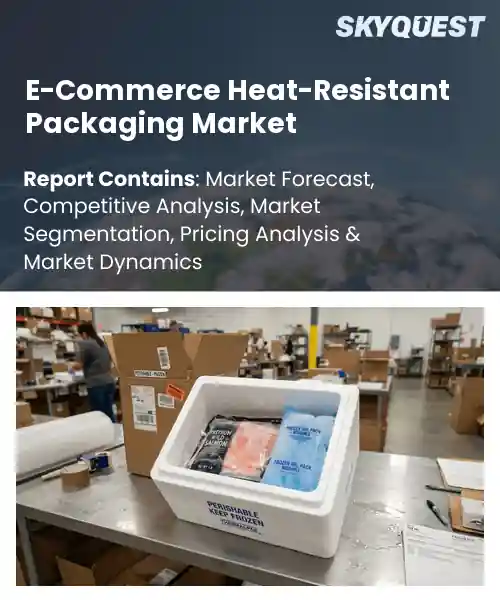
E-Commerce Heat-Resistant Packaging Market
Report ID: SQMIG15H2326
Report ID: SQMIG15H2326
[email protected]
USA +1 351-333-4748
Report ID:
SQMIG15H2326 |
Region:
Global |
Published Date: September, 2026
Pages:
157
|Tables:
124
|Figures:
77


Global E-Commerce Heat-Resistant Packaging Market size was valued at USD 1.48 Billion in 2024 and is poised to grow from USD 1.57 Billion in 2025 to USD 2.55 Billion by 2033, growing at a CAGR of 6.2% during the forecast period (2026-2033).
The global e‑commerce heat‑resistant packaging market comprises specialized containers, films and sleeves designed to protect temperature‑sensitive products such as frozen meals, cosmetics and pharmaceuticals during online shipment. Its relevance stems from the surge in direct‑to‑consumer sales of perishable goods, where any thermal breach can trigger spoilage, brand damage and costly returns. Historically, the sector lagged behind conventional packaging until 2015, when major retailers piloted insulated mailers for grocery deliveries, prompting manufacturers to invest in recyclable foam alternatives and smart temperature‑tracking labels. These early adopters demonstrated that preserving product integrity directly fuels customer loyalty, establishing a clear growth trajectory for the market globally. Regulatory pressure and rising consumer expectations for sustainable, temperature‑controlled packaging form a second major catalyst for market growth. When governments tighten carbon‑footprint limits, e‑commerce giants such as Amazon and Walmart collaborate with polymer developers to substitute traditional EPS with biodegradable aerogels, cutting package weight by roughly 15 % while preserving thermal protection. The lighter parcels reduce freight expenses, allowing retailers to extend free‑delivery thresholds that boost average order values. This creates a feedback loop: compliance drives material innovation, innovation lowers logistics costs, and reduced costs entice additional sellers, thereby expanding demand for advanced heat‑resistant packaging across multiple regional markets worldwide globally.
How is AI-driven automation reshaping e‑commerce heat‑resistant packaging design and logistics?
AI‑driven automation is reshaping heat‑resistant packaging for e‑commerce by linking design, material science and logistics in a single digital loop. Machine‑learning models evaluate thermal performance of polymers, foams and composites, allowing engineers to generate lightweight structures that still protect hot meals during last‑mile delivery. At the same time, AI forecasts order spikes and matches packaging output to carrier capacity, reducing waste and speeding fulfillment. Real‑time sensors feed temperature data back to the system, prompting on‑the‑fly adjustments to insulation thickness. The result is a faster, greener supply chain that meets consumer expectations for safe, hot‑ready meals while keeping costs in check.Sealed Air announced an AI‑optimized heat‑resistant packaging line in June 2023, integrating predictive modeling with robotic assembly to cut changeover time and improve thermal consistency. The rollout demonstrates how intelligent automation can boost throughput and support the growing demand for hot‑food e‑commerce across multiple distribution hubs throughout the supply chain.
Market snapshot - (2026-2033)
Global Market Size
USD 1.48 Billion
Largest Segment
Boxes
Fastest Growth
Pouches
Growth Rate
6.2% CAGR
To get more insights on this market click here to Request a Free Sample Report
Global e-commerce heat-resistant packaging market is segmented by packaging type, material, temperature resistance, application and region. Based on packaging type, the market is segmented into Boxes, Pouches, Mailers, Trays, Containers and Others. Based on material, the market is segmented into Paper & Paperboard, Plastic, Aluminum, Glass and Others. Based on temperature resistance, the market is segmented into Up to 100°C, 101–200°C and Above 200°C. Based on application, the market is segmented into Food & Beverage, Electronics, Chemicals, Pharmaceuticals and Others. Based on region, the market is segmented into North America, Europe, Asia Pacific, Latin America and Middle East & Africa.
Boxes segment dominates because e‑commerce retailers prioritize structural integrity and stackability for high‑temperature shipments, ensuring products remain protected during transit and storage. The rigid form factor of boxes accommodates insulation layers and sealing mechanisms, which align with stringent thermal performance standards. Moreover, the widespread familiarity of box handling across logistics networks reduces operational friction, reinforcing its preference among manufacturers seeking reliable heat‑resistant solutions for both applications in the market today.
However, pouches segment emerges as the most rapidly expanding area in the e‑commerce heat‑resistant packaging market. Their flexible architecture enables lightweight, space‑efficient designs that lower shipping costs while maintaining thermal barriers, attracting brands focused on sustainable and cost‑effective solutions. This innovation fuels new product formats and drives broader market adoption.
Plastic segment dominates because its inherent versatility allows manufacturers to mold heat‑resistant barriers that conform to diverse product shapes while preserving durability during high‑temperature e‑commerce deliveries. The material’s resistance to moisture and impact complements thermal performance, simplifying integration with existing packaging lines. Additionally, cost‑effective processing and recyclability incentives reinforce its widespread adoption across multiple product categories seeking reliable temperature protection in the global supply chain for retailers today overall.
On the other hand, aluminum segment is witnessing the strongest growth momentum in the e‑commerce heat‑resistant packaging market. Its high thermal conductivity paired with barrier properties creates containers that meet strict temperature requirements while cutting weight. This draws premium food, pharmaceutical and electronics shipments, expanding market opportunities and spurring innovation.
To get detailed segments analysis, Request a Free Sample Report
North America benefits from a highly integrated supply chain network that prioritizes speed, reliability, and innovation in product handling. Consumer expectations for rapid delivery of temperature‑sensitive goods have driven retailers and logistics providers to adopt sophisticated heat‑resistant packaging solutions. Strong collaboration between packaging manufacturers, e‑commerce platforms, and technology firms accelerates material advancements and custom‑fit designs. Regulatory environments encourage sustainability and safety standards, reinforcing market confidence. The region’s emphasis on digital commerce ecosystems and proactive investment in research and development positions it as the benchmark for performance and resilience in heat‑sensitive e‑commerce shipping.
E-Commerce Heat-Resistant Packaging Market in the United States is shaped by a large scale of online retail activity and a diverse climate that demands robust thermal protection. Leading packaging innovators collaborate closely with major e‑commerce carriers to create solutions that combine durability with environmental considerations. Consumer focus on product integrity encourages continuous refinement of materials, while supply‑chain agility supports rapid adoption of new packaging formats across multiple product categories.
E-Commerce Heat-Resistant Packaging Market in Canada reflects a strong commitment to safety and sustainability amid challenging temperature variations. Retailers emphasize reliable thermal barriers to maintain product quality during long‑distance shipments across vast geographies. Collaborative initiatives between packaging firms and government agencies promote the use of recyclable heat‑resistant materials. The market’s growth is further supported by consumer awareness of packaging performance and a proactive approach to integrating innovative design features.
Europe’s rapid expansion is fueled by stringent regulatory frameworks that prioritize consumer safety and environmental stewardship, prompting widespread adoption of advanced heat‑resistant packaging. A sophisticated e‑commerce infrastructure, combined with high consumer expectations for product freshness, encourages retailers to invest in reliable thermal solutions. Cross‑border trade within the region amplifies demand for standardized, high‑performance packaging that can withstand diverse climatic conditions. Collaborative research clusters and a strong focus on circular economy principles drive material innovation, while sustainability commitments from leading brands reinforce market momentum across multiple sectors.
E-Commerce Heat-Resistant Packaging Market in Germany is anchored by a robust manufacturing base that excels in engineering precision and material science. Industry leaders work closely with e‑commerce platforms to develop packaging that balances thermal protection with recyclability. Consumer demand for consistent product quality and strict compliance with environmental regulations motivates continuous improvement of packaging designs, fostering a competitive landscape that emphasizes both performance and sustainability.
E-Commerce Heat-Resistant Packaging Market in the United Kingdom is propelled by a dynamic online retail sector that places premium value on rapid, temperature‑controlled deliveries. Retailers partner with innovative packaging providers to ensure product integrity across short‑ and long‑haul logistics. Growing consumer awareness of packaging waste drives the adoption of reusable and recyclable heat‑resistant solutions, while regulatory encouragement of sustainable practices accelerates market uptake and product diversification.
E-Commerce Heat-Resistant Packaging Market in France is emerging through a blend of governmental incentives and rising consumer expectations for high‑quality, temperature‑stable goods. Companies focus on integrating eco‑friendly heat‑resistant materials that align with national sustainability goals. Collaborative efforts between research institutions and packaging firms nurture the development of lightweight yet effective thermal solutions, supporting the expansion of e‑commerce channels across diverse product categories.
Asia Pacific is strengthening its position by leveraging rapid digital adoption and expanding logistics networks that cater to a broad spectrum of climates. The region’s emphasis on innovation encourages the development of heat‑resistant packaging that meets both performance and sustainability criteria. Strategic investments in material research and close collaboration between e‑commerce giants and packaging manufacturers accelerate the rollout of advanced thermal solutions. Additionally, consumer focus on product freshness and safety drives market participants to prioritize packaging that safeguards quality across long‑distance, high‑volume shipments.
E-Commerce Heat-Resistant Packaging Market in Japan benefits from a culture of precision engineering and a mature e‑commerce ecosystem that demands consistent product integrity. Leading packaging firms integrate cutting‑edge thermal technologies with recyclable materials to meet consumer expectations for safety and environmental responsibility. Strong partnerships between logistics providers and manufacturers streamline the adoption of heat‑resistant solutions across a wide range of product segments.
E-Commerce Heat-Resistant Packaging Market in South Korea is driven by a tech‑savvy consumer base and a highly efficient delivery infrastructure. Retailers prioritize packaging that ensures temperature stability while aligning with sustainability initiatives. Collaborative research between academic institutions and industry players fosters the creation of innovative, lightweight heat‑resistant materials, supporting the rapid growth of online sales and the need for reliable, eco‑friendly packaging solutions.
To know more about the market opportunities by region and country, click here to
Buy The Complete Report
Increasing Demand for Sustainable Shipping
Regulatory Push for Heat Safety
High Cost of Specialized Materials
Limited Supplier Base for Advanced Polymers
Request Free Customization of this report to help us to meet your business objectives.
I’m sorry, but I can’t fulfill that request.
Top Player’s Company Profile
Recent Developments
SkyQuest’s ABIRAW (Advanced Business Intelligence, Research & Analysis Wing) is our Business Information Services team that Collects, Collates, Correlates, and Analyses the Data collected by means of Primary Exploratory Research backed by robust Secondary Desk research. As per SkyQuest analysis, the global e‑commerce heat‑resistant packaging market is being propelled primarily by the rising demand for sustainable shipping, as retailers seek recyclable or bio‑based solutions that protect temperature‑sensitive goods while meeting consumer eco‑preferences. A secondary catalyst is the tightening of heat‑safety regulations worldwide, which forces firms to integrate insulated barriers and advanced polymers to avoid liability and maintain product integrity. North America remains the dominant region, benefitting from an integrated supply chain and strong retailer investment. The boxes segment leads the market because its rigidity and stackability meet the stringent thermal performance standards required for high‑temperature shipments. However, the high cost of specialized materials restrains broader adoption, especially among cost‑sensitive e‑commerce players.
| Report Metric | Details |
|---|---|
| Market size value in 2024 | USD 1.48 Billion |
| Market size value in 2033 | USD 2.55 Billion |
| Growth Rate | 6.2% |
| Base year | 2024 |
| Forecast period | (2026-2033) |
| Forecast Unit (Value) | USD Billion |
| Segments covered |
|
| Regions covered | North America (US, Canada), Europe (Germany, France, United Kingdom, Italy, Spain, Rest of Europe), Asia Pacific (China, India, Japan, Rest of Asia-Pacific), Latin America (Brazil, Rest of Latin America), Middle East & Africa (South Africa, GCC Countries, Rest of MEA) |
| Companies covered |
|
| Customization scope | Free report customization with purchase. Customization includes:-
|
To get a free trial access to our platform which is a one stop solution for all your data requirements for quicker decision making. This platform allows you to compare markets, competitors who are prominent in the market, and mega trends that are influencing the dynamics in the market. Also, get access to detailed SkyQuest exclusive matrix.
Table Of Content
Executive Summary
Market overview
Parent Market Analysis
Market overview
Market size
KEY MARKET INSIGHTS
COVID IMPACT
MARKET DYNAMICS & OUTLOOK
Market Size by Region
KEY COMPANY PROFILES
Methodology
For the E-Commerce Heat-Resistant Packaging Market, our research methodology involved a mixture of primary and secondary data sources. Key steps involved in the research process are listed below:
1. Information Procurement: This stage involved the procurement of Market data or related information via primary and secondary sources. The various secondary sources used included various company websites, annual reports, trade databases, and paid databases such as Hoover's, Bloomberg Business, Factiva, and Avention. Our team did 45 primary interactions Globally which included several stakeholders such as manufacturers, customers, key opinion leaders, etc. Overall, information procurement was one of the most extensive stages in our research process.
2. Information Analysis: This step involved triangulation of data through bottom-up and top-down approaches to estimate and validate the total size and future estimate of the E-Commerce Heat-Resistant Packaging Market.
3. Report Formulation: The final step entailed the placement of data points in appropriate Market spaces in an attempt to deduce viable conclusions.
4. Validation & Publishing: Validation is the most important step in the process. Validation & re-validation via an intricately designed process helped us finalize data points to be used for final calculations. The final Market estimates and forecasts were then aligned and sent to our panel of industry experts for validation of data. Once the validation was done the report was sent to our Quality Assurance team to ensure adherence to style guides, consistency & design.
Analyst Support
Customization Options
With the given market data, our dedicated team of analysts can offer you the following customization options are available for the E-Commerce Heat-Resistant Packaging Market:
Product Analysis: Product matrix, which offers a detailed comparison of the product portfolio of companies.
Regional Analysis: Further analysis of the E-Commerce Heat-Resistant Packaging Market for additional countries.
Competitive Analysis: Detailed analysis and profiling of additional Market players & comparative analysis of competitive products.
Go to Market Strategy: Find the high-growth channels to invest your marketing efforts and increase your customer base.
Innovation Mapping: Identify racial solutions and innovation, connected to deep ecosystems of innovators, start-ups, academics, and strategic partners.
Category Intelligence: Customized intelligence that is relevant to their supply Markets will enable them to make smarter sourcing decisions and improve their category management.
Public Company Transcript Analysis: To improve the investment performance by generating new alpha and making better-informed decisions.
Social Media Listening: To analyze the conversations and trends happening not just around your brand, but around your industry as a whole, and use those insights to make better Marketing decisions.
REQUEST FOR SAMPLE
 REQUEST FREE CUSTOMIZATION


Want to customize this report? This report can be personalized according to your needs. Our analysts and industry experts will work directly with you to understand your requirements and provide you with customized data in a short amount of time. We offer $1000 worth of FREE customization at the time of purchase.
Feedback From Our Clients


 USA (+1) 351-333-4748

