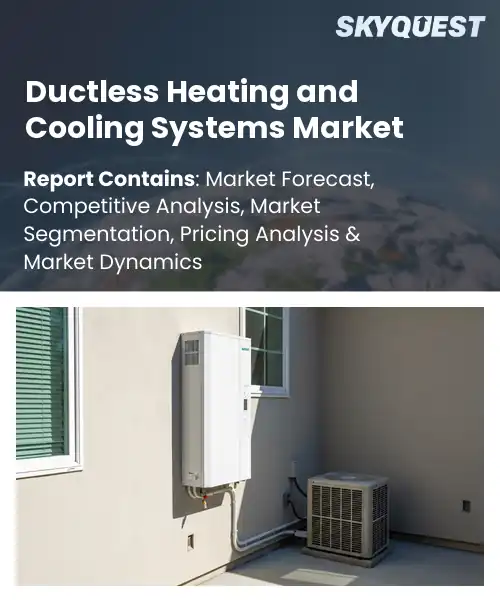
Ductless Heating and Cooling Systems Market
Report ID: SQMIG20I3183
Report ID: SQMIG20I3183
[email protected]
USA +1 351-333-4748
Report ID:
SQMIG20I3183 |
Region:
Global |
Published Date: June, 2026
Pages:
157
|Tables:
143
|Figures:
78


Global Ductless Heating And Cooling Systems Market size was valued at USD 28.52 Billion in 2024 and is poised to grow from USD 30.55 Billion in 2025 to USD 52.85 Billion by 2033, growing at a CAGR of 7.12% during the forecast period (2026-2033).
The ductless heating and cooling systems market comprises indoor units linked to an outdoor compressor, delivering zonal temperature control without ductwork. Its significance stems from rising urban density, stricter regulations, and consumer preference for flexible installations in retrofits and builds. Historically, the sector emerged in the early 2000s as a niche alternative to conventional HVAC, but accelerated adoption occurred after the 2010‑2015 energy‑price spikes that highlighted cost savings. For instance, a complex in Chicago reported a 30 percent reduction in utility bills after replacing a furnace with ductless mini‑splits, illustrating how cost pressures and sustainability goals have propelled market expansion.
The push toward decarbonization stands out as the key trend driving the global ductless heating and cooling sector because it directly links policy incentives to product adoption. Governments in Europe and North America have introduced rebates and zero‑emission building codes that lower upfront costs, prompting developers to specify mini‑splits in commercial projects such as data‑center cooling pods. This regulatory encouragement creates a feedback loop: reduced capital barriers increase installations, which generate performance data that validates energy‑saving claims and attracts investment from utilities seeking demand‑response partnerships. As a result, manufacturers are expanding modular lines to serve emerging off‑grid residential clusters, unlocking new revenue streams while advancing climate‑action goals.
What Role does AI Play in Optimizing Ductless Heating and Cooling System Performance?
Artificial intelligence is reshaping how ductless heating and cooling units operate by turning static equipment into responsive systems. Machine learning models analyze sensor streams such as temperature, humidity and occupancy to predict demand and adjust compressor speed before a room feels uncomfortable. Real time control reduces cycling, improves comfort and cuts waste while remote dashboards let installers fine tune settings without a site visit. Integration with voice assistants and smart thermostats creates a seamless user experience that matches the growing preference for connected homes. As the market seeks higher efficiency and lower carbon footprints, AI provides the intelligence needed to meet those expectations.
In December 2025, Bisschops Industries announced an AI enabled controller for ductless units that learns usage patterns and optimizes energy flow, helping the market expand by delivering smarter, more efficient installations. This development showcases how AI can drive performance gains and supports broader adoption across residential and commercial projects.
Market snapshot - (2026-2033)
Global Market Size
USD 28.52 Billion
Largest Segment
Single-Zone Mini-Split
Fastest Growth
Multi-Zone Mini-Split
Growth Rate
7.12% CAGR
To get more insights on this market click here to Request a Free Sample Report
Global ductless heating and cooling systems market is segmented by type, technology, application, refrigerant, distribution and region. Based on type, the market is segmented into single-zone mini-split, multi-zone mini-split and ceiling cassette. Based on technology, the market is segmented into inverter-driven and fixed speed. Based on application, the market is segmented into residential, commercial and industrial. Based on refrigerant, the market is segmented into R-32, R-410A and R-22 (phased out). Based on distribution, the market is segmented into HVAC contractors, online and retail. Based on region, the market is segmented into North America, Europe, Asia Pacific, Latin America and Middle East & Africa.
Based on the global ductless heating and cooling market growth, single-zone mini-split segment dominates because its compact design offers straightforward installation for individual rooms, meeting the demand for precise temperature control without extensive ductwork. Homeowners favor its affordability and quick return on investment, while contractors appreciate the ease of service and minimal disruption. This combination of user‑centric benefits and low entry barriers drives widespread preference, positioning it as the primary choice across residential ductless heating and cooling deployments.
However, multi-zone mini-split segment emerges as the most rapidly expanding area, leveraging its ability to serve multiple rooms from a single outdoor unit. Growing interest in space‑saving solutions and integrated smart controls fuels adoption in larger homes and retrofit projects, accelerating market breadth and creating new opportunities for system integrators.
Inverter-driven segment leads because its variable‑speed compressors adjust capacity in real time, delivering precise climate control while minimizing energy consumption. Commercial operators value the ability to reduce peak demand charges and align HVAC performance with fluctuating occupancy patterns. The technology’s superior comfort, lower operational costs, and compliance with sustainability standards make it the preferred choice for businesses seeking efficient, adaptable ductless solutions across diverse sectors and building types.
On the other hand, fixed speed segment is witnessing the strongest growth momentum as cost‑sensitive enterprises adopt simpler systems for small‑scale applications. The lower upfront price and reduced maintenance complexity attract businesses with limited budgets, driving rapid uptake and expanding the market footprint of straightforward ductless installations through enhanced reliability and predictable performance.
To get detailed segments analysis, Request a Free Sample Report
As per the global ductless heating and cooling market share, North America leads the industry due to a mature residential and commercial construction landscape that emphasizes energy efficiency and indoor comfort. The region benefits from strong brand presence and a robust supply chain that supports rapid product innovation and reliable service networks. Consumer awareness of the advantages of ductless technology, combined with stringent building codes that favor low‑energy solutions, drives widespread adoption. Additionally, climate variability across the United States and Canada creates demand for versatile systems capable of both heating and cooling, reinforcing market depth. The convergence of financing options, skilled installers, and proactive utility programs further consolidates North America’s dominant position. Regulatory frameworks encouraging low‑carbon retrofits and the presence of leading manufacturers that invest heavily in research and development also amplify the region’s competitive edge. This combination of policy support, consumer confidence, and advanced engineering creates a self‑reinforcing ecosystem that sustains North America’s market leadership.
Ductless heating and cooling systems market in United States thrives on a highly developed HVAC distribution network and a consumer base that prioritizes comfort and energy savings. Strong dealer expertise ensures quality installations, while building standards that promote high performance drive widespread acceptance. Ongoing innovation in inverter and smart‑control technologies aligns with market expectations for reliability and convenience, reinforcing the United States as a key growth engine for ductless solutions.
Ductless heating and cooling systems market in Canada benefits from cold‑climate expertise and a national focus on reducing heating energy consumption. Government incentives for renewable and low‑emission technologies encourage homeowners and businesses to adopt ductless systems. The combination of skilled technicians, robust product availability, and consumer demand for quiet, space‑saving solutions supports steady market expansion across the Canadian provinces.
Based on global ductless heating and cooling regional forecast, the Asia Pacific region experiences rapid expansion of ductless heating and cooling systems driven by accelerating urbanization and a growing preference for flexible, space‑saving HVAC solutions in densely populated cities. Rising environmental consciousness and government initiatives that promote energy‑efficient building practices encourage adoption of ductless technology, which offers superior thermal performance without extensive retrofitting. Climate diversity across Japan and South Korea, with hot summers and cold winters, creates a clear need for systems that seamlessly transition between heating and cooling modes. Strong manufacturer presence and a culture of technological innovation foster continual product enhancements tailored to local market expectations. Additionally, increasing disposable income and a shift toward premium residential and commercial projects amplify demand for high‑comfort, low‑maintenance solutions, cementing ductless systems as a preferred choice throughout the region.
Ductless heating and cooling systems market in Japan benefits from a high‑density building environment where space constraints favor compact HVAC solutions. Consumers value precise temperature control and quiet operation, attributes well aligned with ductless technology. Government energy‑saving guidelines and incentives for low‑emission equipment further motivate installers and developers to choose these systems. Manufacturer collaborations and a focus on smart integration with building automation strengthen market acceptance and drive ongoing growth.
Ductless heating and cooling systems market in South Korea thrives on an emphasis on smart home adoption and performance HVAC standards. Residential projects and developments prioritize solutions that combine efficiency with aesthetic flexibility, making ductless units attractive. Government policies encouraging renewable energy use and reduced carbon footprints align with the low‑impact nature of ductless technology. Local manufacturers invest in advanced inverter and connectivity features, reinforcing consumer confidence and accelerating market penetration.
As per global ductless heating and cooling regional outlook, Europe is strengthening its position in the industry through a combination of rigorous energy regulations, deep engineering expertise, and a commitment to sustainable building practices. The region’s emphasis on decarbonization drives demand for solutions that deliver high efficiency without extensive ductwork, aligning with renovation trends across historic structures. Collaborative research initiatives among universities, industry leaders, and policy bodies foster continuous innovation, particularly in inverter technology and integrated smart controls. Consumer expectations for indoor air quality and low‑maintenance solutions further propel adoption. Moreover, robust training programs and certification schemes ensure a skilled installer base, reinforcing confidence in system performance and accelerating market expansion throughout the continent.
Ductless heating and cooling systems market in Germany benefits from strict energy performance standards that encourage retrofitting of existing buildings with efficient HVAC solutions. The strong engineering culture supports development of high‑performance units with advanced heat‑pump technology. Builders and architects value the flexibility of ductless systems, especially for modular office spaces and historic renovations where duct installation is constrained. Government incentives for low‑carbon heating and cooling reinforce market uptake and stimulate ongoing product refinement.
Ductless heating and cooling systems market in United Kingdom is propelled by a growing emphasis on sustainable retrofitting and the need to improve indoor comfort in older housing stock. Regulatory frameworks promote low‑energy solutions, making ductless technology an attractive alternative to conventional systems that require extensive ductwork. The market benefits from collaborations between manufacturers and design firms that integrate smart controls and renewable energy sources. Consumer awareness of energy bills and air quality drives demand for efficient, low‑maintenance installations.
Ductless heating and cooling systems market in France is shaped by national climate policies that prioritize energy efficiency and reduced greenhouse gas emissions. The prevalence of multifamily dwellings and historic buildings creates a strong incentive for compact, ductless solutions that can be installed with minimal disruption. Manufacturers focus on delivering units with high seasonal performance and compatibility with renewable electricity grids. Professional installer networks and government subsidies further encourage adoption, positioning ductless technology as a cornerstone of France’s sustainable building agenda.
To know more about the market opportunities by region and country, click here to
Buy The Complete Report
Rising Demand For Energy Efficient Solutions
Growth Of Smart Home Integration
High Initial Installation Costs
Limited Retrofit Compatibility
Request Free Customization of this report to help us to meet your business objectives.
The competitive landscape in global ductless heating and cooling market outlook is defined by incumbent leaders such as Eberspaecher, MAHLE, Hanon Systems and Calsonic Kansei facing rapid entry of tech‑focused startups that attract sizable capital; this pressure drives incumbents to accelerate R&D and adopt innovative cooling technologies. Notably, Mojave Energy Systems secured a $9.5 million Series A to commercialize its ultra‑efficient commercial air‑conditioner, while nuuEnergy raised €4.3 million seed funding to advance its heat‑pump platform, exemplifying tech‑innovation financing as a market catalyst.
Top Player’s Company Profile
Recent Developments
SkyQuest’s ABIRAW (Advanced Business Intelligence, Research & Analysis Wing) is our Business Information Services team that Collects, Collates, Correlates, and Analyses the Data collected by means of Primary Exploratory Research backed by robust Secondary Desk research.
As per SkyQuest analysis, the global ductless heating and cooling industry is propelled primarily by the rising demand for energy‑efficient solutions that lower operational costs and support decarbonisation goals, while the rapid growth of smart‑home integration adds a second driver by linking units to IoT platforms for comfort and predictive maintenance. High initial installation costs remain the main restraint, limiting adoption in price‑sensitive projects. North America dominates the market thanks to mature construction practices, strong brand presence and supportive regulations, and the single‑zone mini‑split segment leads overall due to its compact design and easy installation for individual rooms.
| Report Metric | Details |
|---|---|
| Market size value in 2024 | USD 28.52 Billion |
| Market size value in 2033 | USD 52.85 Billion |
| Growth Rate | 7.12% |
| Base year | 2024 |
| Forecast period | (2026-2033) |
| Forecast Unit (Value) | USD Billion |
| Segments covered |
|
| Regions covered | North America (US, Canada), Europe (Germany, France, United Kingdom, Italy, Spain, Rest of Europe), Asia Pacific (China, India, Japan, Rest of Asia-Pacific), Latin America (Brazil, Rest of Latin America), Middle East & Africa (South Africa, GCC Countries, Rest of MEA) |
| Companies covered |
|
| Customization scope | Free report customization with purchase. Customization includes:-
|
To get a free trial access to our platform which is a one stop solution for all your data requirements for quicker decision making. This platform allows you to compare markets, competitors who are prominent in the market, and mega trends that are influencing the dynamics in the market. Also, get access to detailed SkyQuest exclusive matrix.
Table Of Content
Executive Summary
Market overview
Parent Market Analysis
Market overview
Market size
KEY MARKET INSIGHTS
COVID IMPACT
MARKET DYNAMICS & OUTLOOK
Market Size by Region
KEY COMPANY PROFILES
Methodology
For the Ductless Heating and Cooling Systems Market, our research methodology involved a mixture of primary and secondary data sources. Key steps involved in the research process are listed below:
1. Information Procurement: This stage involved the procurement of Market data or related information via primary and secondary sources. The various secondary sources used included various company websites, annual reports, trade databases, and paid databases such as Hoover's, Bloomberg Business, Factiva, and Avention. Our team did 45 primary interactions Globally which included several stakeholders such as manufacturers, customers, key opinion leaders, etc. Overall, information procurement was one of the most extensive stages in our research process.
2. Information Analysis: This step involved triangulation of data through bottom-up and top-down approaches to estimate and validate the total size and future estimate of the Ductless Heating and Cooling Systems Market.
3. Report Formulation: The final step entailed the placement of data points in appropriate Market spaces in an attempt to deduce viable conclusions.
4. Validation & Publishing: Validation is the most important step in the process. Validation & re-validation via an intricately designed process helped us finalize data points to be used for final calculations. The final Market estimates and forecasts were then aligned and sent to our panel of industry experts for validation of data. Once the validation was done the report was sent to our Quality Assurance team to ensure adherence to style guides, consistency & design.
Analyst Support
Customization Options
With the given market data, our dedicated team of analysts can offer you the following customization options are available for the Ductless Heating and Cooling Systems Market:
Product Analysis: Product matrix, which offers a detailed comparison of the product portfolio of companies.
Regional Analysis: Further analysis of the Ductless Heating and Cooling Systems Market for additional countries.
Competitive Analysis: Detailed analysis and profiling of additional Market players & comparative analysis of competitive products.
Go to Market Strategy: Find the high-growth channels to invest your marketing efforts and increase your customer base.
Innovation Mapping: Identify racial solutions and innovation, connected to deep ecosystems of innovators, start-ups, academics, and strategic partners.
Category Intelligence: Customized intelligence that is relevant to their supply Markets will enable them to make smarter sourcing decisions and improve their category management.
Public Company Transcript Analysis: To improve the investment performance by generating new alpha and making better-informed decisions.
Social Media Listening: To analyze the conversations and trends happening not just around your brand, but around your industry as a whole, and use those insights to make better Marketing decisions.
REQUEST FOR SAMPLE
 REQUEST FREE CUSTOMIZATION
Global Ductless Heating And Cooling Systems Market size was valued at USD 28.52 Billion in 2024 and is poised to grow from USD 30.55 Billion in 2025 to USD 52.85 Billion by 2033, growing at a CAGR of 7.12% during the forecast period (2026-2033).
The competitive landscape is defined by incumbent leaders such as Eberspaecher, MAHLE, Hanon Systems and Calsonic Kansei facing rapid entry of tech‑focused startups that attract sizable capital; this pressure drives incumbents to accelerate R&D and adopt innovative cooling technologies. Notably, Mojave Energy Systems secured a $9.5 million Series A to commercialize its ultra‑efficient commercial air‑conditioner, while nuuEnergy raised €4.3 million seed funding to advance its heat‑pump platform, exemplifying tech‑innovation financing as a market catalyst. 'Mitsubishi Electric (Mr. Slim)', 'Daikin Industries', 'Fujitsu General', 'LG Electronics', 'Samsung Electronics', 'Panasonic Corporation', 'Trane Technologies (Trane)', 'Carrier Global', 'Johnson Controls (York)', 'Lennox International', 'Gree Electric Appliances', 'Midea Group', 'Haier Group', 'Aux Group', 'Hisense Group', 'Cooper & Hunter', 'MRCOOL', 'Senville', 'Pioneer HVAC', 'Whynter LLC'
Consumers and commercial building operators increasingly seek solutions that reduce energy consumption while maintaining comfort, prompting manufacturers to prioritize ductless heating and cooling technologies. These systems offer precise temperature control, lower operational losses, and flexible zoning, aligning with sustainability goals and regulatory pressures. As awareness spreads through education campaigns and industry certifications, demand accelerates across residential, hospitality, and office sectors. This momentum drives product innovation, expands distribution networks, and encourages stakeholders to adopt ductless solutions as a primary strategy for long‑term energy efficiency.
Smart Home Integration Surge: The proliferation of IoT platforms is driving seamless connectivity between ductless systems and voice‑controlled assistants, enabling homeowners to adjust temperature, schedule maintenance, and monitor energy use through single apps. Manufacturers are embedding Wi‑Fi modules and open APIs, creating ecosystems that link HVAC performance with lighting, security, and renewable energy sources. This integration enhances user convenience, supports predictive analytics, and positions ductless solutions as core components of intelligent residential environments, accelerating adoption among tech‑savvy consumers and driving long‑term market growth globally.
Why does North America Dominate the Global Ductless Heating and Cooling Systems Market? |@12


Want to customize this report? This report can be personalized according to your needs. Our analysts and industry experts will work directly with you to understand your requirements and provide you with customized data in a short amount of time. We offer $1000 worth of FREE customization at the time of purchase.
Feedback From Our Clients


 USA (+1) 351-333-4748

