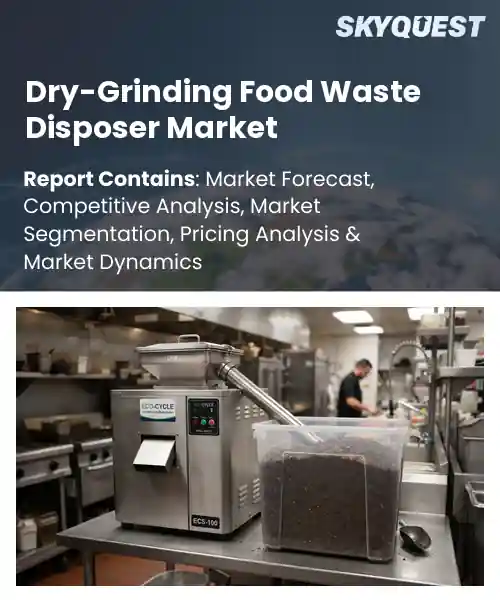
Dry-Grinding Food Waste Disposer Market
Report ID: SQMIG25H2212
Report ID: SQMIG25H2212
[email protected]
USA +1 351-333-4748
Report ID:
SQMIG25H2212 |
Region:
Global |
Published Date: September, 2026
Pages:
157
|Tables:
144
|Figures:
78


Global Dry-Grinding Food Waste Disposer Market size was valued at USD 740.0 Million in 2024 and is poised to grow from USD 777.74 Million in 2025 to USD 1157.87 Million by 2033, growing at a CAGR of 5.1% during the forecast period (2026-2033).
Demand for dry‑grinding food‑waste disposers is being propelled primarily by tightening waste‑management regulations that force municipalities and commercial kitchens to divert organic material from landfill. The market encompasses compact units that mechanically shred food residues into a dry powder, enabling downstream composting or anaerobic digestion without excess moisture. This technology matters because it reduces methane emissions, lowers transport costs, and aligns with circular‑economy targets set by the European Union and several U.S. states. Since the early 2010s, pilot programs in Berlin and San Francisco demonstrated measurable landfill‑diversion rates, prompting manufacturers to scale production and diversify product lines for global adoption. Parallel to regulatory pressure, the surge in food‑service volume and corporate sustainability pledges creates a fertile environment for dry‑grinding disposers to capture market share. When restaurants adopt these units, the effect is a reduction in haul‑away fees because the processed waste can be bundled with municipal compost streams, which are subsidized. This cost advantage incentivizes chain operators such as Starbucks and Pret A Manger to roll out disposers across hundreds of outlets, thereby generating economies that lower unit prices for smaller cafés. Consequently, equipment makers are expanding into emerging economies where urbanization heightens waste challenges, opening opportunities for service contracts.
How is AI-driven automation influencing the Dry-grinding food waste disposer market?
AI‑driven automation is reshaping the dry‑grinding food waste disposer market by embedding smart sensors, adaptive control algorithms and predictive maintenance into compact grinding units. Manufacturers now integrate machine‑learning models that adjust grinding speed based on waste composition, reducing energy use and extending component life. Real‑time data streams enable remote diagnostics, allowing service teams to intervene before failures occur. This connectivity also supports fleet managers in optimizing collection schedules, lowering operational costs and improving sustainability metrics. As households and commercial kitchens demand quieter, more efficient disposers, AI features become a key differentiator that drives product upgrades and market adoption.A recent development from InSinkErator in March 2024, introduced an AI‑enabled disposer that continuously learns waste patterns, boosting grinding efficiency and reducing downtime, thereby supporting market growth through enhanced performance.
Market snapshot - (2026-2033)
Global Market Size
USD 740.0 Million
Largest Segment
Continuous-Feed Disposers
Fastest Growth
Batch-Feed Disposers
Growth Rate
5.1% CAGR
To get more insights on this market click here to Request a Free Sample Report
Global dry-grinding food waste disposer market is segmented by product type, capacity, application, distribution channel, end user and region. Based on product type, the market is segmented into Continuous-Feed Disposers and Batch-Feed Disposers. Based on capacity, the market is segmented into Small Capacity, Medium Capacity and Large Capacity. Based on application, the market is segmented into Residential, Commercial and Institutional. Based on distribution channel, the market is segmented into Offline Retail, Online Retail and Direct Sales. Based on end user, the market is segmented into Households, Restaurants & Foodservice, Hotels and Institutional Facilities. Based on region, the market is segmented into North America, Europe, Asia Pacific, Latin America and Middle East & Africa.
Continuous-Feed disposers segment dominates because it aligns perfectly with mainstream kitchen workflows, allowing users to continuously add waste without interrupting operation, which enhances convenience and reduces blockage risk. Its straightforward integration with standard plumbing and low maintenance demands make it the preferred choice for both residential and commercial kitchens. Consequently, manufacturers prioritize this design, reinforcing brand recognition and supplier confidence, which further entrenches its market leadership across diverse user segments worldwide.
However, batch-feed disposers segment is witnessing the strongest growth momentum because heightened hygiene regulations and increasing demand for controlled waste intake encourage quiet, odor controlled operation. Their sealed grinding chamber appeals to premium residential and upscale foodservice environments, prompting manufacturers to innovate with quieter motors and smarter sensors, thereby expanding market opportunity.
Residential segment dominates because homeowners prioritize convenience and odor management, making silent, compact disposers highly attractive. The ubiquity of kitchen renovations and growing environmental consciousness drive homeowners to adopt sustainable waste solutions. Manufacturers respond with designs emphasizing easy installation, low energy consumption, and aesthetic integration, reinforcing strong demand and solidifying residential leadership within the overall market. Their focus on user friendly controls and quiet operation further differentiates them, encouraging wider adoption across varied household demographics.
Meanwhile, Institutional segment is emerging as the key high growth area because large facilities such as universities and healthcare campuses seek scalable waste reduction systems that comply with strict sustainability mandates. Integrated with building management platforms, these disposers offer centralized monitoring and reduced labor, prompting procurement cycles that accelerate market expansion and open new partnership opportunities.
To get detailed segments analysis, Request a Free Sample Report
North America leads the global dry‑grinding food waste disposer market due to a mature consumer base that prioritises convenience and sustainability in kitchen operations. Strong regulatory frameworks encourage adoption of advanced waste‑reduction technologies, while well‑established distribution networks ensure rapid product rollout. High levels of disposable income support investment in premium appliances, and a culture of environmental stewardship drives demand for solutions that minimise landfill contributions. Innovation ecosystems in key hubs foster continuous product improvement, creating a feedback loop that reinforces market leadership. Additionally, robust after‑sales service infrastructure builds consumer confidence, further entrenching the region’s dominant position. The region also benefits from collaborative initiatives between manufacturers, utilities, and waste‑management agencies that streamline integration of dry‑grinding systems into existing infrastructure. Consumer education campaigns highlight the environmental and economic advantages of diverting organic waste, reinforcing market acceptance. Together, these factors create a synergistic environment that sustains North America’s leadership in the sector.
United States Dry-Grinding Food Waste Disposer Market
Dry‑Grinding Food Waste Disposer Market in the United States is propelled by strong consumer awareness of waste reduction and a well‑developed retail landscape that showcases a wide range of models. Manufacturers benefit from extensive research facilities that accelerate product testing, while utility partnerships enable incentives for residential adoption. The emphasis on energy‑efficient designs aligns with broader sustainability goals, reinforcing market momentum across both new construction and retrofit projects in the market.
Canada Dry-Grinding Food Waste Disposer Market
Dry‑Grinding Food Waste Disposer Market in Canada benefits from proactive environmental policies that encourage household composting and organic waste diversion. Consumer preferences lean toward high‑efficiency appliances, prompting manufacturers to tailor solutions for colder climates and varied kitchen layouts. Collaborative programs between municipalities and appliance retailers provide educational outreach, fostering acceptance among homeowners. This supportive ecosystem drives steady demand across urban and suburban households seeking sustainable waste management options in Canada.
The rapid expansion of the dry‑grinding food waste disposer market in Europe is fueled by a confluence of stringent waste‑management directives and a cultural shift toward circular economy practices. Governments across the region impose ambitious targets for organic waste reduction, prompting households and commercial kitchens to adopt technologies that transform waste into reusable material. Consumer consciousness regarding environmental impact is high, encouraging preference for appliances that minimise landfill reliance. Strong engineering expertise in key industrial hubs supports continuous innovation, delivering quieter, more efficient units that meet diverse regulatory standards. Collaborative initiatives between manufacturers, waste‑processing facilities, and sustainability NGOs create integrated value chains, enhancing product appeal. Moreover, the prevalence of energy‑saving incentives and rebate schemes lowers the cost barrier, accelerating market penetration across both new builds and renovation projects.
Germany Dry-Grinding Food Waste Disposer Market
Dry‑Grinding Food Waste Disposer Market in Germany is anchored by rigorous environmental legislation that mandates reductions in organic landfill contributions. German consumers prefer high‑performance, low‑noise appliances, prompting manufacturers to prioritize engineering excellence. The country’s dense network of waste‑processing facilities enables seamless integration of dry‑grinding outputs into composting and bio‑energy streams. Collaborative research programs funded by industry associations accelerate product refinement, ensuring solutions align with consumer expectations and regulatory requirements.
United Kingdom Dry-Grinding Food Waste Disposer Market
Dry‑Grinding Food Waste Disposer Market in the United Kingdom is experiencing rapid growth due to aggressive national waste‑reduction targets and public campaigns promoting sustainable kitchen practices. Homeowners increasingly adopt compact, energy‑efficient units that fit modern apartment layouts. Collaboration between appliance manufacturers and local authorities facilitates rebate schemes that lower purchase costs. The market benefits from a robust supply chain and a culture of innovation that continuously introduces quieter, smarter devices, reinforcing swift consumer uptake.
France Dry‑Grinding Food Waste Disposer Market
Dry‑Grinding Food Waste Disposer Market in France is emerging as environmental awareness rises and government incentives encourage organic waste diversion. French consumers value sleek, low‑noise designs that complement contemporary kitchen aesthetics, prompting manufacturers to focus on style as well as performance. Partnerships with municipal waste‑management programs enable the collection of dry‑grinding residues for composting, enhancing the perceived value of the technology. This supportive policy environment and growing consumer interest are laying the groundwork for accelerated market development.
Asia Pacific is strengthening its position in the dry‑grinding food waste disposer market through a combination of rapid urbanization, heightened environmental consciousness, and supportive governmental frameworks that prioritize waste‑to‑resource initiatives. The region’s dense metropolitan areas generate substantial organic waste streams, creating a clear demand for compact, high‑efficiency disposal solutions. National policies in key economies encourage the adoption of technologies that reduce landfill dependency and lower greenhouse‑gas emissions. Local manufacturers are investing heavily in research and development, leveraging advanced materials and smart‑control systems to produce quieter, more energy‑conserving units. Collaborative efforts between appliance producers, utility providers, and waste‑processing facilities facilitate seamless integration of dry‑grinding outputs into composting and bio‑energy networks. Consumer education campaigns further accelerate acceptance, positioning Asia Pacific as a dynamic growth frontier for sustainable waste‑management technologies.
Japan Dry‑Grinding Food Waste Disposer Market
Dry‑Grinding Food Waste Disposer Market in Japan is driven by a strong cultural emphasis on cleanliness and efficient space utilization, prompting demand for compact, low‑noise units suitable for small kitchens. Government incentives promote the adoption of technologies that divert organic waste from landfills, aligning with national sustainability goals. Japanese manufacturers leverage precision engineering and advanced sensor technology to deliver high‑performance disposers that integrate seamlessly with existing waste‑processing infrastructure, reinforcing market growth.
South Korea Dry‑Grinding Food Waste Disposer Market
Dry‑Grinding Food Waste Disposer Market in South Korea benefits from aggressive national waste‑reduction policies and a tech‑savvy consumer base that embraces smart home appliances. Manufacturers focus on integrating IoT connectivity and energy‑saving features, creating disposers that can be monitored and optimized remotely. Collaborative programs between local governments and appliance firms provide subsidies that lower purchase barriers, encouraging widespread adoption in both new residential developments and retrofits. This convergence of policy support and technological innovation propels rapid market expansion.
To know more about the market opportunities by region and country, click here to
Buy The Complete Report
Growing Preference For Eco‑Friendly Disposal
Regulatory Incentives Encouraging Installation
High Initial Capital Expenditure
Limited Consumer Awareness And Acceptance
Request Free Customization of this report to help us to meet your business objectives.
The competitive landscape is shaped by aggressive M&A activity, strategic partnerships, and rapid technology innovation, as incumbents and newcomers vie for differentiation in dry‑grinding food‑waste disposers; Veolia’s acquisition of Food Waste Solutions accelerated its entry into compact residential units, while SUEZ’s alliance with IBM leverages AI for predictive maintenance, and Ecolab’s launch of an ultrasonic‑grinding disposer underscores a shift toward higher efficiency and lower noise profiles.
Top Player’s Company Profile
Recent Developments
SkyQuest’s ABIRAW (Advanced Business Intelligence, Research & Analysis Wing) is our Business Information Services team that Collects, Collates, Correlates, and Analyses the Data collected by means of Primary Exploratory Research backed by robust Secondary Desk research. As per SkyQuest analysis, the global dry‑grinding food‑waste disposer market is being propelled primarily by a growing preference for eco‑friendly disposal, as consumers and businesses alike seek solutions that cut landfill waste while maintaining kitchen convenience. A second driver is the rapid adoption of AI‑driven automation and smart‑connectivity, which improve efficiency, reduce energy use and enable predictive maintenance. North America remains the dominant region, thanks to strong regulatory support, high disposable incomes and an established retail network. The continuous‑feed disposer segment continues to lead the market because it fits typical kitchen workflows and offers low blockage risk. However, the high initial capital expenditure required for advanced units restrains broader adoption, especially among price‑sensitive households.
| Report Metric | Details |
|---|---|
| Market size value in 2024 | USD 740.0 Million |
| Market size value in 2033 | USD 1157.87 Million |
| Growth Rate | 5.1% |
| Base year | 2024 |
| Forecast period | (2026-2033) |
| Forecast Unit (Value) | USD Million |
| Segments covered |
|
| Regions covered | North America (US, Canada), Europe (Germany, France, United Kingdom, Italy, Spain, Rest of Europe), Asia Pacific (China, India, Japan, Rest of Asia-Pacific), Latin America (Brazil, Rest of Latin America), Middle East & Africa (South Africa, GCC Countries, Rest of MEA) |
| Companies covered |
|
| Customization scope | Free report customization with purchase. Customization includes:-
|
To get a free trial access to our platform which is a one stop solution for all your data requirements for quicker decision making. This platform allows you to compare markets, competitors who are prominent in the market, and mega trends that are influencing the dynamics in the market. Also, get access to detailed SkyQuest exclusive matrix.
Table Of Content
Executive Summary
Market overview
Parent Market Analysis
Market overview
Market size
KEY MARKET INSIGHTS
COVID IMPACT
MARKET DYNAMICS & OUTLOOK
Market Size by Region
KEY COMPANY PROFILES
Methodology
For the Dry-Grinding Food Waste Disposer Market, our research methodology involved a mixture of primary and secondary data sources. Key steps involved in the research process are listed below:
1. Information Procurement: This stage involved the procurement of Market data or related information via primary and secondary sources. The various secondary sources used included various company websites, annual reports, trade databases, and paid databases such as Hoover's, Bloomberg Business, Factiva, and Avention. Our team did 45 primary interactions Globally which included several stakeholders such as manufacturers, customers, key opinion leaders, etc. Overall, information procurement was one of the most extensive stages in our research process.
2. Information Analysis: This step involved triangulation of data through bottom-up and top-down approaches to estimate and validate the total size and future estimate of the Dry-Grinding Food Waste Disposer Market.
3. Report Formulation: The final step entailed the placement of data points in appropriate Market spaces in an attempt to deduce viable conclusions.
4. Validation & Publishing: Validation is the most important step in the process. Validation & re-validation via an intricately designed process helped us finalize data points to be used for final calculations. The final Market estimates and forecasts were then aligned and sent to our panel of industry experts for validation of data. Once the validation was done the report was sent to our Quality Assurance team to ensure adherence to style guides, consistency & design.
Analyst Support
Customization Options
With the given market data, our dedicated team of analysts can offer you the following customization options are available for the Dry-Grinding Food Waste Disposer Market:
Product Analysis: Product matrix, which offers a detailed comparison of the product portfolio of companies.
Regional Analysis: Further analysis of the Dry-Grinding Food Waste Disposer Market for additional countries.
Competitive Analysis: Detailed analysis and profiling of additional Market players & comparative analysis of competitive products.
Go to Market Strategy: Find the high-growth channels to invest your marketing efforts and increase your customer base.
Innovation Mapping: Identify racial solutions and innovation, connected to deep ecosystems of innovators, start-ups, academics, and strategic partners.
Category Intelligence: Customized intelligence that is relevant to their supply Markets will enable them to make smarter sourcing decisions and improve their category management.
Public Company Transcript Analysis: To improve the investment performance by generating new alpha and making better-informed decisions.
Social Media Listening: To analyze the conversations and trends happening not just around your brand, but around your industry as a whole, and use those insights to make better Marketing decisions.
REQUEST FOR SAMPLE
 REQUEST FREE CUSTOMIZATION


Want to customize this report? This report can be personalized according to your needs. Our analysts and industry experts will work directly with you to understand your requirements and provide you with customized data in a short amount of time. We offer $1000 worth of FREE customization at the time of purchase.
Feedback From Our Clients


 USA (+1) 351-333-4748

