Drug Screening Market
Report ID: SQMIG35D2198
Report ID: SQMIG35D2198
[email protected]
USA +1 351-333-4748
Report ID:
SQMIG35D2198 |
Region:
Global |
Published Date: December, 2025
Pages:
199
|Tables:
64
|Figures:
75


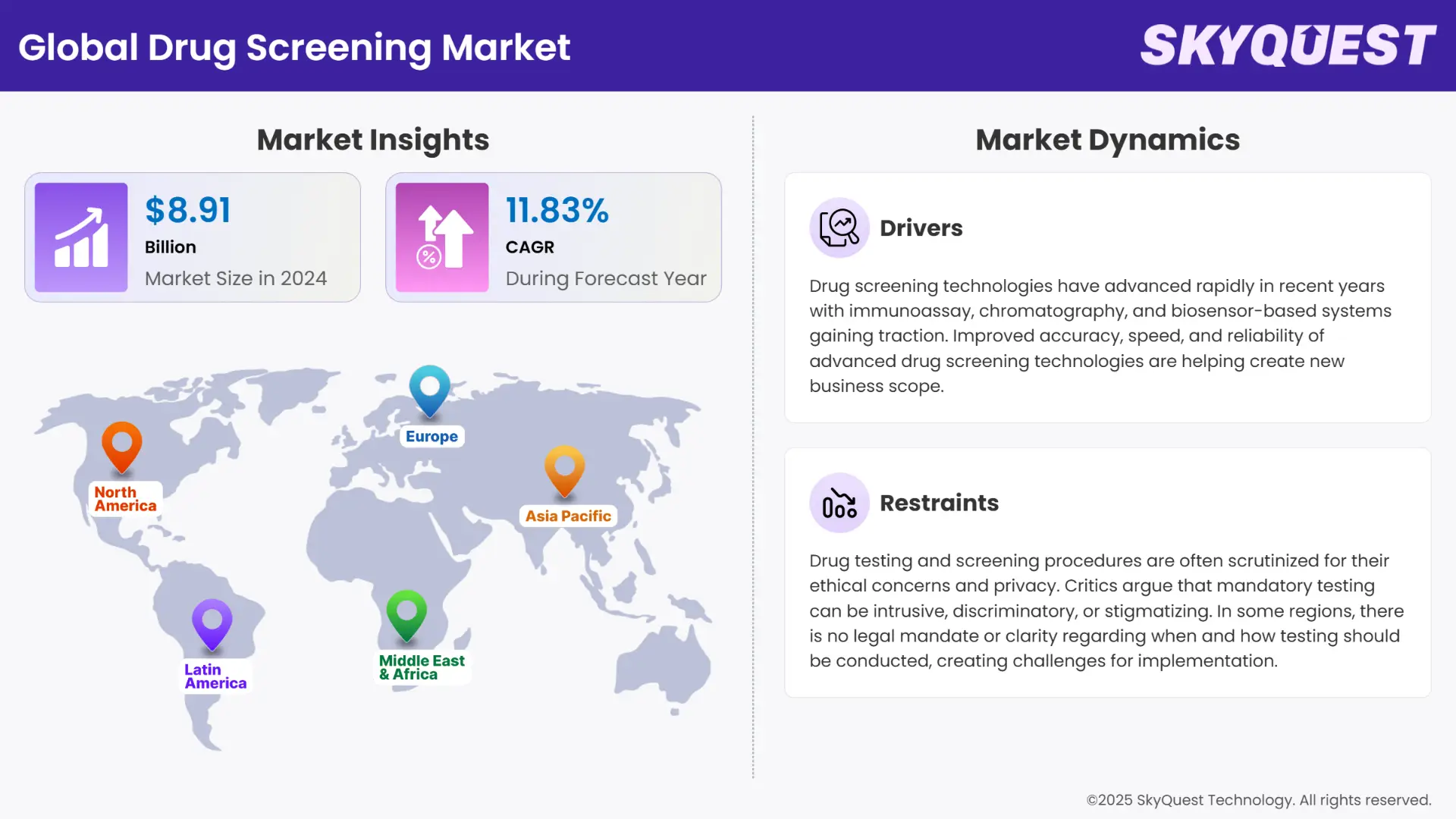
Global Drug Screening Market size was valued at USD 10.37 Billion in 2024 and is poised to grow from USD 12.08 Billion in 2025 to USD 40.99 Billion by 2033, growing at a CAGR of 16.5% during the forecast period (2026–2033).
Surge in drug abuse incidence, advancements in drug screening technologies, government regulations for workplace testing, growth in sports drug testing, and launch of roadside and forensic drug testing programs are driving the adoption of drug screening solutions.
Global increase in consumption of drugs has led to a major rise in substance abuse cases, which prompts high demand for drug screening. Governments across various countries are implementing strict regulations requiring drug testing in safety-sensitive industries like transportation, aviation, construction, and healthcare. Drug screening has become integral in chronic pain management to prevent misuse or diversion of opioids. Governments are strengthening laws against driving under the influence (DUI) by mandating roadside drug screening. Law enforcement agencies are using portable and rapid testing kits for on-the-spot detection of narcotics in drivers. All of these factors are estimated to favor the global drug screening market growth in the long run.
On the contrary, legal and ethical concerns around drug testing, high costs of advanced drug testing equipment, limited detection windows, resistance to testing due to social stigma, and sample manipulation risks are estimated to limit the global drug screening market penetration through 2032 and beyond.
What Role does AI play in Drug Screenings?
Artificial intelligence and automation are transforming laboratory-based drug screening by enhancing precision, speed, and data interpretation. AI-powered systems can identify complex patterns, reduce human error, and handle large sample volumes efficiently. Automated analyzers integrated with AI algorithms are now capable of detecting multiple drug classes simultaneously with high sensitivity. These systems are also improving forensic and post-mortem toxicology analysis. Cloud-based platforms allow for remote access to results and real-time data sharing, enhancing decision-making in clinical and law enforcement applications. This technological integration is particularly relevant as testing complexity increases with the rise of synthetic and designer drugs.
To get more insights on this market click here to Request a Free Sample Report
Global drug screening market is segmented by product, sample type, end user, and region. Based on sample type, the market is segmented into urine samples, breath samples, oral fluid samples, hair samples, and other samples. Based on application, the market is segmented into diagnostics and screening. Based on product, the market is segmented into instruments, rapid testing devices, consumables, services, and others. Based on end users, the market is segmented into hospitals, criminal justice & law enforcement agencies, workplaces, drug treatment centers, individual users, pain management centers, schools & colleges, and others. Based on region, the market is segmented into North America, Europe, Asia Pacific, Latin America, and Middle East & Africa.
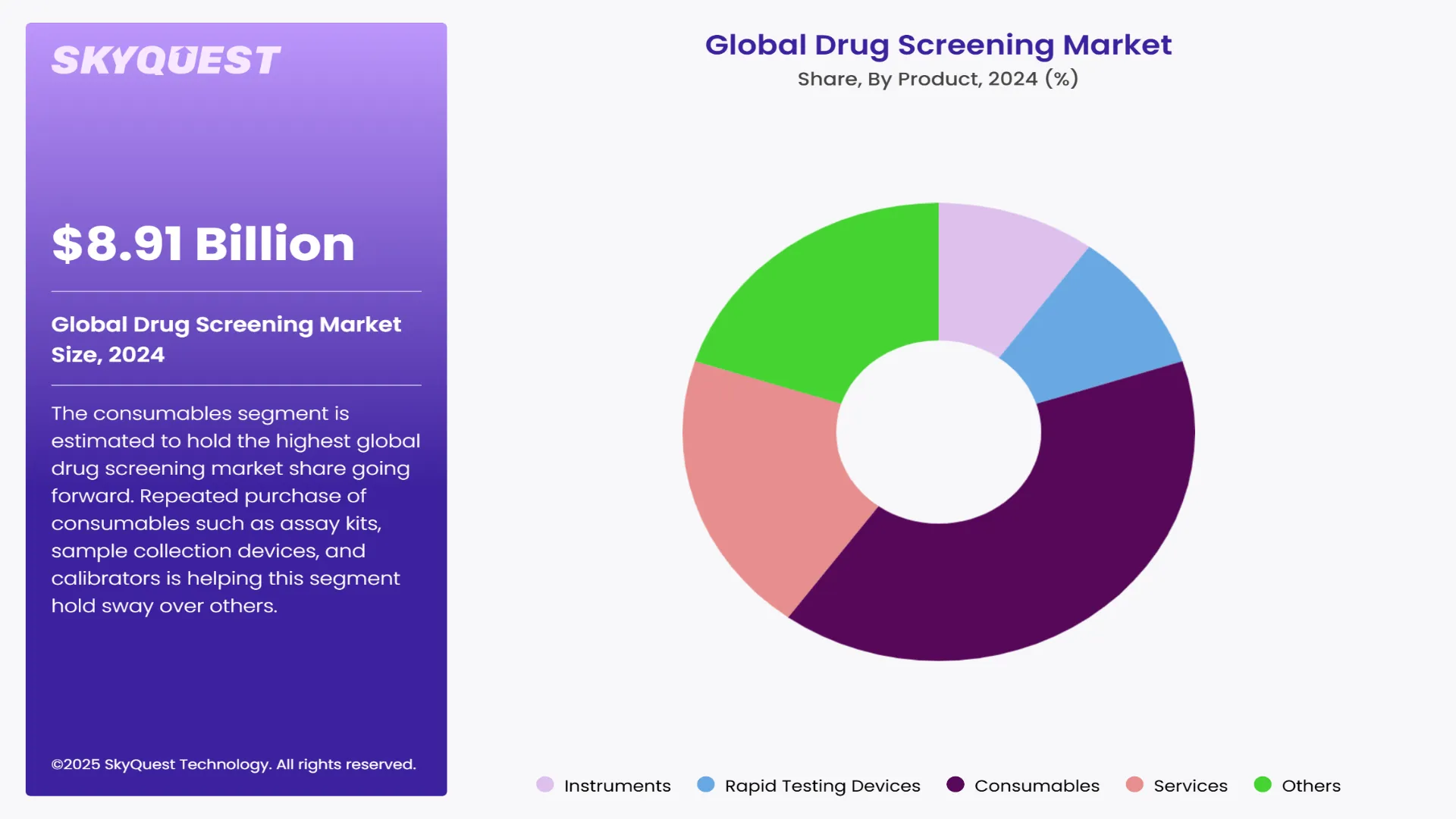
The consumables segment is estimated to hold the highest global drug screening market share going forward. Repeated purchase of consumables such as assay kits, sample collection devices, and calibrators is helping this segment hold sway over others. High reliance on consumables for any type of drug testing and screening is also expected to further cement the high share of this segment in the future.
On the other hand, the demand for services and other goods is expected to rise at a robust pace over the coming years as per this drug screening market forecast. Need specialized services for drug testing and screening coupled with adoption of innovative drug screening programs are helping create new business scope.
The urine samples segment is slated to spearhead the global drug screening market revenue generation potential over the coming years. Ease of collection associated with urine samples makes it a preferred sample for drug screening. Easy detection of a wide range of drugs and non-invasive nature of urine sampling are also expected to help bolster the dominance of this segment over the coming years.
Meanwhile, the use of oral fluid samples for drug screenings is slated to rise at a notable pace in the coming. High preference for less invasive drug testing solutions and growing demand for efficient testing solutions are helping create new opportunities for market players in the long run.
To get detailed segments analysis, Request a Free Sample Report
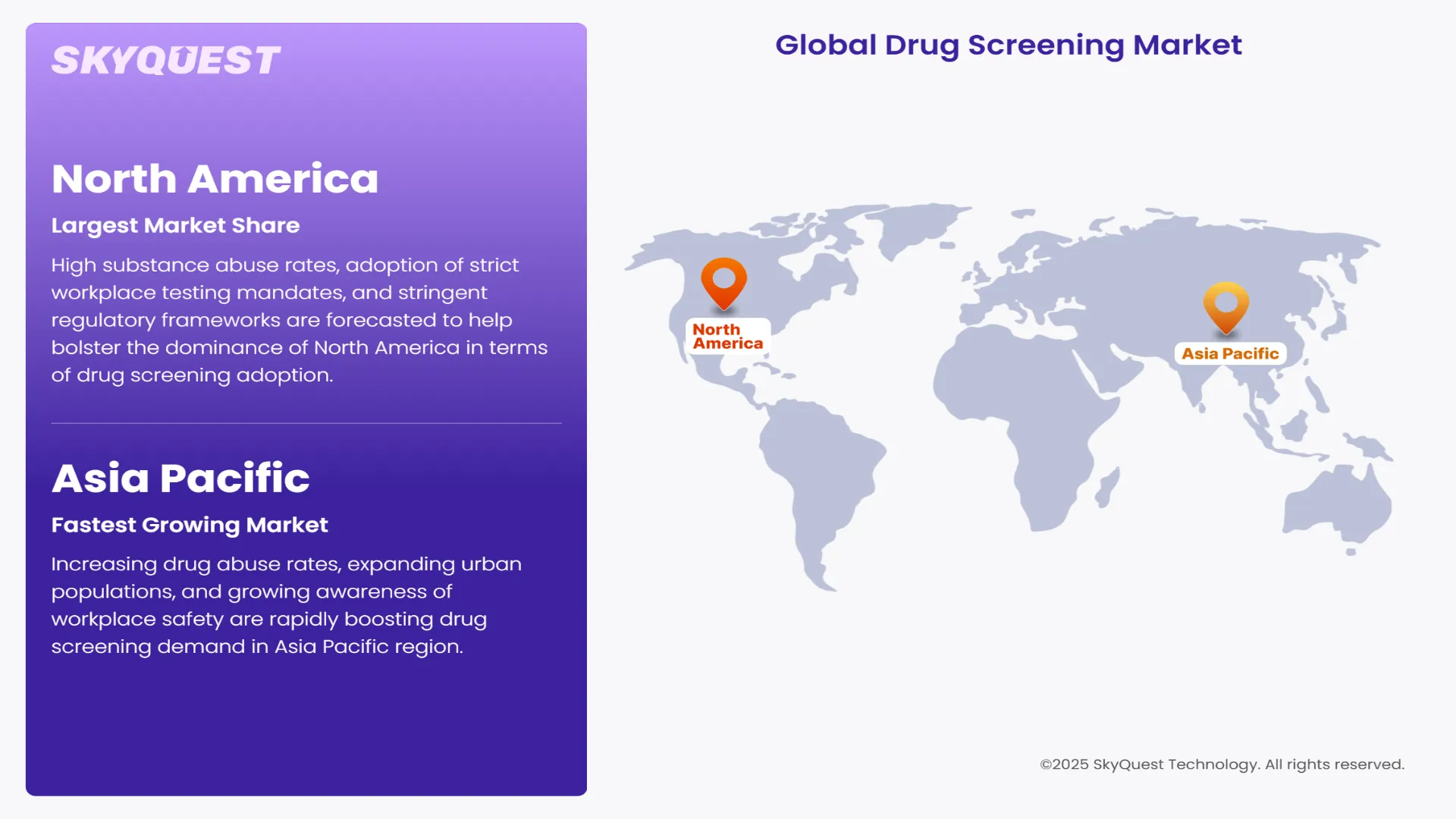
High substance abuse rates, adoption of strict workplace testing mandates, and stringent regulatory frameworks are forecasted to help bolster the dominance of North America in terms of drug screening adoption. High public awareness, strong forensic infrastructure, and the opioid crisis have increased adoption in clinical and home settings. The presence of top drug screening providers and growing insurance coverage are also helping cement the high share of North America over the coming years.
High substance abuse rates and strict federal regulations make this country a top market for drug screening providers. The opioid crisis has prompted hospitals and clinics to integrate routine screening into patient management. Technological advancements in lab-based and point-of-care testing support broad adoption. At-home test kit usage is also rising due to privacy concerns and increasing health awareness. A strong forensic framework and insurance coverage further strengthen the United States’ leadership in the global market.
Demand for drug screening is slated to rise steadily in Canada over the coming years owing to increased drug-related health incidents. The legalization of cannabis has prompted employers to implement stricter testing to ensure productivity and safety, particularly in construction, mining, and transportation sectors. Roadside testing initiatives have expanded under impaired driving laws, with saliva-based tests gaining popularity.
Increasing drug abuse rates, expanding urban populations, and growing awareness of workplace safety are rapidly boosting drug screening demand in Asia Pacific region. Growing investments in healthcare and law enforcement infrastructure are encouraging broader adoption of drug testing in clinical, corporate, and traffic control settings. Local production of cost-effective test kits is also supporting market expansion. The region’s evolving regulatory stance and public health focus position it for continued rapid growth.
Japan is home to a highly conservative drug screening industry backed by increased efforts to combat illicit drug use and maintain workplace discipline. Cultural resistance and privacy concerns have historically limited market expansion, but rising substance-related incidents have triggered public debate and policy revision. Japan’s preference for high accuracy and quality in diagnostics is boosting the adoption of lab-based precision drug screening tests over rapid kits.
Government crackdowns on narcotics and performance-enhancing drugs are expected to boost the demand for drug screening in South Korea through 2032. The Ministry of Food and Drug Safety is investing in detection technology and regulating drug testing protocols. Public awareness regarding substance abuse is being driven by rising media coverage of celebrity drug scandals. South Korea is also focusing on advancing in test kit manufacturing, enabling cost-effective and accurate solutions.
Europe is expected to witness a steady rise in sales of drug screening solutions across the study period backed by increased efforts to combat illicit drug use and stricter workplace policies. EU-funded anti-doping and rehabilitation programs are also expected to boost revenue generation for drug screening companies in the region. Adoption of advanced lab technologies and growing forensic applications of drug screening are also helping create new opportunities for market players through 2032 and beyond.
Robust law enforcement programs and imposition of strict workplace testing policies are helping boost drug screening demand in the country going forward. Compulsory drug testing for individuals working in transportation, construction, and defense industries is also expected to create new business scope for market players going forward. The National Health Service (NHS) incorporates drug screening in mental health and substance abuse treatment programs. Digital drug screening solutions and mobile testing units are also gaining traction in the United Kingdom.
Stringent regulatory environment in transport and industrial sectors is primarily boosting drug screening demand in Germany. The healthcare sector uses screening for opioid prescription monitoring and psychiatric care Germany hosts several advanced laboratories offering high throughput testing solutions. The market emphasizes accuracy and compliance with GDPR, creating demand for secure data handling in digital platforms. Increasing use of recreational drugs is slated to help boost the demand for drug screening solutions in the country.
Growing drug use among youth populations and rising government intervention to curb the same are primarily influencing the demand for drug screening in the future. Public health campaigns and stricter traffic enforcement laws are fueling demand for roadside drug testing, especially in metropolitan areas. Workplace testing is growing, though adoption remains limited by privacy and labor union concerns. France emphasizes high-quality, lab-based analysis, favoring precision over rapid kits.
To know more about the market opportunities by region and country, click here to
Buy The Complete Report
Advancements in Drug Testing Methods
Launch of Multiple Sports Drug Testing Initiatives
Legal and Ethical Concerns Surrounding Drug Testing
Limited Detection Windows and Sample Manipulation Risks
Request Free Customization of this report to help us to meet your business objectives.
Drug screening providers should focus on enhancing the efficiency of their products and developing non-invasive testing solutions. Raising awareness regarding substance abuse can also help improve business scope for zzz providers. Investing in the R&D of novel portable and rapid tests is also a prominent opportunity for companies as per this global drug screening market analysis.
Reducing the test and result times coupled with integration of advanced technologies is slated to help improve efficacy of drug testing. Here’s a startup that has the potential to augment the drug screening industry in the long run.
SkyQuest’s ABIRAW (Advanced Business Intelligence, Research & Analysis Wing) is our Business Information Services team that Collects, Collates, Correlates, and Analyses the Data collected by means of Primary Exploratory Research backed by robust Secondary Desk research.
As per SkyQuest analysis, a growing incidence of substance abuse and a growing emphasis on preventive care are anticipated to drive the demand for drug screening going forward. However, limited detection windows and ethical concerns regarding drug testing are slated to slow down the adoption of drug screening in the future. North America is slated to spearhead the demand for drug screening owing to high number of drug abuse cases and stringent regulatory requirements. Development of at-home drug testing kits and emphasis on non-invasive testing are anticipated to be key trends driving the drug screening industry through 2032 and beyond.
| Report Metric | Details |
|---|---|
| Market size value in 2024 | USD 10.37 Billion |
| Market size value in 2033 | USD 40.99 Billion |
| Growth Rate | 16.5% |
| Base year | 2024 |
| Forecast period | 2026-2033 |
| Forecast Unit (Value) | USD Billion |
| Segments covered |
|
| Regions covered | North America (US, Canada), Europe (Germany, France, United Kingdom, Italy, Spain, Rest of Europe), Asia Pacific (China, India, Japan, Rest of Asia-Pacific), Latin America (Brazil, Rest of Latin America), Middle East & Africa (South Africa, GCC Countries, Rest of MEA) |
| Companies covered |
|
| Customization scope | Free report customization with purchase. Customization includes:-
|
To get a free trial access to our platform which is a one stop solution for all your data requirements for quicker decision making. This platform allows you to compare markets, competitors who are prominent in the market, and mega trends that are influencing the dynamics in the market. Also, get access to detailed SkyQuest exclusive matrix.
Table Of Content
Executive Summary
Market overview
Parent Market Analysis
Market overview
Market size
KEY MARKET INSIGHTS
COVID IMPACT
MARKET DYNAMICS & OUTLOOK
Market Size by Region
KEY COMPANY PROFILES
Methodology
For the Drug Screening Market, our research methodology involved a mixture of primary and secondary data sources. Key steps involved in the research process are listed below:
1. Information Procurement: This stage involved the procurement of Market data or related information via primary and secondary sources. The various secondary sources used included various company websites, annual reports, trade databases, and paid databases such as Hoover's, Bloomberg Business, Factiva, and Avention. Our team did 45 primary interactions Globally which included several stakeholders such as manufacturers, customers, key opinion leaders, etc. Overall, information procurement was one of the most extensive stages in our research process.
2. Information Analysis: This step involved triangulation of data through bottom-up and top-down approaches to estimate and validate the total size and future estimate of the Drug Screening Market.
3. Report Formulation: The final step entailed the placement of data points in appropriate Market spaces in an attempt to deduce viable conclusions.
4. Validation & Publishing: Validation is the most important step in the process. Validation & re-validation via an intricately designed process helped us finalize data points to be used for final calculations. The final Market estimates and forecasts were then aligned and sent to our panel of industry experts for validation of data. Once the validation was done the report was sent to our Quality Assurance team to ensure adherence to style guides, consistency & design.
Analyst Support
Customization Options
With the given market data, our dedicated team of analysts can offer you the following customization options are available for the Drug Screening Market:
Product Analysis: Product matrix, which offers a detailed comparison of the product portfolio of companies.
Regional Analysis: Further analysis of the Drug Screening Market for additional countries.
Competitive Analysis: Detailed analysis and profiling of additional Market players & comparative analysis of competitive products.
Go to Market Strategy: Find the high-growth channels to invest your marketing efforts and increase your customer base.
Innovation Mapping: Identify racial solutions and innovation, connected to deep ecosystems of innovators, start-ups, academics, and strategic partners.
Category Intelligence: Customized intelligence that is relevant to their supply Markets will enable them to make smarter sourcing decisions and improve their category management.
Public Company Transcript Analysis: To improve the investment performance by generating new alpha and making better-informed decisions.
Social Media Listening: To analyze the conversations and trends happening not just around your brand, but around your industry as a whole, and use those insights to make better Marketing decisions.
REQUEST FOR SAMPLE
 REQUEST FREE CUSTOMIZATION


Want to customize this report? This report can be personalized according to your needs. Our analysts and industry experts will work directly with you to understand your requirements and provide you with customized data in a short amount of time. We offer $1000 worth of FREE customization at the time of purchase.
Feedback From Our Clients


 USA (+1) 351-333-4748

