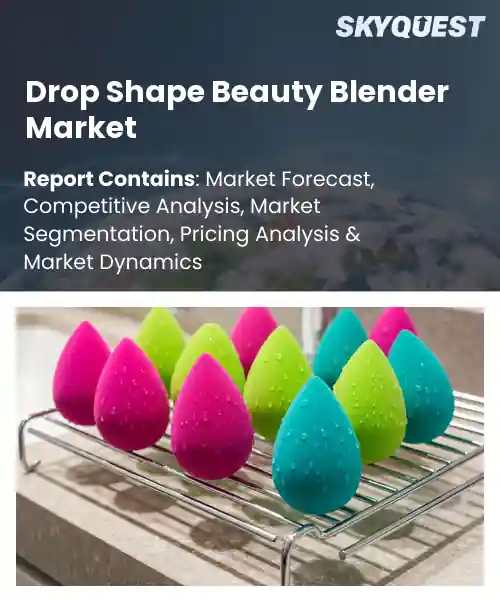
Drop Shape Beauty Blender Market
Report ID: SQMIG30L2539
Report ID: SQMIG30L2539
[email protected]
USA +1 351-333-4748
Report ID:
SQMIG30L2539 |
Region:
Global |
Published Date: August, 2026
Pages:
157
|Tables:
142
|Figures:
78


Global Drop Shape Beauty Blender Market size was valued at USD 128.4 Million in 2024 and is poised to grow from USD 135.98 Million in 2025 to USD 215.1 Million by 2033, growing at a CAGR of 5.9% during the forecast period (2026-2033).
The drop shape beauty blender occupies a niche within the broader cosmetic applicator market, offering a teardrop silhouette that combines sponge porosity with a tapered tip for precise blending. Its primary driver is consumer demand for flawless, airbrushed finishes that emulate professional makeup artistry, a trend amplified by social‑media tutorials and influencer endorsements. Since its introduction in 2015, the product has migrated from boutique salons to mass‑market retailers, with brands such as BeautyBlender and Real Techniques expanding SKU lines to include hypoallergenic and recycled‑foam variants. This evolution illustrates how performance‑focused design and sustainability concerns have reshaped purchasing behavior among global consumers.
Fueling next phase of expansion is integration of advanced foam technologies that enhance product longevity while reducing environmental impact, a factor that directly influences retailer shelf‑space allocation and brand loyalty. Manufacturers that adopt biodegradable polymers can lower production waste, which in turn attracts eco‑conscious buyers and prompts distributors to prioritize these items in displays. Examples include the launch of a plant‑based drop‑shape blender by a leading European brand that captured a 12% market share within six months, prompting competitors to accelerate research into emission manufacturing processes. Consequently, investment in R&D emerges as the most promising growth lever for the sector.
How is AI-driven Customization Influencing The Drop Shape Beauty Blender Market?
AI‑driven customization is reshaping the drop‑shape beauty blender market by turning a once‑static tool into a data‑informed, user‑specific product. Machine‑learning models analyze skin texture, makeup routine and application pressure to recommend optimal sponge density, curvature and material blend. Brands now feed these insights into on‑demand 3‑D printing or modular assembly lines, allowing shoppers to order a sponge that matches their unique facial contours and preferred finish. This reduces inventory waste, shortens time‑to‑market and creates a more engaging buying experience. Early adopters report higher satisfaction as the sponges deliver smoother blend and longer durability, encouraging broader consumer interest.
In June 2023, Beautyblender launched an AI‑powered personalization platform that lets consumers design sponge contours via a mobile app, streamlining production and boosting adoption. The technology tailors shape and firmness to individual needs, accelerating market growth by delivering precisely matched tools that enhance makeup application efficiency and reducing trial‑and‑error steps for users.
Market snapshot - (2026-2033)
Global Market Size
USD 128.4 Million
Largest Segment
Silicone
Fastest Growth
Latex-Free Foam
Growth Rate
5.9% CAGR
To get more insights on this market click here to Request a Free Sample Report
Global drop shape beauty blender market is segmented by material, application, end user, distribution channel, reusability and region. Based on material, the market is segmented into Latex-Free Foam, Polyurethane Foam and Silicone. Based on application, the market is segmented into Liquid Foundation, Cream Makeup and Powder Makeup. Based on end user, the market is segmented into Professional Makeup Artists and Individual Consumers. Based on distribution channel, the market is segmented into Beauty Stores, Online Retail and Supermarkets & Hypermarkets. Based on reusability, the market is segmented into Disposable and Reusable. Based on region, the market is segmented into North America, Europe, Asia Pacific, Latin America and Middle East & Africa.
Latex free foam segment dominates because it aligns with growing consumer intolerance to allergens and the industry's shift toward comfortable skin friendly tools. The material’s soft yet resilient texture mimics the natural pressure of fingertips, delivering flawless blending without irritation. Brands prioritize this foam to meet professional standards and differentiate products in a crowded market, fostering strong brand loyalty and repeat purchases. These attributes also support ease of cleaning and long term durability, reinforcing confidence.
However, silicone segment emerges as the most rapidly expanding area because its hypoallergenic nature and high durability attract both professionals and consumers seeking premium performance. Innovative molding techniques enable precise control of density, enhancing product feel and longevity, which fuels demand and creates new opportunities for premium line extensions.
Cream makeup segment leads because the texture of cream products pairs naturally with the absorbent structure of the drop shape blender, allowing seamless diffusion and a natural finish. Users appreciate the ability to build coverage without streaks, prompting brands to design blenders specifically for this medium. The tactile synergy drives repeat usage, strengthens product positioning, and amplifies cross selling with cream based foundations and concealers.
Meanwhile, powder makeup segment is witnessing the strongest growth momentum because consumers desire matte finishes that the blender can press and blend efficiently. Advances in porous foam design improve powder pickup, encouraging makeup artists to adopt the tool for setting sprays and finishing powders, expanding market reach and inspiring product collaborations.
To get detailed segments analysis, Request a Free Sample Report
North America leads the drop shape beauty blender market due to a mature consumer base that values innovative makeup tools and a strong retail ecosystem that supports rapid product diffusion. Leading beauty brands and high‑end cosmetics retailers in the United States and Canada invest heavily in research, marketing and influencer collaborations, creating sustained consumer awareness. The region also benefits from a culture of frequent makeup experimentation, driving demand for versatile applicators that enhance finish and skin comfort. Efficient distribution networks and widespread e‑commerce platforms enable quick market penetration, while regulatory frameworks ensure product safety, reinforcing consumer confidence. Additionally, strong brand loyalty and a willingness to adopt premium cosmetic accessories further amplify market depth.
Drop Shape Beauty Blender Market in the United States thrives on a sophisticated beauty community that embraces cutting‑edge tools for flawless application. High consumer engagement with social media trends fuels demand for performance‑driven accessories, while premium retail channels provide extensive product exposure. Collaboration between leading makeup artists and manufacturers generates continuous product refinement, reinforcing the United States as a pivotal hub for innovation and market leadership. Retail innovation such as virtual try‑on experiences further amplifies consumer interest and adoption.
Drop Shape Beauty Blender Market in Canada benefits from a discerning consumer base that values premium cosmetic accessories and sustainable product attributes. Retail partnerships across major beauty chains and boutique outlets ensure broad accessibility, while influencer collaborations highlight product versatility. Canadian consumers’ emphasis on skin health and comfort drives preference for ergonomic designs, positioning Canada as a key contributor to the broader North American market narrative. Additionally, strong e‑commerce infrastructure facilitates seamless online purchasing, reinforcing market growth.
Europe’s rapid expansion of the drop shape beauty blender market stems from a blend of sophisticated consumer aesthetics, strong emphasis on product quality, and vibrant beauty culture across key markets. In Germany, the United Kingdom and France, consumers prioritize precision and comfort, encouraging adoption of innovative applicators that deliver seamless makeup finishes. Premium retail environments and a network of specialized salons amplify product visibility, while collaborations with renowned makeup artists generate authentic brand narratives. The region’s robust e‑commerce ecosystem and cross‑border trade facilitate swift diffusion of trends, and regulatory rigor ensures safety standards that bolster consumer trust. Local loyalty programs and experiential pop‑up events further enrich consumer engagement and drive repeat purchases. Together these dynamics propel Europe’s market momentum and position it as a significant growth engine for drop shape beauty blenders.
Drop Shape Beauty Blender Market in Germany is anchored by a consumer segment that values engineering precision and high‑performance cosmetics. Partnerships with leading German beauty retailers ensure extensive shelf presence, while collaborations with professional makeup artists reinforce product credibility. German consumers’ focus on skin health drives demand for ergonomically designed blenders that minimise irritation, positioning Germany as the dominant European market for these innovative tools. Retail experiences that incorporate tactile testing further strengthen consumer confidence and brand loyalty.
Drop Shape Beauty Blender Market in the United Kingdom experiences the fastest growth driven by a beauty influencer ecosystem and an appetite for trend‑setting cosmetics. Rapid adoption of social media platforms accelerates product diffusion, while high‑street retailers and specialty boutiques provide diverse access points. British consumers prioritize ease of use and seamless finish, encouraging innovative designs that cater to both everyday and professional makeup applications, solidifying the role of United Kingdom as continent’s rapidly expanding market.
Drop Shape Beauty Blender Market in France is emerging as consumers increasingly seek high‑performance makeup tools that complement their emphasis on natural beauty. French retailers and boutique concept stores promote curated selections, while collaborations with Parisian makeup artists elevate product credibility. The French market values refined textures and ergonomic comfort, driving demand for blenders that deliver flawless finish without compromising skin health, positioning France as an emerging hub within the European landscape.
Asia Pacific is strengthening its position in the drop shape beauty blender market through a convergence of cultural beauty practices, rapid digital adoption, and innovative product development. In Japan and South Korea, consumers place high value on skin‑care harmony and flawless makeup application, encouraging demand for precision tools that enhance texture and comfort. Strong collaboration between local cosmetics manufacturers and beauty influencers accelerates trend propagation, while sophisticated e‑commerce platforms enable seamless access across diverse markets. Investment in research focuses on ergonomic designs and sustainable materials, aligning with rising environmental consciousness. Additionally, the region’s vibrant retail environments, including luxury department stores and specialty boutiques, provide experiential spaces that reinforce product benefits, collectively elevating Asia Pacific’s influence in the global landscape of drop shape beauty blenders.
Drop Shape Beauty Blender Market in Japan benefits from a consumer culture that values meticulous makeup application and product craftsmanship. Leading Japanese beauty retailers showcase a curated selection of blenders that emphasize refined texture and ergonomic precision, while collaboration with renowned makeup artists highlights performance benefits. The market’s focus on skin health drives preference for gentle, silicone‑based designs, establishing Japan as a key driver of innovation and quality standards within the Asia Pacific region.
Drop Shape Beauty Blender Market in South Korea thrives amid a fast‑moving beauty landscape where trend agility and high‑tech aesthetics dominate. Korean consumers favor lightweight, skin‑friendly applicators that deliver seamless finish, prompting manufacturers to integrate advanced materials and ergonomic forms. Partnerships with K‑beauty influencers and prominent cosmetics brands accelerate market acceptance, while boutique stores provide experiential platforms that reinforce product efficacy, positioning South Korea as a vibrant hub for cutting‑edge drop shape beauty blender adoption.
To know more about the market opportunities by region and country, click here to
Buy The Complete Report
Rising Demand for Seamless Application
Shift Toward Sustainable Packaging
High Cost of Premium Materials
Limited Distribution in Emerging Regions
Request Free Customization of this report to help us to meet your business objectives.
The Drop Shape Beauty Blender market features a competitive mix of established leaders and emerging entrants. Beautyblender is recognized as a pioneer of the drop shape format, having set quality and performance benchmarks that competitors continue to chase. Sephora operates as a major retail channel, while brands such as Amortals and Perfect Diary have built traction in Asian markets through influencer partnerships and localized marketing. Across the sector, companies prioritize product development, expanding sponge sizes, textures, and eco-friendly materials, while integrating AI, automation, and smart manufacturing techniques to improve cost efficiency. Rather than large-scale mergers, players tend to favor strategic collaborations, celebrity endorsements, and social-media-driven brand building to differentiate themselves and defend market share.
SkyQuest’s ABIRAW (Advanced Business Intelligence, Research & Analysis Wing) is our Business Information Services team that Collects, Collates, Correlates, and Analyses the Data collected by means of Primary Exploratory Research backed by robust Secondary Desk research.
As per SkyQuest analysis, the global drop shape beauty blender market is driven primarily by rising demand for seamless application that consumers seek for flawless, airbrushed finishes; a second catalyst is the shift toward sustainable packaging and eco‑friendly materials which is resonating with environmentally conscious buyers. The market is led by North America, where mature retail channels and strong influencer activity fuel adoption, and the latex‑free foam segment holds the largest share due to its hypoallergenic feel and durability. However, the high cost of premium materials such as silicone and biodegradable polymers restrains broader penetration, especially in price‑sensitive segments.
| Report Metric | Details |
|---|---|
| Market size value in 2024 | USD 128.4 Million |
| Market size value in 2033 | USD 215.1 Million |
| Growth Rate | 5.9% |
| Base year | 2024 |
| Forecast period | (2026-2033) |
| Forecast Unit (Value) | USD Million |
| Segments covered |
|
| Regions covered | North America (US, Canada), Europe (Germany, France, United Kingdom, Italy, Spain, Rest of Europe), Asia Pacific (China, India, Japan, Rest of Asia-Pacific), Latin America (Brazil, Rest of Latin America), Middle East & Africa (South Africa, GCC Countries, Rest of MEA) |
| Companies covered |
|
| Customization scope | Free report customization with purchase. Customization includes:-
|
To get a free trial access to our platform which is a one stop solution for all your data requirements for quicker decision making. This platform allows you to compare markets, competitors who are prominent in the market, and mega trends that are influencing the dynamics in the market. Also, get access to detailed SkyQuest exclusive matrix.
Table Of Content
Executive Summary
Market overview
Parent Market Analysis
Market overview
Market size
KEY MARKET INSIGHTS
COVID IMPACT
MARKET DYNAMICS & OUTLOOK
Market Size by Region
KEY COMPANY PROFILES
Methodology
For the Drop Shape Beauty Blender Market, our research methodology involved a mixture of primary and secondary data sources. Key steps involved in the research process are listed below:
1. Information Procurement: This stage involved the procurement of Market data or related information via primary and secondary sources. The various secondary sources used included various company websites, annual reports, trade databases, and paid databases such as Hoover's, Bloomberg Business, Factiva, and Avention. Our team did 45 primary interactions Globally which included several stakeholders such as manufacturers, customers, key opinion leaders, etc. Overall, information procurement was one of the most extensive stages in our research process.
2. Information Analysis: This step involved triangulation of data through bottom-up and top-down approaches to estimate and validate the total size and future estimate of the Drop Shape Beauty Blender Market.
3. Report Formulation: The final step entailed the placement of data points in appropriate Market spaces in an attempt to deduce viable conclusions.
4. Validation & Publishing: Validation is the most important step in the process. Validation & re-validation via an intricately designed process helped us finalize data points to be used for final calculations. The final Market estimates and forecasts were then aligned and sent to our panel of industry experts for validation of data. Once the validation was done the report was sent to our Quality Assurance team to ensure adherence to style guides, consistency & design.
Analyst Support
Customization Options
With the given market data, our dedicated team of analysts can offer you the following customization options are available for the Drop Shape Beauty Blender Market:
Product Analysis: Product matrix, which offers a detailed comparison of the product portfolio of companies.
Regional Analysis: Further analysis of the Drop Shape Beauty Blender Market for additional countries.
Competitive Analysis: Detailed analysis and profiling of additional Market players & comparative analysis of competitive products.
Go to Market Strategy: Find the high-growth channels to invest your marketing efforts and increase your customer base.
Innovation Mapping: Identify racial solutions and innovation, connected to deep ecosystems of innovators, start-ups, academics, and strategic partners.
Category Intelligence: Customized intelligence that is relevant to their supply Markets will enable them to make smarter sourcing decisions and improve their category management.
Public Company Transcript Analysis: To improve the investment performance by generating new alpha and making better-informed decisions.
Social Media Listening: To analyze the conversations and trends happening not just around your brand, but around your industry as a whole, and use those insights to make better Marketing decisions.
REQUEST FOR SAMPLE
 REQUEST FREE CUSTOMIZATION
Global Drop Shape Beauty Blender Market size was valued at USD 128.4 Million in 2024 and is poised to grow from USD 135.98 Million in 2025 to USD 215.1 Million by 2033, growing at a CAGR of 5.9% during the forecast period (2026-2033).
Insufficient data to generate the requested content. 'Beautyblender', 'Real Techniques', 'L'Oréal S.A.', 'e.l.f. Beauty, Inc.', 'JUNO & Co.', 'Fenty Beauty', 'EcoTools', 'BEAKEY', 'Aesthetica Cosmetics', 'CALA Products', 'Miss A', 'Wet n Wild Beauty', 'Sephora Collection', 'KIKO Milano', 'Etude House', 'Morphe LLC', 'DUcare', 'Lamora Beauty', 'ForPro Professional Collection', 'BS-MALL'
Consumers increasingly prioritize a flawless complexion, and the ergonomic shape of drop‑style blenders delivers a smooth, streak‑free finish with minimal product waste. This design aligns with professional makeup techniques, allowing precise coverage across contour lines and hard‑to‑reach areas. As beauty enthusiasts seek tools that simplify routine while enhancing aesthetic results, the perceived value of these blenders rises, encouraging repeat purchases and brand loyalty. Consequently, retailers experience heightened demand, and manufacturers expand production to satisfy growing consumer expectations for effortless application performance.
Sustainable Material Adoption: Consumers are increasingly prioritizing eco‑friendly cosmetics, prompting manufacturers to replace traditional polyurethane foams with biodegradable polymers derived from plant‑based sources. This shift aligns with broader sustainability commitments across the beauty sector and reduces the product’s carbon footprint. Brands that transparently communicate these material changes gain stronger loyalty, while retailers respond by allocating shelf space to greener options. Consequently, supply chains are reconfiguring sourcing strategies, fostering collaborations with innovative material suppliers and accelerating the rollout of recyclable packaging formats for global
Why does North America Dominate the Global Drop Shape Beauty Blender Market? |@12


Want to customize this report? This report can be personalized according to your needs. Our analysts and industry experts will work directly with you to understand your requirements and provide you with customized data in a short amount of time. We offer $1000 worth of FREE customization at the time of purchase.
Feedback From Our Clients


 USA (+1) 351-333-4748

