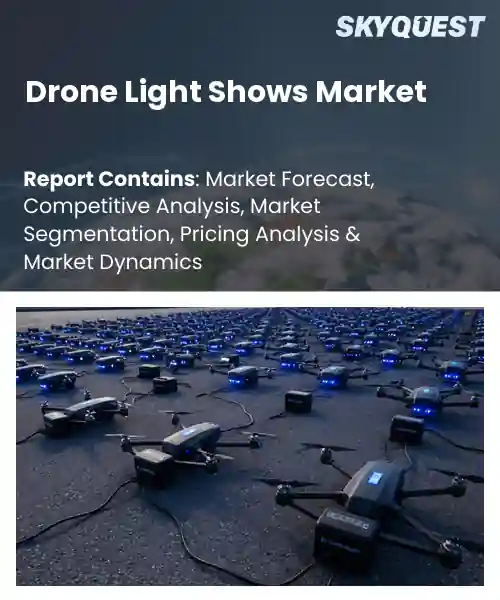
Drone Light Shows Market
Report ID: SQMIG20D2479
Report ID: SQMIG20D2479
[email protected]
USA +1 351-333-4748
Report ID:
SQMIG20D2479 |
Region:
Global |
Published Date: February, 2026
Pages:
157
|Tables:
170
|Figures:
79


Global Drone Light Shows Market size was valued at USD 1.4 Billion in 2024 and is poised to grow from USD 1.62 Billion in 2025 to USD 5.16 Billion by 2033, growing at a CAGR of 15.6% during the forecast period (2026-2033).
At its core the drone light shows market packages choreographed fleets of LED-equipped drones as safer eco-friendlier alternatives to fireworks and static displays; its primary driver is rising demand for memorable spectacles combined with rapid advances in swarm control. The sector matters because public and corporate clients gain programmable three-dimensional canvases that reduce risk, noise and emissions while enabling repeatable branding and storytelling. Over the last decade demonstrations at international ceremonies by prominent pioneers and indoor productions proved artistic viability, and steady improvements in batteries navigation and airspace management professionalized operations. Together these trends expanded capacity and opened commercial pathways.
As pathways widened the market's foundation, regulatory and technological progress became the pivotal key trend driving the global drone light shows sector. As authorities clarified beyond-visual-line-of-sight approvals and standardized safety protocols, operators scaled fleets beyond trials which lowered per-unit costs and supported longer narratives; consequently event planners replaced fireworks with programmable displays for stadiums product launches and city festivals. Improvements in battery energy density and swarm software increased show duration and complexity, attracting advertisers, theme parks and tourism boards that monetize bespoke spectacles. These cause-and-effect dynamics create recurring revenue models, cross-industry partnerships and white-label offerings that extend market reach.
How is AI Improving Drone Light Show Choreography?
AI is reshaping drone light show choreography by moving tasks that were once manual into intelligent design systems. Key aspects include AI driven trajectory planning, safety aware collision avoidance, and generative visual mapping that turns themes into three dimensional formations. Current tools combine simulation, pattern synthesis, and music driven timing so creators can iterate creative concepts faster without deep programming. The desire of people for unforgettable, and safer shows in the evening hour is driving event creators to start implementing these methods of production. A small example would include aerial performances on a large scale for festivals as well as integrated stage productions where the use of AI is to help coordinate drones to be in sync with live music or with immersive lighting.
Verge Aero in February 2026 unveiled an AI driven Design Studio that automates choreography and virtual testing. This development reduces planning time and on site risk while enabling richer animations. The technology supports faster show delivery and broader adoption of drone displays in live entertainment.
Market snapshot - (2026-2033)
Global Market Size
USD 1.4 Billion
Largest Segment
Multi-Rotor Drones
Fastest Growth
Hybrid Drones
Growth Rate
15.6% CAGR
To get more insights on this market click here to Request a Free Sample Report
Global drone light shows market is segmented by drone types, show types, mode of operation, technology, application, end user, and region. Based on drone types, the market is segmented into multi-rotor drones, fixed-wing drones and hybrid drones. Based on show types, the market is segmented into drone formations, animated shows, indoor shows and drone-launched fireworks. Based on mode of operation, the market is segmented into remotely operated, semi-autonomous and fully autonomous. Based on technology, the market is segmented into led lighting, drone control software and communication systems. Based on application, the market is segmented into tourist attractions and events. Based on end user, the market is segmented into private/commercial and government. Based on region, the market is segmented into North America, Europe, Asia Pacific, Latin America and Middle East & Africa.
Based on the global drone light shows market forecast, fully Autonomous segment dominates because its capacity to execute intricate, preplanned choreography with minimal human intervention transforms creative and operational capabilities in drone light shows market. Accurate timekeeping, adaptive flight response and uniform execution across each performance is possible through autonomous control, thereby limiting dependence on manual inputs, and perform technical oversight. These capabilities enable buyers to be more confident prior to their purchasing decision, in addition to allowing producers to develop more complex designs without proportionate increases in either operational complexity or the number of personnel needed.
Remotely operated mode of operation is expected to be the fastest growing in the global drone light shows market due to its superior real-time control, enhanced safety management, and regulatory compliance advantages. In large public events, organizers prefer to have a human supervisor oversee operations. This is because a human can quickly make changes or adjustments during an event, this will lower the amount of operational risk and allow for a better performing event when there are many different factors that are constantly changing in an unpredictable way.
Drone Control Software segment leads because it provides the centralized orchestration and safety logic that makes large scale, synchronized displays feasible and reliable in drone light shows market. Advanced control platforms simplify choreography creation, automate deconfliction routines, and manage fleet telemetry, which reduces operator workload and technical risk. Encouraging more customers to utilize higher complexity in their production are a result of operational improvements; the ability to better predictably complete an order helps to build customer confidence in the execution and adherence to their service agreements.
LED lighting technologies are projected to be the fastest growing in the global drone light shows market due to increasing demand for brighter, energy-efficient, and programmable illumination systems that enhance visual storytelling and brand displays. Recent developments in lightweight high in luminous intensity, colour accuracy and battery life have allowed for longer flight times and more elaborate aerial choreography.
To get detailed segments analysis, Request a Free Sample Report
As per the global drone light shows market analysis, Asia Pacific commands a leading role in the industry due to a convergence of advanced technology ecosystems, proactive regulatory frameworks, and strong event and entertainment cultures. Suppliers of engineering and manufactured products in the area provide high quality hardware and software, while flexible regulatory frameworks in select markets offer opportunities for operational scalability with respect to public spectacles. In addition, the demand for integrated solutions across tourism, live major entertainment and brand activation drive substantial commercial opportunities on an ongoing basis. Collaborative clusters that link research institutions and executive suppliers to create innovative solutions in event choreography, safety and payload design. High density population and iconic skylines provide planners with excellent venues that deliver a distinctive visual image.
Drone light shows market in Japan benefits from a robust electronics supply chain and deep expertise in precision engineering, enabling highly reliable fleets and sophisticated choreography. The use of experienced, local operators combined with stringent safety regulations continues to add a level of public confidence regarding safety and business practice and with a focus on creating an integrated environment across the tourism industry and spectacle-based programming will ensure their long-term viability.
Drone light shows market in South Korea leverages cutting edge research in autonomy and swarm control developed by local universities and technology firms. The entertainment industry is frequently giving opportunity for aerial shows, while commerce is permitted by supportive policy structures and adequate oversight of their use. Manufacturer, content creator, and broadcaster relationships foster newfound concepts in shows fashioned to generate travel-oriented and brand activation through urban and/or culturally based venues.
Rapid expansion in North America stems from a blend of mature event infrastructures, strong commercial demand for experiential marketing, and a growing network of specialized service providers. Established regulation and aviation safety rules create a clearer pathway for corporate and insurance purchasers to obtain permits to conduct these types of events, which supports and motivates them to use this technology for their events. The production companies, creative agencies, and hardware companies that comprise a vibrant production network continue to innovatively create new ways for choreography, designing the production of the show, and safely transporting it to the venue. Strategic relationships between venue operators and technology vendors continue to allow for the implementation of more complex and repeatable productions, while media coverage and branding activities continue to increase the awareness and acceptance of drone light shows with many different types of consumers.
Drone light shows market in the United States is propelled by major live entertainment venues, sporting events, and demand for innovative brand experiences. The collaboration between production houses, creative agencies, and technology vendors to create successful performance in media. Robust safety and compliance frameworks, together with experienced logistics and airspace coordination services, support repeatable deployments that satisfy broadcasters, sponsors, and venue operators widely seeking high impact visual spectacles.
Drone light shows market in Canada is marked by adoption in tourism promotion, cultural festivals, and municipal celebrations seeking experiential programming. Safety, community engagement and environmental analysis are key factors when designing aerial events by regional operators due to different environmental variables (climatic and topographic). Collaborative efforts between creative design companies, event planners and aviation authorities enable the resources required to achieve operational approvals as well as to cultivate local engagement.
Europe is strengthening its position in the drone light shows market through coordinated regulatory efforts, strong creative industries, and a focus on sustainable event practices that meet public and municipal expectations. Expertise in choreography, software development, and airspace integration for complex performances is being developed at national and regional hub locations in preparation for large-scale performances that coincide with cultural festivals, landmark events, etc. Technology firms, cultural institutions and event producers will continue collaborating on new content and solving issues related to noise, visual pollution and environmental issues while encouraging innovative solutions. Cross border touring of productions and a vibrant market for bespoke brand activations further reinforce Europe role as a source of both artistic and technical leadership in aerial entertainment.
Drone light shows market in Germany benefits from engineering excellence, a rigorous safety culture, and a strong manufacturing base that supports reliable platforms and precise choreography. Event producers and tech companies partner with research institutes to create and fine-tune flight control and redundancy systems in accordance with high standards necessary for obtaining a Federal Aviation Administration permit. Cultural festivals, corporate brand activations, and public celebrations continue to drive the demand for aerial productions that require an operational discipline both in testing and risk management.
Drone light shows market in the United Kingdom draws on a vibrant creative sector, established live event production companies, and media partnerships. Operators prioritize the development of unique, narrative-based choreography and content for both local and international celebrations, including cultural festivals, public ceremonies and commercial showcases. Operators will coordinate with aviation authorities as well as venue owners/managers to achieve compliance, with an experienced workforce of pilots and designers providing the means for dependable operations.
Drone light shows market in France blends creative design traditions with technical expertise in audiovisual production to create performances suited to cultural and tourism settings. Production teams integrate narrative elements with music to deepen spectator engagement at festivals and ceremonies. Cooperation with heritage authorities and municipal planners guides risk mitigation and crowd management. Safety protocols in conjunction with artistic organizations have been demanded from municipalities, cultural institutions, and their respective clients.
To know more about the market opportunities by region and country, click here to
Buy The Complete Report
Rising Demand For Spectator Entertainment
The increase in demand by event producers for unique, reusable live events has stimulated more use of drone light show production as a key creative medium. Event producers appreciate being able to customise their choreography and visual programming to each brand’s narrative; they love that drone displays have significantly less environmental impact than traditionally used pyrotechnic devices; and they enjoy being able to produce tightly-controlled events in multiple environments. All of these factors align to the global drone light shows market growth and producers' needs for engaging their audience and running their businesses, thus generating an increased amount of purchasing.
Technological Advancements In Drone Systems
Continuous improvements in drone hardware, navigation algorithms, and choreography software have enabled increasingly complex, reliable, and creative light displays, which encourages adoption by diverse stakeholders. Enhanced precision and safety features allow organizers to plan shows in more constrained and urban environments with greater confidence, while modular software tools reduce production lead times and allow creative teams to iterate rapidly. The technological advancements described here are reducing friction in operations and making drone performances more attractive to both event planners and brands, thus expanding the opportunities available to vendors and service providers throughout the entire industry.
Regulatory Uncertainty and Airspace Rules
Fragmented regulatory frameworks and evolving airspace management policies create uncertainty that constrains market expansion by limiting where and how drone light shows can be conducted. Metropolitan Area Governments (MAGs) and Event Operators face a confusing array of permit processes, have varying safety requirements to satisfy and must also coordinate with aviation authorities, increasing the complexity of their event planning process and creating a dis-incentive for rapid deployment of events. This unpredictability raises operational risk perceptions, leads to cautious investment decisions, and narrows the set of feasible venues and event formats, thereby slowing adoption rates and reducing opportunities for some service providers.
High Operational Costs and Maintenance
The high cost of operating, maintaining, and insuring the fleet of drone(s) creates a barrier to entry, reducing demand in the marketplace and providing greater advantages to financially well-resourced operators. Costs such as specialty equipment, on-going maintenance from replacement batteries, subscription to software, and skilled operators will increase the cost structure required to produce regular shows making it more difficult for smaller operators to be profitable. Furthermore, the cost structure associated with producing shows prevents geographic expansion, reduces the likelihood of new entrants, and, causes existing suppliers to favour larger.
Request Free Customization of this report to help us to meet your business objectives.
Competitive pressure in the global drone light shows market outlook is driven by brands and cities competing for headline aerial experiences, pushing firms to pursue partnerships, fleet transfers and proprietary swarm software to deliver larger, safer displays. Strategic moves include broadcaster and expo tie ups, fleet and IP transfers and choreography innovation, illustrated by DAMODA’s record scale and Celestial’s festival and Eurovision collaborations.
Allumee: Established in 2020, their main objective is to democratize large scale theatrical drone entertainment across Europe by offering turnkey creative programming and operations that act as a lower carbon alternative to fireworks and are adaptable to festivals, municipal events and brand campaigns. The company executed a milestone large scale performance in collaboration with a hardware partner, expanded regional touring capability, increased direct bookings from cultural clients and iterated choreography software to broaden creative options.
Dronico: Established in 2020, their main objective is to supply purpose built show drones and integrated control software for fast deployment at live events, enabling event producers to stage repeatable, safety compliant performances across venues and weather conditions. The company ormalised representation agreements with overseas manufacturers, opened an Estonian operations base to serve European clients, refined automated landing and fail safe routines and scaled logistics trunks for faster site turnarounds and increased rehearsal automation.
SkyQuest’s ABIRAW (Advanced Business Intelligence, Research & Analysis Wing) is our Business Information Services team that Collects, Collates, Correlates, and Analyses the Data collected by means of Primary Exploratory Research backed by robust Secondary Desk research.
As per SkyQuest analysis, the global drone light shows industry is propelled by rising demand for memorable programmable spectacles that replace fireworks and create repeatable branded experiences, and by rapid technological advancements in drone systems and AI-driven choreography that increase show complexity and reduce planning time. Regulatory ambiguity and diffused airspace regulations represent a large barrier to businesses regarding permitting and risk. The Asia Pacific sector is the most advanced in this area due to its established manufacturing ecosystem, clear and supportive regulations, and frequent high-volume events. Autonomous drones dominate an organization’s ability to orchestrate the execution of procedures with a high level of precision and consistency across multiple operations, thereby creating new revenue models and opportunities for businesses to collaborate across industries.
| Report Metric | Details |
|---|---|
| Market size value in 2024 | USD 1.4 Billion |
| Market size value in 2033 | USD 5.16 Billion |
| Growth Rate | 15.6% |
| Base year | 2024 |
| Forecast period | (2026-2033) |
| Forecast Unit (Value) | USD Billion |
| Segments covered |
|
| Regions covered | North America (US, Canada), Europe (Germany, France, United Kingdom, Italy, Spain, Rest of Europe), Asia Pacific (China, India, Japan, Rest of Asia-Pacific), Latin America (Brazil, Rest of Latin America), Middle East & Africa (South Africa, GCC Countries, Rest of MEA) |
| Companies covered |
|
| Customization scope | Free report customization with purchase. Customization includes:-
|
To get a free trial access to our platform which is a one stop solution for all your data requirements for quicker decision making. This platform allows you to compare markets, competitors who are prominent in the market, and mega trends that are influencing the dynamics in the market. Also, get access to detailed SkyQuest exclusive matrix.
Table Of Content
Executive Summary
Market overview
Parent Market Analysis
Market overview
Market size
KEY MARKET INSIGHTS
COVID IMPACT
MARKET DYNAMICS & OUTLOOK
Market Size by Region
KEY COMPANY PROFILES
Methodology
For the Drone Light Shows Market, our research methodology involved a mixture of primary and secondary data sources. Key steps involved in the research process are listed below:
1. Information Procurement: This stage involved the procurement of Market data or related information via primary and secondary sources. The various secondary sources used included various company websites, annual reports, trade databases, and paid databases such as Hoover's, Bloomberg Business, Factiva, and Avention. Our team did 45 primary interactions Globally which included several stakeholders such as manufacturers, customers, key opinion leaders, etc. Overall, information procurement was one of the most extensive stages in our research process.
2. Information Analysis: This step involved triangulation of data through bottom-up and top-down approaches to estimate and validate the total size and future estimate of the Drone Light Shows Market.
3. Report Formulation: The final step entailed the placement of data points in appropriate Market spaces in an attempt to deduce viable conclusions.
4. Validation & Publishing: Validation is the most important step in the process. Validation & re-validation via an intricately designed process helped us finalize data points to be used for final calculations. The final Market estimates and forecasts were then aligned and sent to our panel of industry experts for validation of data. Once the validation was done the report was sent to our Quality Assurance team to ensure adherence to style guides, consistency & design.
Analyst Support
Customization Options
With the given market data, our dedicated team of analysts can offer you the following customization options are available for the Drone Light Shows Market:
Product Analysis: Product matrix, which offers a detailed comparison of the product portfolio of companies.
Regional Analysis: Further analysis of the Drone Light Shows Market for additional countries.
Competitive Analysis: Detailed analysis and profiling of additional Market players & comparative analysis of competitive products.
Go to Market Strategy: Find the high-growth channels to invest your marketing efforts and increase your customer base.
Innovation Mapping: Identify racial solutions and innovation, connected to deep ecosystems of innovators, start-ups, academics, and strategic partners.
Category Intelligence: Customized intelligence that is relevant to their supply Markets will enable them to make smarter sourcing decisions and improve their category management.
Public Company Transcript Analysis: To improve the investment performance by generating new alpha and making better-informed decisions.
Social Media Listening: To analyze the conversations and trends happening not just around your brand, but around your industry as a whole, and use those insights to make better Marketing decisions.
REQUEST FOR SAMPLE
 REQUEST FREE CUSTOMIZATION
Global Drone Light Shows Market size was valued at USD 1.4 Billion in 2024 and is poised to grow from USD 1.62 Billion in 2025 to USD 5.16 Billion by 2033, growing at a CAGR of 15.6% during the forecast period (2026-2033).
Competitive pressure in the global drone light shows market is driven by brands and cities competing for headline aerial experiences, pushing firms to pursue partnerships, fleet transfers and proprietary swarm software to deliver larger, safer displays. Strategic moves include broadcaster and expo tie ups, fleet and IP transfers and choreography innovation, illustrated by DAMODA’s record scale and Celestial’s festival and Eurovision collaborations. 'Sky Elements, LLC', 'Verge, Inc.', 'Intel Corporation', 'Dronisos', 'Great Lakes Drone Company, LLC', 'SKYMAGIC LIVE. PTE. Ltd', 'Firefly Drone Show', 'Nova Sky Stories LLC', 'Verity Studios', 'Aerial Artistry', 'Ehang', 'CollMot', 'Flyfire', 'Drone Show Inc.', 'IllumiNights', 'DRONEX', 'Airborne Illumination', 'Spark Drone Shows', 'Lights Over America', 'Rocket City Drone Company'
The growing appetite among event organizers for distinctive, repeatable live spectacles has encouraged adoption of drone light shows as a primary creative medium. Organizers value the ability to tailor choreography and visuals to brand narratives, reduce environmental impact compared with traditional pyrotechnics, and stage tightly controlled performances in diverse venues. This alignment with audience engagement objectives and operational preferences motivates procurement and commissioning of drone displays, stimulates demand for service providers, and incentivizes investment in fleet and software capabilities that expand market activity.
As per the global drone light shows market analysis, Asia Pacific commands a leading role in the industry due to a convergence of advanced technology ecosystems, proactive regulatory frameworks, and strong event and entertainment cultures.


Want to customize this report? This report can be personalized according to your needs. Our analysts and industry experts will work directly with you to understand your requirements and provide you with customized data in a short amount of time. We offer $1000 worth of FREE customization at the time of purchase.
Feedback From Our Clients


 USA (+1) 351-333-4748

