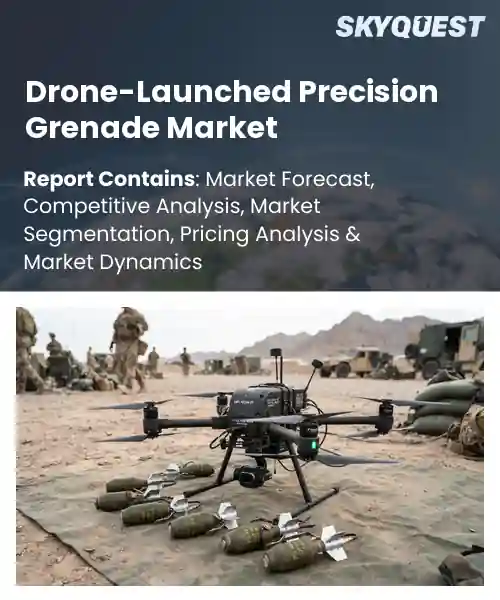
Drone-Launched Precision Grenade Market
Report ID: SQMIG20A2935
Report ID: SQMIG20A2935
[email protected]
USA +1 351-333-4748
Report ID:
SQMIG20A2935 |
Region:
Global |
Published Date: August, 2026
Pages:
157
|Tables:
116
|Figures:
77


Global Drone-Launched Precision Grenade Market size was valued at USD 842.0 Million in 2024 and is poised to grow from USD 958.2 Million in 2025 to USD 2695.21 Million by 2033, growing at a CAGR of 13.8% during the forecast period (2026-2033).
The drone‑launched precision grenade market refers to systems that attach micro‑grenade munitions to unmanned platforms, enabling rapid, pinpoint strikes against personnel or light vehicles. Its importance stems from the ability to deliver lethal effects without exposing pilots to hostile fire, a capability that has reshaped asymmetric warfare. Development began in the early 2010s when hobby‑grade quadcopters proved capable of carrying small payloads; by 2018, defense contractors introduced hardened launch tubes integrated with GPS guidance. Recent field trials in Ukraine and the Sahel illustrate how the technology has transitioned from experimental kits to operational assets, driven by a need for firepower.
The principal growth catalyst for the drone‑launched precision grenade market is the escalating demand for low‑cost, network‑centric fire solutions that infantry can field without extensive logistics. Modern battlefields incorporate sensors and data links, allowing autonomous platforms to receive coordinates and release grenades within seconds, which reduces response time and collateral damage. This capability has attracted NATO interest, as shown by the U.S. Army’s integration of the Small Tactical Aerial Munition into Stryker brigades. Consequently, manufacturers rapidly accelerate modular launch‑kit production while regional allied governments fund joint‑development programs that promise global export potential across Africa, Southeast Asia and the Middle East.
How is AI enhancing the Drone‑launched precision grenade market?
AI is reshaping the drone launched precision grenade sector by giving unmanned platforms the ability to identify and track hidden personnel in real time. Machine learning algorithms process video and infrared feeds to distinguish combatants from background clutter while predictive models calculate optimal release points that consider wind and terrain. Integrated AI also streamlines mission planning allowing operators to upload target coordinates and let the system autonomously adjust flight paths. This reduces reaction time and lowers the cognitive load on soldiers. As a result manufacturers are embedding smarter processors into grenadiers making the weapons more reliable and adaptable across varied battlefields.
FN America, October 2025, secured a prototype contract to develop an AI guided precision grenadier system that fuses sensor data and autonomous targeting. The AI driven approach shortens engagement cycles and improves hit accuracy, reinforcing market momentum and operational efficiency.
Market snapshot - (2026-2033)
Global Market Size
USD 842.0 Million
Largest Segment
Guided Precision Grenades
Fastest Growth
Laser-Guided Precision Grenades
Growth Rate
13.8% CAGR
To get more insights on this market click here to Request a Free Sample Report
Global drone-launched precision grenade market is segmented by product type, platform, application, end user and region. Based on product type, the market is segmented into Guided Precision Grenades, GPS-Guided Precision Grenades and Laser-Guided Precision Grenades. Based on platform, the market is segmented into Fixed-Wing UAVs, Rotary-Wing UAVs and Loitering UAVs. Based on application, the market is segmented into Military Operations, Special Forces Operations and Border Security. Based on end user, the market is segmented into Defense Forces and Homeland Security Agencies. Based on region, the market is segmented into North America, Europe, Asia Pacific, Latin America and Middle East & Africa.
Guided Precision Grenades segment dominates because it offers unparalleled adaptability across varied mission profiles, allowing operators to fine‑tune blast radius and fragmentation patterns in real time. This flexibility reduces collateral damage while maximizing target neutralization, which aligns with modern rules of engagement. The integration of advanced fuze technologies further amplifies reliability, building confidence among procurement officials and driving sustained preference for this product line within the drone‑launched precision grenade market.
However, GPS‑Guided Precision Grenades is witnessing the strongest growth momentum as satellite navigation integration simplifies targeting over extended ranges. Continuous refinements in inertial correction algorithms enhance accuracy under adverse conditions, prompting forces to adopt these munitions for beyond‑visual‑line‑of‑sight engagements. This surge expands the market’s operational envelope and fuels new development cycles.
Rotary‑Wing UAVs segment dominates because their hover capability and vertical takeoff allow precise positioning directly above high‑value targets. This proximity reduces flight time, conserving energy and extending mission endurance. Operators benefit from real‑time visual feedback, enabling dynamic retargeting and reduced response intervals. Consequently, armed forces prioritize rotary platforms for precision grenade deployment, reinforcing their central role in shaping procurement strategies within the drone‑launched precision grenade market.
Meanwhile, Loitering UAVs emerges as the key high‑growth area because their endurance and autonomous loiter capability enable sustained surveillance and on‑demand strike execution. Integration of AI‑driven target recognition accelerates engagement cycles, prompting wider adoption for time‑critical missions. This momentum broadens market horizons and stimulates innovative payload configurations.
To get detailed segments analysis, Request a Free Sample Report
The region benefits from a mature defense industrial ecosystem that consistently pushes the envelope of autonomous weapon integration. Close collaboration between leading aerospace manufacturers, advanced research institutions, and military acquisition agencies creates a pipeline of cutting‑edge platforms and payloads. A regulatory framework that encourages rapid testing and fielding of emerging technologies further accelerates adoption. Strong emphasis on interoperability across land, air, and sea domains ensures that drone‑borne precision grenades are embedded within broader combat concepts. Moreover, extensive investment in training and operational doctrine equips armed forces with the expertise needed to exploit the tactical advantages of these systems, reinforcing the region’s leadership position.
Drone-Launched Precision Grenade Market in the United States is shaped by a deep pool of defense contractors that specialize in miniaturized munition design and autonomous flight control. Robust procurement processes support early integration of novel payloads into existing UAV fleets, while joint exercises foster doctrinal refinement. The focus on high‑value target engagement and risk mitigation drives continuous refinement of precision capabilities, cementing the United States as a central hub for innovation and deployment.
Drone-Launched Precision Grenade Market in Canada leverages a collaborative defense community that blends domestic aerospace expertise with close alignment to allied standards. Investment in modular system architecture enables flexible adaptation of payloads for varied mission sets. Training initiatives prioritize safe handling and precision targeting, while partnerships with research bodies stimulate incremental improvements in guidance technology. This environment nurtures a steady growth trajectory for advanced drone‑borne munitions.
Europe’s expansion is propelled by a unified strategic emphasis on next‑generation combat solutions across member states. Integrated research programs among leading defense manufacturers and academic institutions accelerate the maturation of autonomous targeting and miniaturized warhead technologies. Harmonized procurement policies across the region streamline acquisition, fostering cross‑border collaboration and shared operational concepts. Emphasis on reducing collateral impact and enhancing mission precision aligns with evolving security doctrines, encouraging broader adoption. Additionally, robust testing ranges and regulatory support facilitate rapid iteration, reinforcing Europe’s position as a hub for sophisticated drone‑launched precision munitions.
Drone-Launched Precision Grenade Market in Germany benefits from a strong industrial base that excels in precision engineering and systems integration. Collaborative projects between defense firms and research institutes emphasize scalability and interoperability, ensuring that new payloads can be fitted to a range of UAV platforms. Continuous refinement of targeting algorithms and a focus on high‑risk threat neutralization drive sustained interest and investment within the German defense community.
Drone-Launched Precision Grenade Market in the United Kingdom is accelerated by a dynamic defense modernization agenda that prioritizes autonomous capabilities. Close ties between governmental defense bodies and innovative startups foster rapid prototyping and field trials. Emphasis on expeditionary operations and joint force training amplifies the relevance of precision‑guided aerial munitions, positioning the United Kingdom as a leading catalyst for market growth across the continent.
Drone-Launched Precision Grenade Market in France is emerging through focused research initiatives that blend aerospace expertise with advanced sensor development. Strategic partnerships with European allies enable technology sharing and joint validation exercises. The French defense establishment’s commitment to precision strike concepts encourages early adoption of drone‑borne grenades, supporting a gradual but steady expansion of capabilities.
The Asia Pacific region is advancing its role by aligning national security priorities with emerging autonomous warfare concepts. Strong government support for indigenous defense technology programs fuels innovation in compact munition design and intelligent flight control. Collaborative ventures between regional aerospace firms and research universities accelerate knowledge transfer and reduce reliance on external sources. Emphasis on maritime security and littoral operations underscores the tactical value of precision‑dropping drones, prompting focused investments in platform integration. Together, these dynamics promote a resilient ecosystem that enhances the region’s contribution to the global market.
Drone-Launched Precision Grenade Market in Japan leverages a sophisticated manufacturing sector that emphasizes miniaturization and reliability. Integration of advanced guidance systems with existing UAV fleets reflects a strategic focus on precision engagement in complex terrain. Partnerships with academic research centers drive continual improvements in sensor fusion, while rigorous testing protocols ensure operational safety and effectiveness across diverse mission profiles.
Drone-Launched Precision Grenade Market in South Korea is propelled by a forward‑looking defense strategy that prioritizes rapid response and precision strike capabilities. Strong collaboration between defense contractors and technology incubators accelerates the development of compact, high‑efficiency payloads. Emphasis on interoperability with both domestic and allied platforms encourages flexible deployment, reinforcing South Korea’s growing influence in the regional autonomous weapons landscape.
To know more about the market opportunities by region and country, click here to
Buy The Complete Report
Enhanced Targeting Accuracy
Integration With Networked Systems
Regulatory Export Restrictions
High Development Costs
Request Free Customization of this report to help us to meet your business objectives.
The competitive landscape is shaped by rapid tech integration, with firms securing strategic partnerships and pursuing M&A to enhance precision guidance and autonomous delivery capabilities; PDKINEMATICS recently partnered with a European defense contractor to embed its guidance modules into existing drone platforms, while larger players such as AeroVironment have acquired niche sensor startups to boost payload accuracy, driving intensified rivalry over next‑generation grenade delivery systems.
Top Player’s Company Profile
SkyQuest’s ABIRAW (Advanced Business Intelligence, Research & Analysis Wing) is our Business Information Services team that Collects, Collates, Correlates, and Analyses the Data collected by means of Primary Exploratory Research backed by robust Secondary Desk research.
As per SkyQuest analysis, the global drone‑launched precision grenade market is expanding rapidly, driven primarily by enhanced targeting accuracy that lets forces engage high‑value targets with minimal collateral damage, while a second catalyst is AI‑driven targeting integration which automates threat recognition and shortens reaction times. The guided precision grenade segment dominates because its adaptable fuze technology meets diverse mission needs. North America leads the market due to its mature defense ecosystem and strong investment in autonomous weapons. However, stringent export‑control regulations act as a restraint, slowing adoption in several regions and adding compliance costs for manufacturers and influencing overall industry growth.
| Report Metric | Details |
|---|---|
| Market size value in 2024 | USD 842.0 Million |
| Market size value in 2033 | USD 2695.21 Million |
| Growth Rate | 13.8% |
| Base year | 2024 |
| Forecast period | (2026-2033) |
| Forecast Unit (Value) | USD Million |
| Segments covered |
|
| Regions covered | North America (US, Canada), Europe (Germany, France, United Kingdom, Italy, Spain, Rest of Europe), Asia Pacific (China, India, Japan, Rest of Asia-Pacific), Latin America (Brazil, Rest of Latin America), Middle East & Africa (South Africa, GCC Countries, Rest of MEA) |
| Companies covered |
|
| Customization scope | Free report customization with purchase. Customization includes:-
|
To get a free trial access to our platform which is a one stop solution for all your data requirements for quicker decision making. This platform allows you to compare markets, competitors who are prominent in the market, and mega trends that are influencing the dynamics in the market. Also, get access to detailed SkyQuest exclusive matrix.
Table Of Content
Executive Summary
Market overview
Parent Market Analysis
Market overview
Market size
KEY MARKET INSIGHTS
COVID IMPACT
MARKET DYNAMICS & OUTLOOK
Market Size by Region
KEY COMPANY PROFILES
Methodology
For the Drone-Launched Precision Grenade Market, our research methodology involved a mixture of primary and secondary data sources. Key steps involved in the research process are listed below:
1. Information Procurement: This stage involved the procurement of Market data or related information via primary and secondary sources. The various secondary sources used included various company websites, annual reports, trade databases, and paid databases such as Hoover's, Bloomberg Business, Factiva, and Avention. Our team did 45 primary interactions Globally which included several stakeholders such as manufacturers, customers, key opinion leaders, etc. Overall, information procurement was one of the most extensive stages in our research process.
2. Information Analysis: This step involved triangulation of data through bottom-up and top-down approaches to estimate and validate the total size and future estimate of the Drone-Launched Precision Grenade Market.
3. Report Formulation: The final step entailed the placement of data points in appropriate Market spaces in an attempt to deduce viable conclusions.
4. Validation & Publishing: Validation is the most important step in the process. Validation & re-validation via an intricately designed process helped us finalize data points to be used for final calculations. The final Market estimates and forecasts were then aligned and sent to our panel of industry experts for validation of data. Once the validation was done the report was sent to our Quality Assurance team to ensure adherence to style guides, consistency & design.
Analyst Support
Customization Options
With the given market data, our dedicated team of analysts can offer you the following customization options are available for the Drone-Launched Precision Grenade Market:
Product Analysis: Product matrix, which offers a detailed comparison of the product portfolio of companies.
Regional Analysis: Further analysis of the Drone-Launched Precision Grenade Market for additional countries.
Competitive Analysis: Detailed analysis and profiling of additional Market players & comparative analysis of competitive products.
Go to Market Strategy: Find the high-growth channels to invest your marketing efforts and increase your customer base.
Innovation Mapping: Identify racial solutions and innovation, connected to deep ecosystems of innovators, start-ups, academics, and strategic partners.
Category Intelligence: Customized intelligence that is relevant to their supply Markets will enable them to make smarter sourcing decisions and improve their category management.
Public Company Transcript Analysis: To improve the investment performance by generating new alpha and making better-informed decisions.
Social Media Listening: To analyze the conversations and trends happening not just around your brand, but around your industry as a whole, and use those insights to make better Marketing decisions.
REQUEST FOR SAMPLE
 REQUEST FREE CUSTOMIZATION
Global Drone-Launched Precision Grenade Market size was valued at USD 842.0 Million in 2024 and is poised to grow from USD 958.2 Million in 2025 to USD 2695.21 Million by 2033, growing at a CAGR of 13.8% during the forecast period (2026-2033).
The competitive landscape is shaped by rapid tech integration, with firms securing strategic partnerships and pursuing M&A to enhance precision guidance and autonomous delivery capabilities; PDKINEMATICS recently partnered with a European defense contractor to embed its guidance modules into existing drone platforms, while larger players such as AeroVironment have acquired niche sensor startups to boost payload accuracy, driving intensified rivalry over next‑generation grenade delivery systems. 'RTX Corporation', 'Lockheed Martin Corporation', 'Northrop Grumman Corporation', 'BAE Systems plc', 'Elbit Systems Ltd.', 'Rheinmetall AG', 'Thales S.A.', 'Saab AB', 'KNDS N.V.', 'General Dynamics Corporation', 'L3Harris Technologies, Inc.', 'Leonardo S.p.A.', 'MBDA SAS', 'ST Engineering Ltd.', 'UVision Air Ltd.', 'WB Electronics S.A.', 'EDGE Group PJSC', 'Israel Aerospace Industries Ltd.', 'AeroVironment, Inc.', 'Denel SOC Ltd.'
Enhanced precision guidance and real‑time data links enable drone‑launched grenades to engage moving targets with minimal collateral damage, which encourages armed forces to adopt the technology for urban and asymmetric warfare. The ability to strike high‑value assets from safe distances reduces risk to personnel and equipment, supporting doctrinal shifts toward unmanned strike platforms. Consequently, procurement programs prioritize systems that combine accuracy with rapid deployment, driving demand for advanced grenade munitions that can be integrated onto a variety of modern UAV classes.
Ai‑Driven Targeting Integration: Artificial intelligence algorithms are increasingly embedded in drone platforms, enabling real‑time analysis of terrain, movement patterns, and threat signatures. This capability allows precision grenades to be deployed with minimal collateral damage, even in densely populated urban environments. Operators benefit from automated decision support, reducing cognitive load and reaction time. The convergence of AI and autonomous navigation is reshaping mission planning, fostering adoption among defense forces seeking heightened accuracy and operational efficiency across diverse combat scenarios and future battlefield resilience capability.
Why does North America Dominate the Global Drone-Launched Precision Grenade Market? |@12


Want to customize this report? This report can be personalized according to your needs. Our analysts and industry experts will work directly with you to understand your requirements and provide you with customized data in a short amount of time. We offer $1000 worth of FREE customization at the time of purchase.
Feedback From Our Clients


 USA (+1) 351-333-4748

