Driver Assistance Transceivers Market
Report ID: SQMIG25A2650
Report ID: SQMIG25A2650
[email protected]
USA +1 351-333-4748
Report ID:
SQMIG25A2650 |
Region:
Global |
Published Date: February, 2026
Pages:
157
|Tables:
119
|Figures:
77


Global Driver Assistance Transceivers Market size was valued at USD 3.78 Billion in 2024 and is poised to grow from USD 4.29 Billion in 2025 to USD 11.91 Billion by 2033, growing at a CAGR of 13.6% during the forecast period (2026-2033).
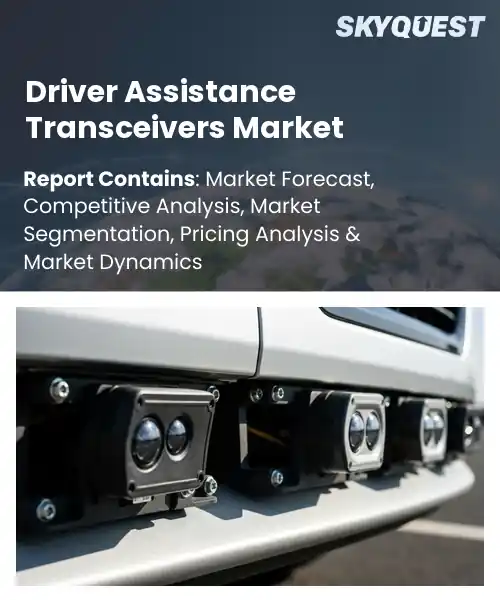
The global driver assistance transceivers industry consists of RF modules and communication devices which provide sensing capability and vehicle-to-everything connectivity for advanced driver assistancesystems. The market holds importance because transceivers transform sensor signals into usable information which decreases accidents while supporting the path to full vehicle autonomy. The industry progressed from basic ultrasonic parking sensors and 24 GHz radars to advanced 77 GHz millimeter-wave systems and C-V2X radio technologies which include Continental automotive radar modules and Qualcomm V2X systems as industry examples.
Moreover, the global driver assistance transceivers market growth is driven because suppliers responded to regulatory pressure while customers wanted better safety which determined supplier system design and system design decisions for their operations. The main development driver for the business stemmed from high-frequency transceiver technology which enables enhanced ADAS functionalities through its improved detection capabilities that stem from increased detection range and resolution. The introduction of 77 GHz radars and cellular V2X radios by automakers results in improved detection capabilities which lead OEMs to implement adaptive cruise control systems and automatic emergency braking systems and lane-keeping assist systems across their entire model range. The combination of regulatory incentives and urban pilot programs in Europe and the United States and China leads to increased infrastructure investments and aftermarket retrofits which provide suppliers with opportunities to scale their production while decreasing unit costs through their modular transceiver system for commercial fleets and shared mobility services.
How is AI Enhancing Performance and Reliability in the Driver Assistance Transceivers Market?
Driver assistance transceivers use AI to improve their performance and reliability because AI processes signals and classifies data directly at the sensor edge. The system uses adaptive beamforming together with clutter suppression and model driven target recognition to enhance detection accuracy during rainy and heavy traffic conditions while reducing false alarms. The market now selects transceivers which integrate multiple transmit and receive channels with on-chip inference to achieve reduced latency while making module design easier. The technology enables automakers to implement advanced driver assistancefeatures in more vehicle models through sensor fusion technology which enhances accuracy and calibration efficiency while decreasing system complexity and maintenance time. In January 2026, Texas Instruments launched a single chip eight by eight four-dimensional imaging radar transceiver which provides enhanced on-chip processing speed for better early detection and simpler design of the module architecture to support faster ADAS implementation with improved system reliability.
Market snapshot - (2026-2033)
Global Market Size
USD 3.78 Billion
Largest Segment
Radar Systems
Fastest Growth
Lidar Systems
Growth Rate
13.6% CAGR
To get more insights on this market click here to Request a Free Sample Report
The global driver assistance transceivers market is segmented based on technology type, vehicle type, application, distribution channel, and region. By technology type, the market is categorized into radar systems, lidar systems, and others. Based on vehicle type, the market is segmented into passenger vehicles and commercial vehicles. In terms of application, the market includes adaptive cruise control (ACC), lane departure warning (LDW), lane keeping assist (LKA), blind spot detection (BSD), parking assistance, autonomous driving, and others. Based on distribution channel, the market is divided into automotive OEMs and the aftermarket. Regionally, the market is segmented into North America, Europe, Asia Pacific, Latin America, and the Middle East & Africa.
According to the global driver assistance transceivers market analysis, the radar systems segment dominates because automotive grade radar delivers robust long-range detection and reliable performance in varied environmental conditions, enabling critical functions like adaptive cruise and blind spot detection. The established supplier base shows cost-effective scalability which leads to OEM integration because customers trust proven reliability while decreasing development costs through proven technology. The technology serves as the essential foundation for transceiver systems which enable continuous development of sensor fusion algorithms through their use in every vehicle platform, leading to widespread radar system adoption.
However, the lidar systems category experiences rapid growth because solid-state technology development enables more companies to create products which need high precision depth sensing systems which permit high-level autonomous operation. The technology attracts investments because it helps users handle difficult urban situations through its ability to work with multiple sensor types.
As per the global driver assistance transceivers market forecast, the adaptive cruise control system which is present in most modern vehicles has become the leading driver assistance transceiver product because drivers want better vehicle comfort and safety features. The highway driving experience benefits ACC systems because they automatically adjust vehicle speed to maintain a safe distance from surrounding vehicles. Automakers are increasingly installing ACC in mid-range and luxury cars which has resulted in the technology achieving strong market adoption while it remains the top global driving assistance system.
Whereas the maximum driver assistance transceivers, market share is predicted to be from autonomous driving systems because sensor technology and artificial intelligence and vehicle automation technology develop at an accelerating pace. The rising investments from automakers and software companies into self-driving systems research are creating faster progress in this field. The need for transceivers that enable autonomous driving functions will experience significant growth because of government regulations that support autonomous driving and increasing public interest in advanced transportation solutions.
To get detailed segments analysis, Request a Free Sample Report
As per the driver assistance transceivers market regional forecast, the automobile business keeps Asia Pacific as the top region because it has its manufacturing plants at one spot and multiple suppliers and it implements technology throughout all its key markets. Manufacturing hubs use advanced sensor and communication system supplier networks to enhance their design-to-production processes while reducing their implementation of obstacles. Consumers prefer connected mobility solutions which drive demand for advanced driver assistance systems while regional OEMs choose to develop vehicles with multiple advanced features. The semiconductor ecosystem combines module assembly and software development to create an environment which enables fast transceiver solution development based on local needs. The market grows because vehicle safety policies and testing infrastructure spending create a beneficial environment. The region becomes the main center for driver assistance transceiver development because of its manufacturing power and innovative research capacity and its complete automotive electronics ecosystem.
The Japanese driver assistance transceivers sector receives benefits from local manufacturers who create demand along with superior semiconductor technology and strong system integrator partnerships with automotive producers. The existing supply chains enable businesses to create high-quality transceiver modules which meet demanding safety requirements through fast prototyping and large-scale production. The local market encourages developers to create small yet powerful solutions through its focus on miniaturization and integration. The combination of engineering talent and testing facilities allows for ongoing development of communication systems that will be used in complex driver assistance system installations.
The South Korean driver assistance transceivers market penetration relies on its strong electronics manufacturing capabilities and advanced semiconductor foundries and its close partnership between suppliers and car manufacturers. The industry develops new products because users demand both fast network connections and optimal RF signal performance, which creates a crucial requirement for both module design and thermal control solutions. The collaborative ecosystems enable fast transceiver component integration with vehicle electronic systems. The government and industry work together to develop smart mobility solutions which will create dependable systems for advanced driver assistance technologies.
The North American market grows quickly because technology innovations and OEMs who build advanced safety systems and automotive technology partnerships create three main forces that drive growth. The automotive industry uses advanced driver assistance systems in their mainstream models, which creates a continuous requirement for transceiver components that can operate multiple sensor networks. The supplier ecosystem together with manufacturing tiers and software development teams enables quick vehicle electronic system integration for communication modules. The market adopts dependable transceiver solutions because active testing of self-driving features and vehicle safety procedures creates demand for them.
The driver assistance transceivers industry in the United States operates through a complete system which connects car manufacturers with technology firms while maintaining extensive facilities for testing and developing software-based electronic systems. People need better sensor systems which also deliver dependable connections, so transceiver designers must create systems with stronger reliability and better performance against latency. The supplier's partnerships together with modular design processes enable businesses to move quickly through the validation and production phases. The market favors flexible solutions which can serve multiple vehicle platforms while meeting new safety requirements.
The Canadian Driver Assistance Transceivers Market gains advantages from its location near car manufacturers and engineers who develop sensor integration methods and system testing procedures. The research centers and supplier networks create an environment which helps businesses develop transceiver modules that will work under different climatic and regulatory conditions. The design process focuses on achieving reliability and electromagnetic compatibility as the top design priority. The suppliers use local aftermarket and retrofit activities to improve their solutions which they develop for different types of vehicles while obeying safety regulations in their area.
Europe establishes its strength because it uses strict safety regulations together with its manufacturing capabilities for original equipment manufacturers and its promotion of industry-wide standards. The regional testing protocols ensure all transceiver technologies will function properly in different vehicle designs. The existing automotive hubs deliver extensive supplier networks together with specialized knowledge about electromagnetic compatibility and functional safety and secure communication systems. The collaboration between car manufacturers and their suppliers and research facilities together with telecommunications companies helps create customized transceiver systems needed for various transportation needs. The organization bolsters its engineering capabilities by investing in testing facilities and pilot projects and workforce training programs. European companies use these conditions to create new products while following industry rules which let them produce transceiver systems that fulfill both demands and regulatory standards. The practical use of technology in the market grows because of rising demand from the aftermarket and technology partnerships with startups. European transceiver solutions gain additional value from their vehicle control system connections and their focus on energy efficient operations.
The driver assistance transceiver market within Germany exists because premium automotive manufacturers together with established supply chains and advanced safety system development expertise create a strong market foundation. The module specifications and validation system development process receive guidance from fundamental safety requirements together with electromagnetic compatibility requirements. Local tier suppliers design high-reliability systems which work perfectly with advanced vehicle electronic systems. The combination of research programs and testing facilities enables businesses to develop products that meet demands in the market.
The driver assistance transceiver market in the United Kingdom exists because of strong software engineering skills and the technology sector and the close cooperation between automotive manufacturers and telecommunications companies. The vehicle development process unifies many features because it combines rapid prototyping with software-defined vehicle operating systems. The specialized suppliers work on three main activities which include system integration and product testing and validation work in multiple operational environments. Advanced transceiver solutions will deploy successfully across all vehicle segments because of research initiatives and programs which establish strict interoperability and safety standards.
The driver assistance transceiver market in France utilizes two main resources which include automotive engineering expertise and research partnerships between electronics companies and automotive research facilities that study sensor fusion and communication reliability. The national innovation hubs function as development centers which help create transceiver modules that fit multiple vehicle configurations and operational requirements. The suppliers develop products which provide both electromagnetic compatibility and durable construction for use in demanding work environments. The combined efforts of OEMs and research centers with suppliers lead to the quicker validation and implementation of transceiver technology which meets local safety requirements and interoperability standards.
To know more about the market opportunities by region and country, click here to
Buy The Complete Report
Increasing Integration with Vehicle Systems
The increasing integration between driver assistance transceivers and vehicle systems helps maintain uninterrupted signal transmission while simplifying interface operations which leads automakers to create common component systems across different vehicle models. The system achieves perfect integration which allows sensors to communicate with control units and actuators, enabling improved system performance and enhanced safety perception. The close alignment with vehicle architectures enables manufacturers and suppliers to easily install and maintain the system while strengthening their relationships with OEMs and making it easier for manufacturers to adopt the product because they can solve engineering problems which lets them create new vehicle models to expand their market presence.
Advancements in Communication Technologies
The function of driver assistance transceivers has expanded because of advances in wireless communication systems and technology that allows transceiver components to become smaller and stronger electromagnetic compatibility. The technological advancements enhance device reliability with superior performance across various driving conditions, which makes the products more appealing to automotive manufacturers and component suppliers. The growing system capabilities enable system architects to create advanced safety systems which will work with transceivers in multiple vehicle categories thus driving market expansion through greater product acceptance.
Complexity In System Integration and Certification
The design process becomes more difficult, and the project schedule extends longer because vehicle platforms need different transceiver integration methods and regional standards create multiple challenges which make it hard for smaller suppliers to deliver products. The engineering requirements for the project increase because the team needs to establish efficient electronic system links with existing systems, and they must comply with strict safety and electromagnetic interference standards. Manufacturers see their risk levels increase because operational challenges create problems that need safety testing and development work to be resolved. The global driver assistance transceivers market experiences slow growth because this situation creates multiple challenges that limit manufacturers' ability to enter new markets and their capacity for fast business expansion.
Limited Standardization Across Vehicle Platforms
The supply chain for driver assistance transceivers faces difficulties because their existing standards remain uncoordinated, and the industry has yet to establish standard connection points. Manufacturers face uncertainties when they choose solutions which must comply with different protocols and connector types because this situation will require additional development work that hinders their ability to implement solutions across multiple vehicle lines. The market structure has developed in a way that supports custom solutions while it forces vendors to invest more in product development, which results in higher integration expenses and fewer benefits from economies of scale. The situation creates a barrier which prevents vendors from making decisions about large-scale production investments, which leads to delays in market development and general product adoption.
Request Free Customization of this report to help us to meet your business objectives.
The global driver assistance transceivers market shows its competitive situation which exists because semiconductor integration and market consolidation are happening. Tier 1 suppliers and chipmakers use their specific merger and acquisition activities together with their product development efforts to achieve customer design wins from original equipment manufacturers. Renesas acquired Steradian 4D radar IP through its acquisition, while Velodyne merged with Ouster. Indie Semiconductor developed 120 gigahertz radar transceiver technology to create high resolution cabin sensing systems.
Enhanced Sensor Fusion: Automotive systems depend on multi-sensor fusion to enhance their environmental perception accuracy, which drives the need for transceivers that enable synchronized data transmission between radar, lidar, camera and ultrasonic systems with minimal delay. The trend promotes suppliers to develop products that achieve redundancy along with better object classification and smoother sensor handoffs between different devices. Sensor manufacturers now collaborate with transceiver vendors to design scalable systems which can handle new algorithms while still powering continuous upgrades throughout various operational environments.
Edge Processing Adoption: Manufacturers increasingly adopt edge processing technology for driver assistance transceivers, which allows them to decrease latency while reducing their dependency on centralized systems through real-time object detection and onboard decision-making at the sensor node. Localized computers enhance privacy protection while maintaining operational effectiveness through their bandwidth efficiency. The market requires transceiver products which combine communication capabilities with computing functions because they must deliver power-efficient hardware solutions together with integrated security systems and flexible software frameworks. Automotive manufacturers use ecosystem partnerships with both semiconductor and software developers to enable them to expand system functionality through vehicle system integration and across various vehicle models.
SkyQuest’s ABIRAW (Advanced Business Intelligence, Research & Analysis Wing) is our Business Information Services team that Collects, Collates, Correlates, and Analyses the Data collected by means ofPrimary Exploratory Research backed by robust Secondary Desk research.
As per SkyQuest analysis, the global driver assistance transceivers market expands because two drivers need to be mentioned: first, the rapid advancement and standardization of high-frequency transceiver technology, which acts as the market's main driver and second, the increasing adoption of AI-enabled edge processing, which enhances detection ability while decreasing latency and enabling sensor fusion. Cross-platform system integration and certification challenges stand as the primary obstacle, which causes delays in system adoption across different platforms. Asia Pacific dominates the market because it contains concentrated manufacturing facilities and supplier networks, whereas Radar Systems leads the industry because it provides dependable long-range detection capabilities at economical prices that OEMs have chosen to adopt. The market favors integrated modular transceivers, which fulfill emerging safety and regulatory requirements.
| Report Metric | Details |
|---|---|
| Market size value in 2024 | USD 3.78 Billion |
| Market size value in 2033 | USD 11.91 Billion |
| Growth Rate | 13.6% |
| Base year | 2024 |
| Forecast period | (2026-2033) |
| Forecast Unit (Value) | USD Billion |
| Segments covered |
|
| Regions covered | North America (US, Canada), Europe (Germany, France, United Kingdom, Italy, Spain, Rest of Europe), Asia Pacific (China, India, Japan, Rest of Asia-Pacific), Latin America (Brazil, Rest of Latin America), Middle East & Africa (South Africa, GCC Countries, Rest of MEA) |
| Companies covered |
|
| Customization scope | Free report customization with purchase. Customization includes:-
|
To get a free trial access to our platform which is a one stop solution for all your data requirements for quicker decision making. This platform allows you to compare markets, competitors who are prominent in the market, and mega trends that are influencing the dynamics in the market. Also, get access to detailed SkyQuest exclusive matrix.
Table Of Content
Executive Summary
Market overview
Parent Market Analysis
Market overview
Market size
KEY MARKET INSIGHTS
COVID IMPACT
MARKET DYNAMICS & OUTLOOK
Market Size by Region
KEY COMPANY PROFILES
Methodology
For the Driver Assistance Transceivers Market, our research methodology involved a mixture of primary and secondary data sources. Key steps involved in the research process are listed below:
1. Information Procurement: This stage involved the procurement of Market data or related information via primary and secondary sources. The various secondary sources used included various company websites, annual reports, trade databases, and paid databases such as Hoover's, Bloomberg Business, Factiva, and Avention. Our team did 45 primary interactions Globally which included several stakeholders such as manufacturers, customers, key opinion leaders, etc. Overall, information procurement was one of the most extensive stages in our research process.
2. Information Analysis: This step involved triangulation of data through bottom-up and top-down approaches to estimate and validate the total size and future estimate of the Driver Assistance Transceivers Market.
3. Report Formulation: The final step entailed the placement of data points in appropriate Market spaces in an attempt to deduce viable conclusions.
4. Validation & Publishing: Validation is the most important step in the process. Validation & re-validation via an intricately designed process helped us finalize data points to be used for final calculations. The final Market estimates and forecasts were then aligned and sent to our panel of industry experts for validation of data. Once the validation was done the report was sent to our Quality Assurance team to ensure adherence to style guides, consistency & design.
Analyst Support
Customization Options
With the given market data, our dedicated team of analysts can offer you the following customization options are available for the Driver Assistance Transceivers Market:
Product Analysis: Product matrix, which offers a detailed comparison of the product portfolio of companies.
Regional Analysis: Further analysis of the Driver Assistance Transceivers Market for additional countries.
Competitive Analysis: Detailed analysis and profiling of additional Market players & comparative analysis of competitive products.
Go to Market Strategy: Find the high-growth channels to invest your marketing efforts and increase your customer base.
Innovation Mapping: Identify racial solutions and innovation, connected to deep ecosystems of innovators, start-ups, academics, and strategic partners.
Category Intelligence: Customized intelligence that is relevant to their supply Markets will enable them to make smarter sourcing decisions and improve their category management.
Public Company Transcript Analysis: To improve the investment performance by generating new alpha and making better-informed decisions.
Social Media Listening: To analyze the conversations and trends happening not just around your brand, but around your industry as a whole, and use those insights to make better Marketing decisions.
REQUEST FOR SAMPLE
 REQUEST FREE CUSTOMIZATION
Global Driver Assistance Transceivers Market size was valued at USD 3.78 Billion in 2024 and is poised to grow from USD 4.29 Billion in 2025 to USD 11.91 Billion by 2033, growing at a CAGR of 13.6% during the forecast period (2026-2033).
Competitive landscape in the global driver assistance transceivers market is driven by semiconductor integration and consolidation, with Tier 1 suppliers and chipmakers executing targeted M&A and product differentiation to secure OEM design wins. Examples include Renesas acquiring Steradian for 4D radar IP and Velodyne merging with Ouster, while indie Semiconductor introduced a 120 gigahertz radar transceiver to advance in cabin high resolution sensing. 'Bosch', 'Continental Automotive', 'Denso', 'Aptiv', 'NXP Semiconductors', 'Texas Instruments', 'Intel', 'Valeo', 'Aurora Innovation', 'Mobileye', 'ZF Friedrichshafen', 'Harman International', 'Veoneer', 'Renesas Electronics', 'Infineon Technologies', 'Magna International', 'Qualcomm', 'Kongsberg Automotive', 'Analog Devices', 'RadiaWave'
Increasing integration of driver assistance transceivers with vehicle systems enhances signal continuity and reduces interface complexity, which encourages automakers to standardize these components across platforms. Seamless integration enables reliable communication between sensors, control units, and actuators, improving system responsiveness and perceived safety. This close alignment with vehicle architectures simplifies installation and maintenance for manufacturers and suppliers, fosters stronger OEM partnerships, and supports broader adoption by easing engineering challenges and accelerating incorporation into new models, thereby contributing to steady market expansion.
Enhanced Sensor Fusion: Automotive systems increasingly rely on multi-sensor fusion to deliver more accurate and reliable environmental perception, driving demand for transceivers that support synchronized, low-latency data exchange among radar, lidar, camera and ultrasonic modules. This trend emphasizes redundancy, improved object classification and smoother sensor handoffs, encouraging suppliers to prioritize interoperability, software-defined flexibility and robust timing mechanisms. Collaboration between sensor manufacturers and transceiver vendors is growing to enable scalable architectures that accommodate evolving algorithms and enable continuous functional upgrades across varied operating conditions.
Why does Asia Pacific Dominate the Global Driver Assistance Transceivers Market? |@12


Want to customize this report? This report can be personalized according to your needs. Our analysts and industry experts will work directly with you to understand your requirements and provide you with customized data in a short amount of time. We offer $1000 worth of FREE customization at the time of purchase.
Feedback From Our Clients


 USA (+1) 351-333-4748

