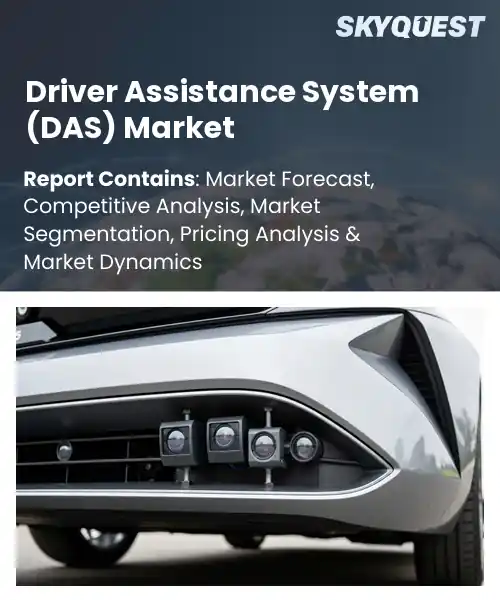
Driver Assistance System (DAS) Market
Report ID: SQMIG50B2062
Report ID: SQMIG50B2062
[email protected]
USA +1 351-333-4748
Report ID:
SQMIG50B2062 |
Region:
Global |
Published Date: June, 2026
Pages:
157
|Tables:
113
|Figures:
77


Global Driver Assistance System (Das) Market size was valued at USD 3.5 Billion in 2024 and is poised to grow from USD 3.72 Billion in 2025 to USD 6.07 Billion by 2033, growing at a CAGR of 6.3% during the forecast period (2026-2033).
As a research analyst I view the driver assistance system market as a maturing segment of automotive electronics that embeds radar, lidar, cameras, and software to automate or assist driving tasks, enhancing safety and convenience. Its importance stems from measurable reductions in accidents, regulatory pressure and consumer demand for mobility, so manufacturers and suppliers invest to differentiate vehicles. Historically the market evolved from basic cruise control and ABS in the 1990s to adaptive cruise control and lane-keeping aids in the 2000s and now toward sensor fusion and over-the-air updates, illustrated by Tesla Autopilot, Bosch emergency braking, and Mobileye’s vision-based solutions.Advances in sensors and computational platforms represent the pivotal factor driving DAS market expansion globally because cheaper radar, high-resolution cameras, and processors enable robust sensor fusion and machine learning inference in production vehicles. As costs decline and algorithms improve, automakers can deploy higher-level functions such as highway pilot, junction assist, and automated parking which accelerate consumer uptake and justify supplier scale investments. This cascade creates downstream opportunities for software monetization, aftermarket retrofits, and insurance telematics, illustrated by NVIDIA DRIVE enabling OEM pilots, Mobileye REM crowd-sourced mapping, and fleets adopting driver-assist suites to reduce operating risk and total cost of ownership.
How is AI enhancing safety and functionality in the driver assistance system market?
AI is improving safety and functionality in driver assistance systems by strengthening perception prediction and decision making. Key aspects include multi sensor fusion for robust detection deep learning for scene understanding continuous fleet learning and driver monitoring that links gaze and behavior to road context. The current state is practical integration of AI into assisted driving to reduce human error and improve comfort. Automakers and tier one suppliers are embedding software driven AI stacks that support continuous improvement and personalized behavior. Real world examples such as Mobileye driver monitoring programs and Bosch AI supported cockpits show how these advances increase system reliability and user acceptance.NVIDIA June 2026, unveiled the Alpamayo 2 Super reasoning model which can be distilled to run on vehicle compute platforms. This development brings higher order reasoning to driver assistance which helps handle rare scenarios reduces false interventions and speeds validation and deployment thereby supporting market growth and operational efficiency.
Market snapshot - (2026-2033)
Global Market Size
USD 3.5 Billion
Largest Segment
Advanced DAS
Fastest Growth
Advanced DAS
Growth Rate
6.3% CAGR
To get more insights on this market click here to Request a Free Sample Report
Global driver assistance system (das) market is segmented by types of systems, end-user industries, technological features, sales channels and region. Based on types of systems, the market is segmented into Advanced DAS and Basic DAS. Based on end-user industries, the market is segmented into Passenger Vehicles and Commercial Vehicles. Based on technological features, the market is segmented into Sensor Technologies and AI Integration. Based on sales channels, the market is segmented into Direct Sales and Online Sales. Based on region, the market is segmented into North America, Europe, Asia Pacific, Latin America and Middle East & Africa.
Advanced DAS segment dominates because automakers and fleet operators prioritize higher automation levels to deliver notable safety improvements and distinct feature sets, prompting widespread inclusion in new vehicle lines. This preference drives supplier investment in complex integration and validation, strengthens OEM supplier relationships, and creates a feedback loop where perceived value and regulatory alignment encourage further feature refinement and ecosystem partnerships that reinforce market leadership.
However, Basic DAS is the most rapidly expanding area as cost sensitive buyers and high volume models push demand for dependable, lower complexity safety features. Simpler architectures shorten time to market and lower integration barriers, prompting broader adoption by vehicle makers and opening channels for scaled production and subsequent feature upgrades that drive continued market expansion.
Sensor Technologies segment leads because multimodal sensing establishes the perceptual backbone required for consistent detection and classification across varied driving conditions, enabling more sophisticated functions to operate reliably. Supplier focus on sensor robustness and incremental performance gains drives system confidence, which compels automakers to standardize sensor suites, fostering tighter integration, richer feature sets, and durable platform demand that underpins market growth.
Meanwhile, AI Integration is emerging as the key high growth area as machine learning enables predictive decision making, sensor fusion and adaptive control, unlocking advanced perception and new software defined features. This draws investment from software partners and tier suppliers, accelerating iterative improvements and opening recurring revenue streams tied to algorithm upgrades and over the air enhancements.
To get detailed segments analysis, Request a Free Sample Report
Asia Pacific dominates the global Driver Assistance System (DAS) market through a convergence of industry strengths that reinforce scale, innovation and supply chain resilience. Established automotive manufacturers and a dense network of component suppliers enable rapid commercialization of advanced sensing and software functions. Strong domestic demand for vehicle safety and connectivity stimulates iterative product refinement, while local semiconductor and sensor capabilities reduce lead times and cost. Collaborative ecosystems among original equipment manufacturers, tier suppliers and research institutions accelerate system integration and validation. Regional testing and regulatory frameworks that encourage deployment of driver assistance features further support adoption. Moreover, service infrastructure and growing aftermarket channels enhance feature availability and maintenance support across urban and peri urban markets.
Driver Assistance System (DAS) Market Japan benefits from indigenous OEM leadership, advanced sensor suppliers and deep vehicle electronics expertise. Focus on precision engineering and user experience produces highly integrated systems suited to dense urban environments. Cooperative development between automakers and technology firms yields proprietary software and validation processes. Supportive regulatory attitudes toward safety features and consumer demand for sophisticated functionality promote refinement and incorporation of DAS across domestic vehicle lineups.
Driver Assistance System (DAS) Market South Korea leverages strong semiconductor and electronics manufacturing, enabling tight integration of sensing and processing elements with vehicle platforms. Emphasis on connectivity, human machine interface sourcing supports sophisticated system architectures tailored to savvy consumers. Strategic collaboration among automakers, component suppliers and research centers accelerates software development and validation. Government emphasis on mobility innovation and dense urban deployment scenarios catalyze adoption and enhancement of DAS features.
Rapid expansion of the Driver Assistance System (DAS) market in North America is propelled by a blend of technological ambition, collaborative ecosystems and market readiness. A mature automotive industry combined with strong presence of software and semiconductor firms enables accelerated integration of advanced perception, control and connectivity functions. Consumer preference for enhanced safety and convenience drives OEMs to accelerate feature rollout, while aftermarket and fleet operators seek scalable solutions. Public and private testing infrastructure along with clearer safety guidance streamlines validation pathways. Close partnerships between automakers, tier suppliers and technology companies foster modular architectures and software centric development. An emphasis on interoperability, supplier diversification and service ecosystems supports faster adoption across passenger and commercial vehicle segments, reinforcing the region center of innovation and deployment.
Driver Assistance System (DAS) Market United States benefits from a dense ecosystem of automakers, technology firms and software developers that prioritize sensor fusion and advanced perception. Fleet operators and aftermarket channels create demand for reliable solutions, while testbeds and private sector investment enable continuous improvement. Emphasis on centric interfaces and compatibility with connected mobility frameworks supports varied deployment pathways. Strong supplier networks and integration expertise accelerate commercialization and market acceptance.
Driver Assistance System (DAS) Market Canada is shaped by a focus on safety, varied road environments and collaborative industry research that inform practical DAS features. OEMs and suppliers emphasize durability, sensor calibration for diverse climates and integration with telematics for fleet management. Provincial and federal dialogues around vehicle safety encourage uptake, while growing network of testing facilities supports refinement. Partnerships between automakers, universities and technology firms accelerate innovation and deployments.
Europe is strengthening its position in the Driver Assistance System (DAS) market through concentrated efforts in regulation, engineering excellence and cross border collaboration. Established automotive manufacturers and sophisticated tier supplier networks prioritize system safety, redundancy and functional integration, driving high quality architectures. Regional policy dialogue and harmonized safety criteria create clearer pathways for certification and market entry, encouraging consistent feature implementation. Focus on diverse sensing modalities, robust localization and human machine interaction reflects commitment to real world usability. Collaborative research initiatives and pan European supply chains facilitate scalable production and shared validation resources. Additionally, integration with urban mobility strategies and emphasis on retrofitable and service oriented models expand reach across passenger and commercial segments, reinforcing Europe role in advanced driver assistance development.
Driver Assistance System (DAS) Market Germany leverages engineering heritage, major automakers and specialized suppliers to produce advanced DAS architectures. Focus on functional safety, system reliability and precise sensor calibration enables robust performance across varied driving scenarios. Collaboration among manufacturers, component developers and research institutes supports rigorous validation and high integration standards. Emphasis on premium user experience and scalable production reinforces Germany role as leading European hub for driver assistance technologies.
Driver Assistance System (DAS) Market United Kingdom leverages strengths in software development, research and a technology sector to advance DAS capabilities. Focus on human machine interaction, cybersecurity and resilient system design promotes differentiated features. Collaboration among OEMs, universities and mobility service providers enables validation across urban and rural conditions. Policy emphasis on safety standards and support for innovation strengthens local development and commercialization of adaptable, software defined driver assistance solutions.
Driver Assistance System (DAS) Market France blends engineering tradition with expertise in connectivity, mapping and urban mobility solutions to refine DAS offerings. Emphasis on localization, perception in complex traffic and integration with traffic management systems shapes practical deployments. Cooperation among automakers and suppliers supports extensive testing for urban use cases. Commitment to interoperability and servicing promotes scalable adoption across domestic vehicle fleets and strengthens regional collaboration in driver assistance development.
To know more about the market opportunities by region and country, click here to
Buy The Complete Report
Advancements In Sensor Technologies
Regulatory Support For Safety Systems
High System Development Costs
Data Privacy And Security Concerns
Request Free Customization of this report to help us to meet your business objectives.
Competition in the global Driver Assistance System market is accelerating as OEM demand for integrated L2 plus functions and stricter safety regulations push suppliers into consolidation, strategic tie ups, and targeted technology buys. High profile moves include Harman’s planned acquisition of ZF’s ADAS unit and MicroVision’s purchase of Luminar assets, while collaborations such as Aeva with Bendix and indie Semiconductor’s bolt on deals reflect sensor and perception consolidation.
Top Player’s Company Profile
Recent Developments
SkyQuest’s ABIRAW (Advanced Business Intelligence, Research & Analysis Wing) is our Business Information Services team that Collects, Collates, Correlates, and Analyses the Data collected by means of Primary Exploratory Research backed by robust Secondary Desk research. As per SkyQuest analysis, the Global Driver Assistance System market is driven primarily by advancements in sensor technologies that enable robust sensor fusion and higher automation, and further supported by AI integration improving perception and decision making. The market faces a key restraint in high system development costs that limit adoption in lower priced segments. Asia Pacific emerges as the dominating region due to manufacturing scale, supplier networks and strong domestic demand, while Advanced DAS is the dominating segment as OEMs prioritize higher automation and safety differentiation. Continued regulatory emphasis on safety and aftermarket monetization will shape near term deployment and product strategies.
| Report Metric | Details |
|---|---|
| Market size value in 2024 | USD 3.5 Billion |
| Market size value in 2033 | USD 6.07 Billion |
| Growth Rate | 6.3% |
| Base year | 2024 |
| Forecast period | (2026-2033) |
| Forecast Unit (Value) | USD Billion |
| Segments covered |
|
| Regions covered | North America (US, Canada), Europe (Germany, France, United Kingdom, Italy, Spain, Rest of Europe), Asia Pacific (China, India, Japan, Rest of Asia-Pacific), Latin America (Brazil, Rest of Latin America), Middle East & Africa (South Africa, GCC Countries, Rest of MEA) |
| Companies covered |
|
| Customization scope | Free report customization with purchase. Customization includes:-
|
To get a free trial access to our platform which is a one stop solution for all your data requirements for quicker decision making. This platform allows you to compare markets, competitors who are prominent in the market, and mega trends that are influencing the dynamics in the market. Also, get access to detailed SkyQuest exclusive matrix.
Table Of Content
Executive Summary
Market overview
Parent Market Analysis
Market overview
Market size
KEY MARKET INSIGHTS
COVID IMPACT
MARKET DYNAMICS & OUTLOOK
Market Size by Region
KEY COMPANY PROFILES
Methodology
For the Driver Assistance System (DAS) Market, our research methodology involved a mixture of primary and secondary data sources. Key steps involved in the research process are listed below:
1. Information Procurement: This stage involved the procurement of Market data or related information via primary and secondary sources. The various secondary sources used included various company websites, annual reports, trade databases, and paid databases such as Hoover's, Bloomberg Business, Factiva, and Avention. Our team did 45 primary interactions Globally which included several stakeholders such as manufacturers, customers, key opinion leaders, etc. Overall, information procurement was one of the most extensive stages in our research process.
2. Information Analysis: This step involved triangulation of data through bottom-up and top-down approaches to estimate and validate the total size and future estimate of the Driver Assistance System (DAS) Market.
3. Report Formulation: The final step entailed the placement of data points in appropriate Market spaces in an attempt to deduce viable conclusions.
4. Validation & Publishing: Validation is the most important step in the process. Validation & re-validation via an intricately designed process helped us finalize data points to be used for final calculations. The final Market estimates and forecasts were then aligned and sent to our panel of industry experts for validation of data. Once the validation was done the report was sent to our Quality Assurance team to ensure adherence to style guides, consistency & design.
Analyst Support
Customization Options
With the given market data, our dedicated team of analysts can offer you the following customization options are available for the Driver Assistance System (DAS) Market:
Product Analysis: Product matrix, which offers a detailed comparison of the product portfolio of companies.
Regional Analysis: Further analysis of the Driver Assistance System (DAS) Market for additional countries.
Competitive Analysis: Detailed analysis and profiling of additional Market players & comparative analysis of competitive products.
Go to Market Strategy: Find the high-growth channels to invest your marketing efforts and increase your customer base.
Innovation Mapping: Identify racial solutions and innovation, connected to deep ecosystems of innovators, start-ups, academics, and strategic partners.
Category Intelligence: Customized intelligence that is relevant to their supply Markets will enable them to make smarter sourcing decisions and improve their category management.
Public Company Transcript Analysis: To improve the investment performance by generating new alpha and making better-informed decisions.
Social Media Listening: To analyze the conversations and trends happening not just around your brand, but around your industry as a whole, and use those insights to make better Marketing decisions.
REQUEST FOR SAMPLE
 REQUEST FREE CUSTOMIZATION


Want to customize this report? This report can be personalized according to your needs. Our analysts and industry experts will work directly with you to understand your requirements and provide you with customized data in a short amount of time. We offer $1000 worth of FREE customization at the time of purchase.
Feedback From Our Clients


 USA (+1) 351-333-4748

