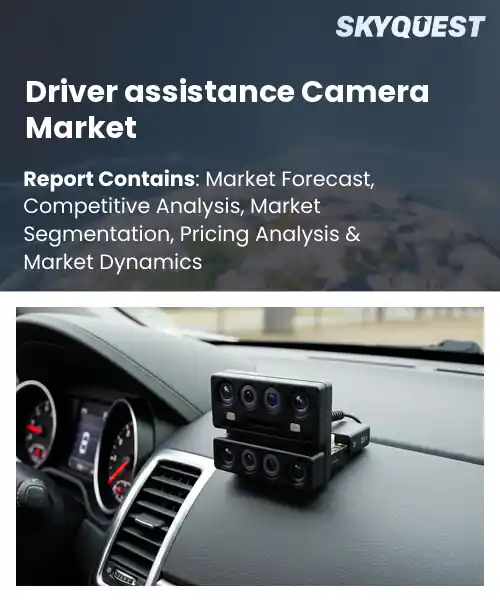
Driver assistance Camera Market
Report ID: SQMIG25E2004
Report ID: SQMIG25E2004
[email protected]
USA +1 351-333-4748
Report ID:
SQMIG25E2004 |
Region:
Global |
Published Date: February, 2026
Pages:
157
|Tables:
142
|Figures:
78


Global Driver Assistance Camera Market size was valued at USD 54.2 Billion in 2024 and is poised to grow from USD 58.48 Billion in 2025 to USD 107.45 Billion by 2033, growing at a CAGR of 7.9% during the forecast period (2026-2033).
Growing demand for vehicle safety features, rising adoption of advanced driver assistance systems (ADAS), increasing regulatory pressure for road safety, advancements in automotive imaging technologies, and expanding integration of camera-based perception systems are driving sales of driver assistance cameras.
Driver assistance camera systems are important because they help reduce accident rates, improve driver awareness, and support the transition toward automated driving. As sensor resolution improves and neural network processing on edge automotive chips advances, vehicle manufacturers are expanding camera coverage to meet evolving safety standards from organizations such as Euro NCAP and NHTSA. Real-world applications including fleet telematics for driver behavior monitoring, urban pedestrian detection in dense traffic environments, and automated parking systems are demonstrating measurable safety and operational benefits. These developments are also creating opportunities for aftermarket retrofits, software-based safety features, validation services, and sensor fusion platforms. Growing consumer demand for enhanced vehicle safety and increasing regulatory requirements for advanced safety technologies are expected to primarily drive driver assistance camera market growth. Regulatory programs such as Euro NCAP safety ratings and early adoption of camera-based driving systems by companies like Tesla have further accelerated global deployment.
On the contrary, high development and integration costs, challenges related to performance in poor lighting or extreme weather conditions, data privacy concerns, and complex validation requirements for autonomous driving technologies are anticipated to slow down driver assistance camera market penetration going forward.
How is AI Improving Detection Accuracy in the Driver Assistance Camera Market?
AI is improving detection accuracy in the driver assistance camera market by combining advanced neural networks with sensor fusion and optimized edge computing. ADAS platforms run convolutional and transformer-based models on dedicated automotive system-on-chips (SoCs). This allows cameras to more accurately detect pedestrians, cyclists, vehicles, and traffic signs while reducing false alerts. As a result, driver assistance systems are evolving from simple warning features to predictive safety actions and smoother lane support.
In January 2026, Mobileye showcased AI-driven vision updates at CES, highlighting stronger integration between software and automotive chips to improve detection reliability. This advancement helps automakers deploy camera-based driver assistance systems with greater confidence while reducing false alerts and simplifying large-scale production deployment.
Market snapshot - (2026-2033)
Global Market Size
USD 54.2 Billion
Largest Segment
Monocular Cameras
Fastest Growth
360-Degree Cameras
Growth Rate
7.9% CAGR
To get more insights on this market click here to Request a Free Sample Report
Global driver assistance camera market is segmented by camera type, technology, application, end user, sensor integration, and region. Based on camera type, the market is segmented into monocular cameras, stereo cameras, and 360-degree cameras. Based on technology, the market is segmented into haptic feedback, vision processing, and machine learning. Based on application, the market is segmented into passenger vehicles, commercial vehicles, and electric vehicles. Based on end user, the market is segmented into OEMs and aftermarket players. Based on sensor integration, the market is segmented into radar integration and LiDAR integration. Based on region, the market is segmented into North America, Europe, Asia Pacific, Latin America, and Middle East & Africa.
The monocular cameras segment is projected to account for the highest global driver assistance camera market share going forward. The cost-effective, compact, and easily integrated optical platform nature of these cameras is helping this segment hold sway over others. Their simpler hardware and lower processing burden enable widespread fitment across vehicle lines, supporting lane departure, traffic sign recognition and basic object detection. Broad supply chain maturity and compatibility with existing electronic architectures cause OEM preference, which in turn drives economies of scale and entrenches monocular designs in mainstream ADAS deployments.
However, the stereo cameras segment is witnessing the strongest growth as per this driver assistance camera industry analysis going forward. Surge in demand for depth perception and robust object localization is promoting stereo camera adoption by OEMS. Advances in stereo algorithms and tighter sensor fusion improve performance in complex driving scenarios, accelerating the adoption of higher-value camera packages and enabling new advanced ADAS features.
The vision processing segment is slated to lead the global driver assistance camera market revenue generation over the coming years. The ability of this technology to offer core real-time image interpretation and low-latency decision pipelines is cementing its dominance going forward. The system converts raw camera footage into operational scene comprehension through its advanced vision stacks which create precise detection, tracking, and classification capabilities that work in different lighting conditions and on various road types. The technology functions as the primary component for safe and expandable ADAS systems because it requires vehicle computing systems to perform its vision processing functions with strict timing accuracy.
On the other hand, the machine learning segment is also emerging as a key high-growth segment with advances in neural models and data-driven perception for better accuracy and adaptability. Model compression for edge devices and better training data sets drive feature innovation to deliver better and updatable driver assistance capabilities to differentiate products and monetize aftermarket opportunities.
To get detailed segments analysis, Request a Free Sample Report
Presence of top automotive manufacturers, developed electronics supply chains, and demand for advanced vehicle safety features are boosting the demand for driver assistance cameras across Asia Pacific. OEMs in this region have already implemented driver assistance camera systems as a standard component of vehicles across all vehicle segments, therefore driving greater demand for driver assistance cameras through the use of camera systems from many leading local tier one suppliers and advanced semiconductor design capabilities. Growing collaboration between large automotive manufacturers, sensor manufacturers, and software developers has created an environment where designs can be rapidly localized, allowing the Asia Pacific to achieve larger economies of scale, quicker time-to-market, and to create technical standards that serve as major influences on both supply chains and standards in the rest of the world.
Presence of a mature automotive industry, established semiconductor and optics expertise, and close collaboration between manufacturers and research institutions help ensure sustained driver assistance camera demand in the country. The preference of Japanese automotive manufacturers for high reliability results in the adoption of high-resolution imaging and sensor calibration techniques. Emphasis on integration with vehicle control systems and maintainability, is expected to be of prime importance for driver assistance camera companies looking to make a mark in Japan through 2033.
Advanced electronics manufacturing, strong semiconductor design capability, and partnerships between technology firms and automakers influence driver assistance camera sales in South Korea. The country is globally recognized for its miniaturized optics, low-light performance, and software-defined imaging solutions. Rapid prototyping and testing culture in the country is also facilitating adoption of novel driver assistance cameras going forward.
The requirement for strict vehicle safety regulations together with the high consumer demand for retrofit solutions to driver assistance systems. The total investment in high-performance camera systems from established automotive manufacturers together with new technology companies. Automated software and cloud-based updates, along with fleet learning capabilities, are also being integrated with driver assistance cameras to expand their capabilities. Further, by working directly with research institutions and testing facilities, the OEMs and their partners are able to validate products in a multitude of climates and roadway conditions, which enhances the competitive position of the region with respect to system validation, customization, and commercialization. The growing demand for active safety features and convenience features from consumers has forced original equipment manufacturers to develop complete camera product systems as their top priority. OEMs have established major strategic alliances with chip manufacturers and sensor production companies to enable their extensive manufacturing operations and create unique products through camera technologies.
Presence of major automakers, startups, and a mature aftermarket are helping boost driver assistance camera adoption in the United States. Software development, sensor fusion, and cloud infrastructure investments lead to sophisticated camera analysis capabilities. Robust test infrastructure and varied road conditions ensure rigorous camera system validation, whereas OEM and semiconductor company collaborations ensure the scaling of camera system production and integration for consumer usage.
A unique blend of OEM assembly operations, strong supplier networks, and a growing focus on safety retrofits are shaping driver assistance camera adoption across Canada. Local engineering resources are working with global companies to develop camera algorithms suitable for low-light and winter driving conditions. Governments are also promoting rigorous testing and international harmonization, enabling Canadian suppliers to offer camera module solutions suitable for the region’s driving habits.
Imposition of stringent safety regulation, leadership from established automotive manufacturers, and a coordinated approach to standardization are shaping driver assistance camera demand in this region. The integration of the camera with advanced vehicle control modules using harmonized sensors, which will help to create economies of scale and allow for cost-effective production. The presence of industry consortia and/or testing agencies creates a rigorous framework for validation that will address the broad range of road environments, including cross-border interoperability. Collaborative involvement by research organizations and telematics providers accelerate algorithm refinement and real-world calibration of machine vision systems, establishing Europe as a center of excellence in the development of high-quality assurance machine vision systems and systems engineering practice. The protection of privacy and the implementation of strict data governance policies will also impact on the design and deployment of automotive cameras.
Longstanding heritage of automotive engineering, extensive supplier networks, and advanced testing facilities make Germany a key market for driver assistance camera vendors. OEMs' focus on functional safety and integration results in cooperation with experts in optics or semiconductors. Local companies' focus on modular design and testing for a variety of driving situations, along with a high export orientation and connection to research institutions, help local suppliers offer camera systems for premium segments.
Increasing collaboration between OEM engineering centers with tech firms is shaping driver assistance camera demand in the United Kingdom. Emphasis on sensor fusion, data protection, and city mobility creates a customized camera solution for a congested city scenario. Investment in simulation testing facilities helps in refining camera algorithms for safety. University and research institution collaborations help in faster commercialization of camera-related innovations, making United Kingdom a leader in camera-based driver assistance integrators.
Emphasis on combining automotive engineering and electronics expertise to advance camera solutions is creating new business scope in the country. Suppliers focus on optics development, sensor calibration, and algorithm creation that meets European standards and urban transportation requirements. The ecosystem supports French companies in creating flexible camera systems which can be used across different vehicle types for international markets.
To know more about the market opportunities by region and country, click here to
Buy The Complete Report
Rising Regulatory Safety Standards
The increasing need for vehicle safety regulations together with crash avoidance requirements drives manufacturers to invest in advanced driver assistance camera systems. Changing compliance requirements lead original equipment manufacturers to focus on integration of advanced driver assistance cameras that enhance safety profiles and comply with regulations. Hence, evolving regulatory landscape and advancements in camera technologies are also expected to bolster the driver assistance camera market outlook through 2033.
Advances In Image Processing
Improvements in image processing algorithms and neural network architectures have led to better perception capabilities of cameras, facilitating better detection of pedestrians, lane markings, and traffic features in different conditions. The better performance of software increases reliability, reducing false alarms, making driver-assistance cameras an attractive option for automakers as well as consumers. The confidence in the reliability of camera-based systems is expected to drive adoption of these systems, encouraging supplier innovation, as well as cooperation among different software and hardware companies, hence creating new opportunities.
High Integration Complexity
Complexity in the integration of the systems can hinder the adoption process due to the challenges that come with the design, validation, and calibration processes, which require a lot of engineering effort to successfully execute the integration process. Cameras' integration with sensors, electronic control units, and vehicle networks requires a lot of expertise to execute the integration process successfully. This complexity increases the perceived implementation risk, which can hinder the adoption process due to the reluctance of the manufacturers to adopt the technology due to the complexity involved.
Cost Pressures On Manufacturers
Pressure on the manufacturing costs of the automakers might affect the adoption of cameras, as there might be a chance of increase in bill of materials, which might affect the price, as price is a major factor in this segment, and cost might be a concern for the consumer as well. The additional cost of integration of camera systems might affect the adoption of cameras, as the automakers might adopt cameras of low specifications. Ongoing cost pressures will impact purchase decisions and limit mid-tier vehicle sales, and force the industry to focus on cost optimization rather than expansion of functional scope.
Request Free Customization of this report to help us to meet your business objectives.
The competitive landscape for camera-based driver assistance is driven by strategic OEM alliances, targeted acquisitions and rapid edge AI innovation, as incumbents and new entrants race to embed perception software into camera stacks. Notable moves include Mobileye's broad OEM supply agreements. Here are a couple of startups that have the potential to transform the future of driver assistance cameras as per this driver assistance camera market analysis. DeepRoute.ai: The Chinese startup focuses on delivering camera first full stack perception and driving software for ADAS and robotaxi platforms. The 2019-founded company has raised a major Alibaba led growth round and expanded its product line with DeepRoute Driver iterations that bundle multi camera perception, compute platforms and map free localization to target OEM partnerships and urban fleet pilots, positioning the company as a competitive camera centric supplier versus legacy Tier 1s.
Ception Technologies: The 2016-founded company provides camera based precise localization, HD mapping and situational awareness software for heavy equipment and automotive ADAS integration. The United States-based startup has launched MineCept, a modular SaaS offering that runs on camera first hardware, won seed backing and an innovation grant, joined industry bodies to validate deployments in mining and construction, and began pilot integrations with OEMs and site operators to differentiate via vision centric mapping versus GNSS dependent approaches.
SkyQuest’s ABIRAW (Advanced Business Intelligence, Research & Analysis Wing) is our Business Information Services team that Collects, Collates, Correlates, and Analyses the Data collected by means of Primary Exploratory Research backed by robust Secondary Desk research.
As per SkyQuest analysis, rising demand for advanced driver assistance systems and increasing regulatory focus on vehicle safety are anticipated to drive the demand for driver assistance cameras going forward. However, high development and integration costs along with performance limitations in adverse weather and lighting conditions are slated to slow down the adoption of driver assistance cameras in the future. Asia Pacific is slated to spearhead the demand for driver assistance cameras owing to strict vehicle safety regulations, strong automotive manufacturing presence, and widespread adoption of ADAS technologies. Integration of AI-driven perception systems and expansion of camera-based safety features across mid-range vehicle models are anticipated to be key trends driving the driver assistance camera industry over the coming years.
| Report Metric | Details |
|---|---|
| Market size value in 2024 | USD 54.2 Billion |
| Market size value in 2033 | USD 107.45 Billion |
| Growth Rate | 7.9% |
| Base year | 2024 |
| Forecast period | (2026-2033) |
| Forecast Unit (Value) | USD Billion |
| Segments covered |
|
| Regions covered | North America (US, Canada), Europe (Germany, France, United Kingdom, Italy, Spain, Rest of Europe), Asia Pacific (China, India, Japan, Rest of Asia-Pacific), Latin America (Brazil, Rest of Latin America), Middle East & Africa (South Africa, GCC Countries, Rest of MEA) |
| Companies covered |
|
| Customization scope | Free report customization with purchase. Customization includes:-
|
To get a free trial access to our platform which is a one stop solution for all your data requirements for quicker decision making. This platform allows you to compare markets, competitors who are prominent in the market, and mega trends that are influencing the dynamics in the market. Also, get access to detailed SkyQuest exclusive matrix.
Table Of Content
Executive Summary
Market overview
Parent Market Analysis
Market overview
Market size
KEY MARKET INSIGHTS
COVID IMPACT
MARKET DYNAMICS & OUTLOOK
Market Size by Region
KEY COMPANY PROFILES
Methodology
For the Driver assistance Camera Market, our research methodology involved a mixture of primary and secondary data sources. Key steps involved in the research process are listed below:
1. Information Procurement: This stage involved the procurement of Market data or related information via primary and secondary sources. The various secondary sources used included various company websites, annual reports, trade databases, and paid databases such as Hoover's, Bloomberg Business, Factiva, and Avention. Our team did 45 primary interactions Globally which included several stakeholders such as manufacturers, customers, key opinion leaders, etc. Overall, information procurement was one of the most extensive stages in our research process.
2. Information Analysis: This step involved triangulation of data through bottom-up and top-down approaches to estimate and validate the total size and future estimate of the Driver assistance Camera Market.
3. Report Formulation: The final step entailed the placement of data points in appropriate Market spaces in an attempt to deduce viable conclusions.
4. Validation & Publishing: Validation is the most important step in the process. Validation & re-validation via an intricately designed process helped us finalize data points to be used for final calculations. The final Market estimates and forecasts were then aligned and sent to our panel of industry experts for validation of data. Once the validation was done the report was sent to our Quality Assurance team to ensure adherence to style guides, consistency & design.
Analyst Support
Customization Options
With the given market data, our dedicated team of analysts can offer you the following customization options are available for the Driver assistance Camera Market:
Product Analysis: Product matrix, which offers a detailed comparison of the product portfolio of companies.
Regional Analysis: Further analysis of the Driver assistance Camera Market for additional countries.
Competitive Analysis: Detailed analysis and profiling of additional Market players & comparative analysis of competitive products.
Go to Market Strategy: Find the high-growth channels to invest your marketing efforts and increase your customer base.
Innovation Mapping: Identify racial solutions and innovation, connected to deep ecosystems of innovators, start-ups, academics, and strategic partners.
Category Intelligence: Customized intelligence that is relevant to their supply Markets will enable them to make smarter sourcing decisions and improve their category management.
Public Company Transcript Analysis: To improve the investment performance by generating new alpha and making better-informed decisions.
Social Media Listening: To analyze the conversations and trends happening not just around your brand, but around your industry as a whole, and use those insights to make better Marketing decisions.
REQUEST FOR SAMPLE
 REQUEST FREE CUSTOMIZATION
Global Driver Assistance Camera Market size was valued at USD 54.2 Billion in 2024 and is poised to grow from USD 58.48 Billion in 2025 to USD 107.45 Billion by 2033, growing at a CAGR of 7.9% during the forecast period (2026-2033).
The competitive landscape for camera based driver assistance is driven by strategic OEM alliances, targeted acquisitions and rapid edge AI innovation, as incumbents and new entrants race to embed perception software into camera stacks. Notable moves include Mobileye's broad OEM supply agreements and China focused startups scaling through Alibaba backed funding, reflecting partnerships and product iteration as primary competitive levers. 'Mobileye', 'Bosch', 'Continental', 'Aptiv', 'Denso', 'Valeo', 'ZF Friedrichshafen', 'Harmon', 'Intel', 'NXP Semiconductors', 'STMicroelectronics', 'Ambarella', 'Omnivision', 'Sensory Inc.', 'Panasonic', 'Texas Instruments', 'Delphi Technologies', 'ON Semiconductor', 'Capanina', 'NVIDIA'
Rising regulatory mandates for vehicle safety and crash avoidance encourage manufacturers to incorporate driver assistance cameras across new models, prompting broader adoption and integration into mainstream vehicle platforms. Compliance requirements motivate OEMs to prioritize camera-based systems during design cycles, resulting in expanded deployment and supplier investments. This regulatory influence fosters a predictable market pull for camera solutions, supporting ecosystem development, increasing supplier scale, and accelerating technology maturation, which in turn strengthens market momentum and creates favorable conditions for continued growth.
Expanding Sensor Fusion: Automotive manufacturers and suppliers are increasingly integrating camera data with radar and lidar streams to create resilient perception stacks. This fusion delivers richer scene understanding, redundancy for adverse conditions, and enhanced object classification, enabling higher levels of driver assistance and interaction with vehicle control systems. The shift drives investment in sensor calibration, synchronized software architectures, and scalable compute platforms, encouraging collaboration between semiconductor providers, software developers, and OEMs to commercialize perception solutions that support feature differentiation and improved occupant safety.
Presence of top automotive manufacturers, developed electronics supply chains, and demand for advanced vehicle safety features are boosting the demand for driver assistance cameras across Asia Pacific.


Want to customize this report? This report can be personalized according to your needs. Our analysts and industry experts will work directly with you to understand your requirements and provide you with customized data in a short amount of time. We offer $1000 worth of FREE customization at the time of purchase.
Feedback From Our Clients


 USA (+1) 351-333-4748

