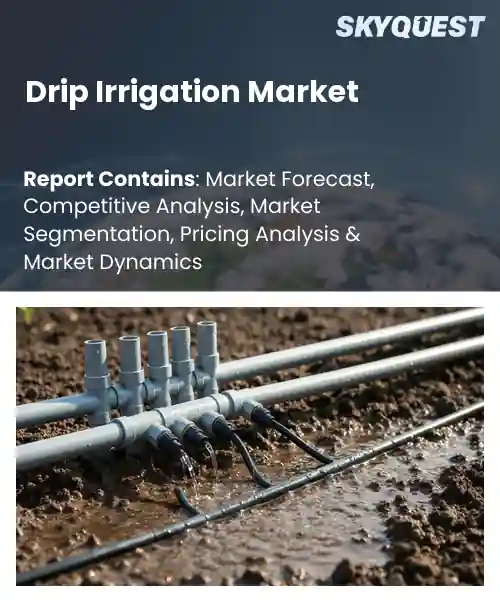
Drip Irrigation Market
Report ID: SQMIG20H2081
Report ID: SQMIG20H2081
[email protected]
USA +1 351-333-4748
Report ID:
SQMIG20H2081 |
Region:
Global |
Published Date: February, 2026
Pages:
175
|Tables:
88
|Figures:
71


Global Drip Irrigation Market size was valued at USD 7.1 Billion in 2024 and is poised to grow from USD 7.65 Billion in 2025 to USD 13.84 Billion by 2033, growing at a CAGR of 7.7% during the forecast period (2026-2033).
Aggravating global water scarcity is now a major issue facing the world’s agricultural sector, and farmers will increasingly need to turn to more efficient irrigation systems to make the best use of this limited resource. Along with increased frequency of drought events resulting from climate change, farmers have been forced to reduce their water table levels in economically critical agricultural regions due to over-extraction from aquifers. Traditional methods of irrigation have a significant amount of water that evaporates, seeps away or does not evenly distribute throughout the soil, resulting in reduced efficiency of crop production. On the other hand, drip irrigation has greatly diminished these water losses because it provides accurate and defined amounts of water to the plants’ root zone, thus offering complete moisture control and efficiency in water usage.
Government initiatives aimed at agricultural modernization play a critical role in expanding the drip irrigation market revenue. Micro-irrigation is being seen by policy makers as a viable means of conserving water, providing food security and stabilizing rural incomes. Subsidizing the costs of these systems via grants, loans with low interest rates and reimbursement programs provides a significant opportunity for many small and marginal farmers to utilize drip irrigation. In parallel, extension programs and digital agriculture initiatives improve awareness and technical knowledge. This cause, policy-backed financial and institutional support, produces the effect of faster technology penetration, higher adoption rates, and sustained demand for drip irrigation systems, reinforcing long-term market growth.
How does AI-Supported Fertigation Reduce Crop Loss?
AI enhances drip irrigation by turning raw data into precise water-management actions. Sensors, remote sensing, and IoT feed AI models real-time soil moisture, weather forecasts, and crop-growth data; the cause richer, continuous data enables the effect automated, demand-driven irrigation schedules and variable-rate dosing that cut water use and raise yields. Predictive analytics spot stress before visible symptoms, prompting preemptive irrigation or fertigation and reducing crop loss. As a related development, integrated decision-support platforms bundle AI, satellite imagery, and farm management software, causing faster farmer adoption by simplifying system control and proving ROI, which in turn accelerates market uptake of smart drip solutions.
In March 2024, Global irrigation expert, NETAFIM, has developed an AI-based digital farming system that combines real-time data analytics, current weather conditions and soil moisture sensors to help farmers efficiently schedule drip irrigation and maximise the efficiency of their water use. With the assistance of this AI system, farmers can now automate and improve the precision of how they deliver their farm water, reduce water waste, and increase crop yields.
Market snapshot - 2026-2033
Global Market Size
USD 8.02 Billion
Largest Segment
Inline Emitters
Fastest Growth
Online Emitters
Growth Rate
9.78% CAGR
To get more insights on this market click here to Request a Free Sample Report
Global Drip Irrigation Market is segmented by System Type, Component Type, Crop Type, End User and region. Based on System Type, the market is segmented into Surface Drip, Subsurface Drip and On-Farm. Based on Component Type, the market is segmented into Emitters, Pipes and Tubing and Filters. Based on Crop Type, the market is segmented into Fruits and Vegetables, Field Crops and Ornamental Plants. Based on End User, the market is segmented into Agricultural, Commercial and Residential. Based on region, the market is segmented into North America, Europe, Asia Pacific, Latin America and Middle East & Africa.
Current innovation in inline emitters focuses on pressure-compensating designs, anti-clogging labyrinth paths, and durable materials that ensure uniform water discharge across long drip lines. Uniform emitters widespread adoption results from consistent spacing, ease of installation, compatibility with row cropping on a large scale and the major benefits of high flow uniformity, less labor and maintenance expense and the ability to irrigate with precision on a large scale, making them well suited for the commercial agricultural sector and water savings farming systems.
Online emitters will grow fastest in the global drip irrigation industry because they offer flexible placement and customizable flow rates, adapting to varied crop types and field layouts. Their simple retrofitting, affordability for orchards and vegetable production, and enhanced clog-resistant designs contribute to widespread acceptance of these systems, particularly by smallholder and diversified farms that require precise water application.
Surface drip irrigation innovations focus on low-cost, pressure-compensating laterals and smart control valves that optimize water delivery directly above the soil, minimizing setup complexity. The surface method has become the dominant method used worldwide. This is primarily due to its reduced labor needs, improved efficiency of water use, and adaptability to many different field types. In addition, the surface irrigation method has become the most popular method of applying water in countries where cost-effective precision irrigation is of primary concern.
Sub-surface drip irrigation is poised for fastest growth because it reduces evaporation, minimizes weed growth, and enhances root-zone moisture precision, boosting yields and water efficiency. While there are benefits from integrating sensors into subsurface systems, farmers are adopting more automated controls and farmers in water-scarce areas as well as in many areas of technological advances are seeing an increase in demand for subsurface systems on the rise rapidly.
To get detailed segments analysis, Request a Free Sample Report
North America represents a mature yet innovation-driven region in the global drip irrigation market regional analysis, supported by large-scale commercial farming and advanced precision agriculture practices. Water scarcity across the western United States is substantial and combined with limited allowable water usage encourages more farmers to adopt smart irrigation because of increased understanding and improved farming mechanization utilizing IoT and AI. As farmers become more aware of the importance of smart irrigating systems, the resulting increase in adoption maintains constant growth in this area of the agricultural industry.
The United States is the largest contributor to North America’s drip irrigation market regional forecast, due to extensive commercial agriculture and persistent water stress, especially in western states. Increasing implementation of government conservation programs, farm mechanisation as well as the need to produce higher yields in drought-prone areas are major contributing factors to the expanding use of drip irrigation systems for all field crop, orchard and horticultural type farming activities.
Canada’s contribution is driven by the growing adoption of drip irrigation in greenhouse farming, specialty crops, and high-value horticulture. As there is a growing trend towards an increase in investment in Controlled Environment Agriculture (CEA), Water Conservation Efforts or Initiatives, and Modern Irrigation Infrastructure, the overall market will continue to grow steadily in Provinces focusing on sustainable and technology driven agriculture.
Asia Pacific represents the fastest-growing region in the global drip irrigation market regional outlook, driven by large agricultural economies and increasing water stress. Government subsidies for water-efficient farming, increased awareness of water-efficient farming, and the expanding production of horticulture are supporting the speedy uptake of this innovation. Continuing to grow in both smallholder and commercial farming as well as the increasing adoption of low-cost drip systems is driving continued growth of the marketplace but will continue to do so through an increasing combination of smart irrigation systems being integrated into the above systems.
Japan’s contribution to the Asia Pacific drip irrigation market statistics is driven by advanced agricultural technology adoption and the need to optimize productivity on limited arable land. Current technology provides districts with an opportunity to improve water use efficiency through the implementation of robotic irrigation systems. These innovations allow drip irrigation practices to be used by the majority, as well as in several other states across the country.
South Korea contributes through rapid adoption of smart agriculture and controlled-environment farming. Greenhouses and specialty crop growers are using drip irrigation systems more regularly, due to a lack of labor availability, combined with the need for more effective use of resources. Additionally, many government-sponsored smart farming initiatives and an ever-growing investment in automated irrigation and fertigation systems will help to continue the upward momentum for the market throughout the U.S.
Europe’s drip irrigation market strategies are expanding as farmers increasingly adopt water-efficient solutions to combat drought and stringent environmental regulations. Spain and Italy are among the leading countries when it comes to the number of field deployments of these technologies in vineyards, orchards and horticulture and Spain and Italy also have significant levels of government support for the development of innovative precision irrigation systems through national and European Union funding. As such, there continues to be an ongoing demand for these technologies throughout Southern Europe, and this will continue to drive market growth in traditional and high-value crops.
Germany’s contribution to Europe’s drip irrigation market penetration is driven by its strong emphasis on agricultural efficiency, technology adoption, and sustainability. Regarding precision Ag products, Germany is at the forefront when it comes to developing and deploying advanced irrigation controls with smart sensors and managing water resources efficiently using automated methods. Investment in automated systems and climate-resilient practices creates an ongoing demand for drip systems in particular; however, most of this growth is coming from horticultural, greenhouse, and high-value specialty crops.
France plays a significant role due to extensive cultivation of vineyards, orchards, and specialty crops that require precise water management. Farmers are increasingly using drip irrigation to get the most out of their yields and meet state water conservation laws due to climate variability and the number of times they have been hit by droughts. The use of government-sponsored sustainability programmes and the modernisation of irrigation infrastructure are also increasing the amount of drip irrigation used on farms throughout the southern and western parts of the US.
The UK’s contribution is centered on controlled-environment agriculture, horticulture, and greenhouse farming rather than large-scale field irrigation. Drip irrigation is increasingly used to improve water efficiency, nutrient delivery, and crop consistency amid unpredictable rainfall patterns. Increasing investment in smart farming technologies and sustainable water use practices help drive slow, steady, and continued adoption of drip irrigation systems over time throughout many large commercial farms.
To know more about the market opportunities by region and country, click here to
Buy The Complete Report
Rising Water Scarcity and Climate Variability
Demand for Higher Crop Yields and Farm Profitability
Limited Awareness and Knowledge Gaps Among Farmers
Fragmented Land Holdings and Infrastructure Constraints
Request Free Customization of this report to help us to meet your business objectives.
The global drip irrigation market trends are moderately consolidated, with competition centered on technology innovation, geographic expansion, and integrated irrigation solutions. International players with the most impact currently are Netafim, Jain Irrigation, Rain Bird, and The Toro Co. Netafim focuses on using Digital and AI solutions for their irrigation products while Jain focuses on providing cost-efficient systems for the emerging markets. Rain Bird and Toro both are now utilizing more sophisticated controllers but have also built extensive distribution networks and now provide value added services to enhance their respective market positions.
The startup landscape of the global drip irrigation market share is increasingly innovation-driven, shaped by water scarcity, energy constraints, and demand for precision farming. The current trend for new companies to enter the agriculture markets has been driven by resource scarcity and the need for greater efficiencies through innovations in solar-powered systems, Ultra Low-Pressure Drip Technology (ULPDT), and data-driven irrigation automation. The combination of these factors has led to an increase in the number of affordable, scalable and smart drip solutions that are rapidly established particularly in developing markets and climate-vulnerable regions as complements to existing supplies from established irrigation companies.
SkyQuest’s ABIRAW (Advanced Business Intelligence, Research & Analysis Wing) is our Business Information Services team that Collects, Collates, Correlates, and Analyses the Data collected by means of Primary Exploratory Research backed by robust Secondary Desk research.
As per SkyQuest analysis, the global drip irrigation market growth is transitioning from a water-saving alternative to a core pillar of modern, resilient agriculture. The increasing scarcity of water and its variable climatic conditions coupled with increased demand for increased productivity will lead to the structural transformation of irrigation practices globally. The growing adoption of Agricultural Technologies (AgTech), along with increasing investment from governments, NGOs and International Development Agencies (IDAs) is creating the environment for farmers of all sizes to implement AgTech solutions and by adopting AgTech solutions across all sizes of farms.
The advancements being made across segment-specific emitter designs and methods of application, as well as by region, show the growth of the technology in all forms within the Asia Pacific region while also illustrating that North America and Europe continue to lead technologically with a steadier rate of growth. In addition, while there are still significant challenges facing drip irrigation (awareness and infrastructure), innovative solutions from both established manufacturers and start-ups are accelerating adoption of drip irrigation technologies globally, thereby ensuring that all nations will ultimately be able to access sustainable food supplies in the future.
| Report Metric | Details |
|---|---|
| Market size value in 2024 | USD 7.1 Billion |
| Market size value in 2033 | USD 13.84 Billion |
| Growth Rate | 7.7% |
| Base year | 2024 |
| Forecast period | 2026-2033 |
| Forecast Unit (Value) | USD Billion |
| Segments covered |
|
| Regions covered | North America (US, Canada), Europe (Germany, France, United Kingdom, Italy, Spain, Rest of Europe), Asia Pacific (China, India, Japan, Rest of Asia-Pacific), Latin America (Brazil, Rest of Latin America), Middle East & Africa (South Africa, GCC Countries, Rest of MEA) |
| Companies covered |
|
| Customization scope | Free report customization with purchase. Customization includes:-
|
To get a free trial access to our platform which is a one stop solution for all your data requirements for quicker decision making. This platform allows you to compare markets, competitors who are prominent in the market, and mega trends that are influencing the dynamics in the market. Also, get access to detailed SkyQuest exclusive matrix.
Table Of Content
Executive Summary
Market overview
Parent Market Analysis
Market overview
Market size
KEY MARKET INSIGHTS
COVID IMPACT
MARKET DYNAMICS & OUTLOOK
Market Size by Region
KEY COMPANY PROFILES
Methodology
For the Drip Irrigation Market, our research methodology involved a mixture of primary and secondary data sources. Key steps involved in the research process are listed below:
1. Information Procurement: This stage involved the procurement of Market data or related information via primary and secondary sources. The various secondary sources used included various company websites, annual reports, trade databases, and paid databases such as Hoover's, Bloomberg Business, Factiva, and Avention. Our team did 45 primary interactions Globally which included several stakeholders such as manufacturers, customers, key opinion leaders, etc. Overall, information procurement was one of the most extensive stages in our research process.
2. Information Analysis: This step involved triangulation of data through bottom-up and top-down approaches to estimate and validate the total size and future estimate of the Drip Irrigation Market.
3. Report Formulation: The final step entailed the placement of data points in appropriate Market spaces in an attempt to deduce viable conclusions.
4. Validation & Publishing: Validation is the most important step in the process. Validation & re-validation via an intricately designed process helped us finalize data points to be used for final calculations. The final Market estimates and forecasts were then aligned and sent to our panel of industry experts for validation of data. Once the validation was done the report was sent to our Quality Assurance team to ensure adherence to style guides, consistency & design.
Analyst Support
Customization Options
With the given market data, our dedicated team of analysts can offer you the following customization options are available for the Drip Irrigation Market:
Product Analysis: Product matrix, which offers a detailed comparison of the product portfolio of companies.
Regional Analysis: Further analysis of the Drip Irrigation Market for additional countries.
Competitive Analysis: Detailed analysis and profiling of additional Market players & comparative analysis of competitive products.
Go to Market Strategy: Find the high-growth channels to invest your marketing efforts and increase your customer base.
Innovation Mapping: Identify racial solutions and innovation, connected to deep ecosystems of innovators, start-ups, academics, and strategic partners.
Category Intelligence: Customized intelligence that is relevant to their supply Markets will enable them to make smarter sourcing decisions and improve their category management.
Public Company Transcript Analysis: To improve the investment performance by generating new alpha and making better-informed decisions.
Social Media Listening: To analyze the conversations and trends happening not just around your brand, but around your industry as a whole, and use those insights to make better Marketing decisions.
REQUEST FOR SAMPLE
 REQUEST FREE CUSTOMIZATION
Global Drip Irrigation Market size was valued at USD 8.02 Billion in 2025 and is expected to grow from USD 8.81 Billion in 2026 to USD 16.93 Billion by 2033, growing at a CAGR of 9.78% in the forecast period (2026-2033).
The global drip irrigation market trends are moderately consolidated, with competition centered on technology innovation, geographic expansion, and integrated irrigation solutions. International players with the most impact currently are Netafim, Jain Irrigation, Rain Bird, and The Toro Co. Netafim focuses on using Digital and AI solutions for their irrigation products while Jain focuses on providing cost-efficient systems for the emerging markets. Rain Bird and Toro both are now utilizing more sophisticated controllers but have also built extensive distribution networks and now provide value added services to enhance their respective market positions. 'Netafim (Israel)', 'Jain Irrigation Systems (India)', 'The Toro Company (USA)', 'Rain Bird (USA)', 'Rivulis (Israel)', 'Lindsay Corporation (USA)', 'Valmont Industries (USA)', 'Irritec (Italy)', 'AZUD (Spain)', 'Amiad Water Systems (Israel)', 'Chinadrip Irrigation (China)', 'Antelco (Australia)', 'Hunter Industries (USA)', 'Metzer (Israel)', 'Mahindra EPC Irrigation (India)'
Climate change is causing increased water shortages, groundwater depletion, and unpredictable rainfall patterns, so more farmers are turning toward more efficient means of irrigation. Drip irrigation is the most effective way to reduce both evaporation and runoff by applying water at the root zone. This efficiency enables farmers to maintain yields with less water, driving global drip irrigation market growth.
Expanding Use in High-Value and Specialty Crops: With the ability to precisely deliver both water and nutrients, drip irrigation is becoming increasingly popular among growers of vineyards, orchards, vegetables, and greenhouse crops. The accuracy of this system enhances the overall quality of crops and improves the consistency of crop yields. As growers are focusing on improving their profitability with premium products, the demand for advanced/modified form of drip irrigation are steadily increasing throughout the world.
Why do Limits on Allowable Water Usage Drive Smart Irrigation Adoption in North America?


Want to customize this report? This report can be personalized according to your needs. Our analysts and industry experts will work directly with you to understand your requirements and provide you with customized data in a short amount of time. We offer $1000 worth of FREE customization at the time of purchase.
Feedback From Our Clients


 USA (+1) 351-333-4748

