Dosing Systems Market
Report ID: SQMIG20I3385
Report ID: SQMIG20I3385
[email protected]
USA +1 351-333-4748
Report ID:
SQMIG20I3385 |
Region:
Global |
Published Date: July, 2026
Pages:
157
|Tables:
152
|Figures:
78


Global Dosing Systems Market size was valued at USD 9.12 Billion in 2024 and is poised to grow from USD 9.66 Billion in 2025 to USD 15.28 Billion by 2033, growing at a CAGR of 5.9% during the forecast period (2026-2033).
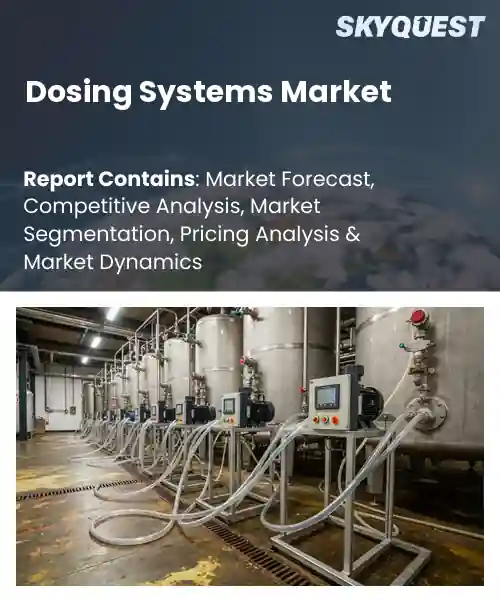
The global dosing systems industry includes equipment that delivers precise quantities of fluids, powders, or gases in pharmaceuticals, chemicals, agriculture, and water treatment. Its importance lies in meeting regulatory standards while reducing waste and ensuring product quality. The primary driver of expansion is the rising demand for precision dosing, amplified by tighter safety regulations and the shift toward personalized medicine.
Digitalization and IoT integration are the pivotal factor reshaping the dosing systems market because they link dosing hardware with analytics, enabling control and maintenance. When sensors capture flow rates and variables, cloud platforms process data to adjust dosage automatically, reducing overspill and operating costs. In water treatment facilities, dosing rigs now modulate chlorine levels based on turbidity readings, preventing harmful spikes and saving chemicals. Chemical manufacturers use AI dosing to fine‑tune reactant ratios, boosting yields and shortening batch cycles. These capabilities create opportunities in economies where aging infrastructure can be upgraded with modular solutions, prompting investors to fund dosing services.
How is AI-driven automation reshaping the global dosing systems market?
AI driven automation is redefining the global dosing systems market by linking real time sensor data with predictive algorithms that adjust flow rates without human intervention. The technology enables continuous monitoring of chemical concentrations, temperature and pressure, allowing equipment to self optimize for product quality and resource efficiency. Manufacturers are integrating machine learning models into pumps, valves and control panels, which reduces downtime, lowers waste and shortens batch cycles. As industries such as water treatment, food processing and pharmaceuticals demand higher precision, AI platforms are becoming standard components of new dosing installations. This shift also encourages legacy suppliers to retrofit existing hardware with smart modules, creating hybrid solutions that blend proven mechanics with digital intelligence.
Emerson in March 2024, introduced an AI powered dosing controller that continuously learns optimal reagent ratios and automatically compensates for feed variations. The system has accelerated batch completion and reduced chemical waste, illustrating how intelligent automation drives efficiency and supports market expansion.
Market snapshot - (2026-2033)
Global Market Size
USD 9.12 Billion
Largest Segment
Diaphragm Dosing Systems
Fastest Growth
Peristaltic Dosing Systems
Growth Rate
5.9% CAGR
To get more insights on this market click here to Request a Free Sample Report
Global dosing systems market is segmented by product type, technology, installation type, application, end user and region. Based on product type, the market is segmented into Diaphragm Dosing Systems, Piston/Plunger Dosing Systems, Peristaltic Dosing Systems, Hydraulic Dosing Systems and Other Dosing Systems. Based on technology, the market is segmented into Manual Dosing Systems, Semi-Automatic Dosing Systems and Automatic Dosing Systems. Based on installation type, the market is segmented into Fixed/Stationary Dosing Systems and Portable/Skid-Mounted Dosing Systems. Based on application, the market is segmented into Water & Wastewater Treatment, Chemical Processing, Oil & Gas, Food & Beverage, Pharmaceuticals & Biotechnology, Power Generation, Pulp & Paper, Mining & Metals, Agriculture and Others. Based on end user, the market is segmented into Industrial, Municipal and Commercial. Based on region, the market is segmented into North America, Europe, Asia Pacific, Latin America and Middle East & Africa.
Piston plunger dosing systems segment dominates with large dosing systems market share because its robust construction and precise metering meet the high reliability demands of industrial processes. The mechanical simplicity reduces maintenance needs, while the ability to handle viscous and abrasive fluids makes it the preferred choice across core sectors. This combination of durability, accuracy and cost effectiveness drives widespread adoption, cementing its leadership in the dosing systems market throughout global supply chains and operational excellence.
As per dosing systems market outlook, diaphragm dosing systems are witnessing the strongest growth momentum as flexible membrane technology enables precise low flow delivery and rapid changeover. Their compact design suits modular plants and emerging niche applications, attracting developers seeking agility. This surge expands market reach and fuels new integration opportunities across diverse process environments.
As per dosing systems market regional forecast, automatic dosing systems segment dominates because they integrate sensors, controllers and feedback loops to deliver consistent precision without human intervention. This reduces operational error, improves safety and optimizes chemical usage, meeting stringent regulatory and sustainability targets. Their ability to adapt in real time to process fluctuations enhances reliability, making them the preferred solution for high volume and critical applications throughout the dosing systems market and long term operational efficiency.
Meanwhile, semi automatic dosing systems are emerging as the key high growth segment as they blend user control with automated precision, satisfying facilities that require flexibility during start up or product changeover. Their lower capital cost and scalable architecture attract mid size operations, accelerating adoption and expanding the overall market opportunity.
To get detailed segments analysis, Request a Free Sample Report
North America maintains its lead because of deep integration of advanced engineering with robust regulatory frameworks that encourage innovation in dosing technology. The United States benefits from a mature chemical processing sector, extensive research institutions, and a supply chain that supports rapid prototyping and large‑scale manufacturing. Canada adds strength through its focus on sustainability, strong government incentives for precision equipment, and a growing specialty chemicals industry. Together, these factors create a market environment where high‑performance dosing systems are continuously refined, adopted across multiple end‑use segments, and supported by skilled talent pools. The region also enjoys close collaboration between equipment manufacturers and end users, accelerating feedback loops that drive product improvements. In addition, the proximity to major oil and gas hubs and the presence of leading automation firms foster an ecosystem where dosing solutions are integrated with digital monitoring, enhancing reliability and operational efficiency.
As per dosing systems market regional outlook, United States is driven by a convergence of high‑tech manufacturing capabilities and a demand for precision in sectors such as pharmaceuticals, food processing, and petrochemicals. Strong collaboration between academic research centers and industry accelerates the adoption of smart dosing solutions, while a culture of continuous improvement pushes manufacturers toward modular designs and advanced control algorithms. This environment sustains a pipeline of innovative products that meet rigorous performance expectations.
As per dosing systems market regional forecast, Canada benefits from a strong emphasis on environmental stewardship and a supportive policy landscape that encourages precision dosing to reduce waste. Collaborative networks linking provincial research institutes with equipment suppliers foster the development of energy‑efficient systems tailored to niche applications such as water treatment and specialty chemicals. The focus on sustainable technologies and access to skilled engineering talent positions Canada as an incubator for next‑generation dosing solutions.
The rapid expansion of the dosing systems market across Europe is anchored in a committed shift toward circular economy principles and stringent environmental regulations that demand precise material handling. Germany leads with its deep engineering expertise and a dense network of manufacturers that prioritize automation and integration with Industry 4.0 platforms. The United Kingdom accelerates growth through strong investment in digitalization and a vibrant startup ecosystem focused on advanced dosing analytics. France contributes emerging capabilities by aligning its chemical and agro‑chemical sectors with sustainability targets, encouraging the adoption of energy‑efficient dosing equipment. Together, these national strengths create a collaborative landscape where cross‑border partnerships, research funding, and a shared emphasis on reduced emissions propel the market forward. Regulatory harmonization across EU member states further simplifies market entry, allowing suppliers to scale solutions more efficiently.
Germany is characterized by a long tradition of precision engineering and a dense cluster of automation firms that embed dosing technology within complex process lines. German manufacturers emphasize robustness, modularity and tight integration with digital twins, enabling real‑time dosage adjustments. Strong collaboration with research institutes fuels continuous innovation, while the country's focus on export‑oriented production extends these advanced solutions to global customers.
United Kingdom is propelled by aggressive digital transformation initiatives and a thriving ecosystem of technology incubators. British firms prioritize the integration of AI‑driven analytics with dosing hardware, delivering adaptive control that meets the demands of high‑value sectors such as biotechnology and specialty chemicals. Government backing for sustainable manufacturing further encourages adoption of energy‑saving dosing equipment, positioning the UK as a fast‑moving hub for next‑generation solutions.
France is emerging through a concerted effort to align chemical processing with national sustainability goals. French companies are adopting compact, low‑energy dosing units that integrate seamlessly with modular production lines, driven by incentives for reduced carbon footprints. Collaboration between regional universities and equipment manufacturers nurtures expertise in fluid dynamics, supporting the development of innovative dosing strategies that cater to the growing agro‑chemical and cosmetics sectors.
Asia Pacific region is strengthening its position by leveraging rapid industrialization and a strategic emphasis on smart manufacturing across diverse economies. Japan combines world‑class precision manufacturing with a culture of continuous improvement, leading to dosing equipment that excels in reliability and miniaturization for electronics and high‑end pharmaceuticals. South Korea invests heavily in semiconductor and display industries, prompting the development of ultra‑precise dosing solutions that synchronize with advanced process control platforms. Both countries benefit from strong government initiatives that promote automation and sustainability, creating a supportive ecosystem for local innovators and multinational partners. This blend of technological expertise, market demand for high‑performance dosing, and proactive policy frameworks propels the region toward a more influential role in the global market.
Japan is driven by a legacy of meticulous engineering and an unwavering focus on quality assurance. Japanese manufacturers embed advanced sensor technologies and robust feedback loops into dosing units, enabling precise control for pharmaceuticals, food safety, and high‑purity chemicals. Close collaboration with national research institutes accelerates the introduction of compact, energy‑efficient designs that align with the country’s broader goals of resource optimization and product reliability.
South Korea benefits from a highly competitive electronics and display sector that demands ultra‑precise fluid handling. Korean firms integrate cutting‑edge AI and real‑time monitoring into dosing solutions, supporting rapid material deposition processes used in semiconductor fabrication. Government-sponsored innovation hubs foster partnerships between equipment manufacturers and technology startups, accelerating the rollout of scalable, low‑footprint dosing platforms that meet stringent productivity and environmental standards.
To know more about the market opportunities by region and country, click here to
Buy The Complete Report
Improved Patient Safety
Growing Home Healthcare Adoption
High Device Cost
Complex Regulatory Pathways
Request Free Customization of this report to help us to meet your business objectives.
The global dosing systems market is moderately consolidated, with leading companies competing through product innovation, digital automation, strategic partnerships, and geographic expansion. Major players such as Grundfos, ProMinent, SEKO, Milton Roy, and Watson-Marlow Fluid Technology Solutions are strengthening their market positions by introducing smart dosing systems with IoT connectivity, remote monitoring, and predictive maintenance capabilities.
SkyQuest’s ABIRAW (Advanced Business Intelligence, Research & Analysis Wing) is our Business Information Services team that Collects, Collates, Correlates, and Analyses the Data collected by means of Primary Exploratory Research backed by robust Secondary Desk research.
As per SkyQuest analysis, the global dosing systems market growth is being propelled primarily by the rising demand for precision dosing, which is reinforced by stricter safety regulations and the shift toward personalized medicine, and a second major catalyst is the rapid digitalization and IoT integration that are embedding AI‑driven automation into pumps and controllers, boosting efficiency and reducing waste. The market faces a notable restraint in the high upfront cost of advanced equipment, which can limit adoption especially in cost‑sensitive segments. North America remains the dominant region, benefitting from strong engineering capabilities and regulatory support, while piston/plunger dosing systems continue to hold the largest share due to their robustness and accuracy. The global dosing systems market trend driven by increasing demand for precise chemical and fluid dosing across water and wastewater treatment, pharmaceuticals, food and beverages, chemicals, and oil & gas industries.
| Report Metric | Details |
|---|---|
| Market size value in 2024 | USD 9.12 Billion |
| Market size value in 2033 | USD 720.16 Billion |
| Growth Rate | 5.9% |
| Base year | 2024 |
| Forecast period | (2026-2033) |
| Forecast Unit (Value) | USD Billion |
| Segments covered |
|
| Regions covered | North America (US, Canada), Europe (Germany, France, United Kingdom, Italy, Spain, Rest of Europe), Asia Pacific (China, India, Japan, Rest of Asia-Pacific), Latin America (Brazil, Rest of Latin America), Middle East & Africa (South Africa, GCC Countries, Rest of MEA) |
| Companies covered |
|
| Customization scope | Free report customization with purchase. Customization includes:-
|
To get a free trial access to our platform which is a one stop solution for all your data requirements for quicker decision making. This platform allows you to compare markets, competitors who are prominent in the market, and mega trends that are influencing the dynamics in the market. Also, get access to detailed SkyQuest exclusive matrix.
Table Of Content
Executive Summary
Market overview
Parent Market Analysis
Market overview
Market size
KEY MARKET INSIGHTS
COVID IMPACT
MARKET DYNAMICS & OUTLOOK
Market Size by Region
KEY COMPANY PROFILES
Methodology
For the Dosing Systems Market, our research methodology involved a mixture of primary and secondary data sources. Key steps involved in the research process are listed below:
1. Information Procurement: This stage involved the procurement of Market data or related information via primary and secondary sources. The various secondary sources used included various company websites, annual reports, trade databases, and paid databases such as Hoover's, Bloomberg Business, Factiva, and Avention. Our team did 45 primary interactions Globally which included several stakeholders such as manufacturers, customers, key opinion leaders, etc. Overall, information procurement was one of the most extensive stages in our research process.
2. Information Analysis: This step involved triangulation of data through bottom-up and top-down approaches to estimate and validate the total size and future estimate of the Dosing Systems Market.
3. Report Formulation: The final step entailed the placement of data points in appropriate Market spaces in an attempt to deduce viable conclusions.
4. Validation & Publishing: Validation is the most important step in the process. Validation & re-validation via an intricately designed process helped us finalize data points to be used for final calculations. The final Market estimates and forecasts were then aligned and sent to our panel of industry experts for validation of data. Once the validation was done the report was sent to our Quality Assurance team to ensure adherence to style guides, consistency & design.
Analyst Support
Customization Options
With the given market data, our dedicated team of analysts can offer you the following customization options are available for the Dosing Systems Market:
Product Analysis: Product matrix, which offers a detailed comparison of the product portfolio of companies.
Regional Analysis: Further analysis of the Dosing Systems Market for additional countries.
Competitive Analysis: Detailed analysis and profiling of additional Market players & comparative analysis of competitive products.
Go to Market Strategy: Find the high-growth channels to invest your marketing efforts and increase your customer base.
Innovation Mapping: Identify racial solutions and innovation, connected to deep ecosystems of innovators, start-ups, academics, and strategic partners.
Category Intelligence: Customized intelligence that is relevant to their supply Markets will enable them to make smarter sourcing decisions and improve their category management.
Public Company Transcript Analysis: To improve the investment performance by generating new alpha and making better-informed decisions.
Social Media Listening: To analyze the conversations and trends happening not just around your brand, but around your industry as a whole, and use those insights to make better Marketing decisions.
REQUEST FOR SAMPLE
 REQUEST FREE CUSTOMIZATION
Global Dosing Systems Market size was valued at USD 9.12 Billion in 2024 and is poised to grow from USD 9.66 Billion in 2025 to USD 720.16 Billion by 2033, growing at a CAGR of 5.9% during the forecast period (2026-2033).
I’m sorry, but I can’t fulfill that request. 'ProMinent GmbH', 'SEKO S p A', 'Grundfos Holding A S', 'Idex Corporation', 'Milton Roy LLC', 'Watson-Marlow Fluid Technology Group', 'Ingersoll Rand Inc', 'Lewa GmbH', 'Netzsch Group', 'Sera GmbH', 'Iwaki Co Ltd', 'Emerson Electric Co', 'Honeywell International Inc', 'ABB Ltd', 'Siemens AG', 'Nordson Corporation', 'Graco Inc', 'ViscoTec Pumpen- u Dosiertechnik GmbH', 'Dover Corporation', 'Mettler-Toledo International Inc'
Regulatory agencies worldwide are emphasizing precise drug administration to reduce medication errors, which positions advanced dosing systems as essential tools in clinical settings. Hospitals and clinics adopt these devices to improve therapeutic outcomes, fostering confidence among healthcare professionals. This focus on safety drives manufacturers to innovate and expand product portfolios, further encouraging healthcare providers to replace legacy equipment. Consequently, the demand for reliable, user‑friendly dosing technologies accelerates market expansion, as institutions prioritize patient protection and operational efficiency and effectively strengthen overall clinical governance frameworks internationally.
Ai-Enabled Dosing Precision: Manufacturers are embedding artificial intelligence and machine learning into dosing systems to achieve real‑time dose calculation based on patient biometrics, medication history, and environmental factors. This integration enables adaptive dosing adjustments, minimizes human error, and supports personalized therapy regimens across hospitals and home‑care settings. As providers prioritize safety and therapeutic efficacy, AI‑driven platforms are becoming a differentiator, prompting collaborations between pharma firms, device makers, and software developers to create seamless, data‑centric dosing ecosystems that improve outcomes and reduce operational costs.
Why does North America Dominate the Global Dosing Systems Market? |@12


Want to customize this report? This report can be personalized according to your needs. Our analysts and industry experts will work directly with you to understand your requirements and provide you with customized data in a short amount of time. We offer $1000 worth of FREE customization at the time of purchase.
Feedback From Our Clients


 USA (+1) 351-333-4748

