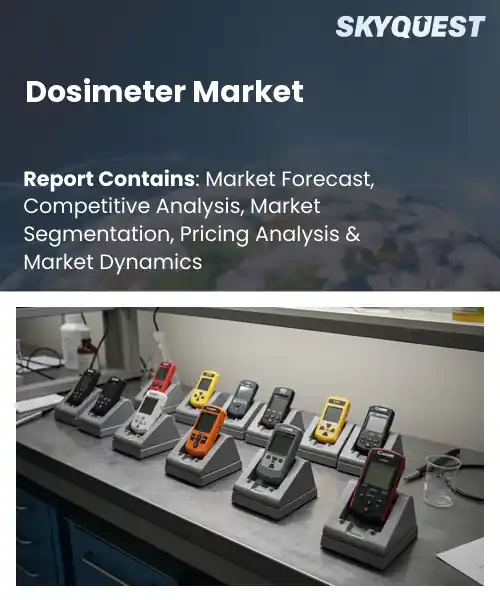
Dosimeter Market
Report ID: SQMIG45J2564
Report ID: SQMIG45J2564
[email protected]
USA +1 351-333-4748
Report ID:
SQMIG45J2564 |
Region:
Global |
Published Date: June, 2026
Pages:
157
|Tables:
115
|Figures:
77


Global Dosimeter Market size was valued at USD 4.35 Billion in 2024 and is poised to grow from USD 4.66 Billion in 2025 to USD 8.15 Billion by 2033, growing at a CAGR of 7.23% during the forecast period (2026-2033).
I view the dosimeter market as a specialized segment supplying instruments that measure and record ionizing radiation exposure, protecting workers, patients and the public. The primary driver has been expanding medical imaging together with tighter occupational safety regulations, which compel hospitals, nuclear facilities and industrial radiography firms to monitor cumulative dose accurately. Over decades the market shifted from film badges and pocket ion chambers to thermoluminescent dosimeters to electronic active devices with data logging and network connectivity. That technological progression responds to demands for faster, more accurate readings and stronger regulatory traceability, as radiology departments adopt digital monitoring systems globally.Building on that technological shift, digitization and connectivity have become the pivotal growth factor because real time dose tracking enables compliance, efficiency and proactive risk management, which persuades institutions to invest. For example hospitals that deploy wireless personal dosimeters linked to EHRs can reduce staff exposure while streamlining workflow and documenting audits; nuclear facilities that use networked area monitors gain faster situational awareness during maintenance and decommissioning; emergency response teams mapping exposures with GPS devices can prioritize evacuations. As these use cases lower liability and operational cost, demand rises and manufacturers expand into analytics, cloud services and emerging global markets.
How is IoT enabling real-time monitoring in the dosimeter market?
Internet of Things is enabling real time monitoring in the dosimeter market by linking wearable detectors and area monitors to wireless networks and cloud platforms. Key aspects include continuous telemetry from personal devices, automated alerts for elevated exposure, and centralized data aggregation for trend analysis and compliance. The current market is moving from passive badges to active connected solutions that support clinical workflows and industrial safety programs. Vendors and research teams are adapting sensors to low power communications and secure telemetry so devices can inform immediate operational decisions. Examples range from wearable patches used in therapy settings to crew worn instruments for complex environments.Mirion March 2026, announced its Crew Active Dosimeters will be carried on NASA Artemis II, demonstrating how connected, time resolved personal dosimetry supports real world monitoring. This innovation shows how IoT style telemetry and cloud analysis improve operational safety and encourage broader adoption of integrated real time radiation monitoring.
Market snapshot - (2026-2033)
Global Market Size
USD 4.35 Billion
Largest Segment
Passive Non-Electronic Dosimeters
Fastest Growth
Active Electronic Dosimeters
Growth Rate
7.23% CAGR
To get more insights on this market click here to Request a Free Sample Report
Global dosimeter market is segmented by device product type, monitoring modality, end-use industry, distribution channel and region. Based on device product type, the market is segmented into Active Electronic Dosimeters and Passive Non-Electronic Dosimeters. Based on monitoring modality, the market is segmented into Personal Body Wearable Dosimeters and Environmental Area Monitoring Monitors. Based on end-use industry, the market is segmented into Healthcare & Medical Facilities, Nuclear Power & Utilities, Aerospace & Defense and Manufacturing & Industrial Radiography. Based on distribution channel, the market is segmented into Direct and Indirect. Based on region, the market is segmented into North America, Europe, Asia Pacific, Latin America and Middle East & Africa.
Active Electronic Dosimeters segment dominates because their real time measurement and digital connectivity enable immediate exposure awareness and rapid mitigation. The ability to integrate with data platforms and provide continuous logging drives adoption among employers seeking operational safety and regulatory compliance. Advanced features like alarms, remote configuration, and software analytics create workflow efficiencies, causing organizations to prefer active devices for proactive radiation management across varied operational environments and long term exposure trend analysis.
However, Passive Non-Electronic Dosimeters are witnessing the strongest growth momentum as demand rises for low cost, maintenance free monitoring in resource constrained settings. Material and readout improvements plus regulatory acceptance for routine screening boost adoption. Their simplicity and long service life enable widespread deployment across transient workforces and small facilities, creating scalable opportunities for routine radiation surveillance.
Personal Body Wearable Dosimeters segment dominates because wearable devices provide individualized, point of exposure measurement that directly supports worker safety programs and compliance workflows. Their on person placement enables precise dose attribution, informing shift planning and exposure control actions while reducing operational uncertainty. Advances in comfort, battery life, and data syncing technologies drive user acceptance and institutional procurement, causing widespread adoption across occupations that prioritize continuous personal exposure assessment and responsive mitigation strategies.
However, Environmental Area Monitoring Monitors are emerging as the fastest growing group as facilities deploy networked ambient sensors for continuous perimeter and workspace surveillance. Improvements in sensor interoperability, low power wireless connectivity, and analytics enable proactive exposure mapping and remote oversight. Integration with safety management systems expands use cases and creates opportunities for broader deployment beyond single point detection.
To get detailed segments analysis, Request a Free Sample Report
North America dominates the global dosimeter market because of an established combination of advanced healthcare systems, stringent regulatory frameworks, and a mature industrial safety culture that prioritizes radiation protection. A concentration of leading dosimeter manufacturers and innovators fosters rapid development and early commercialization of cutting edge sensors and analytics, while extensive clinical and nuclear infrastructures create steady institutional demand. Well developed service and calibration networks support device lifecycle management and purchasing confidence. Robust reimbursement practices and strong public and private investment in research and occupational safety further reinforce market leadership, enabling broad adoption across medical, industrial, and emergency response segments and sustaining technological leadership through continual product refinement and integration with digital monitoring platforms. Close collaboration between academia, specialized service providers and end users accelerates validation and uptake of advanced wearable and environmental dosimetry solutions.
Dosimeter Market in United States benefits from a dense concentration of hospitals, research institutes, and industrial facilities that demand high performance radiation monitoring. A robust manufacturing and innovation ecosystem delivers a wide range of devices and integrated monitoring services, supported by calibration and service infrastructure. Strong emphasis on compliance and occupational safety drives routine procurement, while partnerships between suppliers and clinical end users accelerate adoption of advanced wearable dosimetry solutions.
Dosimeter Market in Canada is shaped by a strong public health system and a regulatory environment that emphasizes occupational radiation protection. Demand is driven by medical imaging centers, research facilities, and nuclear operations that prioritize reliable monitoring and traceable calibration. Domestic procurement favors long term service relationships and vendors that offer training and maintenance. Collaboration between local distributors and international manufacturers supports access to advanced portable and fixed dosimetry solutions across clinical and industrial settings.
Rapid expansion in Europe stems from a convergence of regulatory harmonization, heightened attention to radiological safety, and a robust healthcare and industrial base that prioritizes reliable monitoring. Evolving standards and greater enforcement across jurisdictions have elevated demand for certified dosimetry solutions and lifecycle services. Strong manufacturing clusters and specialized service providers accelerate commercialization of next generation wearable and environmental sensors, while cross border clinical networks and industrial decommissioning projects create sustained institutional demand. Market dynamics are further supported by collaborative research initiatives and public procurement practices that reward proven performance and integrated service offerings. Local vendor relationships and an emphasis on interoperability and data security enable broad uptake across medical, nuclear, and occupational safety applications, reinforcing Europe strategic position in the global value chain.
Dosimeter Market Germany benefits from a deep industrial engineering base and a strong tradition of occupational safety that fosters demand for robust radiation monitoring solutions. Local manufacturers and specialized service firms offer comprehensive product portfolios and calibration networks that meet rigorous national standards. Close ties between industry, research institutes, and procurement bodies promote innovation and reliable supply. Export orientation supports technology refinement and sustained leadership in fixed and wearable dosimetry.
Dosimeter Market United Kingdom is characterized by regulatory modernization and strong private investment that encourage adoption of interoperable monitoring solutions. Agile technology firms and service oriented suppliers promote deployment of wearable and integrated dosimeters across clinical and industrial settings. Suppliers that bundle training, calibration, and data management secure institutional contracts. Cross border collaborations with international vendors further enable localization of advanced offerings and support evolving end user requirements and adoption.
Dosimeter Market France is emerging as a focus for innovation driven by public health priorities and a significant nuclear energy presence. Procurement emphasizes proven safety and service continuity, prompting suppliers to provide integrated calibration and maintenance offerings. Collaborative programs connect manufacturers and hospitals to pilot new sensor technologies and improve workflow integration. The market atmosphere supports steady uptake of advanced portable and fixed dosimetry solutions adapted to local regulatory expectations.
Asia Pacific is strengthening its position through a combination of expanding healthcare capacity, targeted industrial safety initiatives, and growing local manufacturing capabilities that lower barriers to adoption. Governments and private investors are supporting modernization of clinical and occupational monitoring infrastructures, while an emphasis on cost effective, scalable solutions encourages uptake in diverse markets. Technology transfer and partnerships between regional OEMs and international innovators accelerate localization of advanced sensor and software offerings. Strong competence in electronics and system integration in key countries supports the development of compact, networked devices suited to both clinical and environmental monitoring. Cross border supply chains and growing service ecosystems for calibration, training, and field support further enable market penetration and gradual movement up the technology value chain.
Dosimeter Market Japan is characterized by advanced electronics expertise, stringent safety standards, and emphasis on disaster preparedness that drive demand for reliable dosimetry. Domestic manufacturers and engineering firms lead development of compact, quality sensors and integrated monitoring platforms. Hospitals, research centers, and industrial operators favor solutions with proven traceability and robust service support. Collaborative programs between industry and academia facilitate validation of technologies and adaptation to regulatory and operational needs.
Dosimeter Market South Korea benefits from a dynamic industrial and medical technology sector with government emphasis on occupational safety. Local electronics expertise supports development of compact, connected dosimeters and integrated data platforms. Suppliers offer bundled hardware, software, calibration, and field services to meet operational needs. Export orientation and collaborations with global partners enable regional scaling, while hospital networks and industrial operators serve as practical testbeds for product refinement and adoption.
To know more about the market opportunities by region and country, click here to
Buy The Complete Report
Growing Medical Imaging And Radiation Usage
Advancements In Real Time Dosimetry
High Cost Of Advanced Dosimeters
Regulatory Complexity And Approval Delays
Request Free Customization of this report to help us to meet your business objectives.
Competitive landscape in the global dosimeter market is defined by consolidation and rapid product innovation driven by demand for connected, real time monitoring and tighter regulatory compliance. Companies execute M&A to acquire software and cloud capabilities and form partnerships to embed connectivity; examples include Mirion’s ec2 acquisition and Thermo Fisher’s NetDose Pro product rollout.
Top Player’s Company Profile
Recent Developments
SkyQuest’s ABIRAW (Advanced Business Intelligence, Research & Analysis Wing) is our Business Information Services team that Collects, Collates, Correlates, and Analyses the Data collected by means of Primary Exploratory Research backed by robust Secondary Desk research. As per SkyQuest analysis, the global dosimeter market is being driven by growing medical imaging and increased use of radiation, which raises institutional demand for exposure monitoring, while a second driver is rapid advancement in real time, connected dosimetry and IoT-enabled monitoring that supports compliance and operational efficiency. However, high cost of advanced dosimeters remains a key restraint, slowing adoption in budget-constrained settings. North America dominates the market thanks to mature healthcare systems, rigorous regulation and a strong vendor base, and active electronic dosimeters are the dominating segment as their real time measurement and digital connectivity meet modern safety and workflow needs.
| Report Metric | Details |
|---|---|
| Market size value in 2024 | USD 4.35 Billion |
| Market size value in 2033 | USD 8.15 Billion |
| Growth Rate | 7.23% |
| Base year | 2024 |
| Forecast period | (2026-2033) |
| Forecast Unit (Value) | USD Billion |
| Segments covered |
|
| Regions covered | North America (US, Canada), Europe (Germany, France, United Kingdom, Italy, Spain, Rest of Europe), Asia Pacific (China, India, Japan, Rest of Asia-Pacific), Latin America (Brazil, Rest of Latin America), Middle East & Africa (South Africa, GCC Countries, Rest of MEA) |
| Companies covered |
|
| Customization scope | Free report customization with purchase. Customization includes:-
|
To get a free trial access to our platform which is a one stop solution for all your data requirements for quicker decision making. This platform allows you to compare markets, competitors who are prominent in the market, and mega trends that are influencing the dynamics in the market. Also, get access to detailed SkyQuest exclusive matrix.
Table Of Content
Executive Summary
Market overview
Parent Market Analysis
Market overview
Market size
KEY MARKET INSIGHTS
COVID IMPACT
MARKET DYNAMICS & OUTLOOK
Market Size by Region
KEY COMPANY PROFILES
Methodology
For the Dosimeter Market, our research methodology involved a mixture of primary and secondary data sources. Key steps involved in the research process are listed below:
1. Information Procurement: This stage involved the procurement of Market data or related information via primary and secondary sources. The various secondary sources used included various company websites, annual reports, trade databases, and paid databases such as Hoover's, Bloomberg Business, Factiva, and Avention. Our team did 45 primary interactions Globally which included several stakeholders such as manufacturers, customers, key opinion leaders, etc. Overall, information procurement was one of the most extensive stages in our research process.
2. Information Analysis: This step involved triangulation of data through bottom-up and top-down approaches to estimate and validate the total size and future estimate of the Dosimeter Market.
3. Report Formulation: The final step entailed the placement of data points in appropriate Market spaces in an attempt to deduce viable conclusions.
4. Validation & Publishing: Validation is the most important step in the process. Validation & re-validation via an intricately designed process helped us finalize data points to be used for final calculations. The final Market estimates and forecasts were then aligned and sent to our panel of industry experts for validation of data. Once the validation was done the report was sent to our Quality Assurance team to ensure adherence to style guides, consistency & design.
Analyst Support
Customization Options
With the given market data, our dedicated team of analysts can offer you the following customization options are available for the Dosimeter Market:
Product Analysis: Product matrix, which offers a detailed comparison of the product portfolio of companies.
Regional Analysis: Further analysis of the Dosimeter Market for additional countries.
Competitive Analysis: Detailed analysis and profiling of additional Market players & comparative analysis of competitive products.
Go to Market Strategy: Find the high-growth channels to invest your marketing efforts and increase your customer base.
Innovation Mapping: Identify racial solutions and innovation, connected to deep ecosystems of innovators, start-ups, academics, and strategic partners.
Category Intelligence: Customized intelligence that is relevant to their supply Markets will enable them to make smarter sourcing decisions and improve their category management.
Public Company Transcript Analysis: To improve the investment performance by generating new alpha and making better-informed decisions.
Social Media Listening: To analyze the conversations and trends happening not just around your brand, but around your industry as a whole, and use those insights to make better Marketing decisions.
REQUEST FOR SAMPLE
 REQUEST FREE CUSTOMIZATION
Global Dosimeter Market size was valued at USD 4.35 Billion in 2024 and is poised to grow from USD 4.66 Billion in 2025 to USD 8.15 Billion by 2033, growing at a CAGR of 7.23% during the forecast period (2026-2033).
Competitive landscape in the global dosimeter market is defined by consolidation and rapid product innovation driven by demand for connected, real time monitoring and tighter regulatory compliance. Companies execute M&A to acquire software and cloud capabilities and form partnerships to embed connectivity; examples include Mirion’s ec2 acquisition and Thermo Fisher’s NetDose Pro product rollout. 'Mirion Technologies', 'Landauer', 'Thermo Fisher Scientific', 'Ludlum Measurements', 'Ametek', 'Fluke Corporation', 'Teledyne Technologies', 'Fuji Electric', 'Toshiba Corporation', 'Hitachi', 'Mitsubishi Electric', 'Panasonic Holdings', 'Sony Group', 'Polimaster', 'Kromek Group', 'Arktis Radiation Detectors', 'Saphymo', 'Tracerco', 'Radiation Detection Company', 'EcoTest'
Increased use of diagnostic imaging and radiation-based therapies has elevated institutional focus on exposure monitoring, driving demand for personal and area dosimeters. Healthcare facilities prioritize worker safety and patient protection through routine dose assessment and programmatic monitoring, prompting procurement of reliable detection devices. Regulatory expectations and accreditation standards reinforce these practices, encouraging hospitals and clinics to adopt advanced dosimetry solutions as part of safety management. Consequently, manufacturers respond with targeted offerings to meet clinical needs, expanding availability and adoption across healthcare settings.
Connected Wearable Monitoring: Adoption of compact, wearable dosimeters that integrate with wireless networks and applications is reshaping exposure management. Real time alerts, location based tracking and continuous logging allow organizations to enforce safety protocols proactively and personalize protection for individuals in varied environments. Interoperability with facility management systems and cloud platforms enables centralized oversight, smoother incident response and easier compliance reporting. This convergence emphasizes user comfort, battery efficiency and secure data transmission, driving manufacturers to prioritize intelligent sensor design and seamless software ecosystems.
Why does North America Dominate the Global Dosimeter Market? |@12


Want to customize this report? This report can be personalized according to your needs. Our analysts and industry experts will work directly with you to understand your requirements and provide you with customized data in a short amount of time. We offer $1000 worth of FREE customization at the time of purchase.
Feedback From Our Clients


 USA (+1) 351-333-4748

