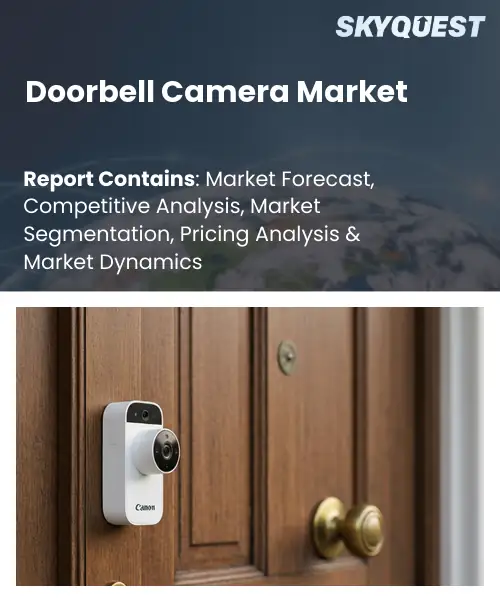
Doorbell Camera Market
Report ID: SQMIG45I2393
Report ID: SQMIG45I2393
[email protected]
USA +1 351-333-4748
Report ID:
SQMIG45I2393 |
Region:
Global |
Published Date: May, 2026
Pages:
157
|Tables:
197
|Figures:
80


Global Doorbell Camera Market size was valued at USD 2.8 Billion in 2024 and is poised to grow from USD 3.18 Billion in 2025 to USD 8.75 Billion by 2033, growing at a CAGR of 13.5% during the forecast period (2026-2033).
Video-enabled doorbell cameras now serve as key security tools in homes and businesses. This grew out of affordable imaging tech, easy wireless links, and cloud analysis. Companies like Ring and Nest really pushed things forward. These devices turn plain doorways into safety hubs by stopping theft, offering proof, and giving remote entry control. Once pricy and niche, falling costs in CMOS sensors and Wi-Fi, plus the rise of smartphones, made them popular fast. Now, many homes have them integrated into smart ecosystems.
Adoption plays a big role in the Global Doorbell Camera Market too. When these cameras integrate with larger smart-home and smart-city systems, there are more ways to use them and earn money. As manufacturers connect the devices and add cloud analytics, property managers can bundle security services, leading to steady income and more profit over time. For instance, retailers use geofencing to stop package theft, while logistics firms confirm deliveries with timestamps. Care facilities keep an eye on residents without bulky gadgets. The benefits draw telecom and insurance companies as partners, offering even more chances to expand worldwide and benefiting from larger scales.
How is AI Reshaping the Doorbell Camera Market?
AI is transforming the doorbell camera market, making these gadgets more than just simple bells and whistles. Devices now boast onboard computer vision, which can tell the difference between people, packages, and pets. Plus, edge processing cuts down on pointless notifications and saves bandwidth. There are also cloud models continually adding improvements and extra insights. Presently, companies include AI-powered features like package recognition and voice-driven searches in their products. This stuff makes recorded footage way more useful but often comes via paid service plans, influencing what buyers pick and how much value they get in the long run. As these high-tech bells become the norm, privacy concerns grow, and brands must find ways to stand out from one another.
Market snapshot - (2026-2033)
Global Market Size
USD 2.8 Billion
Largest Segment
Wireless Doorbell Cameras
Fastest Growth
Battery-Powered Doorbell Cameras
Growth Rate
13.5% CAGR
To get more insights on this market click here to Request a Free Sample Report
Global doorbell camera market is segmented by product type, resolution, power source, end user, distribution channel, installation type, integration and region. Based on product type, the market is segmented into Wired Doorbell Cameras, Wireless Doorbell Cameras, Battery-Powered Doorbell Cameras and Smart Video Doorbell Cameras. Based on resolution, the market is segmented into HD (720p), Full HD (1080p), 2K Resolution and 4K & Above. Based on power source, the market is segmented into Hardwired, Rechargeable Battery, Replaceable Battery and Solar Powered. Based on end user, the market is segmented into Residential and Commercial. Based on distribution channel, the market is segmented into Online Retail and Offline Retail. Based on installation type, the market is segmented into DIY Installation and Professional Installation. Based on integration, the market is segmented into Smart Home Integrated and Standalone Systems. Based on region, the market is segmented into North America, Europe, Asia Pacific, Latin Americaand Middle East & Africa.
The hardwired segment dominates since it offers non-stop power and stable connectivity. This lets it handle tasks like continuous video streaming and home chime operations smoothly. It's favored for its reliability, supporting constant monitoring and easy system integration. The steady power also cuts down on maintenance and limits false alarms from power issues.
On the flip side, the rechargeable battery segment is growing quickly. As tech improves, batteries now last longer and charge faster. They can even support regular updates. These perks make them perfect for DIY projects and places where wiring is tough. So, this type is seeing use in more retrofit and rental setups, opening up new markets and possibilities.
The smart video doorbell cameras dominate the market since they blend high-fidelity video, onboard AI, cloud services, and app ecosystems. These features offer advanced detection, playback, and subscription options that consumers love. Manufacturers really push these models to stand out on software and ongoing services, which drives collaborations with analytics and cloud providers. This trend keeps buyers expecting smart, integrated systems.
However, battery-powered doorbell cameras are growing super-fast. They appeal a lot because of how easy they are to install and the fact that there aren't any wiring hassles. Plus, they're big on DIY channels. With improved battery tech and modular design, there's a spike in retrofits and aftermarket accessories. This leads to more accessible models from makers, tapping into new customer groups, and speeding up market spread.
To get detailed segments analysis, Request a Free Sample Report
North America is at the top of the global doorbell camera market because of consumer readiness, mature smart home systems, and a concentration of companies in the field. People there really care about home security and want connected homes, driving up demand. The products are easily available through retailers and online, making distribution quick. Big tech firms and startups in the region lead with innovative features like AI, cloud integration, and smooth platform connections. With good telecoms support and widespread broadband, performance and remote access are reliable. Companies often work with insurers, builders, and internet providers to make products for new builds and renovations. Clear rules on data privacy and big brand marketing also help. So, both businesses and consumers keep finding new uses for these devices and constantly improving them.
The Doorbell Camera Market in the United States thrives because of a robust network of manufacturers, channel partners, and service providers. This ecosystem boosts both innovation and accessibility. Homeowners' high interest in safety and convenience drives varied product offerings, from budget to premium. Tech firms and telecom companies work together on integrated solutions, and both pro installs and retrofits open up more customer bases. As a result, strong brand awareness and targeted marketing push sales among house owners.
The Doorbell Camera Market in Canada thrives because of connected home technology adoption and solid retail distribution networks focusing on urban homes. When folks care about privacy and data security, companies adjust how they handle data and push for secure cloud services. Manufacturers hook up with telecom firms to boost their sales, and installers help with setting these systems up in existing houses. Since Canada's climate varies so much, products need to stand up to different weather conditions, steering how vendors market their stuff to match what homeowners want.
Europe is seeing the doorbell camera market expand thanks to growing urbanization, increasing concerns about safety both publicly and in homes, and strict data protection regulations. These rules encourage making products that prioritize privacy. The market is full of different vendors, including big electronics companies and agile startups. These startups cater to areas with high-density housing. Integration with building management systems and smart city projects makes doorbell cameras useful for more than just consumers – municipalities and businesses find value in them too. Easy distribution through cross-border networks and well-established retail routes helps get the products out there fast. Plus, local engineering skills help create durable equipment that stands up to varying climates. Working with insurance firms, system integrators, and property managers boosts options for both new builds and retrofits. This teamwork means a good range of high-end and budget-friendly choices are hitting European markets.
The Doorbell Camera Market in Germany thrives due to the country's strong engineering history and focus on product quality. Both local manufacturers and system integrators concentrate on durable hardware and secure software, which fits the strict privacy and interoperability standards. Because of established trade routes and professional installers, these systems are used in both single and multi-family homes. Plus, there's a high demand for integrating doorbell cameras with building management and security services, pushing growth in both new builds and retrofits.
In the UK, the doorbell camera market is all about people looking for easy home security. Retail stores and online sellers are making these gadgets easier to find in cities. Tech firms push how well cameras work with voice assistants and various platforms, and services include setup help and subscription plans. Rules influence what privacy features the products have, and teams up with building managers and insurance folks to get more owners and tenants on board.
The Doorbell Camera Market in France is really taking off, thanks to increasing interest in home security. Both retail stores and the web make these devices easier to find. Companies are customizing their gadgets for what locals prefer, like design and privacy rules. Working with installers, landlords, and insurance folks speeds up adding these cameras to homes in cities and the ‘burbs. To top it off, makers focus on simple controls, language support, and system integration, boosting sales in both new houses and buildings.
Asia Pacific is stepping up its game in the doorbell camera market thanks to a blend of manufacturing skill, tech innovation, and a growing desire for connected security features. Local manufacturers lead in developing cost-effective hardware, and software specialists focus on AI, multilingual interfaces, and streaming tailored for regional networks. Online sales platforms and retail stores make these products easier to find and buy, especially in cities and nearby areas. Companies tailor their cameras to local climates with weather-resistant designs and offer efficient power usage too. Plus, teams made up of device makers, phone companies, and builders work together on bundle deals for both new homes and older ones being updated. All these factors are helping Asia Pacific not only compete more strongly but also expand the ways security devices can be sold and used in different parts of the region.
The Doorbell Camera Market in Japan stresses quality engineering, small designs, and smooth integration with home automation systems. Manufacturers aim for long-lasting hardware and excellent imaging in different lighting. Since people prefer something subtle that fits well with other appliances, these cameras are sleek and work with various platforms. A robust network of retailers and installers, plus teamwork between device makers and telecoms, boosts usage in both new homes and retrofits in cities and suburbs.
South Korea's doorbell camera market shows a high consumer comfort with tech and desire for smart features. Local companies focus on AI, clear images, and linking with phones and payments. Products become known quickly thanks to e-commerce and teamwork with telecoms and builders, creating package deals. Since many people live in apartments, there's a push for designs that look good and are easy to use.
To know more about the market opportunities by region and country, click here to
Buy The Complete Report
Rising Adoption of Smart Homes
The increasing use of connected home systems is pushing doorbell cameras to become essential parts of both security and convenience in homes. Since folks love remote monitoring and controlling things through voice assistants, they want all these features to work together seamlessly. This desire leads manufacturers to improve connectivity, make user interfaces better, and even simplify installations. They do this to meet what consumers want, which makes people more likely to buy and replace old systems. The loop here—more smart homes mean more innovation, leading to more sales—is helping these products reach a wider variety of housing types and markets.
Advances in Video Analytics
Continuous improvements in on-device video analytics and cloud-based artificial intelligence boost the usefulness of doorbell cameras. They make motion detection better, help recognize actual events, and cut down on false alarms. This makes automated surveillance more trustworthy and easier to integrate with other security systems. It also lets companies offer extra features and hook ups with outside services. As a result, users like these upgrades better, pushing both buyers and installers towards choosing smarter doorbells. This speeds up how quickly people adopt them and makes one model stand out from another.
Data Privacy and Security Concerns
Rising concerns about data privacy and worries over unauthorized video access or misuse keep many people and organizations from using doorbell cameras, even though these devices offer some handy features. Buyers get hesitant because of confusion regarding vendor practices, possible third-party data sharing, and unclear storage policies. This pushes folks to desire strict compliance measures, adding to development and operational costs. So, manufacturers must put more into security and transparency, delaying product launches, and making it harder for smaller companies to compete in the market.
Interoperability and Standardization Challenges
Fragmented device ecosystems and the lack of universal technical standards create interoperability issues, complicating installation and communication between devices for doorbell cameras. When consumers run into platforms, cloud service, or smart home hub incompatibilities, they find the tech too complex and become less willing to commit to any solution. Manufacturers have to spend time creating multiple integrations or proprietary bridges, which drives costs and slows down feature rollout. This fragmentation limits market growth by making smooth expansion harder and discouraging stakeholders who want seamless, long-term compatibility.
Request Free Customization of this report to help us to meet your business objectives.
The global doorbell camera market is getting more competitive. Big players are making moves by buying out others, partnering with retailers, and adding edge AI. Amazon grabbed Ring, Generac got ecobee, and now eufy is pushing its new EdgeAgent tech for AI on devices. These M&A deals, channel tightenings, and tech tweaks are ratcheting up competition and speeding up product releases.
On-Device Intelligence Growth: Manufacturers and platform providers are now adding advanced machine learning models right into doorbell cameras. This lets them do real-time object classification and contextual alerts, and cuts down on the need for cloud processing. Because of this, response times get better, and bandwidth needs to drop. Devices can also work even when connectivity is spotty. This move helps create distinct product tiers through varied local feature sets and firmware upgrades. These upgrades speed up feature releases and improve integration with smart home systems. All this not only makes things smoother for users but helps cut costs for service providers too.
Subscription Service Expansion: More vendors are now focusing on subscriptions and services that combine cloud storage, advanced analytics, and priority support to earn ongoing income. This lets them constantly update software, fine-tune alerts, and coordinate devices in home ecosystems. In turn, channel partners get extra margin room and customers enjoy simpler maintenance and single bills. It leads to lasting customer ties and opens chances for upselling unique security via platform collaborations and integrated marketplaces.
SkyQuest’s ABIRAW (Advanced Business Intelligence, Research & Analysis Wing) is our Business Information Services team that Collects, Collates, Correlates, and Analyses the Data collected by means ofPrimary Exploratory Research backed by robust Secondary Desk research.
As per SkyQuest analysis, the global doorbell camera market is growing fast. One reason is the increasing use of smart homes, which includes these devices in larger connected systems, expanding how we can use them. Another factor is advancements in video analytics and on-device AI; these make detection more accurate and open up new subscription services. However, a big issue is people's worries about data privacy and security. These concerns can slow down adoption and increase compliance costs. North America leads the market because of its well-established smart home presence and strong retail networks. Among products, smart video doorbells dominate due to their extensive features and recurring service models.
| Report Metric | Details |
|---|---|
| Market size value in 2024 | USD 2.8 Billion |
| Market size value in 2033 | USD 8.75 Billion |
| Growth Rate | 13.5% |
| Base year | 2024 |
| Forecast period | (2026-2033) |
| Forecast Unit (Value) | USD Billion |
| Segments covered |
|
| Regions covered | North America (US, Canada), Europe (Germany, France, United Kingdom, Italy, Spain, Rest of Europe), Asia Pacific (China, India, Japan, Rest of Asia-Pacific), Latin America (Brazil, Rest of Latin America), Middle East & Africa (South Africa, GCC Countries, Rest of MEA) |
| Companies covered |
|
| Customization scope | Free report customization with purchase. Customization includes:-
|
To get a free trial access to our platform which is a one stop solution for all your data requirements for quicker decision making. This platform allows you to compare markets, competitors who are prominent in the market, and mega trends that are influencing the dynamics in the market. Also, get access to detailed SkyQuest exclusive matrix.
Table Of Content
Executive Summary
Market overview
Parent Market Analysis
Market overview
Market size
KEY MARKET INSIGHTS
COVID IMPACT
MARKET DYNAMICS & OUTLOOK
Market Size by Region
KEY COMPANY PROFILES
Methodology
For the Doorbell Camera Market, our research methodology involved a mixture of primary and secondary data sources. Key steps involved in the research process are listed below:
1. Information Procurement: This stage involved the procurement of Market data or related information via primary and secondary sources. The various secondary sources used included various company websites, annual reports, trade databases, and paid databases such as Hoover's, Bloomberg Business, Factiva, and Avention. Our team did 45 primary interactions Globally which included several stakeholders such as manufacturers, customers, key opinion leaders, etc. Overall, information procurement was one of the most extensive stages in our research process.
2. Information Analysis: This step involved triangulation of data through bottom-up and top-down approaches to estimate and validate the total size and future estimate of the Doorbell Camera Market.
3. Report Formulation: The final step entailed the placement of data points in appropriate Market spaces in an attempt to deduce viable conclusions.
4. Validation & Publishing: Validation is the most important step in the process. Validation & re-validation via an intricately designed process helped us finalize data points to be used for final calculations. The final Market estimates and forecasts were then aligned and sent to our panel of industry experts for validation of data. Once the validation was done the report was sent to our Quality Assurance team to ensure adherence to style guides, consistency & design.
Analyst Support
Customization Options
With the given market data, our dedicated team of analysts can offer you the following customization options are available for the Doorbell Camera Market:
Product Analysis: Product matrix, which offers a detailed comparison of the product portfolio of companies.
Regional Analysis: Further analysis of the Doorbell Camera Market for additional countries.
Competitive Analysis: Detailed analysis and profiling of additional Market players & comparative analysis of competitive products.
Go to Market Strategy: Find the high-growth channels to invest your marketing efforts and increase your customer base.
Innovation Mapping: Identify racial solutions and innovation, connected to deep ecosystems of innovators, start-ups, academics, and strategic partners.
Category Intelligence: Customized intelligence that is relevant to their supply Markets will enable them to make smarter sourcing decisions and improve their category management.
Public Company Transcript Analysis: To improve the investment performance by generating new alpha and making better-informed decisions.
Social Media Listening: To analyze the conversations and trends happening not just around your brand, but around your industry as a whole, and use those insights to make better Marketing decisions.
REQUEST FOR SAMPLE
 REQUEST FREE CUSTOMIZATION
Global Doorbell Camera Market size was valued at USD 2.8 Billion in 2024 and is poised to grow from USD 3.18 Billion in 2025 to USD 8.75 Billion by 2033, growing at a CAGR of 13.5% during the forecast period (2026-2033).
Competition in the global doorbell camera market is intensifying as incumbents pursue acquisitions, retail partnerships and edge AI upgrades to protect share; Amazon's acquisition of Ring, Generac's integration of ecobee, and eufy's recent EdgeAgent on device AI announcement illustrate M&A, channel consolidation and technology differentiation strategies driving rivalry and faster product cycles. 'Ring LLC', 'Arlo Technologies, Inc.', 'Google Nest', 'Wyze Labs, Inc.', 'Eufy Security', 'SimpliSafe, Inc.', 'Vivint Smart Home, Inc.', 'ADT Inc.', 'Lorex Technology Inc.', 'Zmodo Technology Corporation Ltd.', 'Aqara', 'Blink', 'August Home, Inc.', 'Yale Home', 'Panasonic Holdings Corporation', 'SkyBell Technologies, Inc.', 'Netatmo', 'EZVIZ Inc.', 'TP-Link Systems Inc.', 'Bosch Security Systems GmbH'
The growing consumer adoption of connected home ecosystems encourages integration of doorbell cameras as essential components of residential security and convenience solutions. As households prioritize remote monitoring, voice assistant compatibility, and seamless control through centralized platforms, demand for interoperable and feature rich doorbell cameras increases. Manufacturers and service providers respond by enhancing connectivity, user interfaces, and installation simplicity, which in turn reinforces consumer purchases and replacements. This virtuous cycle between smart home adoption and product innovation supports market expansion and deeper penetration across varied housing segments.
On-Device Intelligence Growth: Manufacturers and platform providers are embedding advanced machine learning models directly within doorbell cameras to enable real-time object classification, contextual alerts, and reduced dependence on cloud processing. This shift toward on-device analytics improves responsiveness, lowers bandwidth requirements, and allows devices to operate with intermittent connectivity. It also supports differentiated product tiers through local feature sets and firmware-driven enhancements, encouraging faster feature rollouts and closer integration with smart home hubs while reducing ongoing operational costs for service providers.
Why does North America Dominate the Global Doorbell Camera Market? |@12


Want to customize this report? This report can be personalized according to your needs. Our analysts and industry experts will work directly with you to understand your requirements and provide you with customized data in a short amount of time. We offer $1000 worth of FREE customization at the time of purchase.
Feedback From Our Clients


 USA (+1) 351-333-4748

