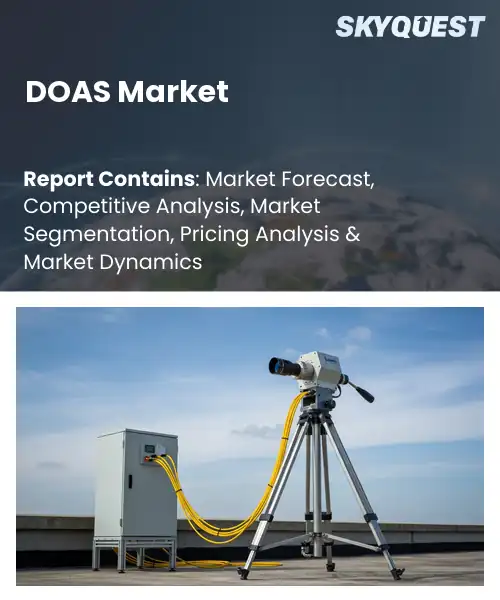
DOAS Market
Report ID: SQMIG20I2916
Report ID: SQMIG20I2916
[email protected]
USA +1 351-333-4748
Report ID:
SQMIG20I2916 |
Region:
Global |
Published Date: April, 2026
Pages:
157
|Tables:
88
|Figures:
76


Global Doas Market size was valued at USD 5.12 Billion in 2024 and is poised to grow from USD 5.58 Billion in 2025 to USD 5.1 Billion by 2033, growing at a CAGR of 8.9% during the forecast period (2026-2033).
The primary driver of the Dedicated Outdoor Air System market is the growing regulatory emphasis on energy-efficient ventilation and indoor air quality, which forces building designers to separate fresh-air handling from thermal loads to improve health and reduce energy use. DOAS units supply treated outdoor air while leaving temperature control to parallel heating and cooling systems, a conceptual shift that has matured over decades from niche hospital installations to mainstream commercial campuses. Standards such as ASHRAE 62.1 and retrofit incentives have accelerated adoption, while pandemic-era concerns about pathogen transmission highlighted DOAS effectiveness in significantly improving ventilation rates and reducing recirculation.A central factor driving Global DOAS Market growth is tightening energy codes and decarbonization commitments that penalize inefficient recirculation and favor systems with enthalpy recovery that reduce HVAC runtime. As governments raise minimum ventilation and efficiency standards, developers choose DOAS with energy recovery ventilators to meet compliance while avoiding oversized chillers, lowering operating costs and unlocking adoption in schools, hospitals and data centers where air quality and humidity control are essential. The availability of modular rooftop DOAS and smart controls creates retrofit and service opportunities and enables manufacturers to sell packaged solutions linked to performance contracts, thereby reducing lifecycle emissions.
How is IoT-enabled automation driving efficiency in the DOAS market?
IoT enabled automation in dedicated outdoor air systems combines networked sensors cloud analytics and adaptive controls to optimize outdoor air delivery and indoor air quality. Key aspects include real time monitoring of CO2 and VOC levels demand responsive ventilation based on occupancy and predictive maintenance that reduces unexpected downtime. The current market shows growing adoption as manufacturers offer IoT ready DOAS and building owners use remote optimization to coordinate ventilation with energy recovery and central plant equipment. Practical examples from suppliers illustrate how cloud based control and integrated platforms simplify commissioning enable continuous tuning and shift service models toward proactive maintenance.Carrier February 2026, introduced a dedicated outdoor air system with integrated smart controls and cloud connectivity that enables remote tuning and automatic fault detection supporting efficiency gains by automating ventilation schedules optimizing energy recovery and enabling proactive service to maintain peak performance.
Market snapshot - (2026-2033)
Global Market Size
USD 5.12 Billion
Largest Segment
Synthetic Melanin
Fastest Growth
Natural Melanin (Plant/Animal/Microbial Extraction)
Growth Rate
8.9% CAGR
To get more insights on this market click here to Request a Free Sample Report
Global doas market is segmented by product source, application vertical (strategic drivers), product grade and region. Based on product source, the market is segmented into Synthetic Melanin and Natural Melanin (Plant/Animal/Microbial Extraction). Based on application vertical (strategic drivers), the market is segmented into Cosmetics & Skin Care (UV Protection), Pharmaceutical & Biomedical Research and Others (Electronics/Bio-polymers Research). Based on product grade, the market is segmented into Research Grade and Cosmetic/Commercial Grade. Based on region, the market is segmented into North America, Europe, Asia Pacific, Latin America and Middle East & Africa.
Synthetic Melanin segment dominates because manufacturers prioritize predictable molecular composition and scalable production that align with DOAS performance requirements. Controlled synthesis enables fine tuning of optical and binding properties, reduces batch variability, and simplifies regulatory validation, which in turn lowers integration risk for device and formulation developers. Consistent supply and formulation compatibility drive preference among industrial users seeking predictable performance and streamlined qualification pathways in the DOAS Market.
However, Natural Melanin (Plant/Animal/Microbial Extraction) is the fastest growing area as consumer preference for bioderived ingredients and improved extraction and fermentation methods drive adoption in cosmetics and biomedical research. This momentum unlocks new formulation pathways and investment in sustainable supply chains, broadening application scope and accelerating future DOAS Market opportunities.
Cosmetics & Skin Care (UV Protection) segment dominates because UV-blocking performance and safety profiles are primary commercial drivers for DOAS adoption. Formulators prioritize materials that deliver predictable photoprotective properties while integrating into diverse topical systems, prompting suppliers to align R&D to meet stability, regulatory and sensory requirements. Strong product development pipelines and high consumer visibility translate into steady demand for qualified DOAS materials, steering investment toward cosmetic-tailored chemistries and processing.
However, Pharmaceutical & Biomedical Research is emerging as the fastest growing area as researchers leverage DOAS materials for biointerfaces, imaging and therapeutic delivery, driven by advances in biocompatibility and functionalization. This translational focus attracts funding and cross-sector collaborations, accelerating novel applications, clinical validation pathways and commercial opportunities in the DOAS Market.
To get detailed segments analysis, Request a Free Sample Report
North America dominates the global DOAS market on the strength of integrated building codes, a mature HVAC equipment supply chain, and early adoption of indoor air quality strategies across commercial and institutional sectors. Large institutional clients, advanced facility management practices, and a culture of specifying energy and health outcomes drive demand for dedicated outdoor air systems. Strong local manufacturing capacity and close collaboration between equipment suppliers, engineering firms, and commissioning providers support rapid project delivery and customization. Regulatory focus on occupant comfort and indoor environmental quality encourages retrofit and new construction uptake, while service and maintenance ecosystems ensure long term performance. These combined factors create a reinforcing market dynamic that sustains high levels of specification and deployment without relying solely on short term incentives.
DOAS Market in the United States reflects a wide range of commercial, healthcare, and educational projects focused on indoor air quality and occupant comfort. Specification practices favor packaged and custom DOAS integrated with central air systems. A competitive vendor environment and robust commissioning support complex integrations. Emphasis on operational efficiency and occupant wellbeing sustains demand for durable outdoor air handling solutions and service models oriented to lifecycle performance and resilience.
DOAS Market in Canada is driven by strong emphasis on indoor environmental quality across urban centers and institutional facilities. Specification trends favor flexible DOAS solutions that adapt to climate conditions and building types. Local manufacturers collaborate with engineering consultants to tailor systems for energy conscious operation and maintainability. Service networks and commissioning practices reinforce system reliability. Public building stakeholders prioritize long term air quality improvements and efficient outdoor air management.
Rapid expansion in Asia Pacific is propelled by intensifying urban development, rising attention to indoor environmental quality, and growing commercial and institutional construction activity. Market momentum is supported by a combination of local manufacturing strengths, increasing specification of mechanical ventilation separate from recirculation systems, and adoption of energy efficient design practices. Technology transfer and collaborations between regional suppliers and international HVAC firms accelerate availability of tailored DOAS products that respond to diverse climate conditions. Demand is also driven by heightened awareness of health and productivity benefits, and by retrofit opportunities in aging building stocks where upgrading ventilation is seen as a practical intervention. Policy signals and professional adoption among engineers and facility operators further catalyze deployment across multiple building typologies.
DOAS Market in Japan is shaped by rigorous building performance expectations and an engineering culture that prioritizes compact, high efficiency ventilation solutions. Manufacturers focus on precision control, noise reduction and integration with compact HVAC systems suited to dense urban developments. Retrofit and new construction favor modular DOAS units enabling improved air quality without major reconfiguration. Professional specification and maintenance practices support operational reliability and localized customization widely across building types.
DOAS Market in South Korea reflects strong industrial capability and adoption of advanced ventilation technologies. Local manufacturers emphasize compact, efficient units with sophisticated controls that align with smart building systems. Urban redevelopment and demand for healthier indoor environments drive specification of dedicated outdoor air approaches in commercial and urban developments. Collaboration between equipment makers and engineering firms supports tailored solutions, and professional commissioning practices underpin reliable operation and service delivery.
Europe is strengthening its role in the DOAS market through a combination of stringent building performance expectations, widespread retrofitting activity, and a mature engineering and specification community that values indoor environmental quality and energy efficient ventilation solutions. Manufacturers and engineering consultancies focus on integrating heat recovery, advanced controls, and flexible modular designs to meet diverse building needs. Cross border collaboration among technology providers, standards bodies, and service firms encourages harmonized solutions and best practices. Public procurement and institutional clients often prioritize lifecycle performance and maintainability, prompting suppliers to offer comprehensive commissioning, maintenance, and upgrade services. Robust testing and certification frameworks and a strong contractor ecosystem facilitate predictable outcomes and ease of integration into renovation projects. This ecosystem supports steady adoption across commercial, institutional, and multi residential sectors while promoting technical innovation and higher operational standards.
DOAS Market in Germany benefits from a robust engineering and manufacturing base emphasizing energy recovery and system robustness. Architects and consulting engineers specify DOAS solutions integrated with heat recovery and building automation to meet high performance expectations. An established supply chain and service ecosystem support complex installations and long term maintenance. Retrofit and new build demand is driven by focus on lifecycle efficiency and compliance with stringent building performance standards.
DOAS Market in the United Kingdom is influenced by retrofit activity and an emphasis on improving indoor air quality across commercial and public sectors. Consultants specify DOAS solutions that integrate with building management systems and HVAC infrastructure to balance ventilation needs and energy use. A strong aftermarket for commissioning and service supports lifecycle performance. Procurement practices in public and institutional projects prioritize maintainability and demonstrable operational benefits, shaping supplier offerings.
DOAS Market in France is characterized by growing retrofit initiatives and a design focus that integrates ventilation solutions into schemes. Engineers and architects collaborate to specify DOAS units that balance indoor air quality, acoustic comfort, and energy performance. Local manufacturers and system integrators offer modular options and control strategies. Public investments in building upgrades and private sector attention to occupant wellbeing drive adoption across office, education, and residential refurbishment projects.
To know more about the market opportunities by region and country, click here to
Buy The Complete Report
Rising Demand For Energy Efficiency
Stringent Indoor Air Quality Standards
High Initial System Costs
Complex Integration With Existing Systems
Request Free Customization of this report to help us to meet your business objectives.
The DOAS competitive landscape is shaped by incumbent consolidation and fast-following climate tech entrants that target ventilation and dehumidification efficiency to meet stricter building codes and decarbonization mandates. Established HVAC firms have pursued strategic acquisitions to acquire desiccant and ERV capabilities while startups push product innovations such as liquid desiccant DOAS and plug and play rooftop DOAS, and defense and facility partnerships accelerate field validation.
Top Player’s Company Profile
Recent Developments
SkyQuest’s ABIRAW (Advanced Business Intelligence, Research & Analysis Wing) is our Business Information Services team that Collects, Collates, Correlates, and Analyses the Data collected by means of Primary Exploratory Research backed by robust Secondary Desk research. As per SkyQuest analysis, the global DOAS market is propelled by growing regulatory emphasis on energy-efficient ventilation and indoor air quality, with IoT-enabled automation emerging as a second driver by enabling demand-responsive ventilation and predictive maintenance. Adoption is tempered by high initial system costs that slow retrofit uptake and require stronger value demonstration. North America remains the dominating region due to mature codes, supply chains and specification practices, while the synthetic melanin product source is the dominating segment given its predictable composition and scalable production that align with performance and regulatory needs. Manufacturers focusing on modular, smart DOAS and service models are best placed to capture near-term growth.
| Report Metric | Details |
|---|---|
| Market size value in 2024 | USD 5.12 Billion |
| Market size value in 2033 | USD 5.1 Billion |
| Growth Rate | 8.9% |
| Base year | 2024 |
| Forecast period | (2026-2033) |
| Forecast Unit (Value) | USD Billion |
| Segments covered |
|
| Regions covered | North America (US, Canada), Europe (Germany, France, United Kingdom, Italy, Spain, Rest of Europe), Asia Pacific (China, India, Japan, Rest of Asia-Pacific), Latin America (Brazil, Rest of Latin America), Middle East & Africa (South Africa, GCC Countries, Rest of MEA) |
| Companies covered |
|
| Customization scope | Free report customization with purchase. Customization includes:-
|
To get a free trial access to our platform which is a one stop solution for all your data requirements for quicker decision making. This platform allows you to compare markets, competitors who are prominent in the market, and mega trends that are influencing the dynamics in the market. Also, get access to detailed SkyQuest exclusive matrix.
Table Of Content
Executive Summary
Market overview
Parent Market Analysis
Market overview
Market size
KEY MARKET INSIGHTS
COVID IMPACT
MARKET DYNAMICS & OUTLOOK
Market Size by Region
KEY COMPANY PROFILES
Methodology
For the DOAS Market, our research methodology involved a mixture of primary and secondary data sources. Key steps involved in the research process are listed below:
1. Information Procurement: This stage involved the procurement of Market data or related information via primary and secondary sources. The various secondary sources used included various company websites, annual reports, trade databases, and paid databases such as Hoover's, Bloomberg Business, Factiva, and Avention. Our team did 45 primary interactions Globally which included several stakeholders such as manufacturers, customers, key opinion leaders, etc. Overall, information procurement was one of the most extensive stages in our research process.
2. Information Analysis: This step involved triangulation of data through bottom-up and top-down approaches to estimate and validate the total size and future estimate of the DOAS Market.
3. Report Formulation: The final step entailed the placement of data points in appropriate Market spaces in an attempt to deduce viable conclusions.
4. Validation & Publishing: Validation is the most important step in the process. Validation & re-validation via an intricately designed process helped us finalize data points to be used for final calculations. The final Market estimates and forecasts were then aligned and sent to our panel of industry experts for validation of data. Once the validation was done the report was sent to our Quality Assurance team to ensure adherence to style guides, consistency & design.
Analyst Support
Customization Options
With the given market data, our dedicated team of analysts can offer you the following customization options are available for the DOAS Market:
Product Analysis: Product matrix, which offers a detailed comparison of the product portfolio of companies.
Regional Analysis: Further analysis of the DOAS Market for additional countries.
Competitive Analysis: Detailed analysis and profiling of additional Market players & comparative analysis of competitive products.
Go to Market Strategy: Find the high-growth channels to invest your marketing efforts and increase your customer base.
Innovation Mapping: Identify racial solutions and innovation, connected to deep ecosystems of innovators, start-ups, academics, and strategic partners.
Category Intelligence: Customized intelligence that is relevant to their supply Markets will enable them to make smarter sourcing decisions and improve their category management.
Public Company Transcript Analysis: To improve the investment performance by generating new alpha and making better-informed decisions.
Social Media Listening: To analyze the conversations and trends happening not just around your brand, but around your industry as a whole, and use those insights to make better Marketing decisions.
REQUEST FOR SAMPLE
 REQUEST FREE CUSTOMIZATION


Want to customize this report? This report can be personalized according to your needs. Our analysts and industry experts will work directly with you to understand your requirements and provide you with customized data in a short amount of time. We offer $1000 worth of FREE customization at the time of purchase.
Feedback From Our Clients


 USA (+1) 351-333-4748

