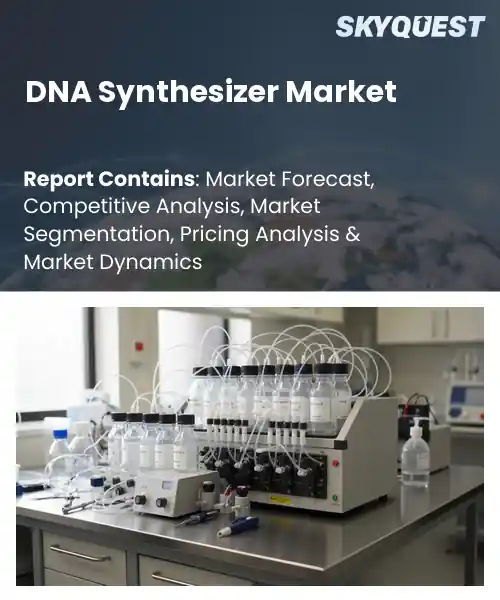
DNA Synthesizer Market
Report ID: SQMIG35H2506
Report ID: SQMIG35H2506
[email protected]
USA +1 351-333-4748
Report ID:
SQMIG35H2506 |
Region:
Global |
Published Date: May, 2026
Pages:
157
|Tables:
175
|Figures:
79


Global Dna Synthesizer Market size was valued at USD 680.00 Million in 2024 and is poised to grow from USD 780.00 Million in 2025 to USD 2230.00 Million by 2033, growing at a CAGR of 14.1% during the forecast period (2026-2033).
As an analyst of research, I see the primary drivers of the DNA synthesizer market trends as the increasing demand for custom oligonucleotides and synthetic genes, which will drive innovations via biotechnology. The market comprises all of the instruments and reagents necessary to automate the de novo synthesis of DNA and to enable researchers to use DNA to do everything from basic research to the production of therapeutics to the production of industrial biology products. It is important because it provides a platform for gene editing, vaccine manufacturing, and bio-manufacturing of synthetic DNA, shortening the time required to complete the work and reducing the cost of products. Previously, the industry developed from manually synthesizing DNA using phosphoramidite chemistry, to high-throughput synthesizers operated on lab benches, to using cloud-based systems to order DNA. Companies such as Twist Bioscience and Agilent represent the evolution of the capacity within the industry. The growing capacity in the industry leads to greater adoption by academic researchers and industry users. As such, as technology continues to evolve, a main driver/root cause of the growth in the global DNA synthesizer market is the integration of automation with economies of scale, leading to lower costs to synthesize each base pair of nucleotides, and allowing the formulation of new commercial business models.
Due to the continual emergence of new high-throughput synthesizers with improved error correction capabilities, pharmaceutical developers, as well as contract manufacturing organisations (CMOs) are increasing the demand for longer synthetic sequences of nucleotides to develop products for gene therapy and quickly prototype new vaccines. For example, these high-throughput synthesizers enabled the rapid design of SARS-CoV-2 antigens and the manufacture of DNA-based diagnostic panels, which created an opportunity for an ongoing revenue stream from reagents and services. As a result, investors are increasing funding for building additional capacity as well as developing new automated workflows, and academic research laboratories are adopting in-house manufacturing capabilities for synthesizing DNA.
How is AI Improving Throughput and Accuracy in the DNA Synthesizer Market?
Through the application of predictive sequence design and use of process control with quality prediction capabilities, the use of Artificial Intelligence in DNA synthesizer market growth has allowed for increased productivity and accuracy. By utilizing machine learning models to forecast commonly occurring modes of synthesis failure, AI can recommend the most efficient mix of reagents and cycle profiles to ensure synthesis success. Real-time sensor data from the synthesis process is also used as part of closed-loop systems, which help decrease time spent on rework and scrap as well as increasing the productivity of smart automation/scheduling solutions. As the needs for longer, more complex therapeutic constructs increase, the application of AI in the realm of manufacturing/quality control is enabling companies to reduce the length of their iteration cycles and improve first-pass success rates; ultimately leading to the scalability and reliability of synthesis service providers.
For example, Twist Bioscience announced in May 2026 the expansion of their clonal gene product line, while also showcasing how the employment of improved levels of automation and AI-guided workflows have resulted in increased reliability and throughput, reduced downstream quality control cycles/times, and improved the efficiency of delivery of complex sequences, thereby enhancing their overall marketability.
Market snapshot - (2026-2033)
Global Market Size
USD 0.68 Billion
Largest Segment
Benchtop DNA Synthesizers
Fastest Growth
High-Throughput DNA Synthesizers
Growth Rate
14.1% CAGR
To get more insights on this market click here to Request a Free Sample Report
Global dna synthesizer market is segmented by product type, technology, application, end user, scale, automation level and region. Based on product type, the market is segmented into benchtop DNA synthesizers, high-throughput DNA synthesizers, portable DNA synthesizers and others. Based on technology, the market is segmented into phosphoramidite synthesis, microarray-based synthesis and enzymatic DNA synthesis. Based on application, the market is segmented into synthetic biology, gene synthesis, PCR primer synthesis, DNA sequencing, drug discovery and others. Based on end user, the market is segmented into biotechnology companies, pharmaceutical companies, academic & research institutes, contract research organizations (CROs) and diagnostic laboratories. Based on scale, the market is segmented into research scale and commercial scale. Based on automation level, the market is segmented into fully automated and semi-automated. Based on region, the market is segmented into North America, Europe, Asia Pacific, Latin America, and Middle East & Africa.
The primary segment is phosphoramidite synthesis, which benefits from being an established chemical process used in most commercial oligonucleotide manufacturing due to its predictable coupling efficiency and overall compatibility with existing automation and reagent systems. The early development of this process has resulted in lower technical and operational risks for both manufacturers and users, therefore sustaining supply chains and service infrastructures. Consequently, there is continued supplier investment into this area, which has enabled its wide adoption across both research and industrial settings, providing significant incumbent advantages.
The second major segment being developed is enzymatic DNA synthesis, which is the fastest growing segment within the DNA synthesis business. In addition to having the potential to produce longer, cleaner DNA sequences, enzymes also allow for much quicker cycle times and milder reaction conditions, making them valuable for new applications such as on-demand and in-situ synthesis. This development is attracting innovation investment, facilitating their integration into existing applications, and creating opportunities for new service models and automated platforms, which are expected to greatly increase future market growth.
The benchtop DNA synthesizer market share is expected to continue commanding the largest share due to their ideal combination of price, size and ease of use; they address the needs of many laboratories for typical oligonucleotide and primer production. Since they are simple to implement and can be operated in a standard laboratory environment, the few hurdles associated with their procurement and use paint a picture of producing oligonucleotides at multiple locations, which encourages vendors to provide dedicated customer support and continued feature enhancements to ensure that benchtop DNA synthesizers become even more popular.
On the other hand, high-throughput DNA synthesizers have experienced the most rapid growth due to the increased demand for large oligonucleotide libraries and scalable gene assembly, the advantages of improvements in parallelization and automation, the decrease in unit costs and delivery times; these factors have created opportunities for commercial service providers and synthetic biology companies to capitalize on pooled screening, high-throughput library generation, and large-scale gene synthesis.
To get detailed segments analysis, Request a Free Sample Report
North America dominates due to a dense concentration of research institutions, leading biotechnology and pharmaceutical companies, and a well established ecosystem for instrument development and commercialization. Strong collaboration among academia, industry and clinical centers drives rapid translation of synthetic biology advances into practical workflows, while a supportive funding and venture environment sustains technology maturation. Established manufacturers provide local engineering, customer service and application support that reduce adoption barriers. Robust clinical research activity and large diagnostics markets create consistent demand for high throughput and flexible synthesis platforms. Regulatory frameworks that enable clinical translation and pathways for technology validation further reinforce regional leadership, as do a skilled talent pool and integrated supply chains that facilitate both innovation and operational scale up and commercialization readiness.
DNA synthesizer market forecast in United States, high levels of commitment from biotechnology companies, and a large clinical pipeline, US researchers will benefit greatly in developing DNA synthesizers. Established instrument manufacturers and service providers have been instrumental in accelerating technical adoption and providing technical support for users of DNA synthesizers. Collaborative relationships between universities and companies are increasing the number of methods developed and the number of unique applications created for DNA synthesis by creating more opportunities for testing and developing new applications. A mature regulatory and reimbursement landscape, along with more skilled professionals, will contribute to improved use of DNA synthesizing among researchers and pharmaceutical companies for research and clinical trials.
DNA synthesizer market outlook in Canada has been developed through an integrated health research network emphasizing the relationship between academic institutions and clinic networks via translational science. Provincial research groups are receiving public funding to improve the adoption rate of diagnostic devices as well as for therapeutic research. There is an emphasis on the quality of local labs, along with the compliance to regulations and training the workforce, while partnerships with international suppliers allow local labs to have easy access to equipment. In addition, the regional distribution of laboratories indicates that there are multiple hubs throughout Canada, which could be used for various public health and industrial biotechnological application uses.
The growth in healthcare research and development of drugs in Europe is due to many factors. The European Union has created a strong framework in which companies can develop drugs efficiently by encouraging collaboration, exchanging technology among academic and industry partners, and providing support through investments in public sector research programs. Successful collaborations are taking place throughout Europe to pursue new therapies, diagnostics, and platforms; however, the speed at which new products and technologies are developed varies amongst countries within Europe. In addition to research activities, European countries have created large start-up networks that enable companies to grow rapidly. Companies can leverage their production and engineering expertise in Germany to expand and produce innovative products. As new companies emerge throughout Europe, the regulatory paradigm will continue to evolve toward standardization and harmonization, providing a strong foundation for continued growth in the European healthcare system. Cross-border collaborations enabled by high-quality skilled labor provide an environment conducive to developing innovative products in Europe. Overall, the combination of all these factors makes Europe a desirable market for companies looking to develop and commercialize advanced synthetic biology technologies.
DNA synthesizer market regional outlook in Germany is characterized by strong industrial engineering capabilities and a manufacturing ecosystem that supports instrument production and customization. Established pharmaceutical and chemical clusters drive demand for scalable synthesis platforms while applied research centers collaborate closely with industry to validate advanced workflows. Emphasis on precision engineering, quality management and automation underpins supplier competitiveness. Integrated supply chains and service networks facilitate deployment across academic, clinical and industrial environments.
DNA synthesizer market regional forecast in United Kingdom is driven by an energetic innovation ecosystem with prolific startups, translational hubs and leading genomics centers that accelerate adoption of cutting edge synthesis platforms. Strong links between academic research, healthcare systems and venture networks support commercialization and deployment of applications. Emphasis on agile regulatory approaches, collaborative projects and technical expertise attracts suppliers and users seeking iterative development and clinical integration of novel synthesis technologies.
DNA synthesizer market analysis in France is shaping up in terms of targeted public initiatives, strong translational research centers, and active academic-industrial partnerships. An emphasis on precision medicine and therapy development constitutes demand built around multi-functional synthesis platforms. Growing proportions of national support for innovation, as well as incubators and regional bioclusters, are driving supplier engagement and local validation. The focus on regulatory compliance and quality systems provides the framework for integration within clinical and research workflows.
Asia Pacific is strengthening its position through a combination of domestic manufacturing prowess, strategic public investment and growing capabilities in life sciences research. Regional instrument manufacturers and automation suppliers are adapting offerings to local market needs while academic and industrial research centers expand translational programs that demand advanced synthesis capabilities. Cross border collaborations and commercial partnerships with global vendors accelerate technology transfer and validation. Emphasis on workflow automation, integration with downstream sequencing platforms and workforce development supports wider adoption, while regional supply chain resilience and cost effective manufacturing further enhance competitiveness in both research and commercial contexts. National strategies that prioritize genomics, diagnostics and biomanufacturing create sustained demand, while initiatives to commercialize academic discoveries increase market depth. Investments in high precision engineering and automation enable competitive instrument development. Growing clinical research activity and industrial biotechnology applications further drive uptake across diverse use cases.
DNA synthesizer market penetration in Japan is on technological innovation, through precision engineering, a strong electronics industry, and long-standing research institutions that require high-quality synthesis technologies. Domestic manufacturers prioritize develop products that are reliable, smaller in form, and can be integrated into automated laboratory workflows in order to provide customers with complete laboratory solutions. The collaboration between academic and industry partners will promote the rapid validation of the methodologies used for clinical and biopharmaceutical use through adherence to the relevant regulatory and quality standards. Ongoing investment into both skills and infrastructure will also promote the adoption and use/commercialisation of DNA synthesizers.
DNA synthesizer industry in South Korea benefits from a dynamic biotech startup scene, strong industrial partnerships supporting life sciences innovation. Local firms focus on compact, high throughput platforms and seamless integration with laboratory automation systems. Collaborative programs between research hospitals and industry enable rapid clinical validation and application tailoring. Emphasis on manufacturing quality, export orientation and strategic alliances with global suppliers expands market reach while cultivating skilled personnel and capabilities.
To know more about the market opportunities by region and country, click here to
Buy The Complete Report
Advancements In Automation
Expansion Of Therapeutic Research
High Equipment And Maintenance Costs
Regulatory And Quality Challenges
Request Free Customization of this report to help us to meet your business objectives.
The competitive dynamics of the global market for DNA Synthesizers are defined and shaped by technology differentiation and strategic consolidation. The primary competition between firms is for intellectual property and economies of scale. In response, companies are engaged in mergers and acquisitions (M&A) and forming commercial partnerships, as evidenced by Ginkgo's acquisition of Gen9. Competitors are also using innovative enzymatic and platform technologies; for example, Ansa's long fragment enzymatic synthesis. A majority of the companies in the industry are also using a combination of external financing and commercial arrangements to accelerate product launches in addition to forming partnerships with other companies for manufacturing.
Top Player’s Company Profile
Recent Developments in the DNA Synthesizer Market
SkyQuest’s ABIRAW (Advanced Business Intelligence, Research & Analysis Wing) is our Business Information Services team that Collects, Collates, Correlates, and Analyses the Data collected by means of Primary Exploratory Research backed by robust Secondary Desk research.
As per SkyQuest analysis, the global DNA synthesizer market is driven primarily by accelerating demand for custom oligonucleotides and synthetic genes that speed research and therapeutic development, while a second strong driver is advancing automation and economies of scale that lower per‑base costs and enable high‑throughput commercial models. Adoption is restrained by high equipment and maintenance costs that limit uptake in smaller labs and prolong procurement cycles. North America remains the dominating region supported by dense research clusters, industry hubs and supportive funding. The phosphoramidite synthesis segment continues to dominate due to its established chemistry, broad compatibility and entrenched production infrastructure, positioning incumbents to retain market leadership.
| Report Metric | Details |
|---|---|
| Market size value in 2024 | USD 0.68 Billion |
| Market size value in 2033 | USD 2.23 Billion |
| Growth Rate | 14.1% |
| Base year | 2024 |
| Forecast period | (2026-2033) |
| Forecast Unit (Value) | USD Billion |
| Segments covered |
|
| Regions covered | North America (US, Canada), Europe (Germany, France, United Kingdom, Italy, Spain, Rest of Europe), Asia Pacific (China, India, Japan, Rest of Asia-Pacific), Latin America (Brazil, Rest of Latin America), Middle East & Africa (South Africa, GCC Countries, Rest of MEA) |
| Companies covered |
|
| Customization scope | Free report customization with purchase. Customization includes:-
|
To get a free trial access to our platform which is a one stop solution for all your data requirements for quicker decision making. This platform allows you to compare markets, competitors who are prominent in the market, and mega trends that are influencing the dynamics in the market. Also, get access to detailed SkyQuest exclusive matrix.
Table Of Content
Executive Summary
Market overview
Parent Market Analysis
Market overview
Market size
KEY MARKET INSIGHTS
COVID IMPACT
MARKET DYNAMICS & OUTLOOK
Market Size by Region
KEY COMPANY PROFILES
Methodology
For the DNA Synthesizer Market, our research methodology involved a mixture of primary and secondary data sources. Key steps involved in the research process are listed below:
1. Information Procurement: This stage involved the procurement of Market data or related information via primary and secondary sources. The various secondary sources used included various company websites, annual reports, trade databases, and paid databases such as Hoover's, Bloomberg Business, Factiva, and Avention. Our team did 45 primary interactions Globally which included several stakeholders such as manufacturers, customers, key opinion leaders, etc. Overall, information procurement was one of the most extensive stages in our research process.
2. Information Analysis: This step involved triangulation of data through bottom-up and top-down approaches to estimate and validate the total size and future estimate of the DNA Synthesizer Market.
3. Report Formulation: The final step entailed the placement of data points in appropriate Market spaces in an attempt to deduce viable conclusions.
4. Validation & Publishing: Validation is the most important step in the process. Validation & re-validation via an intricately designed process helped us finalize data points to be used for final calculations. The final Market estimates and forecasts were then aligned and sent to our panel of industry experts for validation of data. Once the validation was done the report was sent to our Quality Assurance team to ensure adherence to style guides, consistency & design.
Analyst Support
Customization Options
With the given market data, our dedicated team of analysts can offer you the following customization options are available for the DNA Synthesizer Market:
Product Analysis: Product matrix, which offers a detailed comparison of the product portfolio of companies.
Regional Analysis: Further analysis of the DNA Synthesizer Market for additional countries.
Competitive Analysis: Detailed analysis and profiling of additional Market players & comparative analysis of competitive products.
Go to Market Strategy: Find the high-growth channels to invest your marketing efforts and increase your customer base.
Innovation Mapping: Identify racial solutions and innovation, connected to deep ecosystems of innovators, start-ups, academics, and strategic partners.
Category Intelligence: Customized intelligence that is relevant to their supply Markets will enable them to make smarter sourcing decisions and improve their category management.
Public Company Transcript Analysis: To improve the investment performance by generating new alpha and making better-informed decisions.
Social Media Listening: To analyze the conversations and trends happening not just around your brand, but around your industry as a whole, and use those insights to make better Marketing decisions.
REQUEST FOR SAMPLE
 REQUEST FREE CUSTOMIZATION
Global Dna Synthesizer Market size was valued at USD 0.68 Billion in 2024 and is poised to grow from USD 0.78 Billion in 2025 to USD 2.23 Billion by 2033, growing at a CAGR of 14.1% during the forecast period (2026-2033).
Competitive dynamics in the global DNA synthesizer market are shaped by technology differentiation and strategic consolidation, driven by competition for IP and scale; firms pursue M&A and commercial partnerships such as Ginkgo’s acquisition of Gen9, while rivals deploy enzymatic and platform innovations exemplified by Ansa’s long fragment enzymatic synthesis, and multiple companies use funding and commercial programs to accelerate product rollout and manufacturing partnerships. 'Thermo Fisher Scientific', 'Danaher Corporation', 'Merck KGaA', 'BioAutomation Corporation', 'DNA Script', 'Twist Bioscience', 'Codex DNA', 'Kilobaser', 'Synbio Technologies', 'Bioneer Corporation', 'LGC Biosearch Technologies', 'K&A Labs', 'Hongene Biotech', 'GenScript Biotech', 'Eurofins Genomics', 'Integrated DNA Technologies', 'CEM Corporation', 'Biolytic Lab Performance', 'Polygen GmbH', 'Nitto Denko Avecia'
Continued improvements in automation and integration of synthesis workflows reduce manual intervention, streamline reagent handling, and improve throughput consistency, enabling laboratories to adopt DNA synthesizers for routine applications. By lowering the operational complexity and allowing operators with varied expertise to run instruments reliably, these technological advances expand the user base beyond specialized facilities. Greater ease of use and workflow standardization encourage investment by research organizations and industry, supporting broader deployment and driving demand for diverse synthesizer platforms across applications worldwide.
Platform Integration Enhancing Accessibility: Consolidation of synthesis workflows into user friendly platforms is expanding access to DNA production for a broader range of laboratories. Streamlined software, standardized reagent interfaces and modular hardware reduce technical barriers, enabling life science researchers, small biotech firms and clinical teams to adopt gene synthesis capabilities without deep specialist infrastructure. This trend fosters faster experimental iteration, collaborative design sharing and distributed application development across research and therapeutic discovery environments, shifting value toward ease of use, interoperability and service delivery models.
Why does North America Dominate the Global DNA Synthesizer Market? |@12


Want to customize this report? This report can be personalized according to your needs. Our analysts and industry experts will work directly with you to understand your requirements and provide you with customized data in a short amount of time. We offer $1000 worth of FREE customization at the time of purchase.
Feedback From Our Clients


 USA (+1) 351-333-4748

