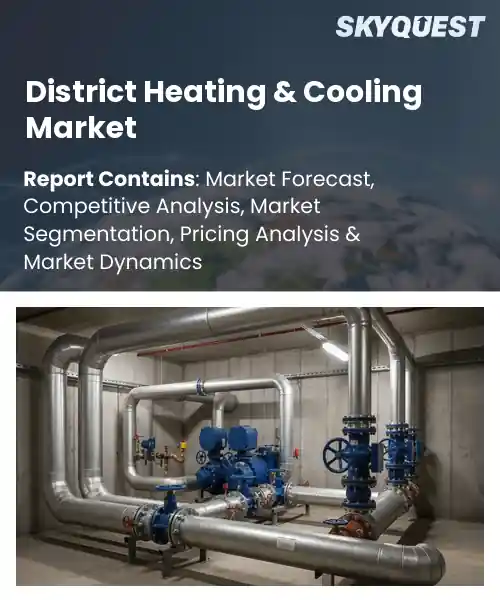
District Heating & Cooling Market
Report ID: SQMIG55B2020
Report ID: SQMIG55B2020
[email protected]
USA +1 351-333-4748
Report ID:
SQMIG55B2020 |
Region:
Global |
Published Date: May, 2026
Pages:
157
|Tables:
117
|Figures:
72


Global District Heating & Cooling Market size was valued at USD 222.52 Billion in 2024 and is poised to grow from USD 236.36 Billion in 2025 to USD 382.85 Billion by 2033, growing at a CAGR of 6.22% during the forecast period (2026-2033).
High emphasis on decarbonization, increasing adoption of energy-efficient urban infrastructure, rising integration of renewable energy sources, expansion of smart city projects, and supportive government policies are driving demand for district heating and cooling systems.
Increasing capital expenditure on low carbon energy infrastructure, digital energy management solutions, and integration of renewable sources of heat are likely to be instrumental in increasing the demand for district heating and cooling systems as well. Efforts to utilize waste heat recovered from industries and data centers, hybrid heat pumps, thermal energy storage, and monitoring of district energy systems through digital technologies is also expected to expand the business potential of district heating and cooling system manufactuers. The rise in the utilization of centralized heating and chilled water distribution systems in residential blocks and commercial spaces adds to the opportunities for sales as well. Rising emphasis on reducing carbon emissions and improving energy efficiency around the world coupled with rising demand for centralized thermal management systems is expected to primarily drive district heating and cooling market growth.
On the contrary, high infrastructure installation and retrofit costs, long project development timelines, regulatory and permitting complexities, and dependence on urban population density and public infrastructure investments are anticipated to impede district heating and cooling market penetration across the study period.
How is AI-driven Optimization Improving District Heating And Cooling System Efficiency?
AI technology implementation into district heating and cooling systems is leading to an improvement in the efficiency of these systems based on forecasting techniques, digital twins, and adaptive control. Implementation of AI in real-life situations is effective in terms of improving the efficiency of the system and at the same time improving flexibility and reliability of district energy networks. Digitalization of energy networks is becoming increasingly popular due to efforts to reduce costs in energy grids and integration of renewables and waste heat into energy networks.
Market snapshot - (2026-2033)
Global Market Size
USD 222.52 Billion
Largest Segment
District Heating
Fastest Growth
District Cooling
Growth Rate
6.22% CAGR
To get more insights on this market click here to Request a Free Sample Report
Global district heating & cooling market is segmented by type, energy source, end-use, and region. Based on type, the market is segmented into district heating, district cooling, and combined district energy. Based on energy source, the market is segmented into fossil fuels, renewable energy and waste heat recovery. Based on end-use, the market is segmented into residential, commercial, and industrial. Based on region, the market is segmented into North America, Europe, Asia Pacific, Latin America, and Middle East & Africa.
The waste heat recovery segment is projected to account for the highest global district heating and cooling market share going forward. It provides access to low-carbon thermal energy from the current industrial operations and built-up environment, decreasing dependency on primary sources, and enhancing energy efficiency. The capture of excess energy from industrial operations, data centers, and treated wastewater will allow providers to offer consistent temperatures and loads, leading to reduced sizes for the centralized energy plants. Such causal impact will decrease the consumption of fuels and minimize operational costs.
However, renewable energy is emerging as the most rapidly expanding segment, as per this district heating and cooling industry analysis. Geothermal and solar thermal technologies deployment provides scalable, low-emission base load, and peak shaving generation capacity. Government policy measures, along with carbon reduction targets, lead to investments, allowing for module-based integration into district heating schemes and stimulating storage technology development.
The industrial segment is forecasted to lead the global district heating and cooling market revenue generation in the long run. The constant thermal requirements of industries allow for a stable backbone for energy networks and make high-capacity investments economically viable. Predictable load profiles and the possibilities of direct thermal use, as well as waste heat recovery from industrial sites create steady incomes and decrease costs per unit. Such factors promote utility-scale engineering solutions and help to obtain finances and accelerate the development of energy networks.
On the other hand, Residential is proving to be the fastest-growing segment due to urban retrofits, the trend towards building electrification, and the introduction of demand-side tariff rates, which boost district energy connections. In addition, efficiency measures, along with consumers' desire for low-carbon heating solutions, lead to equipment replacement and increased distribution networks; hence, smart controls and distributed storage generate additional income opportunities.
To get detailed segments analysis, Request a Free Sample Report
Supportive policy frameworks, long standing urban planning, and mature infrastructure are helping Europe lead district heating and cooling adoption around the world. The technical capacity of experienced utilities and equipment manufacturers accelerates the deployment of systems. Regulatory emphasis on energy efficiency, waste heat recovery, and integration of renewable technologies help to provide stability in the marketplace and modernization of the system within urban and industrial sectors. This has encouraged a considerable emphasis on district cooling in the large coastal and commercial hubs to aid in providing the heating networks, while collaborative research across the countries has spearheaded standardization and best practices. Public acceptance has been enhanced by visible benefits of community resilience towards localized pollution, allowing cities to stay engaged. Coordination in the market helps network development under integrated planning, linking new constructions to network expansions.
District heating & cooling demand in Germany benefits from an extensive industrial and urban engineering ecosystem that prioritizes integration of combined heat and power, waste heat recovery, and renewable thermal sources. Adept technical knowledge facilitates sophisticated system controls as well as effective distribution within industrial and urban clusters. Policy mechanisms help in the retrofitting process and meeting national targets in terms of decarbonization. Utilities and suppliers help in expanding and upgrading the district heating and cooling networks.
Urban renewal programs, heat network proposals in urban areas, and an emphasis on low-carbon heat technologies have begun to determine the future demand for heating and cooling in the United Kingdom. The key issues will be those of retrofit and connection to new buildings, as well as standardization and contractual arrangements. Partnership between local governments, utilities, and developers facilitates the establishment and funding of networks that make use of thermal energy from waste, industrial recovery, and renewable sources.
District heating & cooling adoption in France reflects strong municipal engagement, established urban networks, and major utilities and energy service companies. Emphasis on connecting municipal heat sources, including waste energy, river and industrial recovery, and renewable thermal generation, enables diverse supply portfolios. Local authorities focus on integrating networks with urban planning and building renovations, while innovation in heat pump deployment and system management improves flexibility and supports broader decarbonization objectives.
Accelerating urbanization, high demand for efficient thermal services in dense metropolitan and industrial hubs, and a strategic push for energy security and local decarbonization help create an opportune setting in the region. Regions that have colder climates have been investing in integrated heating network systems with the separation of hot water and cold water. As a result, cross border technology transfer; the formation of alliances with reputable international suppliers; and investments in local manufacturing have all helped to accelerate the deployment of district systems. Rural and/or urban policies that promote district cooling and/or integrated heating networks; have embraced pilot program initiatives and have encouraged innovative financings for the development of large scale projects; while also utilizing innovations in digital network management and thermal storage solutions to provide greater operational flexibility and system resiliency to the different urban contexts in which these programs are planned and developed. District systems are being recognized as a way for governments and city planners to minimize local emissions, manage peaks in energy consumption, and provide energy efficiency for buildings and factories. Climatic demands of the subtropical and tropical environments make district cooling particularly appealing.
District heating & cooling market in Japan focuses on technological refinement, integration with building management systems, and solutions for dense urban and mixed-use applications. Utilities and industrial firms prioritize recovery of process heat and deployment of compact heat pump systems, while coastal cities evaluate seawater cooling. Strong engineering capacity and collaboration between public agencies and private firms drive pilot projects, operational optimization, and measured incremental scaling across urban districts.
Urban redevelopment, industrial heat demand, and utility engagement in network development are shaping sales of district heating and cooling systems in South Korea. City-level planning and smart cities projects help in realizing district heating and district cooling systems. Focusing on the integrated generation of energy, recovery of heat, and automation helps achieve this. Public-private partnerships, along with technological manufacturing processes help bring about these changes.
Municipal leadership, utility pilots, and innovative financing approaches that reduce project risks and attract private capital help shape district heating and cooling demand in this region. Cities and manufacturing sites are evaluating interconnected networks that make use of combined heat and power (CHP), waste heat from data centers and manufacturing, and renewable thermal energy, thereby enhancing their local energy supply. By developing policy and building code changes to facilitate retrofitting and linking of new construction, suppliers are producing scalable and modular solutions that can serve the diverse climates. Public and private partnerships as well as digital control advances, thermal storage and distributed energy generation, provide a foundation for developing replicable project models and for spreading beyond traditional clusters into larger metropolitan and suburban areas and their adjacent regions.
Municipal pilots, university campus projects, with utility involvement in district cooling and heating networks are helping boost district heating and cooling demand in the United States. Technology vendors improve digital control and thermal energy storage for increased efficiency and resiliency. The focus on combined heat and power (CHP), waste heat recovery from data centers, and modular systems enables deployment regardless of the climate. Public-private finance and changing regulations facilitate retrofitting and incorporation into new projects.
District heating & cooling demand in Canada is shaped by municipal initiatives and utility involvement focused on cold climate district heating. Working in partnership with Indigenous communities and utilizing community-based energy planning with procurement models make it possible to scale up pilot programs. Urban municipalities focus on integrating sources like geothermal energy and bioenergy, along with waste heat recovery, into their systems, with modular designs making such innovations viable both within urban and suburban settings.
To know more about the market opportunities by region and country, click here to
Buy The Complete Report
Integration Of Renewable Energy Sources
Urbanization and Network Expansion
High Initial Capital Requirements
Regulatory and Policy Uncertainty
Request Free Customization of this report to help us to meet your business objectives.
Competition in the global district heating and cooling market is intensifying as utilities and new entrants deploy mergers and acquisitions, strategic investments, and technology partnerships to secure low-carbon heat sources. Recent activity includes Baker Hughes and EREN Groupe investing in ExerGo. Public innovation programmes and CEA spinouts are backing microreactor and modular thermal storage projects that accelerate deployment and raise competitive pressure on incumbents.
SkyQuest’s ABIRAW (Advanced Business Intelligence, Research & Analysis Wing) is our Business Information Services team that Collects, Collates, Correlates, and Analyses the Data collected by means of Primary Exploratory Research backed by robust Secondary Desk research.
As per SkyQuest analysis, focus on decarbonization and increasing adoption of energy-efficient urban infrastructure are anticipated to drive the demand for district heating and cooling systems going forward. However, high infrastructure installation costs and long project development timelines are slated to slow down the adoption of district heating and cooling systems in the future. Europe is slated to spearhead the demand for district heating and cooling systems owing to strong renewable energy integration, supportive government policies, and advanced urban energy infrastructure. Development of AI-enabled predictive energy management systems and increasing integration of waste heat recovery and renewable energy technologies are anticipated to be key trends driving the district heating and cooling industry in the long run.
| Report Metric | Details |
|---|---|
| Market size value in 2024 | USD 222.52 Billion |
| Market size value in 2033 | USD 382.85 Billion |
| Growth Rate | 6.22% |
| Base year | 2024 |
| Forecast period | (2026-2033) |
| Forecast Unit (Value) | USD Billion |
| Segments covered |
|
| Regions covered | North America (US, Canada), Europe (Germany, France, United Kingdom, Italy, Spain, Rest of Europe), Asia Pacific (China, India, Japan, Rest of Asia-Pacific), Latin America (Brazil, Rest of Latin America), Middle East & Africa (South Africa, GCC Countries, Rest of MEA) |
| Companies covered |
|
| Customization scope | Free report customization with purchase. Customization includes:-
|
To get a free trial access to our platform which is a one stop solution for all your data requirements for quicker decision making. This platform allows you to compare markets, competitors who are prominent in the market, and mega trends that are influencing the dynamics in the market. Also, get access to detailed SkyQuest exclusive matrix.
Table Of Content
Executive Summary
Market overview
Parent Market Analysis
Market overview
Market size
KEY MARKET INSIGHTS
COVID IMPACT
MARKET DYNAMICS & OUTLOOK
Market Size by Region
KEY COMPANY PROFILES
Methodology
For the District Heating & Cooling Market, our research methodology involved a mixture of primary and secondary data sources. Key steps involved in the research process are listed below:
1. Information Procurement: This stage involved the procurement of Market data or related information via primary and secondary sources. The various secondary sources used included various company websites, annual reports, trade databases, and paid databases such as Hoover's, Bloomberg Business, Factiva, and Avention. Our team did 45 primary interactions Globally which included several stakeholders such as manufacturers, customers, key opinion leaders, etc. Overall, information procurement was one of the most extensive stages in our research process.
2. Information Analysis: This step involved triangulation of data through bottom-up and top-down approaches to estimate and validate the total size and future estimate of the District Heating & Cooling Market.
3. Report Formulation: The final step entailed the placement of data points in appropriate Market spaces in an attempt to deduce viable conclusions.
4. Validation & Publishing: Validation is the most important step in the process. Validation & re-validation via an intricately designed process helped us finalize data points to be used for final calculations. The final Market estimates and forecasts were then aligned and sent to our panel of industry experts for validation of data. Once the validation was done the report was sent to our Quality Assurance team to ensure adherence to style guides, consistency & design.
Analyst Support
Customization Options
With the given market data, our dedicated team of analysts can offer you the following customization options are available for the District Heating & Cooling Market:
Product Analysis: Product matrix, which offers a detailed comparison of the product portfolio of companies.
Regional Analysis: Further analysis of the District Heating & Cooling Market for additional countries.
Competitive Analysis: Detailed analysis and profiling of additional Market players & comparative analysis of competitive products.
Go to Market Strategy: Find the high-growth channels to invest your marketing efforts and increase your customer base.
Innovation Mapping: Identify racial solutions and innovation, connected to deep ecosystems of innovators, start-ups, academics, and strategic partners.
Category Intelligence: Customized intelligence that is relevant to their supply Markets will enable them to make smarter sourcing decisions and improve their category management.
Public Company Transcript Analysis: To improve the investment performance by generating new alpha and making better-informed decisions.
Social Media Listening: To analyze the conversations and trends happening not just around your brand, but around your industry as a whole, and use those insights to make better Marketing decisions.
REQUEST FOR SAMPLE
 REQUEST FREE CUSTOMIZATION
Global District Heating & Cooling Market size was valued at USD 222.52 Billion in 2024 and is poised to grow from USD 236.36 Billion in 2025 to USD 382.85 Billion by 2033, growing at a CAGR of 6.22% during the forecast period (2026-2033).
Competition in the global district heating and cooling market is intensifying as utilities and new entrants deploy mergers and acquisitions, strategic investments, and technology partnerships to secure low carbon heat sources. Recent activity includes Baker Hughes and EREN Groupe investing in ExerGo. Public innovation programmes and CEA spinouts are backing microreactor and modular thermal storage projects that accelerate deployment and raise competitive pressure on incumbents. 'Veolia Environment', 'Fortum Oyj', 'Engie SA', 'E.ON SE', 'Vattenfall AB', 'Danfoss A/S', 'Alfa Laval', 'GE Power', 'Goteborg Energi', 'Stockholm Exergi', 'Statkraft', 'Emicool (Dubai)', 'TABREED (National Central Cooling)', 'ADC Energy Systems', 'Logstor (Georg Fischer)'
District heating and cooling systems that integrate renewable energy sources improve sustainability credentials and provide a compelling value proposition for municipalities and developers, encouraging broader adoption and investment. By combining geothermal, biomass, and solar thermal into centralized networks, systems reduce reliance on fossil fuels and align with policy objectives and corporate environmental commitments. This integration supports long term planning, stimulates infrastructure development, and attracts stakeholders seeking low carbon solutions, collectively driving market expansion through enhanced project feasibility and stakeholder confidence.
Decarbonized Thermal Integration: District heating and cooling systems are increasingly integrating low-carbon heat sources and waste heat from industrial processes, enabling system-wide emissions reductions and improved sustainability. This trend drives development of hybrid networks combining geothermal, heat pumps, and captured industrial heat, expanding feedstock diversity. Operators prioritize long-term fuel flexibility, partnerships with industries, and strategic planning to optimize thermal resource sharing and reduce reliance on fossil fuels, while demonstrating environmental benefits to stakeholders and aligning infrastructure investments with broader decarbonization goals and resilience.
Why does Europe Dominate the Global District Heating & Cooling Market? |@12


Want to customize this report? This report can be personalized according to your needs. Our analysts and industry experts will work directly with you to understand your requirements and provide you with customized data in a short amount of time. We offer $1000 worth of FREE customization at the time of purchase.
Feedback From Our Clients


 USA (+1) 351-333-4748

