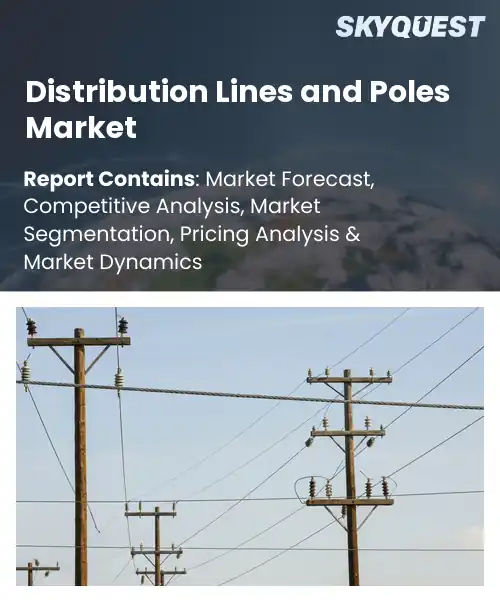
Distribution Lines and Poles Market
Report ID: SQMIG20D2730
Report ID: SQMIG20D2730
[email protected]
USA +1 351-333-4748
Report ID:
SQMIG20D2730 |
Region:
Global |
Published Date: July, 2026
Pages:
157
|Tables:
175
|Figures:
79


Global Distribution Lines And Poles Market size was valued at USD 42.75 Billion in 2024 and is poised to grow from USD 45.4 Billion in 2025 to USD 73.47 Billion by 2033, growing at a CAGR of 6.2% during the forecast period (2026-2033).
The global distribution lines and poles market encompasses the manufacturing, installation and maintenance of overhead and underground conductors, support structures and hardware which deliver electricity from substations to end-users. What makes it important is that it provides reliable power to residential, commercial and industrial customers and that is the foundation of economic activity and life. The market has evolved from timber poles and copper wires to composite materials, low-sag (HTLS) lines and sensors in the last century, after the 1990s. U.S. utilities have been replacing wooden poles with steel-reinforced composites for the past decade as urban sprawl, growing capacity needs and regulatory requirements for grid resilience drive the change.
The major factor driving the next phase of the global distribution lines and poles market is the push for grid modernization and renewable integration which drives demand for higher capacity and lower loss conductors and support structures. Solar and wind farms are farther away from load centers, so utilities are either upgrading existing corridors or building new corridors with bidirectional flow capacity. A good example of this is the European Green Deal’s 10 GW offshore network, which uses composite, corrosion-resistant poles that reduce maintenance and speed deployment. Advanced composites, embedded sensors and modular designs give manufacturers an edge. Emerging markets are accelerating infrastructure rollouts, creating revenues and bolstering market growth.
How is IoT Enhancing Reliability And Monitoring In The Distribution Lines And Poles Market?
IoT sensors are being installed on distribution lines and poles, continuously feeding data about temperature, vibration, line sag and fault conditions. That real-time visibility enables utilities to detect anomalies before they become outages, schedule maintenance more precisely and balance loads across the grid. Integrated platforms apply analytics to the sensor feeds and trigger automated alerts, reducing manual inspections and improving safety for crews. With urbanization and the need for energy on the rise, the ability to remotely monitor thousands of assets is becoming a key driver of reliability and operational efficiency in the sector. In April 2026, Siemens announced an IoT-enabled smart pole deployment showcasing how connected hardware can support fault detection and enable proactive grid management.
Market snapshot - (2026-2033)
Global Market Size
USD 42.75 Billion
Largest Segment
Distribution Poles
Fastest Growth
Insulators & Fittings
Growth Rate
6.2% CAGR
To get more insights on this market click here to Request a Free Sample Report
Global distribution lines and poles market is segmented by product type, voltage level, application, end user, installation type, distribution channel and region. Based on product type, the market is segmented into Distribution Poles, Distribution Lines, Crossarms & Pole Hardware, Insulators & Fittings and Others. Based on voltage level, the market is segmented into Low Voltage (LV) Distribution, Medium Voltage (MV) Distribution and High Voltage (HV) Distribution. Based on application, the market is segmented into Urban Power Distribution, Rural Electrification, Industrial Power Distribution, Renewable Energy Grid Integration and Others. Based on end user, the market is segmented into Electric Utilities, Industrial Facilities, Commercial Establishments, Government & Municipal Authorities and Others. Based on installation type, the market is segmented into New Installations and Replacement & Retrofit. Based on distribution channel, the market is segmented into Direct Sales and Distributors & Dealers. Based on region, the market is segmented into North America, Europe, Asia Pacific, Latin America and Middle East & Africa.
The Distribution Poles segment is expected to dominate the market, as they make the physical backbone of every overhead network, directly impacting line sag, clearances and maintenance accessibility. Wood, steel, composite – the selection of materials provides tailored responses to climatic stress, load requirements and considerations of lifecycle cost. Utilities prefer poles due to their proven reliability, ease of installation, and compatibility with a wide range of accessories. They provide uninterrupted power delivery across a wide range of terrains and long term service reliability for all stakeholders.
However, the Crossarms & Pole Hardware segment is witnessing the highest growth momentum as innovative composite designs and smart sensor integration are expanding functionality beyond simple support. These improvements enable condition monitoring, reduce line losses and provide higher voltage clearances driving demand from utilities for cost effective upgrades and future proof grid architectures.
The Distribution Poles segment is expected to dominate the market, as they make the physical backbone of every overhead network, directly impacting line sag, clearances and maintenance accessibility. Wood, steel, composite – the selection of materials provides tailored responses to climatic stress, load requirements and considerations of lifecycle cost. Utilities prefer poles due to their proven reliability, ease of installation, and compatibility with a wide range of accessories. They provide uninterrupted power delivery across a wide range of terrains and long term service reliability for all stakeholders.
However, the Crossarms & Pole Hardware segment is witnessing the highest growth momentum as innovative composite designs and smart sensor integration are expanding functionality beyond simple support. These improvements enable condition monitoring, reduce line losses and provide higher voltage clearances driving demand from utilities for cost effective upgrades and future proof grid architectures.
To get detailed segments analysis, Request a Free Sample Report
North America is still at the top of the list, thanks to a combination of a mature grid infrastructure and a strong focus on reliability and safety. Utilities in the region consistently invest in modernising assets using advanced materials and design standards that improve performance. We have a strong supply chain that allows us to quickly roll out new solutions, and a talented engineering workforce that is at the forefront of product development innovation. Regulation promotes the combination and ongoing development of renewable energy sources, guaranteeing a steady demand for high-quality distribution lines and poles. The presence of large manufacturers with robust R&D capabilities further enhances the region’s competitive advantage, ensuring that North America continues to be the benchmark for industry best practices and technological advancement.
United States Distribution Lines and Poles Market has the advantage of extensive network coverage and proactive stance on grid resilience. Utilities point to the use of advanced pole materials and line designs that are more fault tolerant and require fewer maintenance cycles. We’re always innovating by working with research universities and manufacturers . Strong procurement processes help ensure critical parts arrive in a timely manner . The focus on integrating distributed energy resources also drives the need for flexible distribution solutions that can accommodate a diverse mix of energy sources.
Canada’s Distribution Lines and Poles Market is a promise to harsh‑climate dependability and environmentally responsible infrastructure development. Engineers want durable designs that can withstand extreme weather conditions, and this is why they use composites and treated timber solutions. Regional utilities use strategic planning to upgrade aging assets to meet broader environmental goals. Through close collaboration with North American manufacturers, access to the most advanced technologies is gained, increasing the market’s ability to deliver resilient and efficient distribution networks.
Europe’s expansion is propelled by ambitious energy transition initiatives and stringent grid performance standards. Policy frameworks encourage the integration of renewable generation, necessitating flexible and robust distribution infrastructure. Utilities across the continent are actively replacing legacy assets with smart‑enabled lines and poles that support real‑time monitoring and automated fault management. Investment in grid automation and digitalization enhances operational efficiency, while a collaborative research environment spurs the development of innovative materials. Market participants benefit from harmonized regulations that streamline cross‑border projects, fostering a dynamic ecosystem where sustainability and reliability drive continuous growth.
Distribution Lines and Poles Market in Germany reflects a strong focus on engineering excellence and sustainability. Industry leaders prioritize high‑strength steel and composite solutions that align with stringent safety standards. Utilities pursue extensive network reinforcement to accommodate expanding renewable capacity, emphasizing modular designs that simplify installation. Collaborative research initiatives between academia and manufacturers accelerate the adoption of smart‑grid technologies, reinforcing Germany’s position as a benchmark for advanced distribution infrastructure.
Distribution Lines and Poles Market in United Kingdom is characterized by rapid modernization and a keen emphasis on digital integration. Utility companies are accelerating the rollout of intelligent pole systems equipped with sensors for predictive maintenance. The market embraces lightweight composite materials that reduce installation time and mitigate environmental impact. Strong policy support for low‑carbon electricity distribution fuels investment in adaptive line configurations that enhance grid flexibility and resilience.
Distribution Lines and Poles Market in France is emerging as a focal point for sustainable grid development. Emphasis on eco‑friendly materials drives the adoption of treated timber and recycled composites. Utilities are undertaking strategic upgrades to improve network reliability, aligning projects with national renewable energy targets. Partnerships with research institutions encourage the exploration of smart‑grid solutions that enable efficient load management and fault detection.
Asia Pacific is enhancing its role through a blend of rapid urbanization, progressive policy support, and a thriving manufacturing base. Governments across the region are prioritizing grid upgrades to accommodate burgeoning demand and the integration of distributed generation sources. The market sees heightened interest in smart‑enabled distribution lines and poles that facilitate real‑time monitoring and adaptive operation. A strong focus on research and development yields innovative material applications, while close collaboration between utilities and domestic manufacturers ensures swift adoption of emerging technologies. This synergistic environment positions Asia Pacific as a dynamic hub for both production capacity and forward‑looking distribution solutions.
Distribution Lines and Poles Market in Japan emphasizes resilience against seismic activity and advanced technological integration. Utilities adopt high‑performance pole systems designed for earthquake resistance, complemented by smart line monitoring that supports rapid fault isolation. Continuous collaboration with leading manufacturers drives the incorporation of lightweight composites, enhancing installation efficiency while maintaining stringent safety standards. The market’s commitment to reliability sustains its reputation for cutting‑edge distribution infrastructure.
Distribution Lines and Poles Market in South Korea focuses on high‑density urban deployment and smart‑grid readiness. Utilities prioritize compact pole designs that meet space constraints while embedding sensors for condition‑based maintenance. Strong governmental incentives encourage the rollout of intelligent distribution components that enable seamless integration with renewable energy assets. Domestic manufacturing expertise supports rapid scaling of innovative solutions, reinforcing South Korea’s growing influence in the regional distribution landscape.
To know more about the market opportunities by region and country, click here to
Buy The Complete Report
Increasing Urban Infrastructure Demand
Adoption Of Smart Grid Technologies
High Installation Cost Barriers
Regulatory Compliance Complexity
Request Free Customization of this report to help us to meet your business objectives.
The Distribution Lines and Poles market is moderately concentrated, led by players like Prysmian Group, Nexans, and ZTT, alongside regional leaders such as KEI Industries (India) and Riyadh Cables Group (Saudi Arabia). Other key names include Amphenol, Southwire Company, Eaton, Siemens, Triton International, Schneider Electric, ABB, Valeo, Mitsubishi Electric, and Apar Industries. M&A activity is moderate, with larger players strategically acquiring smaller companies to expand geographic reach and product portfolios. Companies are also pursuing product innovation and geographical expansion alongside joint ventures and partnerships to strengthen smart-pole and grid-modernization capabilities
Recent Developments
SkyQuest’s ABIRAW (Advanced Business Intelligence, Research & Analysis Wing) is our Business Information Services team that Collects, Collates, Correlates, and Analyses the Data collected by means of Primary Exploratory Research backed by robust Secondary Desk research.
As per SkyQuest analysis, the global distribution lines and poles market is propelled primarily by rising urban infrastructure demand, which pushes utilities to expand and upgrade networks, while the adoption of smart‑grid technologies serves as a second catalyst by requiring lines and poles that embed sensors and support real‑time communication. The main restraint comes from high installation costs that limit rapid rollout, especially in emerging economies. North America remains the dominant region due to its mature grid, strong supply chain and ongoing modernization programs. Within the market, distribution poles are the leading segment, providing the essential backbone for overhead networks and benefiting most from material‑innovation trends.
| Report Metric | Details |
|---|---|
| Market size value in 2024 | USD 42.75 Billion |
| Market size value in 2033 | USD 73.47 Billion |
| Growth Rate | 6.2% |
| Base year | 2024 |
| Forecast period | (2026-2033) |
| Forecast Unit (Value) | USD Billion |
| Segments covered |
|
| Regions covered | North America (US, Canada), Europe (Germany, France, United Kingdom, Italy, Spain, Rest of Europe), Asia Pacific (China, India, Japan, Rest of Asia-Pacific), Latin America (Brazil, Rest of Latin America), Middle East & Africa (South Africa, GCC Countries, Rest of MEA) |
| Companies covered |
|
| Customization scope | Free report customization with purchase. Customization includes:-
|
To get a free trial access to our platform which is a one stop solution for all your data requirements for quicker decision making. This platform allows you to compare markets, competitors who are prominent in the market, and mega trends that are influencing the dynamics in the market. Also, get access to detailed SkyQuest exclusive matrix.
Table Of Content
Executive Summary
Market overview
Parent Market Analysis
Market overview
Market size
KEY MARKET INSIGHTS
COVID IMPACT
MARKET DYNAMICS & OUTLOOK
Market Size by Region
KEY COMPANY PROFILES
Methodology
For the Distribution Lines and Poles Market, our research methodology involved a mixture of primary and secondary data sources. Key steps involved in the research process are listed below:
1. Information Procurement: This stage involved the procurement of Market data or related information via primary and secondary sources. The various secondary sources used included various company websites, annual reports, trade databases, and paid databases such as Hoover's, Bloomberg Business, Factiva, and Avention. Our team did 45 primary interactions Globally which included several stakeholders such as manufacturers, customers, key opinion leaders, etc. Overall, information procurement was one of the most extensive stages in our research process.
2. Information Analysis: This step involved triangulation of data through bottom-up and top-down approaches to estimate and validate the total size and future estimate of the Distribution Lines and Poles Market.
3. Report Formulation: The final step entailed the placement of data points in appropriate Market spaces in an attempt to deduce viable conclusions.
4. Validation & Publishing: Validation is the most important step in the process. Validation & re-validation via an intricately designed process helped us finalize data points to be used for final calculations. The final Market estimates and forecasts were then aligned and sent to our panel of industry experts for validation of data. Once the validation was done the report was sent to our Quality Assurance team to ensure adherence to style guides, consistency & design.
Analyst Support
Customization Options
With the given market data, our dedicated team of analysts can offer you the following customization options are available for the Distribution Lines and Poles Market:
Product Analysis: Product matrix, which offers a detailed comparison of the product portfolio of companies.
Regional Analysis: Further analysis of the Distribution Lines and Poles Market for additional countries.
Competitive Analysis: Detailed analysis and profiling of additional Market players & comparative analysis of competitive products.
Go to Market Strategy: Find the high-growth channels to invest your marketing efforts and increase your customer base.
Innovation Mapping: Identify racial solutions and innovation, connected to deep ecosystems of innovators, start-ups, academics, and strategic partners.
Category Intelligence: Customized intelligence that is relevant to their supply Markets will enable them to make smarter sourcing decisions and improve their category management.
Public Company Transcript Analysis: To improve the investment performance by generating new alpha and making better-informed decisions.
Social Media Listening: To analyze the conversations and trends happening not just around your brand, but around your industry as a whole, and use those insights to make better Marketing decisions.
REQUEST FOR SAMPLE
 REQUEST FREE CUSTOMIZATION
Global Distribution Lines And Poles Market size was valued at USD 42.75 Billion in 2024 and is poised to grow from USD 45.4 Billion in 2025 to USD 73.47 Billion by 2033, growing at a CAGR of 6.2% during the forecast period (2026-2033).
Insufficient data to generate the requested section. 'Prysmian S.p.A.', 'Nexans S.A.', 'Southwire Company, LLC', 'Valmont Industries, Inc.', 'Stella-Jones Inc.', 'Elsewedy Electric Co. S.A.E.', 'APAR Industries Limited', 'KEI Industries Limited', 'Skipper Limited', 'Lamifil NV', 'Hubbell Incorporated', 'Preformed Line Products Company', 'MacLean Power Systems, LLC', 'Sabre Industries, Inc.', 'Arcosa, Inc.', 'Creative Composites Group, Inc.', 'StressCrete Group', 'Bell Lumber & Pole Company', 'Pelco Structural, LLC', 'RS Technologies Inc.'
Rapid urbanization drives municipalities to expand electrical distribution networks, prompting a surge in demand for reliable lines and poles. The growing need for resilient infrastructure supports extensive deployment projects, encouraging manufacturers to scale production and innovate material performance. Consequently, the sector experiences heightened activity as utilities prioritize upgrading aging assets to meet increased load requirements and ensure consistent service delivery across expanding urban landscapes. These initiatives are often aligned with government sustainability targets, further reinforcing investment in high‑quality distribution components that can accommodate future capacity expansions and technological integration.
Smart Grid Integration: The proliferation of smart‑grid architectures is reshaping utility infrastructure, creating a strong preference for distribution lines and poles that can accommodate embedded sensors, automated fault detection, and bi‑directional power flow. Manufacturers are embedding communication modules and designing modular connection points to enable real‑time data exchange with control centers. This capability enhances grid resilience, reduces outage duration, and supports the integration of distributed energy resources, making adaptive hardware a strategic priority for utilities seeking operational efficiency and higher reliability in evolving electricity networks.
Why does North America Dominate the Global Distribution Lines and Poles Market? |@12


Want to customize this report? This report can be personalized according to your needs. Our analysts and industry experts will work directly with you to understand your requirements and provide you with customized data in a short amount of time. We offer $1000 worth of FREE customization at the time of purchase.
Feedback From Our Clients


 USA (+1) 351-333-4748

