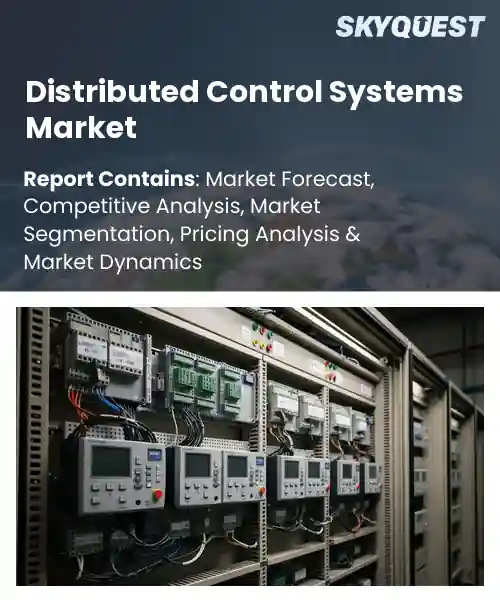
Distributed Control Systems Market
Report ID: SQMIG45J2626
Report ID: SQMIG45J2626
[email protected]
USA +1 351-333-4748
Report ID:
SQMIG45J2626 |
Region:
Global |
Published Date: July, 2026
Pages:
157
|Tables:
119
|Figures:
76


Global Distributed Control Systems Market size was valued at USD 19.04 Billion in 2024 and is poised to grow from USD 19.97 Billion in 2025 to USD 29.29 Billion by 2033, growing at a CAGR of 4.9% during the forecast period (2026-2033).
The distributed control system (DCS) market encompasses hardware and software platforms that coordinate monitoring and regulation of processes across nodes, replacing centralized architectures with modular controllers. Its significance stems from the ability to improve reliability, scalability, and efficiency in sectors such as oil & gas, chemicals, power generation, and pharmaceuticals. The primary driver today is the accelerating adoption of Industry 4.0 standards, which demand seamless data exchange between sensors, edge devices, and systems. Since early 2000s, DCS solutions have evolved from field‑bus networks to Ethernet‑based protocols, exemplified by Siemens' Simatic PCS 7 and ABB's 800xA platforms, enabling tighter integration with IoT analytics.
A key trend driving the global distributed control systems sector is the rising demand for process automation in renewable power and hydrogen production, which compels operators to seek control architectures. As renewable installations expand, the need to balance fluctuating inputs and maintain grid stability drives investors toward DCS solutions capable of load forecasting and dispatch. Companies such as Schneider Electric have introduced cloud‑connected DCS suites that integrate weather analytics, allowing wind farms to optimize turbine output while minimizing wear. This capability creates a loop: improved efficiency lowers operating costs, encouraging further deployment of renewable assets, which generates market volume for advanced DCS platforms.
How are AI and IoT Driving Innovation in the Distributed Control Systems Market?
AI and IoT are reshaping distributed control systems by turning static hardware into adaptive networks that learn and react in real time. Sensors embedded in process equipment feed continuous streams of data to cloud platforms where machine learning models identify patterns, predict faults and suggest optimal set points. Edge computing reduces latency, allowing controllers to execute decisions locally while still benefiting from centralized analytics. The fusion of AI driven analytics with IoT connectivity enables operators to monitor assets remotely, schedule maintenance before failures occur and fine‑tune processes for energy efficiency. This convergence creates smarter plants that can scale across industries and respond quickly to market demands, driving both innovation and competitiveness.
In June 2025, Honeywell International Inc. launched an AI-enabled digital suite for industrial automation, integrating advanced AI, Digital Prime, and cybersecurity capabilities with its process control portfolio. The platform enhances predictive operations, autonomous decision-making, and lifecycle management, enabling Distributed Control System (DCS) users to improve plant efficiency, reliability, and operational resilience.
Market snapshot - (2026-2033)
Global Market Size
USD 19.04 Billion
Largest Segment
Hardware
Fastest Growth
Software
Growth Rate
4.9% CAGR
To get more insights on this market click here to Request a Free Sample Report
Global distributed control systems market is segmented by component, deployment type, functionality, end-use industry and region. Based on component, the market is segmented into hardware, software and services. Based on deployment type, the market is segmented into on-premises and cloud-connected / hybrid. Based on functionality, the market is segmented into process control, safety instrumented systems and data acquisition & SCADA integration. Based on end-use industry, the market is segmented into oil & gas, chemicals, power generation, pharmaceuticals, water & wastewater and food & beverage. Based on region, the market is segmented into North America, Europe, Asia Pacific, Latin America and Middle East & Africa.
Based on the global distributed control systems market growth, hardware segment dominates because plant engineers prioritize rugged, field proven devices that can endure extreme temperature, vibration and electromagnetic interference. These devices form the backbone of control loops, ensuring continuous operation and minimal downtime. Manufacturers focus on modular designs and long life components, which reduce maintenance costs and simplify upgrades. Consequently, the trust placed in physical controllers and I/O modules drives the majority of investment within the Distributed Control Systems market.
However, software segment emerges as the most rapidly expanding area because developers integrate analytics, edge computing and open architecture that enable real time optimization. This flexibility draws operators aiming to future proof plants and adopt predictive maintenance. Growing software licensing and cloud based upgrade services creates revenue streams and widens the market for Distributed Control Systems.
On premises segment dominates because plant operators rely on local control to meet stringent security and reliability requirements. Keeping hardware and software within the facility limits exposure to external threats and enables direct oversight of network traffic. This approach aligns with legacy safety standards and facilitates tailored access controls, reinforcing trust in critical processes. Consequently, organizations allocate the bulk of their Distributed Control Systems spending to on site solutions that assure data integrity and operational continuity.
Meanwhile, cloud connected segment emerges as the most rapidly expanding area because enterprises seek scalable architectures that simplify remote monitoring and rapid deployment of updates. Cloud services enable centralized data aggregation, advanced analytics and collaborative troubleshooting across multiple sites. This flexibility drives broader adoption and unlocks new revenue models, accelerating growth of Distributed Control Systems.
To get detailed segments analysis, Request a Free Sample Report
As per the global distributed control systems market share, Asia Pacific dominance stems from a combination of robust industrial manufacturing, early adoption of advanced automation technologies, and sustained investment in research and development. The region’s leading economies prioritize efficiency and reliability in process industries, driving demand for sophisticated control solutions. Strong governmental initiatives encourage digital transformation and integration of smart manufacturing practices, creating an ecosystem that supports continuous innovation. Additionally, a deep pool of engineering talent and a dynamic supply chain enable rapid deployment of customized systems across sectors such as chemicals, energy, and automotive, reinforcing the region’s competitive advantage in the global market.
Distributed control systems market in Japan benefits from a long-standing culture of precision engineering and a strategic focus on high‑value manufacturing. The market is propelled by intensive automation in automotive and electronics sectors, where reliability and real‑time performance are paramount. Collaborative efforts between industry leaders and research institutions foster continuous improvement, while regulatory emphasis on safety and environmental stewardship further drives adoption of advanced control solutions.
Distributed control systems market in South Korea is energized by rapid growth in petrochemical and semiconductor production, where process optimization is critical. Strong governmental support for smart factory initiatives encourages integration of sophisticated control architectures. The presence of leading global equipment manufacturers enhances technology transfer and local customization, ensuring that control solutions meet stringent performance and sustainability criteria across diverse industrial applications.
Based on global distributed control systems regional forecast, North America’s rapid expansion is fueled by a deep commitment to digital transformation and operational excellence across its diverse industrial base. The region’s emphasis on safety, reliability, and energy efficiency motivates the adoption of advanced control technologies, particularly in sectors such as oil and gas, chemicals, and food processing. Strong engineering expertise, extensive research collaborations, and a mature supply chain enable swift integration of innovative solutions. Moreover, the focus on sustainability and regulatory compliance encourages the deployment of intelligent systems that enhance process visibility and reduce environmental impact, reinforcing the market’s growth trajectory.
Distributed control systems market in the United States thrives on a culture of innovation and large‑scale industrial operations. The market is propelled by extensive investment in smart manufacturing and a robust ecosystem of technology providers. Emphasis on high reliability and advanced data analytics drives adoption across energy, automotive, and specialty chemical sectors. Collaborative initiatives between academia, industry, and government further accelerate the development of next‑generation control solutions tailored to complex process requirements.
Distributed control systems market in Canada is shaped by a strong focus on resource extraction and renewable energy sectors, where precise process control is essential. Government incentives for technology adoption and a well‑established engineering talent pool support the integration of sophisticated control platforms. The market benefits from close collaboration among industry players, fostering solutions that address the unique challenges of harsh operating environments while upholding high standards of safety and sustainability.
As per global distributed control systems regional outlook, Europe strengthens its position through a strategic emphasis on standardization, sustainability, and digital integration across its industrial landscape. The region leverages rigorous regulatory frameworks that promote energy efficiency and environmental responsibility, driving demand for advanced control systems. Collaborative research networks and industry clusters facilitate the development of interoperable solutions that align with broader initiatives such as the digital single market. Strong engineering heritage and a focus on cybersecurity ensure that European offerings remain competitive, while the integration of IoT and data analytics enhances operational insight across sectors like automotive, chemicals, and pharmaceuticals.
Distributed control systems market in Germany reflects a deep engineering tradition and a commitment to high‑performance manufacturing. The market is reinforced by the country’s leadership in automotive and advanced chemicals, where precise process control underpins product quality. Emphasis on Industry 4.0 standards and robust cybersecurity measures drives the adoption of modular, scalable control solutions that integrate seamlessly with digital twins and predictive maintenance frameworks.
Distributed control systems market in the United Kingdom is characterized by a strong focus on innovation and regulatory compliance within process industries. The market benefits from extensive research collaborations between universities and technology firms, fostering advanced control architectures tailored to energy, pharmaceuticals, and aerospace sectors. A proactive approach to sustainability and risk management accelerates the integration of intelligent systems that enhance efficiency and resilience.
Distributed control systems market in France is propelled by a sophisticated industrial base and a strategic commitment to digital transformation. The market gains momentum from the country's leadership in aerospace, nuclear, and specialty chemicals, where stringent safety and performance standards demand cutting‑edge control technologies. Collaborative initiatives across industry and research institutions support the development of adaptable solutions that align with national sustainability goals and the broader European digital agenda.
To know more about the market opportunities by region and country, click here to
Buy The Complete Report
Growing Adoption Of IoT Connectivity
Leveraging Cloud‑Based Analytics
High Initial Capital Investment
Complex Integration With Legacy Systems
Request Free Customization of this report to help us to meet your business objectives.
The competitive landscape of the global distributed control systems market outlook is defined by intense rivalry among established automation giants and emerging technology firms, prompting a wave of mergers, strategic alliances, and accelerated innovation in edge computing, cybersecurity, and cloud‑enabled control platforms; recent mega‑funding rounds for niche players illustrate the drive to capture market share through differentiated DCS solutions.
Top Player’s Company Profile
Recent Developments
SkyQuest’s ABIRAW (Advanced Business Intelligence, Research & Analysis Wing) is our Business Information Services team that Collects, Collates, Correlates, and Analyses the Data collected by means of Primary Exploratory Research backed by robust Secondary Desk research.
As per SkyQuest analysis, the global distributed control systems industry is propelled primarily by the growing adoption of IoT connectivity, which enables data exchange and predictive maintenance across plants. A second driver is cloud‑based analytics that provides scalable computing, remote supervision and software upgrades, expanding advanced control to more users. The hardware component remains the dominant segment because engineers prioritize rugged controllers and I/O modules for reliability. Asia Pacific leads the market thanks to its strong industrial base, early automation uptake and supportive government policies. However, the high initial capital investment needed for sensors, controllers and secure networks acts as a notable restraint on faster adoption.
| Report Metric | Details |
|---|---|
| Market size value in 2024 | USD 19.04 Billion |
| Market size value in 2033 | USD 29.29 Billion |
| Growth Rate | 4.9% |
| Base year | 2024 |
| Forecast period | (2026-2033) |
| Forecast Unit (Value) | USD Billion |
| Segments covered |
|
| Regions covered | North America (US, Canada), Europe (Germany, France, United Kingdom, Italy, Spain, Rest of Europe), Asia Pacific (China, India, Japan, Rest of Asia-Pacific), Latin America (Brazil, Rest of Latin America), Middle East & Africa (South Africa, GCC Countries, Rest of MEA) |
| Companies covered |
|
| Customization scope | Free report customization with purchase. Customization includes:-
|
To get a free trial access to our platform which is a one stop solution for all your data requirements for quicker decision making. This platform allows you to compare markets, competitors who are prominent in the market, and mega trends that are influencing the dynamics in the market. Also, get access to detailed SkyQuest exclusive matrix.
Table Of Content
Executive Summary
Market overview
Parent Market Analysis
Market overview
Market size
KEY MARKET INSIGHTS
COVID IMPACT
MARKET DYNAMICS & OUTLOOK
Market Size by Region
KEY COMPANY PROFILES
Methodology
For the Distributed Control Systems Market, our research methodology involved a mixture of primary and secondary data sources. Key steps involved in the research process are listed below:
1. Information Procurement: This stage involved the procurement of Market data or related information via primary and secondary sources. The various secondary sources used included various company websites, annual reports, trade databases, and paid databases such as Hoover's, Bloomberg Business, Factiva, and Avention. Our team did 45 primary interactions Globally which included several stakeholders such as manufacturers, customers, key opinion leaders, etc. Overall, information procurement was one of the most extensive stages in our research process.
2. Information Analysis: This step involved triangulation of data through bottom-up and top-down approaches to estimate and validate the total size and future estimate of the Distributed Control Systems Market.
3. Report Formulation: The final step entailed the placement of data points in appropriate Market spaces in an attempt to deduce viable conclusions.
4. Validation & Publishing: Validation is the most important step in the process. Validation & re-validation via an intricately designed process helped us finalize data points to be used for final calculations. The final Market estimates and forecasts were then aligned and sent to our panel of industry experts for validation of data. Once the validation was done the report was sent to our Quality Assurance team to ensure adherence to style guides, consistency & design.
Analyst Support
Customization Options
With the given market data, our dedicated team of analysts can offer you the following customization options are available for the Distributed Control Systems Market:
Product Analysis: Product matrix, which offers a detailed comparison of the product portfolio of companies.
Regional Analysis: Further analysis of the Distributed Control Systems Market for additional countries.
Competitive Analysis: Detailed analysis and profiling of additional Market players & comparative analysis of competitive products.
Go to Market Strategy: Find the high-growth channels to invest your marketing efforts and increase your customer base.
Innovation Mapping: Identify racial solutions and innovation, connected to deep ecosystems of innovators, start-ups, academics, and strategic partners.
Category Intelligence: Customized intelligence that is relevant to their supply Markets will enable them to make smarter sourcing decisions and improve their category management.
Public Company Transcript Analysis: To improve the investment performance by generating new alpha and making better-informed decisions.
Social Media Listening: To analyze the conversations and trends happening not just around your brand, but around your industry as a whole, and use those insights to make better Marketing decisions.
REQUEST FOR SAMPLE
 REQUEST FREE CUSTOMIZATION
Global Distributed Control Systems Market size was valued at USD 19.04 Billion in 2024 and is poised to grow from USD 19.97 Billion in 2025 to USD 29.29 Billion by 2033, growing at a CAGR of 4.9% during the forecast period (2026-2033).
The competitive landscape of the global Distributed Control Systems market is defined by intense rivalry among established automation giants and emerging technology firms, prompting a wave of mergers, strategic alliances, and accelerated innovation in edge computing, cybersecurity, and cloud‑enabled control platforms; recent mega‑funding rounds for niche players illustrate the drive to capture market share through differentiated DCS solutions. 'Siemens AG', 'ABB Ltd.', 'Honeywell International Inc.', 'Yokogawa Electric Corporation', 'Emerson Electric Co.', 'Rockwell Automation', 'Schneider Electric', 'Metso Corporation', 'NovaTech Process Solutions LLC', 'General Electric (GE Vernova)', 'Auma Riester GmbH', 'Mitsubishi Electric Corporation', 'Omron Corporation', 'Beckhoff Automation GmbH', 'Endress+Hauser', 'Siemens Process Systems', 'Pepperl+Fuchs', 'HIMA Paul Hildebrandt GmbH', 'National Instruments (NI, Emerson)'
The increasing integration of Internet of Things devices enables real‑time data exchange across distributed assets, allowing control systems to respond swiftly to operational changes. This connectivity expands the functional scope of control architectures, supports predictive maintenance, and enhances system resilience. As manufacturers and utilities seek to improve efficiency and reduce downtime, the demand for platforms that can orchestrate heterogeneous devices intensifies, directly driving market expansion through broader application across process automation, smart grids, and building management in industrial and environmental contexts.
Edge‑Driven Architecture Adoption: Manufacturers are shifting from centralized PLC networks to edge‑driven control architectures that embed processing power directly within field devices. This transition reduces latency, enhances real‑time decision making, and supports modular scaling of production lines. By distributing intelligence across sensors, actuators, and gateways, plants can respond instantly to process variations, improve fault tolerance, and simplify system upgrades. The trend is propelled by advances in micro‑controller capabilities, open‑source middleware, and the need for agile, resilient automation in volatile markets global supply chains.
Why does Asia Pacific Dominate the Global Distributed Control Systems Market? |@12


Want to customize this report? This report can be personalized according to your needs. Our analysts and industry experts will work directly with you to understand your requirements and provide you with customized data in a short amount of time. We offer $1000 worth of FREE customization at the time of purchase.
Feedback From Our Clients


 USA (+1) 351-333-4748

