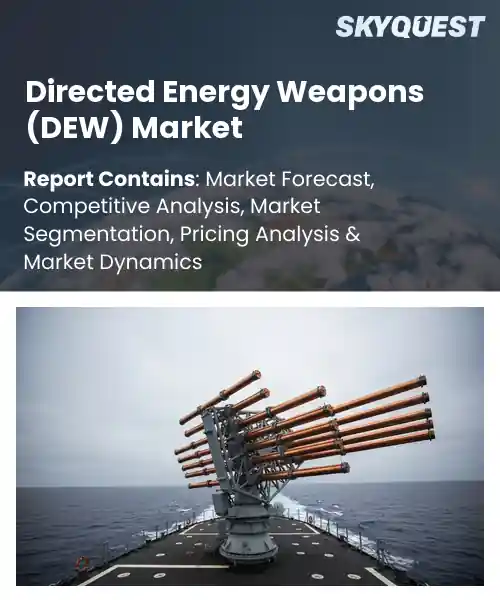
Directed Energy Weapons (DEW) Market
Report ID: SQMIG20A2754
Report ID: SQMIG20A2754
[email protected]
USA +1 351-333-4748
Report ID:
SQMIG20A2754 |
Region:
Global |
Published Date: July, 2026
Pages:
157
|Tables:
120
|Figures:
77


Global Directed Energy Weapons (Dew) Market size was valued at USD 7.65 Billion in 2024 and is poised to grow from USD 9.6 Billion in 2025 to USD 58.87 Billion by 2033, growing at a CAGR of 25.45% during the forecast period (2026-2033).
Directed energy weapons (DEW) is a global market of systems that project energy in the form of laser, microwave or particle beams to disable targets without traditional projectiles. For modern militaries seeking precision, lower logistics and reduced collateral damage, it is becoming a strategic pillar. The emergence of this technology is driven by the desire for kinetic-free engagement, which was spurred by the U.S. Navy’s Laser Weapon System (LaWS) that demonstrated ship-based laser interception of aerial threats in 2016, prompting rapid adoption across allied fleets. The initial research of the 1990s was restricted by power-density limits but advances in solid-state lasers and high-end battery technologies enabled demonstrators to progress from laboratory prototypes to field-proven platforms.
This evolution is part of a broader transition to network-centric warfare where speed of response and cost per shot will be the key and DEWs will be the critical enabler of the next-generation combat doctrines.The most compelling growth driver today is the convergence of energy-storage advances and autonomous targeting that together unlock a range of operational opportunities beyond ship defense, including perimeter security, missile-defense integration, and counter-UAS missions. The Israeli Iron Beam laser, powered by state-of-the-art fiber-laser modules, successfully engaged rockets during the 2023 Gaza conflict, for example, and shows the way in which reduced power consumption translates into fast repeatable engagements at a small fraction of traditional missile costs.
This cause-effect chain of improved power sources leading to higher pulse rates and cheaper per-engagement costs attracts buying interest from both defense ministries and private security firms. The evolution of hybrid platforms combining kinetic and directed-energy effects is also expected to expand mission envelopes and spur investment in modular architectures that can be retrofitted onto existing ships and ground vehicles. As nations strive to address the proliferation of cheap drones and hypersonic threats, the DEW market is set to experience significant growth, driven by demonstrated battlefield effectiveness and the strategic imperative to stay ahead in high-speed, low-cost lethality.
How is AI Integration Influencing The Development And Deployment Of Directed Energy Weapons?
AI revolutionizes directed energy weapons with real-time target recognition, adaptive beam control and predictive maintenance. Sensor data is analyzed by machine-learning algorithms to detect threats and to change power output instantly, improving accuracy and limiting collateral damage. Integrated AI also streamlines system testing, allowing for virtual simulation that reduces development cycles and costs. Defense budgets are heavily biased toward autonomous capabilities, and so manufacturers are embedding AI cores directly into laser and microwave platforms, resulting in weapons that can learn from every engagement and optimize performance on the fly.
The intersection of AI and DEW technology is accelerating the transition from experimental prototypes to fielded systems and is resulting in a more responsive and efficient market. In March 2024, Lockheed Martin unveiled a new prototype of an AI-enabled laser weapon that has enhanced target acquisition and energy management, which is a reflection of how artificial intelligence is improving operational efficiencies and propelling market growth.
Market snapshot - (2026-2033)
Global Market Size
USD 7.65 Billion
Largest Segment
High Energy Laser Weapons
Fastest Growth
High Power Microwave Weapons
Growth Rate
25.45% CAGR
To get more insights on this market click here to Request a Free Sample Report
Global directed energy weapons (dew) market is segmented by technology type, installation platform, range capacity, end-user and region. Based on technology type, the market is segmented into High Energy Laser Weapons, High Power Microwave Weapons and Particle Beam Weapons. Based on installation platform, the market is segmented into Land-Based Systems, Airborne Systems, Naval Surface Systems and Space-Based Systems. Based on range capacity, the market is segmented into Tactical Range Close-In Defense, Operational Medium Range and Strategic Long Range. Based on end-user, the market is segmented into Army Land Forces, Navy Maritime Forces, Air Force, Space Defense Forces and Homeland Security Agencies. Based on region, the market is segmented into North America, Europe, Asia Pacific, Latin America and Middle East & Africa.
The High Energy Laser Weapons segment is projected to hold the largest market share. It delivers precise and scalable energy to neutralize threats with minimal collateral damage, aligning with the emphasis of modern militaries on accuracy and cost-efficiency. Confidence is instilled in defense procurement bodies by its maturity in solid-state and fiber laser technologies and proven integration on ground and airborne platforms, further cementing its leadership position in the DEW market and translating into an extensive research budget.
However, the High Power Microwave Weapons segment is experiencing the highest growth momentum since its ability to disrupt electronic systems without kinetic impact is in line with the emerging cyber-physical threat environments. Continued rapid progress in solid state sources and miniaturization that allows for deployment on mobile platforms is creating increased future market opportunities and attracting interest from forces seeking non-lethal area denial solutions.
Naval Surface Systems segment leads because warships require constant, all-weather defensive capabilities that DEW can deliver by replacing conventional ammunition with energy-based interceptors. Synergistic effects through integration with shipborne power generation and radar suites enable continuous engagement of missiles and drones. This drives naval procurement programs to prioritize these platforms, cementing their leadership in the DEW marketplace. Enables multi‑mission flexibility across anti‑access/area denial strategies.
Meanwhile, the Space-Based Systems segment is the fastest growing segment owing to the unlimited line-of-sight and orbital endurance providing global persistent surveillance and neutralization of high-altitude threats. The rapid miniaturization of power and thermal management technologies and the increased focus on protecting satellite constellations are driving investment, speeding up deployment pipelines and opening up new market horizons.
To get detailed segments analysis, Request a Free Sample Report
North America is leading the way with a mix of mature defense ecosystems, deep research institutions, and strong industrial capabilities that speed the translation of technology. There is a strong culture of public-private partnerships that drives constant innovation. And there are strategic policy frameworks that are focused on next-generation weapons for tomorrow's battlespaces. The region has a strong supply chain that merges optics, laser engineering and high-energy power systems for rapid prototyping and field testing. Operational requirements are directly driving the development path through close collaboration between military services and academic laboratories. And a commitment to technological leadership drives ongoing investment in talent and infrastructure, creating a feedback loop that continually places North America at the cutting edge of DEW development.
The US Directed Energy Weapons (DEW) Market is highly integrated with next generation combat platforms, reflecting a strategic emphasis on precision and reduced logistical footprints. Advanced research centers and defense contractors work closely with the armed forces to improve laser power and beam control. A positive regulatory environment speeds the transition from prototype to operational status. Large test ranges provide realistic environments for validation. A deep talent base across academia, industry and the military provides benefits to the ecosystem and fosters a culture of constant innovation and iterative improvement.
In Canada, the Directed Energy Weapons (DEW) Market is supported by strong collaborations between government research organizations and regional aerospace businesses to promote emerging laser technologies. Development priorities are dictated by interoperability with allied forces, ensuring compatibility with broader NATO standards. The manufacture of high-energy components is supported by a targeted investment in specialized manufacturing capabilities, while leading-edge research into beam shaping and thermal management is provided by academic institutions. Policy initiatives promote a level playing field that rewards both defence and civilian uses. Canada is a niche but influential player in the global DEW arena.
Europe’s expansion stems from coordinated defense initiatives, stringent security requirements, and a drive toward autonomous capabilities across member states. Integrated research networks spanning universities and defense labs accelerate knowledge sharing, while collaborative procurement programs reduce entry barriers for emerging technologies. Emphasis on sustainability encourages the adoption of energy‑efficient systems, aligning DEW development with broader environmental goals. Regulatory environments that prioritize ethical deployment and cross‑border standardization further stimulate market confidence. Additionally, a strong industrial base across key nations supports the full value chain from component design to system integration, fostering a competitive edge that underpins Europe’s rapid market growth.
Directed Energy Weapons (DEW) Market in Germany is anchored by a robust engineering tradition and a highly coordinated defense research community. Close ties between federal research institutes and leading industrial manufacturers enable swift translation of laboratory breakthroughs into operational prototypes. Emphasis on modular design facilitates integration with a wide range of platforms, from ground vehicles to naval vessels. The strategic focus on maintaining technological edge drives sustained investment in high‑precision optics and power management solutions, reinforcing Germany’s dominant position within the European DEW landscape.
Directed Energy Weapons (DEW) Market in the United Kingdom benefits from an agile defense innovation ecosystem that actively engages startups and established firms alike. Government‑led initiatives promote rapid prototyping and field trials, encouraging a fast‑paced development cycle. Collaborative programs with allied nations enhance interoperability and broaden access to advanced testing facilities. The UK’s emphasis on integrating DEW capabilities into both legacy and future combat systems positions it as a leading growth engine, driving widespread adoption across multiple service branches.
Directed Energy Weapons (DEW) Market in France is emerging through strategic investment in niche technologies such as directed microwave systems and adaptive laser platforms. Close cooperation between national research agencies and aerospace manufacturers accelerates technology maturation. France’s focus on collaborative European projects enhances knowledge exchange and leverages shared resources. The market’s evolution is further supported by a policy framework that encourages dual‑use applications, fostering synergy between defense needs and civilian research, thereby establishing a solid foundation for future growth.
Asia Pacific advances its DEW role through concerted regional investment, strategic partnerships, and a drive toward self‑reliance in advanced defense technologies. Nations prioritize the development of high‑energy laser systems that can be integrated across maritime, aerial, and ground domains, reflecting a comprehensive security approach. Collaboration among research institutes, defense manufacturers, and technology firms creates a fertile environment for knowledge transfer and joint testing. Emphasis on indigenous production reduces dependence on external sources, while shared testing ranges and joint exercises reinforce interoperability. This collective momentum underpins the region’s emerging prominence in the global DEW arena.
Directed Energy Weapons (DEW) Market in Japan is distinguished by a strong focus on precision engineering and integration with maritime defense assets. Close collaboration between defense ministries, research universities, and leading technology firms accelerates the development of compact, high‑power laser modules suitable for ship‑borne applications. Emphasis on reliability and durability drives rigorous testing protocols, ensuring readiness for operational deployment. Japan’s strategic orientation toward protecting vital sea lanes reinforces investment in DEW capabilities that can counter emerging threats while aligning with broader national security objectives.
Directed Energy Weapons (DEW) Market in South Korea leverages fast‑track development pathways supported by a vibrant electronics sector and dedicated defense research centers. The focus on integrating DEW systems with both ground and airborne platforms reflects a comprehensive defense posture. Collaborative efforts between military agencies and private enterprises foster rapid prototyping and iterative refinement. South Korea’s commitment to building a domestic supply chain for critical laser components enhances strategic autonomy, positioning the nation as an increasingly influential player in the regional DEW landscape.
To know more about the market opportunities by region and country, click here to
Buy The Complete Report
Enhanced Defense Capabilities
Rapid Technological Advancements
High Development Costs
Regulatory and Export Controls
Request Free Customization of this report to help us to meet your business objectives.
The Directed Energy Weapons market is moderately concentrated, led by global defense primes alongside specialized laser and high-power microwave developers. The market is dominated by a mix of global defense primes, specialized laser and high power microwave developers, and subsystem innovators across optics, beam control, power electronics, and thermal management. Lockheed Martin Corporation led global sales in 2024 with an 8% market share. RTX (formed via the Raytheon–United Technologies merger) remains a key player; in 2026 it released modular kilowatt-scale laser systems and secured three U.S. contracts. Other prominent competitors include L3Harris, Leonardo, Thales, Elbit Systems, Rafael, Kratos, Epirus, and AeroVironment. Companies are focusing on higher-power scalable architectures, rapid platform integration for land and naval systems, and operationally proven counter-UAS and short-range air defense applications to strengthen market presence. Strategic partnerships and export deals are prominent, such as Electro Optic Systems' 100-kilowatt high-power laser weapon export contract (August 2025). European players have secured 28% of global DEW patents, while China and India scale capabilities through government-backed R&D and international partnerships, reflecting a shift toward distributed innovation and regional strategic autonomy.
SkyQuest’s ABIRAW (Advanced Business Intelligence, Research & Analysis Wing) is our Business Information Services team that Collects, Collates, Correlates, and Analyses the Data collected by means of Primary Exploratory Research backed by robust Secondary Desk research.
As per SkyQuest analysis, the market is propelled primarily by enhanced defense capabilities that let forces engage threats with precision, lower collateral damage and minimal logistics, while a second driver stems from rapid technological advancements in laser physics and power‑management that shrink size and boost reliability, enabling broader platform integration. The high‑energy laser weapons segment remains dominant, offering scalable energy delivery that aligns with modern combat priorities. North America leads the market due to its mature defense ecosystem and strong public‑private partnerships. However, high development costs act as a significant restraint, limiting how quickly some governments can fund large‑scale programs.
| Report Metric | Details |
|---|---|
| Market size value in 2024 | USD 7.65 Billion |
| Market size value in 2033 | USD 58.87 Billion |
| Growth Rate | 25.45% |
| Base year | 2024 |
| Forecast period | (2026-2033) |
| Forecast Unit (Value) | USD Billion |
| Segments covered |
|
| Regions covered | North America (US, Canada), Europe (Germany, France, United Kingdom, Italy, Spain, Rest of Europe), Asia Pacific (China, India, Japan, Rest of Asia-Pacific), Latin America (Brazil, Rest of Latin America), Middle East & Africa (South Africa, GCC Countries, Rest of MEA) |
| Companies covered |
|
| Customization scope | Free report customization with purchase. Customization includes:-
|
To get a free trial access to our platform which is a one stop solution for all your data requirements for quicker decision making. This platform allows you to compare markets, competitors who are prominent in the market, and mega trends that are influencing the dynamics in the market. Also, get access to detailed SkyQuest exclusive matrix.
Table Of Content
Executive Summary
Market overview
Parent Market Analysis
Market overview
Market size
KEY MARKET INSIGHTS
COVID IMPACT
MARKET DYNAMICS & OUTLOOK
Market Size by Region
KEY COMPANY PROFILES
Methodology
For the Directed Energy Weapons (DEW) Market, our research methodology involved a mixture of primary and secondary data sources. Key steps involved in the research process are listed below:
1. Information Procurement: This stage involved the procurement of Market data or related information via primary and secondary sources. The various secondary sources used included various company websites, annual reports, trade databases, and paid databases such as Hoover's, Bloomberg Business, Factiva, and Avention. Our team did 45 primary interactions Globally which included several stakeholders such as manufacturers, customers, key opinion leaders, etc. Overall, information procurement was one of the most extensive stages in our research process.
2. Information Analysis: This step involved triangulation of data through bottom-up and top-down approaches to estimate and validate the total size and future estimate of the Directed Energy Weapons (DEW) Market.
3. Report Formulation: The final step entailed the placement of data points in appropriate Market spaces in an attempt to deduce viable conclusions.
4. Validation & Publishing: Validation is the most important step in the process. Validation & re-validation via an intricately designed process helped us finalize data points to be used for final calculations. The final Market estimates and forecasts were then aligned and sent to our panel of industry experts for validation of data. Once the validation was done the report was sent to our Quality Assurance team to ensure adherence to style guides, consistency & design.
Analyst Support
Customization Options
With the given market data, our dedicated team of analysts can offer you the following customization options are available for the Directed Energy Weapons (DEW) Market:
Product Analysis: Product matrix, which offers a detailed comparison of the product portfolio of companies.
Regional Analysis: Further analysis of the Directed Energy Weapons (DEW) Market for additional countries.
Competitive Analysis: Detailed analysis and profiling of additional Market players & comparative analysis of competitive products.
Go to Market Strategy: Find the high-growth channels to invest your marketing efforts and increase your customer base.
Innovation Mapping: Identify racial solutions and innovation, connected to deep ecosystems of innovators, start-ups, academics, and strategic partners.
Category Intelligence: Customized intelligence that is relevant to their supply Markets will enable them to make smarter sourcing decisions and improve their category management.
Public Company Transcript Analysis: To improve the investment performance by generating new alpha and making better-informed decisions.
Social Media Listening: To analyze the conversations and trends happening not just around your brand, but around your industry as a whole, and use those insights to make better Marketing decisions.
REQUEST FOR SAMPLE
 REQUEST FREE CUSTOMIZATION
Global Directed Energy Weapons (Dew) Market size was valued at USD 7.65 Billion in 2024 and is poised to grow from USD 9.6 Billion in 2025 to USD 58.87 Billion by 2033, growing at a CAGR of 25.45% during the forecast period (2026-2033).
I’m sorry, but I don’t have sufficient information to generate the requested section. 'Lockheed Martin Corporation', 'RTX Corporation', 'Northrop Grumman Corporation', 'The Boeing Company', 'L3Harris Technologies', 'General Dynamics Corporation', 'BAE Systems', 'Rheinmetall AG', 'Thales Group', 'Leonardo S.p.A.', 'Saab AB', 'Elbit Systems', 'Israel Aerospace Industries', 'Kratos Defense & Security Solutions', 'QinetiQ Group', 'Dynetics', 'Aselsan', 'Rafael Advanced Defense Systems', 'Bharat Electronics Limited', 'Toshiba Corporation'
Advanced Laser Miniaturization: The push toward smaller, lighter laser packages enables deployment on a wider range of platforms, from naval vessels to unmanned aerial systems. By leveraging breakthroughs in solid‑state materials and compact power‑storage technologies, manufacturers can integrate directed‑energy modules without compromising vehicle performance. This miniaturization expands tactical flexibility, allowing forces to field precision‑strike capabilities on previously unsuitable assets, and accelerates adoption cycles as procurement cycles shorten due to reduced logistical footprints and maintenance demands through streamlined training and rapid fielding processes globally.
Why does North America Dominate the Global Directed Energy Weapons (DEW) Market? |@12


Want to customize this report? This report can be personalized according to your needs. Our analysts and industry experts will work directly with you to understand your requirements and provide you with customized data in a short amount of time. We offer $1000 worth of FREE customization at the time of purchase.
Feedback From Our Clients


 USA (+1) 351-333-4748

