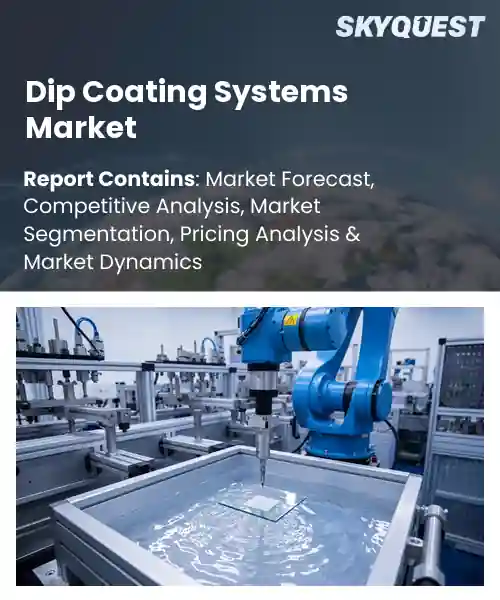
Dip Coating Systems Market
Report ID: SQMIG20G2096
Report ID: SQMIG20G2096
[email protected]
USA +1 351-333-4748
Report ID:
SQMIG20G2096 |
Region:
Global |
Published Date: February, 2026
Pages:
157
|Tables:
90
|Figures:
76


Global Dip Coating Systems Market size was valued at USD 2.5 Billion in 2024 and is poised to grow from USD 2.93 Billion in 2025 to USD 10.59 Billion by 2033, growing at a CAGR of 17.4% during the forecast period (2026-2033).
The primary driver of the global dip coating systems market is growing demand for conformal and thin-film coatings as devices shrink and performance demands rise. Dip coating systems immerse substrates in liquid formulations to deposit uniform films and matter because they provide repeatable thickness, high throughput and reduced waste versus manual methods. The industry has evolved over time from just using simple benchtop tanks to using fully automatic inline equipment and robotic systems, resulting in integration of clean rooms for applications such as applying conformal coatings on PCBs and biocompatible coatings on implantable medical devices. Examples include automatic dip lines within PCB manufacturing and clean room dip stations for medical device manufacture.
Building on that evolution, a key trend driving the global dip coating systems sector is integration of automation and monitoring which improves yield and lowers unit costs, thereby prompting wider adoption. When manufacturers add robotic handling, closed-loop thickness control and in-line curing, coating uniformity rises and defects fall so rework declines and time-to-market shortens. This dynamic creates opportunities for suppliers bundling analytics and solvent recovery, particularly in consumer electronics where conformal coatings protect dense PCBs, in electric vehicle battery components enhancing safety, and in implantable devices that require tight biocompatibility margins. Real deployments report reduced scrap rates and faster return on capital across multiple segments globally.
How is AI Optimizing Process Control in the Dip Coating Systems Market?
The way process control in dip coating is being revolutionized by AI through use of real-time data from sensors, machine learning and CV, with closed loop systems now becoming commonplace; key attributes include using adaptive tuning of viscosity, withdrawal parameters, predictive models for cure and drain behavior, as well as automated optical inspection (with immediate flagging of defects). The market is moving toward Industry 4.0 solutions that prioritize consistent film uniformity and lower rework across electronics, optics and medical device manufacturing. Practical instances include systems that adjust bath conditions mid run, digital twins that validate recipes before production, and analytics that convert shop floor data into continuous process improvement.
Nordson in June 2025 released an ASYMTEK Vantage dispensing solution equipped with IntelliJet technology and real-time monitoring capabilities that allows for closed-loop adjustments, decreases in defect rates, and an increase in production volume. This development illustrates how AI enabled sensing and analytics make dip and conformal coating more reliable and easier to scale for high reliability markets.
Market snapshot - (2026-2033)
Global Market Size
USD 2.5 Billion
Largest Segment
Electro Dip Coating
Fastest Growth
Electro Dip Coating
Growth Rate
17.4% CAGR
To get more insights on this market click here to Request a Free Sample Report
Global dip coating systems market is segmented by dip coating types, coating materials, end-use industries and region. Based on dip coating types, the market is segmented into Air Dip Coating, Vacuum Dip Coating and Electro Dip Coating. Based on coating materials, the market is segmented into Polymer Coatings, Metal Coatings and Ceramic Coatings. Based on end-use industries, the market is segmented into Automotive Industry, Electronics Industry and Aerospace Industry. Based on region, the market is segmented into North America, Europe, Asia Pacific, Latin America and Middle East & Africa.
Based on the global dip coating systems market forecast, vacuum dip coating segment dominates because it enables tight control over atmospheric conditions during withdrawal and drying, which minimizes defects and yields uniform thin films on sensitive and complex substrates. A lower concentration of air and the regulation of solvent evaporation positively affect bonding and surface quality, thus they are the two most preferred processes for applications needing optical clarity as well as high electrical performance. Process reliability and compatibility with advanced materials drive supplier focus and customer adoption.
However, air dip coating is emerging as the most rapidly expanding area because its low capital intensity and simple process suit high throughput manufacturing of large parts. The development of rapid evaporation technologies that can produce high-quality, low-cost coatings, coupled with a need for effective solvent management, are driving more rapid acceptance of these technologies and new opportunities for suppliers and servicing providers in automotive and industrial sectors.
Electro dip coating segment leads because electrophoretic deposition enables rapid, uniform buildup of functional layers with precise control over film thickness across complex geometries, reducing rework and material waste. Due to its high transfer efficiency and compatibility to allow for automation, the method provides an extremely efficient way to reduce cycle times and increase line utilization at the same time, resulting in a very attractive option for the manufacturer who is trying to increase production while maintaining repeatability and compliance with regulations regarding a coating's performance.
Meanwhile, vacuum dip coating is emerging as the most rapidly expanding area driven by advances in low pressure processing and compatibility with sensitive materials. Improved vacuum technologies and gentler drying cycles are unlocking new applications in optics and advanced electronics, attracting investment and opening opportunities for specialized equipment suppliers.
To get detailed segments analysis, Request a Free Sample Report
As per the global dip coating systems market analysis, Asia Pacific commands leadership through a convergence of robust manufacturing ecosystems, deep technology specialization, and dense supply chain networks. Electronics and semiconductors will continually be in demand because they require highly precise coatings. Certain industries, like automotive and display, have volume and variety needs, so the OEMs and manufacturers in those sectors are creating solutions that cater to complex surfaces by integrating new materials and processes as well as incorporating automation.
Companies working together through R&D partnerships between universities and other companies enhance the process of developing new materials and processes together. In addition to building scalable manufacturing and aftermarket services, manufacturers can build their systems more quickly by being located close companies that make components as well as to the companies that use them, resulting in shorter lead times and faster responses.
Dip Coating Systems Market in Japan benefits from precision engineering traditions and leading electronics and semiconductor clusters that demand extremely reliable and highly automated coating platforms. Equipment manufacturers collaborate closely with their material suppliers to produce custom solutions based on their individual needs. To meet demanding OEM standards, systems offer full support for quality assurance, stringent controls over processes, and ongoing technical assistance. As a result, there is more emphasis placed on miniaturization and high-value applications, leading to greater demand for complex control architectures, as well as enhanced service options.
Dip Coating Systems Market in South Korea is characterized by rapid adoption driven by major display and semiconductor companies that require high throughput and consistent film performance. Local systems integrators place a high priority on creating designs that are compact, fully automated, and compliant with standards of factory automation. An established network of domestic suppliers as well as a number of active process development laboratories provide an opportunity for the rapid customization of new coating chemistries and finished goods using advanced raw materials. The commercial emphasis on yield optimization and the integration of coating processes with those used to prepare and inspect the surface creates a competitive atmosphere for the continued development of innovative coating equipment.
North American expansion is fueled by a combination of advanced research activity, technology driven end markets, and a mature service ecosystem that supports complex equipment deployment. The need for precision coating is driven by high-quality aerospace, medical device and specialty electronics products. Customized system investments, particularly high-reliance systems, are being made in industries where this demand is growing. Accelerating process innovation and material application results from collaborative relationships among industry, universities and national laboratories.
Companies that offer these types of systems benefit from a skilled engineering labor force and existing aftermarket services focused on process validation and uptime. Increased emphasis on automation, the integration of digital quality systems, and customized support provided by system providers are increasing adoption by contract manufacturers and OEMs.
Dip Coating Systems Market in United States reflects a focus on advanced applications such as aerospace coatings, medical device surface treatments and specialty electronics finishing. Customers prioritize systems that offer rigorous process documentation automation and compatibility with strict quality standards. A vibrant community of equipment integrators and service providers supports rapid deployment and lifecycle management. Commercial applications of coatings technology are largely represented by industry groups that support the creation of an innovation ecosystem to drive the development of new coatings chemistries as well as implement new measurement tools.
Dip Coating Systems Market in Canada is shaped by specialized industrial segments and research-driven collaborations that demand adaptable and robust coating solutions. The acceptance of new systems often revolves around established relationships between equipment makers and colleges or universities who have further developed the methods associated with these specialized applications. The focus of sustainable development and material efficiency has compelled manufacturers to create designs with energy-efficient features and to implement manufacturing processes with minimal waste.
Europe is reinforcing its role through a combination of engineering excellence, regulatory alignment toward sustainable processes, and strong industry collaboration across key manufacturing hubs. The demand for successful, accurate, and repeatable coating systems is driven by the desire for high-quality manufacturing and rigid industry standards. Manufacturers invest in environmentally friendly chemistry and efficiencies in their manufacturing processes, which leads to equipment designs that are consistent with and assist in meeting environmental and lifecycle objectives. Through user-consortiums and joint public/private partnerships, manufacturers can transfer knowledge and rapidly develop and disseminate new technologies. To support a variety of applications (automotive, medical devices, etc.) manufacturers build their systems utilizing modulatory and interfacing technology.
Dip Coating Systems Market in Germany is anchored by a strong engineering heritage and a dense manufacturing base that demands durable high precision equipment. Automotive, aerospace and industrial coating professionals have created long-term relationships that allow for quick customization of equipment. In addition, most manufacturers are driven by providing mechanisms to achieve quality and establish compatibility with factory equipment standards through mechanical stability, repeatability in the manufacture of products and systems integration.
Dip Coating Systems Market in United Kingdom benefits from vibrant research institutions and a diverse manufacturing landscape that includes medical and advanced electronics sectors. Demand centers on flexible modular systems that can be adapted for prototyping and small batch production as well as scale up. The value of these systems & the technical service networks supporting them is very important in the market; they help companies comply with regulations, as well as provide quality documentation that can be tracked.
Dip Coating Systems Market in France combines strong chemical industry expertise with advanced manufacturing needs in aerospace and specialty sectors. Suppliers focus heavily on the ability of their products to work with many complex coating chemical systems including solvent management capabilities. The partnerships between equipment manufacturers & research labs help to create custom-made solutions for high-value applications. The market appreciates robust aftersales support and systems designed for environmental compliance and energy efficiency.
To know more about the market opportunities by region and country, click here to
Buy The Complete Report
Increasing Demand From Automotive Sector
The expansion of automotive manufacturing and the pursuit of higher aesthetic and corrosion resistant finishes drive investment in dip coating systems because these processes provide uniform coverage for complex parts and enable efficient high volume production. Manufacturers want trustworthy and consistent coating processes to fulfil more stringent quality demands as well as to reduce the need for manual rework, and dip coating systems allow users to automate the various parameters involved with coating processes to improve production time and maintain consistency in coatings. This requirement is encouraging manufacturers of this equipment to develop custom-designed equipment, which will support the global dip coating systems market growth of this market by creating differentiating products and encouraging greater levels of customer adoption.
Adoption Of Advanced Coating Materials
The introduction and wider use of advanced coating chemistries, including low VOC formulations and multifunctional finishes, promotes adoption of dip coating systems because these platforms can be finely tuned to accommodate diverse material properties and deposition requirements. Equipment suppliers are meeting these challenges by improving bath management and control systems to deliver consistent results for sensitive process chemistries–thereby reducing waste and increasing yield. As manufacturers continue to focus on quality and regulatory compliance, the evolving compatibility of dip coatings with new and different materials is driving the need for new and unique systems; thus, enabling manufacturers to expand their market share; improve their ability to apply coatings to more products; and create products that are more attractive to consumers.
High Initial Capital Investment
Small manufacturers may be deterred from acquiring and installing industrial dip coating systems because of the significant upfront costs associated with these systems and limited budgets. Because capital expenditures compete with other operational priorities, the lower automation associated with less automated or manual dip coating systems may be favored during the procurement process, even when these options provide less consistent and lower throughput results. This limits the penetration of these systems into segments that have budget limitations and has led several manufacturers to pursue financial solutions and offer modular products but this significant upfront investment limit continues to impede the rapid and broad market development of these products.
Complex Regulatory Compliance Requirements
Operators of dip coating systems face increasing operational complexities and ongoing costs resulting from strict and continuously changing environmental, health and safety regulations for coating chemistry and wastewater treatment. Manufacturers will have to modify their equipment, processes and waste management practices to comply with the differing requirements in various geographic locations, creating confusion for both suppliers and purchasers when evaluating installations across different jurisdictions. The requirement for continuous compliance management, as well as the possibility of having to retrofit equipment due to changing regulations, hampers rapid investment by manufacturers and restricts the growth.
Request Free Customization of this report to help us to meet your business objectives.
The competitive landscape of global dip coating systems outlook is shaped by consolidation, technology licensing, and targeted strategic investment that drive differentiation for scale and process sustainability. Through acquisition and vertical breadth, manufacturers increase their capacity (examples include Molded Devices). Ketters are used for financing a number of coating-specialist niche-solutions by private and venture-capital funds. University technology transfers and industrial clean technology initiatives accelerate product innovation.
Sustainable Coating Materials: Supplier actions have shifted to produce coatings that use less solvent and emphasize the use of environmentally friendly chemistries. Their newer formulations are waterborne, bio-based, or low-volume-emission compatible with the global dip coating systems market trends. Manufacturers create equipment designs that will have minimal waste and allow for solvent recovery and will support a circular flow of materials throughout the life cycle of each product. Formulators and system integrators working together speed up the process of qualifying and scaling up of green chemistries, which manufacturers want to be able to prove to their customers through transparency in the source of materials and end-of-life concerns so they can meet sustainability commitments as well as traceability requirements.
Smart Factory Integration: The growing focus on digital transformation is leading to an increase in integrated dip-coating systems that are part of a connected factory ecosystem; these systems can provide real-time process monitoring, adaptive controls, and predictive maintenance using networks of sensors and sophisticated software. The integration and seamless communication of dip-coating systems with equipment both upstream and downstream can enhance throughput, improve consistent quality of product, and facilitate traceable batch records as well as automated recipe generation/management. Modular, software-based solutions provided by suppliers make it easier to integrate and commission these systems; thus providing manufacturers with greater flexibility for scaling their operations.
SkyQuest’s ABIRAW (Advanced Business Intelligence, Research & Analysis Wing) is our Business Information Services team that Collects, Collates, Correlates, and Analyses the Data collected by means of Primary Exploratory Research backed by robust Secondary Desk research.
As per SkyQuest analysis, the key driver for global dip coating systems market growth is rising demand for conformal and thin-film coatings as devices shrink, and a second driver is the integration of automation and AI-enabled process control that improves yield and reduces defects. The restraint is high initial capital investment which can deter smaller manufacturers. Asia Pacific is the dominating region thanks to large electronics, automotive and semiconductor ecosystems, and vacuum dip coating is the dominating segment because controlled atmospheres deliver superior thin-film uniformity for optics and electronics. Suppliers that couple solvent recovery, sustainable chemistries and smart factory connectivity will be best positioned to capture accelerated adoption across industries.
| Report Metric | Details |
|---|---|
| Market size value in 2024 | USD 2.5 Billion |
| Market size value in 2033 | USD 10.59 Billion |
| Growth Rate | 17.4% |
| Base year | 2024 |
| Forecast period | (2026-2033) |
| Forecast Unit (Value) | USD Billion |
| Segments covered |
|
| Regions covered | North America (US, Canada), Europe (Germany, France, United Kingdom, Italy, Spain, Rest of Europe), Asia Pacific (China, India, Japan, Rest of Asia-Pacific), Latin America (Brazil, Rest of Latin America), Middle East & Africa (South Africa, GCC Countries, Rest of MEA) |
| Companies covered |
|
| Customization scope | Free report customization with purchase. Customization includes:-
|
To get a free trial access to our platform which is a one stop solution for all your data requirements for quicker decision making. This platform allows you to compare markets, competitors who are prominent in the market, and mega trends that are influencing the dynamics in the market. Also, get access to detailed SkyQuest exclusive matrix.
Table Of Content
Executive Summary
Market overview
Parent Market Analysis
Market overview
Market size
KEY MARKET INSIGHTS
COVID IMPACT
MARKET DYNAMICS & OUTLOOK
Market Size by Region
KEY COMPANY PROFILES
Methodology
For the Dip Coating Systems Market, our research methodology involved a mixture of primary and secondary data sources. Key steps involved in the research process are listed below:
1. Information Procurement: This stage involved the procurement of Market data or related information via primary and secondary sources. The various secondary sources used included various company websites, annual reports, trade databases, and paid databases such as Hoover's, Bloomberg Business, Factiva, and Avention. Our team did 45 primary interactions Globally which included several stakeholders such as manufacturers, customers, key opinion leaders, etc. Overall, information procurement was one of the most extensive stages in our research process.
2. Information Analysis: This step involved triangulation of data through bottom-up and top-down approaches to estimate and validate the total size and future estimate of the Dip Coating Systems Market.
3. Report Formulation: The final step entailed the placement of data points in appropriate Market spaces in an attempt to deduce viable conclusions.
4. Validation & Publishing: Validation is the most important step in the process. Validation & re-validation via an intricately designed process helped us finalize data points to be used for final calculations. The final Market estimates and forecasts were then aligned and sent to our panel of industry experts for validation of data. Once the validation was done the report was sent to our Quality Assurance team to ensure adherence to style guides, consistency & design.
Analyst Support
Customization Options
With the given market data, our dedicated team of analysts can offer you the following customization options are available for the Dip Coating Systems Market:
Product Analysis: Product matrix, which offers a detailed comparison of the product portfolio of companies.
Regional Analysis: Further analysis of the Dip Coating Systems Market for additional countries.
Competitive Analysis: Detailed analysis and profiling of additional Market players & comparative analysis of competitive products.
Go to Market Strategy: Find the high-growth channels to invest your marketing efforts and increase your customer base.
Innovation Mapping: Identify racial solutions and innovation, connected to deep ecosystems of innovators, start-ups, academics, and strategic partners.
Category Intelligence: Customized intelligence that is relevant to their supply Markets will enable them to make smarter sourcing decisions and improve their category management.
Public Company Transcript Analysis: To improve the investment performance by generating new alpha and making better-informed decisions.
Social Media Listening: To analyze the conversations and trends happening not just around your brand, but around your industry as a whole, and use those insights to make better Marketing decisions.
REQUEST FOR SAMPLE
 REQUEST FREE CUSTOMIZATION
Global Dip Coating Systems Market size was valued at USD 2.5 Billion in 2024 and is poised to grow from USD 2.93 Billion in 2025 to USD 10.59 Billion by 2033, growing at a CAGR of 17.4% during the forecast period (2026-2033).
Global dip coating systems competitive landscape is shaped by consolidation, technology licensing, and targeted strategic investment that drive differentiation for scale and process sustainability. Manufacturers pursue acquisitions to add capacity and vertical offerings as seen with Molded Devices. Private equity and venture rounds finance niche coater specialists. University technology transfers and industrial clean technology initiatives accelerate product innovation. 'J. D. Neuhaus GmbH & Co. KG', 'PPG Industries, Inc.', 'DuPont', 'Nordson Corporation', 'Wagner Spray Tech Corporation', 'Sames Kremlin', 'Gema USA, Inc.', 'Graco Inc.', 'ITW Gema', 'Axalta Coating Systems', 'AkzoNobel', 'BASF SE', 'Sherwin-Williams Company', 'Carlisle Companies Incorporated', 'Tank coating systems', 'Cardinal Paints LLC', 'Hentzen Coatings, Inc.', 'Coastal Coating Systems', 'MetoKote Corporation', 'DipCoat Systems LLC'
The expansion of automotive manufacturing and the pursuit of higher aesthetic and corrosion resistant finishes drive investment in dip coating systems because these processes provide uniform coverage for complex parts and enable efficient high volume production. Manufacturers seek reliable, repeatable coating methods to meet stricter quality expectations and to reduce manual rework, and dip coating systems offer automated control over coating parameters that improve throughput while maintaining finish consistency. This demand incentivizes suppliers to develop tailored equipment and service offerings, reinforcing market growth through product differentiation and stronger customer adoption.
Sustainable Coating Materials: Market demand is shifting toward coating systems that enable environmentally preferable chemistries and reduced solvent usage, prompting suppliers to develop waterborne, bio-based, and low-emission formulations compatible with dip processes. Manufacturers prioritize equipment designs that minimize waste, facilitate solvent recovery, and support circular material flows across product lifecycles. Collaboration between formulators and system integrators accelerates process qualification and scale-up of greener chemistries, while brand owners emphasize transparency in material sourcing and end-of-life considerations to meet sustainability commitments and traceability expectations.
As per the global dip coating systems market analysis, Asia Pacific commands leadership through a convergence of robust manufacturing ecosystems, deep technology specialization, and dense supply chain networks. Electronics and semiconductors will continually be in demand because they require highly precise coatings.


Want to customize this report? This report can be personalized according to your needs. Our analysts and industry experts will work directly with you to understand your requirements and provide you with customized data in a short amount of time. We offer $1000 worth of FREE customization at the time of purchase.
Feedback From Our Clients


 USA (+1) 351-333-4748

