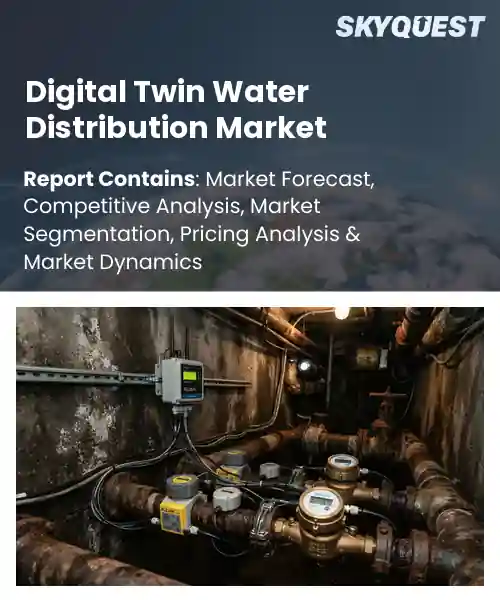
Digital Twin Water Distribution Market
Report ID: SQMIG55D2051
Report ID: SQMIG55D2051
[email protected]
USA +1 351-333-4748
Report ID:
SQMIG55D2051 |
Region:
Global |
Published Date: August, 2026
Pages:
157
|Tables:
118
|Figures:
77


Global Digital Twin Water Distribution Market size was valued at USD 1.86 Billion in 2024 and is poised to grow from USD 2.31 Billion in 2025 to USD 13.18 Billion by 2033, growing at a CAGR of 24.3% during the forecast period (2026-2033).
Digital twin technology replicates water‑distribution networks in a virtual environment, enabling operators to simulate flows, detect leaks, and optimize pressure in real time. The primary driver of this market is the escalating demand for resilient infrastructure amid climate‑induced water scarcity and aging assets. Over the past decade, municipalities such as Singapore and Barcelona have deployed twin models to integrate sensor data with predictive analytics, reducing non‑revenue water by up to 15 percent. This evolution from static GIS maps to dynamic, data‑rich replicas reflects a shift toward proactive asset management, making the market essential for sustainable urban growth and long‑term resilience.
The next critical factor accelerating global adoption is the convergence of Internet‑of‑Things sensors with advanced analytics platforms, which transforms raw telemetry into actionable intelligence. As utilities install pressure‑transmitters and acoustic leak detectors, the twin model ingests this stream, identifies anomalies, and triggers automated valve adjustments that curtail water loss. This cause‑and‑effect loop has opened opportunities for third‑party service providers to offer subscription‑based optimization bundles, exemplified by Siemens’ WaterTwin solution deployed in Los Angeles, where reported savings exceed $12 million annually. Consequently, investment capital flows toward software‑centric ecosystems, expanding market size while fostering cross‑industry collaborations that deepen functional capabilities for future water security.
How are AI and IoT driving innovation in the digital twin water distribution market?
AI and IoT are reshaping digital twin water distribution by linking physical sensors with virtual replicas. IoT devices feed continuous flow, pressure and quality data into cloud platforms where AI models detect anomalies and forecast demand. This closed loop enables operators to test scenarios, optimize valve settings and reduce leaks before they occur. The approach turns static maps into living simulations that adapt to weather patterns and consumption trends. As utilities adopt these tools, they gain greater resilience and can plan upgrades with confidence, making the sector more responsive and cost effective.
Treeview was highlighted as a leading digital twin developer in February 2026, showcasing an AI driven water network twin that integrates IoT sensor streams to improve leak detection and operational efficiency, reinforcing market momentum.
Market snapshot - (2026-2033)
Global Market Size
USD 1.86 Billion
Largest Segment
Dental Implants
Fastest Growth
Barrier Membranes
Growth Rate
24.3% CAGR
To get more insights on this market click here to Request a Free Sample Report
Global digital twin water distribution market is segmented by product, material, procedure, end user and region. Based on product, the market is segmented into Dental Implants, Bone Graft Materials, Barrier Membranes and Implant Accessories. Based on material, the market is segmented into Titanium, Zirconia and Others. Based on procedure, the market is segmented into Single-Tooth Implant, Multiple-Tooth Implant and Full-Arch Restoration. Based on end user, the market is segmented into Dental Hospitals, Dental Clinics and Academic & Research Institutes. Based on region, the market is segmented into North America, Europe, Asia Pacific, Latin America and Middle East & Africa.
Titanium segment dominates because its inherent durability and corrosion resistance align with the stringent operational demands of water distribution networks, enabling reliable simulation of pipe integrity within digital twin platforms. Engineers rely on its predictable performance to model stress‑free scenarios, fostering higher fidelity virtual replicas. The material’s compatibility with existing infrastructure further streamlines data integration, driving widespread adoption and establishing it as the cornerstone of digital twin implementations.
On the other hand, Zirconia segment is witnessing the strongest growth momentum as manufacturers innovate lightweight composite pipes that integrate seamlessly with twin analytics, reducing computational load and expanding real‑time monitoring capabilities. This emerging focus on agility and rapid prototyping is accelerating market expansion and unlocking new application scenarios.
Full-Arch Restoration segment dominates because its holistic modeling mirrors the full complexity of water distribution networks, delivering end‑to‑end virtual replicas that capture interdependent pipe interactions and pressure dynamics. This comprehensive approach enables utilities to conduct scenario planning, risk assessment, and system‑wide optimization within a single twin environment. Its capacity to ingest real‑time sensor feeds and scale across legacy and smart assets further entrenches its role as the cornerstone of digital twin deployments.
Meanwhile, Single-Tooth Implant segment emerges as the fastest growing area as firms develop modular twin components that focus on discrete pipeline sections, enabling rapid prototyping and targeted performance upgrades. This niche focus reduces implementation time, encourages broader adoption among smaller utilities, and fuels demand for specialized analytics, thereby accelerating market expansion and creating new revenue streams.
To get detailed segments analysis, Request a Free Sample Report
North America maintains leadership in the global Digital Twin Water Distribution market because of a mature water infrastructure base combined with a highly innovative technology ecosystem. Utilities benefit from early adoption of advanced sensor networks and strong data analytics capabilities that enable real‑time modeling of distribution networks. Significant collaboration between leading research institutions and major technology suppliers accelerates the development of sophisticated twin platforms. Regulatory frameworks encourage efficiency and sustainability, providing clear incentives for utilities to invest in digital replication of physical assets. The market is further reinforced by substantial funding for smart‑city initiatives that embed water twin solutions within broader urban management strategies. This convergence of technical expertise, supportive policy, and investment readiness solidifies North America’s dominant position. Industry consortia also drive standards that enhance interoperability across platforms.
Digital Twin Water Distribution Market in the United States is propelled by legacy water networks being retrofitted with sensors and analytics. Leading utility operators partner with technology firms to create virtual replicas that support predictive maintenance and demand forecasting. The presence of research universities fosters innovation, while government programs prioritize resilience against climate‑induced stressors, encouraging widespread nationally adoption of twin solutions across municipal, public sector and industrial water systems. critical
Digital Twin Water Distribution Market in Canada benefits from an emphasis on sustainable water stewardship and an ecosystem linking utilities, technology innovators, and government agencies. Canadian water authorities adopt modular twin architectures that enable seamless integration with renewable energy initiatives and climate adaptation plans. Academic research centers contribute simulation techniques, while federal funding programs incentivize pilot deployments in urban and remote communities, fostering a base of experience and advancing expertise.
The European landscape is driving a rapid expansion of the Digital Twin Water Distribution market through a combination of stringent environmental directives, ambitious smart‑city agendas, and a tradition of engineering excellence. Policymakers prioritize water efficiency and climate resilience, creating regulatory momentum that pushes utilities toward virtual replication of assets. Strong collaborations between leading research institutes and technology firms accelerate the development of interoperable platforms tailored to diverse water networks. Funding mechanisms support pilot projects that demonstrate tangible benefits in leak detection, demand management and infrastructure longevity. This ecosystem of policy support, technical expertise and financial backing positions Europe as a hotbed of innovation, with each nation leveraging its unique strengths to accelerate adoption across the continent. Collaboration across borders further amplifies knowledge transfer and standardization, reinforcing the continent’s collective progress.
Digital Twin Water Distribution Market in Germany is anchored by an engineering sector and a proactive regulatory environment that emphasizes water quality and resource optimization. German utilities integrate modeling tools with existing SCADA systems to enable scenario analysis. Close ties between research universities and industry accelerate the rollout of advanced twin functionalities, while federal incentives support implementation across urban and industrial water networks, fostering a mature and reliable market ecosystem.
Digital Twin Water Distribution Market in the United Kingdom is experiencing growth driven by a water strategy and an innovation sector. British water companies adopt twin platforms to improve leakage detection and meet stringent efficiency targets. Partnerships with data‑analytics firms expand the value chain, enabling predictive asset management and services. Research programs and regulatory incentives accelerate deployment, positioning the United Kingdom as a leading European hub for water twin technologies.
Digital Twin Water Distribution Market in France is a focal point for pilot initiatives that combine water management with sustainability goals. French utilities test twin models to optimize pressure control and reduce water loss, collaborating with research laboratories specializing in fluid dynamics. Policy frameworks encourage data sharing and integration, while venture support nurtures startups delivering analytics solutions. These efforts lay the groundwork for scalable adoption across the national water infrastructure.
Asia Pacific is steadily strengthening its position in the Digital Twin Water Distribution market by capitalizing on its advanced manufacturing capabilities, high urbanization rates, and proactive governmental policies aimed at water security. Nations such as Japan and South Korea integrate twin technologies with existing smart‑city frameworks to enhance real‑time monitoring and predictive maintenance of extensive water networks. Public‑private partnerships drive rapid deployment of sensor‑rich infrastructure, while academic research focuses on AI‑enhanced modeling for resilience against natural hazards. Regional collaboration initiatives facilitate sharing of best practices and standardization efforts, fostering a cohesive ecosystem that accelerates technology diffusion. The combined focus on innovation, sustainability, and disaster preparedness positions Asia Pacific as an emerging leader in the global water twin arena.
Digital Twin Water Distribution Market in Japan focuses on resilient infrastructure. Japanese water utilities adopt twin platforms that integrate seismic sensor data for scenario analysis and emergency response planning. Collaboration between universities and technology firms creates simulation models for water grids. Government incentives support pilot projects that demonstrate reduced water loss and improved operational efficiency. These efforts position Japan as a pioneer in applying digital twin technology to safeguard water services.
Digital Twin Water Distribution Market in South Korea builds on the nation’s ecosystem and water management. Korean utilities implement twin solutions that fuse feeds with analytics to optimize pressure and detect anomalies. Collaboration between research institutes and partners accelerates development of platforms for metropolitan networks. Government programs provide funding and regulatory incentives that encourage rollout, establishing South Korea as a leading example of digital twins enhancing water system resilience and efficiency.
To know more about the market opportunities by region and country, click here to
Buy The Complete Report
Smart Cities Adoption
Real-Time Optimization using AI
High Initial Capital Investment
Regulatory Compliance Complexity
Request Free Customization of this report to help us to meet your business objectives.
The competitive landscape is shaped by a handful of specialist firms racing to embed advanced simulation and real‑time analytics into municipal water networks, with technology innovation driving differentiation; leading developers such as Treeview, TechViz, Dassault Systèmes, Toobler and KWR are leveraging proprietary twin engines, forming utility partnerships and accelerating product rollouts, while strategic M&A activity consolidates niche capabilities and expands market reach.
Top Player’s Company Profile
SkyQuest’s ABIRAW (Advanced Business Intelligence, Research & Analysis Wing) is our Business Information Services team that Collects, Collates, Correlates, and Analyses the Data collected by means of Primary Exploratory Research backed by robust Secondary Desk research.
As per SkyQuest analysis, the market is being propelled primarily by the rapid adoption of smart‑city programs that embed digital twins into water networks, enabling proactive leak detection and pressure management, while the high initial capital outlay required for sensors, computing infrastructure and skilled staff restrains many smaller utilities. North America leads the landscape, benefitting from mature infrastructure, strong research ecosystems and supportive policies. The full‑arch restoration segment, which offers comprehensive end‑to‑end virtual replicas of entire distribution systems, currently dominates the market. A second powerful catalyst is the convergence of AI and IoT, turning continuous sensor streams into predictive analytics that drive real‑time optimization and further accelerate deployment.
| Report Metric | Details |
|---|---|
| Market size value in 2024 | USD 1.86 Billion |
| Market size value in 2033 | USD 13.18 Billion |
| Growth Rate | 24.3% |
| Base year | 2024 |
| Forecast period | (2026-2033) |
| Forecast Unit (Value) | USD Billion |
| Segments covered |
|
| Regions covered | North America (US, Canada), Europe (Germany, France, United Kingdom, Italy, Spain, Rest of Europe), Asia Pacific (China, India, Japan, Rest of Asia-Pacific), Latin America (Brazil, Rest of Latin America), Middle East & Africa (South Africa, GCC Countries, Rest of MEA) |
| Companies covered |
|
| Customization scope | Free report customization with purchase. Customization includes:-
|
To get a free trial access to our platform which is a one stop solution for all your data requirements for quicker decision making. This platform allows you to compare markets, competitors who are prominent in the market, and mega trends that are influencing the dynamics in the market. Also, get access to detailed SkyQuest exclusive matrix.
Table Of Content
Executive Summary
Market overview
Parent Market Analysis
Market overview
Market size
KEY MARKET INSIGHTS
COVID IMPACT
MARKET DYNAMICS & OUTLOOK
Market Size by Region
KEY COMPANY PROFILES
Methodology
For the Digital Twin Water Distribution Market, our research methodology involved a mixture of primary and secondary data sources. Key steps involved in the research process are listed below:
1. Information Procurement: This stage involved the procurement of Market data or related information via primary and secondary sources. The various secondary sources used included various company websites, annual reports, trade databases, and paid databases such as Hoover's, Bloomberg Business, Factiva, and Avention. Our team did 45 primary interactions Globally which included several stakeholders such as manufacturers, customers, key opinion leaders, etc. Overall, information procurement was one of the most extensive stages in our research process.
2. Information Analysis: This step involved triangulation of data through bottom-up and top-down approaches to estimate and validate the total size and future estimate of the Digital Twin Water Distribution Market.
3. Report Formulation: The final step entailed the placement of data points in appropriate Market spaces in an attempt to deduce viable conclusions.
4. Validation & Publishing: Validation is the most important step in the process. Validation & re-validation via an intricately designed process helped us finalize data points to be used for final calculations. The final Market estimates and forecasts were then aligned and sent to our panel of industry experts for validation of data. Once the validation was done the report was sent to our Quality Assurance team to ensure adherence to style guides, consistency & design.
Analyst Support
Customization Options
With the given market data, our dedicated team of analysts can offer you the following customization options are available for the Digital Twin Water Distribution Market:
Product Analysis: Product matrix, which offers a detailed comparison of the product portfolio of companies.
Regional Analysis: Further analysis of the Digital Twin Water Distribution Market for additional countries.
Competitive Analysis: Detailed analysis and profiling of additional Market players & comparative analysis of competitive products.
Go to Market Strategy: Find the high-growth channels to invest your marketing efforts and increase your customer base.
Innovation Mapping: Identify racial solutions and innovation, connected to deep ecosystems of innovators, start-ups, academics, and strategic partners.
Category Intelligence: Customized intelligence that is relevant to their supply Markets will enable them to make smarter sourcing decisions and improve their category management.
Public Company Transcript Analysis: To improve the investment performance by generating new alpha and making better-informed decisions.
Social Media Listening: To analyze the conversations and trends happening not just around your brand, but around your industry as a whole, and use those insights to make better Marketing decisions.
REQUEST FOR SAMPLE
 REQUEST FREE CUSTOMIZATION
Global Digital Twin Water Distribution Market size was valued at USD 1.86 Billion in 2024 and is poised to grow from USD 2.31 Billion in 2025 to USD 13.18 Billion by 2033, growing at a CAGR of 24.3% during the forecast period (2026-2033).
The competitive landscape is shaped by a handful of specialist firms racing to embed advanced simulation and real‑time analytics into municipal water networks, with technology innovation driving differentiation; leading developers such as Treeview, TechViz, Dassault Systèmes, Toobler and KWR are leveraging proprietary twin engines, forming utility partnerships and accelerating product rollouts, while strategic M&A activity consolidates niche capabilities and expands market reach. 'Autodesk, Inc.', 'Bentley Systems, Incorporated', 'Siemens AG', 'Schneider Electric SE', 'AVEVA Group Limited', 'Xylem Inc.', 'Esri, Inc.', 'Innovyze, Inc.', 'Trimble Inc.', 'Hexagon AB', 'Oracle Corporation', 'Microsoft Corporation', 'IBM Corporation', 'SUEZ S.A.', 'KROHNE Messtechnik GmbH', 'Badger Meter, Inc.', 'Itron, Inc.', 'Emerson Electric Co.', 'ABB Ltd.', 'Huawei Technologies Co., Ltd.'
Smart city programs are integrating digital twin technology to enhance water network visibility, enabling proactive leak detection, pressure management and demand forecasting. By providing a virtual replica of physical infrastructure, municipalities can simulate scenarios, reduce operational costs, and improve service reliability. The collaborative nature of smart city initiatives also fosters data sharing among utilities, technology providers and planners, accelerating innovation cycles and encouraging investment in advanced modeling tools. Consequently, the momentum from these programs substantively supports market expansion for digital twin solutions in water distribution.
Ai‑Driven Predictive Analytics: Water utilities are increasingly deploying AI‑driven predictive analytics within digital twin platforms to anticipate pipe failures, pressure anomalies, and demand spikes before they materialize. By continuously ingesting sensor data, weather forecasts, and consumption patterns, the twin can simulate multiple scenarios and recommend proactive maintenance schedules. This capability reduces unplanned outages, extends asset life, and improves service reliability, while enabling operators to shift from reactive repairs to data‑informed, condition‑based interventions across the distribution network, and supporting sustainable water management goals globally.
Why does North America Dominate the Global Digital Twin Water Distribution Market? |@12


Want to customize this report? This report can be personalized according to your needs. Our analysts and industry experts will work directly with you to understand your requirements and provide you with customized data in a short amount of time. We offer $1000 worth of FREE customization at the time of purchase.
Feedback From Our Clients


 USA (+1) 351-333-4748

