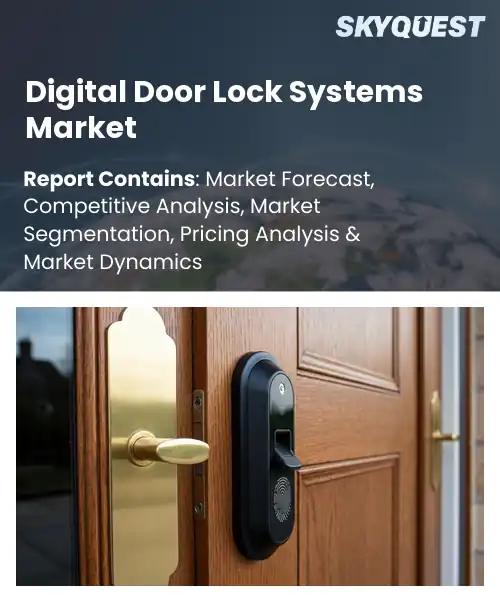
Digital Door Lock Systems Market
Report ID: SQMIG45I2333
Report ID: SQMIG45I2333
[email protected]
USA +1 351-333-4748
Report ID:
SQMIG45I2333 |
Region:
Global |
Published Date: February, 2026
Pages:
157
|Tables:
91
|Figures:
76


Global Digital Door Lock Systems Market size was valued at USD 2.7 Billion in 2024 and is poised to grow from USD 3.14 Billion in 2025 to USD 10.43 Billion by 2033, growing at a CAGR of 16.2% during the forecast period (2026-2033).
Electronic and smart locks come as digital door lock systems that can replace or supplement standard mechanical devices. These devices are used to control access in residential, commercial, and institutional facilities. The global digital door lock market strategies are worth watching because it is changing the way that we think about security, convenience, and asset management. Digital door lock systems provide the ability to have remote access to facilities, track who has accessed a facility, and integrate with automated systems. As such, they represent the transition from traditional electronic keypad locks to connected smart devices with access via Bluetooth, Wi-Fi, and biometrics. Early adopters such as hotel chains use mobile check-in while property managers tie locks into management platforms to streamline operations and improve occupant experience.
A principal growth factor is the convergence of Internet of Things connectivity and cloud-based access management, which enables centralized control and analytics and therefore creates new revenue and operational models for vendors and facility managers. As locks become networked, property owners can deploy remote provisioning, time-limited guest credentials, and usage analytics, leading to lower labor costs, faster turnover in hospitality and short-term rentals, and improved safety in healthcare settings where access to medication rooms can be tightly audited. This connectivity also produces opportunities for recurring service models, integration with energy management systems, and demand for cybersecurity solutions to protect data.
How is IoT Transforming the Digital Door Lock Systems Market?
IoT is reshaping digital door lock systems by combining networked sensors, cloud platforms and mobile devices to enable remote access, flexible authentication and continuous monitoring. The combination of residential convenience and commercial/hospitality requirements in the marketplace is growing; consequently, operators are looking for solutions that will allow them to connect their access control systems with their property management and building systems as part of an overall operational workflow. Examples range from mobile keys and biometric unlocks to API based integrations that let platforms manage fleets of locks and automate guest check in.
Seam, February 2026, announced an integration that lets platforms manage Ultraloq locks through a unified API and deliver real time events. This development shows how IoT connectivity and standard APIs reduce integration work and speed deployments and enable scalable remote provisioning and audit trails for streamlined operations.
Market snapshot - 2026-2033
Global Market Size
USD 2.7 Billion
Largest Segment
Access Mechanism
Fastest Growth
Communication Protocol
Growth Rate
16.2% CAGR
To get more insights on this market click here to Request a Free Sample Report
Global digital door lock systems market is segmented by product type, end use, distribution channel and region. Based on product type, the market is segmented into lock type, access mechanism and communication protocol. Based on end use, the market is segmented into residential, commercial, industrial and institutional. Based on distribution channel, the market is segmented into online retail, offline retail and distributors and wholesalers. Based on region, the market is segmented into North America, Europe, Asia Pacific, Latin America and Middle East & Africa.
Based on the global digital door lock systems market forecast, communication Protocol segment dominates because standardized wireless and wired protocols provide the common language that links lock hardware to control systems and management platforms, reducing fragmentation and integration friction. The use of established protocol features, such as secure pairing and authentication, also helps manufacturers adopt these standards and encourages installer confidence. Furthermore, the maturity of the protocol reduces the complexity of developing new devices and meets the needs of buyers with respect to security. There is therefore a strong preference for protocol-based designs.
Access mechanism product type is projected to be the fastest growing in the global digital door lock systems market due to rising demand for biometric, PIN-based, and smartphone-enabled authentication solutions. There has been increased interest in smart homes, as well as greater security consciousness and a growing interest in keyless and contactless entry methods, which are helping to create innovation and make advanced access technologies much more desirable than traditional locking systems.
Online Retail segment leads because digital storefronts centralize product information, comparison tools, and customer feedback, which shortens buyers’ decision processes and aligns with smart device shopping behavior. The removal of constraints to purchases is made possible by better merchandise placement, recommendations tailored to the shopper, and easy checkout processes; Additionally, detailed product information and products' user guides will provide for easier/less complicated installing or using the purchased item after it has been received, thereby establishing e-commerce as the primary source for consumer shopping decisions.
Offline retail distribution channel is expected to be the fastest growing in the global digital door lock systems market due to increasing consumer preference for in-store product demonstrations, professional installation support, and trusted after-sales services. Growth in construction activities, commercial infrastructure projects, and security-focused purchasing behavior further strengthens reliance on specialized retail stores and authorized dealers.
To get detailed segments analysis, Request a Free Sample Report
As per the global digital door lock systems market analysis, Asia Pacific dominance reflects a confluence of consumer readiness, manufacturing depth and active innovation ecosystems that favor rapid deployment of connected access solutions. There is a natural need for small, integrated locks in major cities because of the combination of densification of living standards and the presence of smart home technologies. The ability of local electronics suppliers to quickly iterate products will also enable continued innovation and less expensive sourcing for smart home devices. Regional collaboration efforts among global companies, telecoms and systems integration firms allows manufacturers and developers to quickly bring products to market with tailored features. Regulatory issues concerning building safety, energy efficiency and the piloting of smart buildings allows for testing within the region, while features such as multilingual user interface, biometrics and payment integration are attractive to consumers.
Digital door lock systems market in Japan benefits from high consumer trust in technology, meticulous quality standards and strong domestic manufacturing foundations. Service-oriented installation and maintenance will support long-term product performance, while local user preferences will provide a preference for multilingual interfaces as well as secure and dependable biometric options. Collaborative product testing with standards organizations will contribute to enhanced product safety and product interoperability, as well as provide customers with access to reliable aftermarket support.
Digital door lock systems market in South Korea is characterized by early consumer adoption of smart home technologies and strong electronics supply chains. Local brands emphasize seamless smartphone integration, frequent firmware updates and sleek design. Telecommunications companies collaborating with locked device manufacturers create new connections and new bundled offers. The focus on biometric identification systems as well as ease of use for the end user results in acceptance by multi-family and commercial facilities.
North America expansion is driven by demand for enhanced security, convenience and integration within established smart home ecosystems, supported by mature retail and professional installation channels. Users of both residential and commercial property find it attractive to have access to voice assistants, home hubs and building management software that can all work together. Housing renovations and increased interest from institutions have resulted in a broad array of access control products that can be used on a cloud-based network or in a scalable way. As manufacturers, integrators and service contractors work together on channel partnerships, support after the sale has become easier for customers, while increased focus on data privacy and building compliance has helped build confidence for customers. A competitive vendor landscape with a variety of features and localized service models has provided an increased opportunity for manufacturers.
Digital door lock systems market in United States is shaped by strong interest in connected living, property management and retrofit solutions. Demand favors products that integrate with common home automation platforms and voice assistants, with emphasis on installation channels and robust cybersecurity measures. Commercial adoption for offices and communities drives demand for multiuser administration and audit trail capabilities. Vendor focus on warranty, service networks and partnerships eases customer decision making.
Digital door lock systems market in Canada reflects blend of urban demand and interest in smart security for suburban residences. Energy efficient integration and bilingual user interface preferences play a large part in product selection. Educating the consumer about what to look for when installing a system is one of the primary responsibilities of the installer or local distributor around the country. The public sector supports the use of standardized solutions when procuring community facilities and encourages the use of those solutions that comply with safety standards.
Europe is strengthening its position through emphasis on regulatory alignment, interoperability standards and strong focus on product security and privacy. By collaborating, manufacturers, standard setting organizations and building officials can provide solutions that will work across a wide variety of building types and existing conditions; and market demand in the commercial and multi-family residential sectors is pushing towards centralized management systems and scalable access control models. The local engineering expertise coupled with a focus on lifespan will lead to more durable hardware and serviceable firmware. Language localization and the integration of regional smart home ecosystems will make these products easier to use for everyone's benefit; and the availability of both public procurement and pilot projects will provide reference installations for confidence among building owners and specifiers.
Digital door lock systems market in Germany emphasizes engineering quality, compliance with building codes and integration with facility management systems. Commercial upgrades as well as an emphasis on secure, durable, multiunit residential hardware drive demand in the market. Regional suppliers focus on longevity of serviceability and interoperability with existing European standards. Security installer/integrators develop customized applications for retrofits and newly constructed properties. Procurement criteria typically favour certified products and warranty support.
Digital door lock systems market in United Kingdom benefits from retrofit designs and compatibility with popular home automation platforms. An established network of retailers/installer locations provides various paths for the adoption of technology, while also meaning that people have different expectations from their devices due to privacy and/or data management concerns. The push for social housing and leasing has increased interest in scalable management tools among the two sectors.
Digital door lock systems market in France is influenced by demand for stylish design, bilingual interfaces and compliance with European safety norms. The demand for retrofits in urban apartments and preferences for compact, integrated products is high. Local distributors and installers have an important role in educating consumers on products and providing service after the sale. Interest in these types of features is growing in hospitality and commercial sectors with a focus on support for central management and integration with an individual building's automation system.
To know more about the market opportunities by region and country, click here to
Buy The Complete Report
Rising Adoption Of Smart Homes
The expanding prevalence of connected residential ecosystems encourages homeowners to integrate digital door locks as part of broader smart home setups, because these locks provide seamless compatibility with voice assistants and home automation platforms. With advancements in entry-way management and allowing for remote access via internet connected devices, digital locks offer consumers additional convenience and security. As such, many consumers have been encouraged to upgrade their traditional doors/locks. The increased use of technology aligned with social trends supports manufacturers' development and production of interoperable products.
Enhanced Security and Access Control
Growing consumer and institutional emphasis on robust, customizable access control elevates demand for digital door locks that offer multifactor authentication, audit trails, and remote credential management, because stakeholders prioritize prevention of unauthorized entry and accountable access. These capabilities make digital locks attractive replacements for mechanical alternatives in both residences and commercial sites, motivating property developers and facility managers to specify electronic locking solutions. The perceived improvement in asset protection and operational oversight fosters procurement decisions that expand installation rates and encourage ongoing product innovation.
High Installation and Integration Complexity
The significant challenges to deploying digital door locks, including the diverse range of home and building automation systems on which they must interface, create obstructions to accelerating their adoption. Owners and installers will frequently encounter differing degrees of compatibility issues (e.g., wiring and configuration), increasing the likelihood that a prospective owner or buyer will delay or decline an upgrade. In addition, because service providers typically need to use a degree of specialized skill in order to configure or install them, they are limited in the timeframe available to do so. These logistical challenges can increase the perceived total cost of ownership and reduce the overall speed at which digital door locks penetrate the market, even with their inherent advantages.
Data Privacy and Cybersecurity Concerns
Worries about unauthorized remote access, weak encryption, and potential exposure of personal entry data make end users and organizations cautious about adopting networked door locks, because privacy risks can undermine trust in connected access solutions and trigger regulatory scrutiny. When stakeholders perceive inadequate safeguards or unclear data handling practices, procurement timelines lengthen and decision makers may opt for conservative alternatives. These apprehensions compel manufacturers to allocate resources to security audits and certification efforts, which can slow product rollout and increase prices, thereby limiting rapid global digital door lock systems market growth.
Request Free Customization of this report to help us to meet your business objectives.
Competition in the global digital door lock market outlook is driven by strategic consolidation, platform integrations, and ecosystem partnerships that shift competition from price to interoperability and distribution reach. Major incumbents are using acquisitions and standards adoption to accelerate market access, for example ASSA ABLOY’s acquisition of Level Lock and Level’s Matter-over-Thread rollout, while vendors also secure strategic investments and IoT partnerships to strengthen go-to-market and technology differentiation.
Raonac: Established in 2020, Their primary purpose is to create future-generation smart lock hardware and include security solutions for both houses (home) and businesses (commercial). Biometric and artificial intelligence-enabled authentication methods and applications in the construction industry are a focus of Raonac, as there are numerous projects underway that include not only biometric technology but will also rely heavily upon biometric authentication and verification technology in the future. Recent Technology Development: Raonac has recently received a strategic investment and technology alliance with Suprema, a manufacturer of biometric devices.
Topteq Smart Lock: Established in 2019, their main objective is to supply OEM and ODM smart lock hardware and modules compatible with global IoT platforms to accelerate cross-border e-commerce and channel sales, focusing on modular designs and retrofit solutions. Recent development: Topteq expanded its R&D and product lineup and announced Tuya and TTLock platform compatibility, emphasized patent filings, and pursued international customization and production partnerships to serve integrators and retailers and to support regional compliance and certification efforts.
SkyQuest’s ABIRAW (Advanced Business Intelligence, Research & Analysis Wing) is our Business Information Services team that Collects, Collates, Correlates, and Analyses the Data collected by means of Primary Exploratory Research backed by robust Secondary Desk research.
As per SkyQuest analysis, the global digital door lock systems industry is propelled by IoT-driven connectivity and cloud-based access management that enable remote provisioning and new service models and further supported by rising smart home adoption that drives consumer demand for integrated, convenient access solutions. However, adoption is tempered by high installation and integration complexity which raises retrofit costs and slows deployments. Asia Pacific leads the market thanks to strong manufacturing ecosystems, urban density and early consumer acceptance, while the Communication Protocol segment dominates as standardized protocols enable interoperability, security and scalable integration across residential and commercial deployments. This mix creates opportunities for recurring service models and vendor differentiation.
| Report Metric | Details |
|---|---|
| Market size value in 2024 | USD 2.7 Billion |
| Market size value in 2033 | USD 10.43 Billion |
| Growth Rate | 16.2% |
| Base year | 2024 |
| Forecast period | 2026-2033 |
| Forecast Unit (Value) | USD Billion |
| Segments covered |
|
| Regions covered | North America (US, Canada), Europe (Germany, France, United Kingdom, Italy, Spain, Rest of Europe), Asia Pacific (China, India, Japan, Rest of Asia-Pacific), Latin America (Brazil, Rest of Latin America), Middle East & Africa (South Africa, GCC Countries, Rest of MEA) |
| Companies covered |
|
| Customization scope | Free report customization with purchase. Customization includes:-
|
To get a free trial access to our platform which is a one stop solution for all your data requirements for quicker decision making. This platform allows you to compare markets, competitors who are prominent in the market, and mega trends that are influencing the dynamics in the market. Also, get access to detailed SkyQuest exclusive matrix.
Table Of Content
Executive Summary
Market overview
Parent Market Analysis
Market overview
Market size
KEY MARKET INSIGHTS
COVID IMPACT
MARKET DYNAMICS & OUTLOOK
Market Size by Region
KEY COMPANY PROFILES
Methodology
For the Digital Door Lock Systems Market, our research methodology involved a mixture of primary and secondary data sources. Key steps involved in the research process are listed below:
1. Information Procurement: This stage involved the procurement of Market data or related information via primary and secondary sources. The various secondary sources used included various company websites, annual reports, trade databases, and paid databases such as Hoover's, Bloomberg Business, Factiva, and Avention. Our team did 45 primary interactions Globally which included several stakeholders such as manufacturers, customers, key opinion leaders, etc. Overall, information procurement was one of the most extensive stages in our research process.
2. Information Analysis: This step involved triangulation of data through bottom-up and top-down approaches to estimate and validate the total size and future estimate of the Digital Door Lock Systems Market.
3. Report Formulation: The final step entailed the placement of data points in appropriate Market spaces in an attempt to deduce viable conclusions.
4. Validation & Publishing: Validation is the most important step in the process. Validation & re-validation via an intricately designed process helped us finalize data points to be used for final calculations. The final Market estimates and forecasts were then aligned and sent to our panel of industry experts for validation of data. Once the validation was done the report was sent to our Quality Assurance team to ensure adherence to style guides, consistency & design.
Analyst Support
Customization Options
With the given market data, our dedicated team of analysts can offer you the following customization options are available for the Digital Door Lock Systems Market:
Product Analysis: Product matrix, which offers a detailed comparison of the product portfolio of companies.
Regional Analysis: Further analysis of the Digital Door Lock Systems Market for additional countries.
Competitive Analysis: Detailed analysis and profiling of additional Market players & comparative analysis of competitive products.
Go to Market Strategy: Find the high-growth channels to invest your marketing efforts and increase your customer base.
Innovation Mapping: Identify racial solutions and innovation, connected to deep ecosystems of innovators, start-ups, academics, and strategic partners.
Category Intelligence: Customized intelligence that is relevant to their supply Markets will enable them to make smarter sourcing decisions and improve their category management.
Public Company Transcript Analysis: To improve the investment performance by generating new alpha and making better-informed decisions.
Social Media Listening: To analyze the conversations and trends happening not just around your brand, but around your industry as a whole, and use those insights to make better Marketing decisions.
REQUEST FOR SAMPLE
 REQUEST FREE CUSTOMIZATION
Global Digital Door Lock Systems Market size was valued at USD 2.7 Billion in 2024 and is poised to grow from USD 3.14 Billion in 2025 to USD 10.43 Billion by 2033, growing at a CAGR of 16.2% during the forecast period (2026-2033).
Competition in the global digital door lock market is driven by strategic consolidation, platform integrations, and ecosystem partnerships that shift competition from price to interoperability and distribution reach. Major incumbents are using acquisitions and standards adoption to accelerate market access, for example ASSA ABLOY’s acquisition of Level Lock and Level’s Matter-over-Thread rollout, while vendors also secure strategic investments and IoT partnerships to strengthen go-to-market and technology differentiation. 'Assa Abloy', 'Allegion', 'Kwikset', 'Schlage', 'Yale', 'Samsung', 'Danalock', 'August', 'Lockly', 'Dormakaba Group', 'Godrej & Boyce Manufacturing Company Limited', 'Honeywell International Inc.', 'Legrand', 'SALTO Systems, S.L', 'Onity Inc.', 'Shenzhen Kaadas Intelligent Technology Co., Ltd.', 'Dahua Technology', 'ZKTECO Co., Ltd.', 'Vivint', 'iLockey'
The expanding prevalence of connected residential ecosystems encourages homeowners to integrate digital door locks as part of broader smart home setups, because these locks provide seamless compatibility with voice assistants and home automation platforms. By simplifying entry management and enabling remote control alongside other smart devices, digital locks enhance perceived convenience and security, prompting consumer willingness to upgrade traditional hardware. This increasing alignment with lifestyle trends supports manufacturer investment in interoperable products, which in turn accelerates market availability and stimulates adoption across diverse residential segments.
Asia Pacific Dominate the Global Digital Door Lock Systems Market.


Want to customize this report? This report can be personalized according to your needs. Our analysts and industry experts will work directly with you to understand your requirements and provide you with customized data in a short amount of time. We offer $1000 worth of FREE customization at the time of purchase.
Feedback From Our Clients


 USA (+1) 351-333-4748

