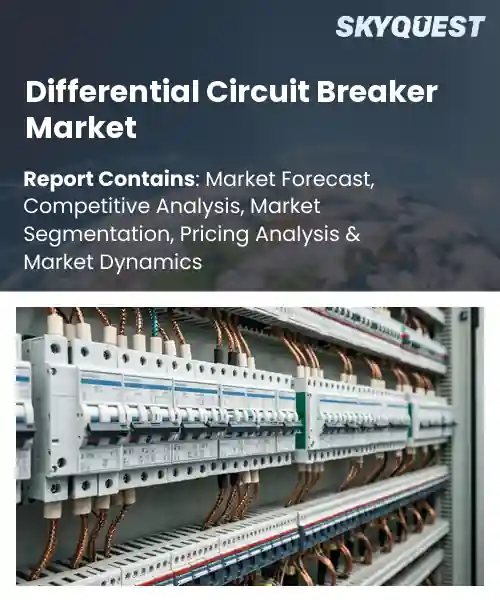
Differential Circuit Breaker Market
Report ID: SQMIG20I2935
Report ID: SQMIG20I2935
[email protected]
USA +1 351-333-4748
Report ID:
SQMIG20I2935 |
Region:
Global |
Published Date: April, 2026
Pages:
157
|Tables:
89
|Figures:
76


Global Differential Circuit Breaker Market size was valued at USD 24.4 Billion in 2024 and is poised to grow from USD 26.47 Billion in 2025 to USD 24.5 Billion by 2033, growing at a CAGR of 8.5% during the forecast period (2026-2033).
Regulatory tightening combined with accelerating electrification constitutes the primary driver of the differential circuit breaker market because stricter safety codes and growing electrical loads directly increase demand for reliable residual current protection. Differential circuit breakers are devices that detect imbalance between live and neutral conductors to prevent electrocution and electrical fires, so they are central to household, commercial and industrial safety. Over time the market matured from thermal-magnetic breakers to residual current devices and integrated RCBOs, with public policy examples such as the European Union's expanded RCD mandates in the 1990s and Australia's wiring rules illustrating how regulation shaped adoption.Building on regulatory momentum, rapid adoption of distributed generation and electric vehicle infrastructure is a key factor expanding the market because these applications alter leakage behavior and demand DC-sensitive residual current protection. As rooftop solar and EV chargers introduce steady and pulsed DC, conventional AC-only RCDs can miss hazardous imbalances, which has pushed manufacturers to deliver Type B DC-sensitive breakers certified for PV arrays and fast-charging stations. Consequently utilities and installers specify advanced differential devices for commercial solar farms and municipal EV fleets, which creates opportunities for integrated monitoring, predictive maintenance and retrofitting older buildings, and emerging service-oriented business models.
How is IoT enhancing reliability in the differential circuit breaker market?
Internet of Things is raising the reliability of differential circuit breakers by adding sensor based monitoring of leakage current temperature and trip status plus communications to cloud platforms. These capabilities let operators detect anomalous trends locate fault sources and perform predictive maintenance before failures. In the current market manufacturers integrate digital metering communications and analytics so breakers serve as nodes in building and grid monitoring. This reduces nuisance trips and unplanned outages and improves component life in applications such as data centers EV charging and renewable power. Field studies and product information report faster detection and clearer maintenance guidance for IoT enabled breakers.Siemens April 2026, introduced the SENTRON 3QD2 semiconductor circuit breaker which combines ultrafast interruption with monitoring and parametrizable protection. Its embedded sensing and analytics support predictive maintenance and reduce downtime which bolsters adoption of intelligent differential protection and fuels market efficiency by lowering lifecycle costs and simplifying grid integration.
Market snapshot - (2026-2033)
Global Market Size
USD 24.4 Billion
Largest Segment
Multiple Myeloma (Primary Revenue Segment)
Fastest Growth
Multiple Myeloma (Primary Revenue Segment)
Growth Rate
8.5% CAGR
To get more insights on this market click here to Request a Free Sample Report
Global differential circuit breaker market is segmented by neoplasm type focus, treatment modality, end-user and region. Based on neoplasm type focus, the market is segmented into Multiple Myeloma (Primary Revenue Segment), Plasmacytoma (Solitary/Extramedullary) and Others (Amyloidosis & MGUS). Based on treatment modality, the market is segmented into Targeted Therapy & Immunotherapy, Chemotherapy & Corticosteroids and Stem Cell Transplantation. Based on end-user, the market is segmented into Specialized Oncology Centers and Multi-specialty Hospitals. Based on region, the market is segmented into North America, Europe, Asia Pacific, Latin America and Middle East & Africa.
Multiple Myeloma segment dominates because the chronic treatment pathways and high acuity care associated with this condition create concentrated demand for fault-tolerant electrical protection in clinical environments. The reliance on continuous infusion systems, precision diagnostics and temperature sensitive storage compels manufacturers to prioritize differential breakers with refined sensitivity, low nuisance tripping and integrated monitoring. This clinical pressure drives suppliers to deliver tailored reliability and compliance features that anchor product preference and procurement.
However, Plasmacytoma is emerging as the fastest growing area, driven by increased outpatient lesion management and solitary treatment workflows that favor compact, modular protection. Demand for portable differential breakers in ambulatory clinics and therapy suites encourages lightweight designs, quicker certification and expanded aftermarket services, creating new application pathways and supplier entry points.
Targeted Therapy & Immunotherapy segment dominates because the specialized delivery systems and continuous monitoring used in these therapies demand highly reliable, low-noise electrical protection tailored to sensitive clinical workflows. The imperative to avoid spurious trips during critical infusions and to preserve uninterrupted device operation motivates development of breakers with refined differential detection, integrated diagnostics and seamless integration with medical power infrastructures. These requirements concentrate R&D and product differentiation around therapy-aligned solutions.
Conversely, Stem Cell Transplantation is the fastest growing application area due to expanding transplant programs that require robust, redundant electrical protection in dedicated suites. Demand for breakers offering enhanced fault isolation, scalable panel designs and simplified maintenance fosters rapid product adaptation and broader aftermarket support, enabling modular, high-reliability offerings that accelerate future market expansion and opportunity creation.
To get detailed segments analysis, Request a Free Sample Report
Asia Pacific dominates the global differential circuit breaker market due to a combination of concentrated manufacturing capacity, robust industrial electrification, and rapid infrastructure development across major economies. Strong presence of established original equipment manufacturers and component suppliers creates efficient supply chains and localized innovation, enabling tailored products for diverse applications. Regulatory emphasis on electrical safety and grid reliability encourages adoption of advanced protective devices. Rapid expansion of manufacturing facilities, urban systems, and renewable energy integration further fuels demand for differential protection solutions. Competitive production costs and an extensive network of distributors and service partners support market penetration and aftermarket growth. Collaborative research between utilities and technology firms accelerates feature enhancements and standardization, reinforcing regional leadership in both volume and technological maturity.
Differential Circuit Breaker Market Japan benefits from a mature electrical industry and strong technological expertise concentrated in domestic manufacturers. Local demand is driven by stringent safety culture, advanced industrial automation, and dense urban infrastructure requiring reliable fault protection. Integration with intelligent building systems and compatibility with grid modernization initiatives encourage uptake of feature rich devices. Aftermarket services and collaboration between utilities and suppliers support customization and maintenance, sustaining market sophistication.
Differential Circuit Breaker Market South Korea is characterized by industrial innovation and close alignment between electronics manufacturers and power utilities. Domestic firms emphasize compact high performance solutions suited to advanced manufacturing and urban power networks. Government focus on resilience and continuity of critical infrastructure drives procurement toward reliable protective equipment. Export orientation complements local deployment, while research partnerships foster sensor integration and diagnostics, enhancing product competitiveness and serviceability across applications.
Europe is experiencing rapid expansion in the differential circuit breaker market driven by a convergence of regulatory emphasis on electrical safety, intensive grid modernization efforts, and a broad push toward electrification of building and industrial systems. Mandates for enhanced protection and harmonized standards encourage adoption of advanced differential protection devices across utilities and commercial sectors. Integration of variable renewable generation and distributed energy resources places higher demand on selective and sensitive fault detection. Strong engineering capabilities and established manufacturing bases support rapid deployment and customization. Retrofit activity for aging infrastructure and rising emphasis on energy efficiency and resilience further stimulate procurement, while mature aftermarket networks and testing facilities enable long term reliability and compliance, consolidating Europe position as a dynamic growth region.
Differential Circuit Breaker Market Germany is anchored by a strong industrial base and rigorous safety standards that favor high quality protective equipment. Demand stems from manufacturing, automotive, and industrial automation sectors that require precise fault discrimination. Established manufacturers provide certified products and comprehensive testing infrastructure. Close collaboration among utilities, engineers, and suppliers promotes tailored solutions and lifecycle service agreements, reinforcing market leadership and practical operational expertise across critical power applications.
Differential Circuit Breaker Market United Kingdom pairs strong innovation ecosystems with proactive utility engagement to encourage adoption of advanced protection devices. Focus on smart grid initiatives, flexible generation integration, and resilient urban infrastructure increases demand for adaptive differential solutions. Collaboration between startups and established manufacturers yields compact designs with improved diagnostics and connectivity. Retrofit activity supports deployment, while service networks and certification bodies uphold interoperability and performance across industrial sectors.
Differential Circuit Breaker Market France is emerging as modernization of distribution networks and heightened focus on electrical safety drive demand. Domestic manufacturers and research centers advance adaptable protection devices suited to urban and renewable energy deployments. Priority on compliance with regional standards and certification encourages uptake of validated solutions. Expansion of installation and maintenance services, along with targeted pilot projects, supports market maturation and wider adoption among utilities and buildings.
North America is strengthening its position in the differential circuit breaker market through coordinated modernization efforts across utilities, robust demand from commercial and industrial sectors, and sustained innovation from leading manufacturers. Emphasis on grid resilience, reliable power for data intensive facilities, and integration of distributed energy resources increases need for precise fault detection and rapid isolation. Advanced feature integration, such as improved sensing and diagnostic capabilities, aligns with utility and end user priorities for reduced downtime and easier maintenance. Mature service networks, rigorous testing regimes, and partnerships between technology providers and system integrators facilitate faster adoption of tailored solutions. Focused investments in retrofits and standards harmonization further support regional competitiveness and technical depth. A strong ecosystem of component suppliers and after sales service providers ensures rapid local support, while collaborative research with universities advances protection algorithms and intelligent coordination strategies.
Differential Circuit Breaker Market United States is driven by demand from critical infrastructure, data centers, and advanced manufacturing facilities that prioritize uptime and safety. Domestic manufacturers focus on integrating smarter sensing and remote diagnostics to meet utility requirements. Strong service and distribution networks enable rapid deployment and maintenance, while collaboration with research institutions supports innovation in protection coordination. Emphasis on resilience and interoperability underpins procurement of advanced differential protection solutions.
Differential Circuit Breaker Market Canada benefits from strong focus on grid reliability across transmission networks and expanding deployment of distributed energy resources in remote areas. Manufacturers and system integrators adapt products for harsh environments and sustained reliability. Provincial utility programs and standards encourage adoption of sensitive protective devices, while service providers emphasize local support and training. Collaborative pilots with technology firms improve diagnostics and fault location capabilities, reinforcing operational confidence.
To know more about the market opportunities by region and country, click here to
Buy The Complete Report
Rising Renewable Energy Integration
Increasing Focus on Electrical Safety
High Initial Purchase Costs
Complex Installation and System Integration
Request Free Customization of this report to help us to meet your business objectives.
Competitive landscape in the global differential circuit breaker market is defined by incumbents and challengers deploying acquisitions, partnerships and semiconductor alliances to accelerate smart and solid-state protection. Examples include major suppliers expanding EVSE and smart-breaker offerings, semiconductor partners enabling silicon-based switching, and co-development of medium-voltage protection to address electrification and EV charging pressures.
Top Player’s Company Profile
Recent Developments
SkyQuest’s ABIRAW (Advanced Business Intelligence, Research & Analysis Wing) is our Business Information Services team that Collects, Collates, Correlates, and Analyses the Data collected by means of Primary Exploratory Research backed by robust Secondary Desk research. As per SkyQuest analysis, the global differential circuit breaker market is driven primarily by regulatory tightening and accelerating electrification, which compel adoption of advanced residual current protection. A second driver is rising renewable energy integration and electric vehicle infrastructure that introduce DC leakage profiles and spur demand for DC-sensitive and intelligent breakers. However high initial purchase costs remain a key restraint that slows retrofit and adoption in cost-sensitive projects. Asia Pacific dominates the market owing to concentrated manufacturing capacity, rapid infrastructure expansion and strong electrification trends. The Multiple Myeloma segment is identified as the primary revenue segment, highlighting demand for fault-tolerant, monitored protection in high-acuity clinical and continuous-operation environments.
| Report Metric | Details |
|---|---|
| Market size value in 2024 | USD 24.4 Billion |
| Market size value in 2033 | USD 24.5 Billion |
| Growth Rate | 8.5% |
| Base year | 2024 |
| Forecast period | (2026-2033) |
| Forecast Unit (Value) | USD Billion |
| Segments covered |
|
| Regions covered | North America (US, Canada), Europe (Germany, France, United Kingdom, Italy, Spain, Rest of Europe), Asia Pacific (China, India, Japan, Rest of Asia-Pacific), Latin America (Brazil, Rest of Latin America), Middle East & Africa (South Africa, GCC Countries, Rest of MEA) |
| Companies covered |
|
| Customization scope | Free report customization with purchase. Customization includes:-
|
To get a free trial access to our platform which is a one stop solution for all your data requirements for quicker decision making. This platform allows you to compare markets, competitors who are prominent in the market, and mega trends that are influencing the dynamics in the market. Also, get access to detailed SkyQuest exclusive matrix.
Table Of Content
Executive Summary
Market overview
Parent Market Analysis
Market overview
Market size
KEY MARKET INSIGHTS
COVID IMPACT
MARKET DYNAMICS & OUTLOOK
Market Size by Region
KEY COMPANY PROFILES
Methodology
For the Differential Circuit Breaker Market, our research methodology involved a mixture of primary and secondary data sources. Key steps involved in the research process are listed below:
1. Information Procurement: This stage involved the procurement of Market data or related information via primary and secondary sources. The various secondary sources used included various company websites, annual reports, trade databases, and paid databases such as Hoover's, Bloomberg Business, Factiva, and Avention. Our team did 45 primary interactions Globally which included several stakeholders such as manufacturers, customers, key opinion leaders, etc. Overall, information procurement was one of the most extensive stages in our research process.
2. Information Analysis: This step involved triangulation of data through bottom-up and top-down approaches to estimate and validate the total size and future estimate of the Differential Circuit Breaker Market.
3. Report Formulation: The final step entailed the placement of data points in appropriate Market spaces in an attempt to deduce viable conclusions.
4. Validation & Publishing: Validation is the most important step in the process. Validation & re-validation via an intricately designed process helped us finalize data points to be used for final calculations. The final Market estimates and forecasts were then aligned and sent to our panel of industry experts for validation of data. Once the validation was done the report was sent to our Quality Assurance team to ensure adherence to style guides, consistency & design.
Analyst Support
Customization Options
With the given market data, our dedicated team of analysts can offer you the following customization options are available for the Differential Circuit Breaker Market:
Product Analysis: Product matrix, which offers a detailed comparison of the product portfolio of companies.
Regional Analysis: Further analysis of the Differential Circuit Breaker Market for additional countries.
Competitive Analysis: Detailed analysis and profiling of additional Market players & comparative analysis of competitive products.
Go to Market Strategy: Find the high-growth channels to invest your marketing efforts and increase your customer base.
Innovation Mapping: Identify racial solutions and innovation, connected to deep ecosystems of innovators, start-ups, academics, and strategic partners.
Category Intelligence: Customized intelligence that is relevant to their supply Markets will enable them to make smarter sourcing decisions and improve their category management.
Public Company Transcript Analysis: To improve the investment performance by generating new alpha and making better-informed decisions.
Social Media Listening: To analyze the conversations and trends happening not just around your brand, but around your industry as a whole, and use those insights to make better Marketing decisions.
REQUEST FOR SAMPLE
 REQUEST FREE CUSTOMIZATION


Want to customize this report? This report can be personalized according to your needs. Our analysts and industry experts will work directly with you to understand your requirements and provide you with customized data in a short amount of time. We offer $1000 worth of FREE customization at the time of purchase.
Feedback From Our Clients


 USA (+1) 351-333-4748

