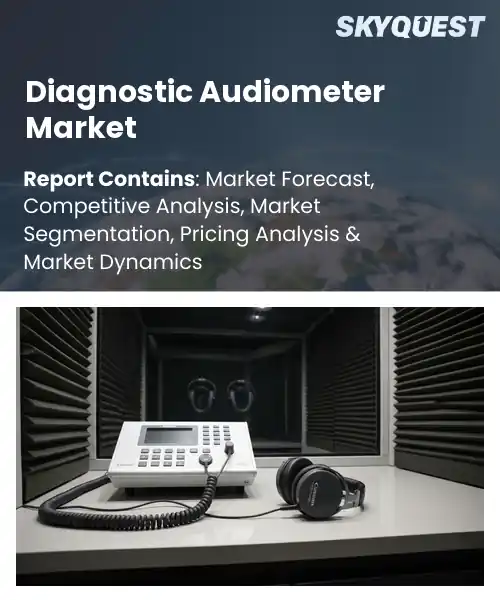
Diagnostic Audiometer Market
Report ID: SQMIG35A3889
Report ID: SQMIG35A3889
[email protected]
USA +1 351-333-4748
Report ID:
SQMIG35A3889 |
Region:
Global |
Published Date: June, 2026
Pages:
157
|Tables:
145
|Figures:
78


Global Diagnostic Audiometer Market size was valued at USD 293.0 Million in 2024 and is poised to grow from USD 308.53 Million in 2025 to USD 466.36 Million by 2033, growing at a CAGR of 5.3% during the forecast period (2026-2033).
The diagnostic audiometer market comprises devices used to assess hearing thresholds and tympanometric function in clinical and occupational settings. Its importance stems from the growing prevalence of noise‑induced hearing loss, an aging population, and stricter health‑safety regulations that compel employers to monitor employee auditory health. Historically, the market began with analog tone‑burst generators in the 1950s, evolved to digital platforms in the 1990s, and now embraces cloud‑based data management and AI‑assisted interpretation. For example, a major US hospital chain upgraded its fleet in 2022, citing improved diagnostic accuracy and streamlined record‑keeping as decisive factors for patient safety and compliance requirements. The next pivotal factor shaping the global diagnostic audiometer market is the acceleration of tele‑health and remote monitoring solutions, which convert traditional clinic visits into data‑rich engagements. As healthcare providers strive to reduce overhead while expanding access, manufacturers integrate Bluetooth connectivity and smartphone apps that transmit real‑time audiograms to specialists. This capability enables occupational health programs in emerging economies to screen workers without onsite audiologists, thereby lowering screening costs and accelerating early intervention. Consequently, companies that invest in interoperable platforms and secure cloud storage capture a growing share of contracts with insurers and corporate wellness providers seeking measurable hearing‑health outcomes.
How is AI improving accuracy in the diagnostic audiometer market?
AI improves diagnostic audiometer accuracy by applying advanced signal‑processing algorithms that filter ambient noise and isolate true auditory thresholds. Machine‑learning models analyze response patterns across large patient datasets, enabling adaptive test protocols that adjust stimulus intensity in real time. Cloud‑based analytics integrate results with electronic health records, providing clinicians with precise trend insights and reducing manual interpretation errors. The market, valued at $116.427 million in 2021, is expanding as providers adopt these intelligent systems to deliver faster, more reliable hearing assessments and to meet growing demand for personalized care.June 2026, a leading audiology equipment manufacturer launched an AI enhanced diagnostic audiometer that automatically refines stimulus levels, cutting measurement variance and accelerating patient throughput, thereby supporting market growth and operational efficiency.
Market snapshot - (2026-2033)
Global Market Size
USD 293.0 Million
Largest Segment
Standalone Audiometers
Fastest Growth
PC-Based Audiometers
Growth Rate
5.3% CAGR
To get more insights on this market click here to Request a Free Sample Report
Global diagnostic audiometer market is segmented by product configuration, device portability modality, test methodology, operation interface, application setting and region. Based on product configuration, the market is segmented into PC-Based Audiometers, Standalone Audiometers and Hybrid Audiometers. Based on device portability modality, the market is segmented into Desktop Audiometers, Portable and Handheld Audiometers and Wireless Audiometers. Based on test methodology, the market is segmented into Pure Tone Audiometry, Speech Audiometry, Bone Conduction Testing and High-Frequency Audiometry. Based on operation interface, the market is segmented into Digital Automated Systems and Manual Operating Systems. Based on application setting, the market is segmented into Hospitals, Specialty ENT Clinics, Hearing Aid and Audiology Centers and Research and Academic Institutes. Based on region, the market is segmented into North America, Europe, Asia Pacific, Latin America and Middle East & Africa.
PC‑Based audiometers segment dominates because they seamlessly integrate with existing hospital information systems, enabling automated data capture and streamlined workflow. Clinicians value the ability to store test results directly into electronic health records, reducing manual entry errors and improving patient management. This integration also supports advanced analytics, fostering a more data‑driven approach to hearing assessment and reinforcing the preference for PC‑based solutions in diagnostic settings.
However, hybrid audiometers segment emerges as the most rapidly expanding because they combine the robustness of standalone units with the flexibility of PC integration, appealing to clinics seeking both reliability and connectivity. Ongoing innovations in modular design and cloud‑enabled firmware updates drive adoption, creating new opportunities for versatile testing environments.
Desktop audiometers segment dominates because they provide stable platforms, extensive frequency range, and superior acoustic isolation, meeting the rigorous standards of clinical audiology. Their fixed configuration supports comprehensive test batteries and ensures consistent calibration, which clinicians rely on for accurate diagnosis. The trust in their performance sustains their leading position in the diagnostic audiometer market. Additionally, the robust hardware minimizes maintenance downtime, enabling high patient throughput and supporting large audiology departments.
Meanwhile, wireless audiometers segment emerges as the most rapidly expanding because they eliminate cable constraints, offering clinicians greater flexibility to conduct assessments in diverse environments. Integration with mobile devices and cloud platforms accelerates data sharing and remote monitoring, spurring adoption in teleaudiology and expanding market opportunities for next‑generation diagnostic solutions.
To get detailed segments analysis, Request a Free Sample Report
North America retains a leading position due to a confluence of mature healthcare systems, high disposable income, and early adoption of sophisticated audiological technologies. The market benefits from a dense network of clinics and hospitals that prioritize preventive hearing care, supported by strong reimbursement frameworks that encourage clinicians to integrate diagnostic audiometers into routine assessments. Moreover, innovation hubs located across the United States and Canada foster continuous product development, while established manufacturers maintain close collaborations with academic and research institutions. Moreover, regulatory environments provide clear pathways for device approval, accelerating market entry. These factors collectively create a robust ecosystem that sustains demand and reinforces North America’s dominance on the global stage. The presence of leading academic audiology programs also contributes to a skilled workforce that drives both clinical adoption and research collaboration.
Diagnostic Audiometer Market in United States benefits from extensive clinical networks and a strong emphasis on early hearing detection. Leading manufacturers collaborate closely with major hospital systems, fostering rapid integration of advanced diagnostic tools. The regulatory framework offers transparent pathways that accelerate device rollout, while insurance reimbursement models incentivize routine audiometric screening. This environment sustains high clinician adoption and supports continuous innovation across the sector. and drives market resilience. today.
Diagnostic Audiometer Market in Canada is shaped by a publicly funded healthcare system that emphasizes universal access to hearing assessment services. Provincial health agencies prioritize preventive audiology, encouraging widespread deployment of diagnostic audiometers in community clinics. Collaborative research initiatives between universities and manufacturers foster tailored device solutions that address regional population needs. Reimbursement policies support regular screening, reinforcing a steady demand and fostering a supportive environment for technology advancement. today.
The European landscape experiences rapid expansion driven by a cohesive regulatory environment that streamlines device approval across member states, encouraging manufacturers to introduce innovative audiometric solutions. Health policies increasingly recognize hearing health as a critical component of overall wellbeing, prompting governments to embed diagnostic audiometers within preventive care pathways. Collaboration between leading academic institutions and industry accelerates research into personalized hearing assessments, fostering advanced technology adoption. Comprehensive reimbursement mechanisms in several countries reduce financial barriers for both providers and patients, supporting routine screening. Furthermore, growing public awareness campaigns highlight the importance of early detection, stimulating demand across clinical settings. These combined forces create a fertile market climate that propels the European Diagnostic Audiometer sector forward. Innovation hubs in major cities further reinforce a culture of continuous improvement, ensuring that product lifecycles align with evolving clinical standards.
Diagnostic Audiometer Market in Germany is anchored by a robust healthcare insurance framework that fully supports routine audiometric testing. The country’s strong engineering tradition fuels close partnerships between device manufacturers and clinical institutions, driving precision technology development. National guidelines emphasize early hearing assessment, prompting widespread integration of diagnostic audiometers in both hospital and outpatient settings. Continuous professional education ensures clinicians stay abreast of emerging capabilities, reinforcing market stability and growth.
Diagnostic Audiometer Market in United Kingdom experiences the fastest growth driven by proactive public health initiatives that prioritize hearing preservation across all ages. The National Health Service has expanded screening programmes, creating heightened demand for reliable diagnostic tools. Collaboration between research universities and manufacturers accelerates the introduction of cutting‑edge audiometric technology. Reimbursement pathways are evolving to reduce barriers, encouraging widespread adoption in primary care and specialist clinics alike. Nationwide today.
Diagnostic Audiometer Market in France is emerging as a vibrant segment supported by government health reforms that emphasize early detection of auditory disorders. Public health campaigns raise awareness, encouraging patients to seek routine screenings. Partnerships between regional hospitals and technology firms facilitate the rollout of modern diagnostic audiometers tailored to local clinical workflows. Reimbursement schemes are gradually expanding, enabling broader access and fostering incremental market development. across the healthcare system.
The Asia Pacific region is advancing its position through a synergistic blend of rising demand for hearing health services and a vibrant manufacturing ecosystem that delivers cost‑effective yet high‑quality diagnostic audiometers. Government health agendas increasingly incorporate auditory screening as a pillar of preventive care, prompting expansion of public and private audiology facilities. Rapid urbanization and heightened awareness of occupational hearing risks drive broader adoption of diagnostic tools in workplace health programs. Collaborative innovation clusters in key economies foster the development of portable and AI‑enhanced audiometric devices, meeting the needs of diverse clinical environments. Strong export capabilities further amplify the region’s influence on global supply chains, while continued investment in professional training ensures a skilled workforce capable of leveraging advanced technologies. These dynamics collectively reinforce Asia Pacific’s growing prominence in the diagnostic audiometer landscape.
Diagnostic Audiometer Market in Japan benefits from an integrated healthcare system that emphasizes routine hearing assessments as part of comprehensive elderly care. Strong collaboration between national research institutes and leading manufacturers drives the creation of precise, user‑friendly devices. Government subsidies support the deployment of diagnostic audiometers in community health centers, expanding accessibility. Ongoing professional development programs ensure clinicians are adept at utilizing features, maintaining demand and fostering technological refinement.
Diagnostic Audiometer Market in South Korea is propelled by a health strategy that incorporates hearing screening into care visits. Strong ties between academic hospitals and device producers accelerate innovation of compact, high‑accuracy audiometers suited for varied clinical settings. Reimbursement policies are being refined to support usage, reducing financial obstacles for providers. Education initiatives equip audiologists with skills to exploit emerging technologies, ensuring sustained market growth and alignment with global standards.
To know more about the market opportunities by region and country, click here to
Buy The Complete Report
Increasing Prevalence of Hearing Loss
Advancements In Portable Audiometer Technology
High Cost Of Advanced Devices
Limited Reimbursement Policies Worldwide
Request Free Customization of this report to help us to meet your business objectives.
The diagnostic audiometer market is intensely competitive, with manufacturers racing to capture share as digital diagnostic audiometers gain traction. Growth is driven by the push for portable, AI‑enhanced devices and increasing demand from hearing‑health clinics. Companies are pursuing technology innovation and strategic partnerships with clinical networks to broaden product reach and differentiate offerings.
Top Player’s Company Profile
Recent Developments
SkyQuest’s ABIRAW (Advanced Business Intelligence, Research & Analysis Wing) is our Business Information Services team that Collects, Collates, Correlates, and Analyses the Data collected by means of Primary Exploratory Research backed by robust Secondary Desk research. As per SkyQuest analysis the global diagnostic audiometer market is propelled primarily by the rising prevalence of hearing loss, which pushes hospitals, clinics and hearing‑aid centers to replace legacy equipment with modern devices, while a second catalyst is the rapid advancement of portable, AI‑enhanced audiometers that bring clinical‑grade testing to remote and occupational settings. The market is still constrained by the high cost of advanced units, which limits adoption in smaller practices and emerging economies, and by uneven reimbursement policies that create purchasing uncertainty. North America remains the dominant region, benefitting from mature healthcare infrastructure and strong reimbursement support. Within the product landscape, PC‑based audiometers lead the segment, offering seamless integration with electronic health records and streamlined data workflows.
| Report Metric | Details |
|---|---|
| Market size value in 2024 | USD 293.0 Million |
| Market size value in 2033 | USD 466.36 Million |
| Growth Rate | 5.3% |
| Base year | 2024 |
| Forecast period | (2026-2033) |
| Forecast Unit (Value) | USD Million |
| Segments covered |
|
| Regions covered | North America (US, Canada), Europe (Germany, France, United Kingdom, Italy, Spain, Rest of Europe), Asia Pacific (China, India, Japan, Rest of Asia-Pacific), Latin America (Brazil, Rest of Latin America), Middle East & Africa (South Africa, GCC Countries, Rest of MEA) |
| Companies covered |
|
| Customization scope | Free report customization with purchase. Customization includes:-
|
To get a free trial access to our platform which is a one stop solution for all your data requirements for quicker decision making. This platform allows you to compare markets, competitors who are prominent in the market, and mega trends that are influencing the dynamics in the market. Also, get access to detailed SkyQuest exclusive matrix.
Table Of Content
Executive Summary
Market overview
Parent Market Analysis
Market overview
Market size
KEY MARKET INSIGHTS
COVID IMPACT
MARKET DYNAMICS & OUTLOOK
Market Size by Region
KEY COMPANY PROFILES
Methodology
For the Diagnostic Audiometer Market, our research methodology involved a mixture of primary and secondary data sources. Key steps involved in the research process are listed below:
1. Information Procurement: This stage involved the procurement of Market data or related information via primary and secondary sources. The various secondary sources used included various company websites, annual reports, trade databases, and paid databases such as Hoover's, Bloomberg Business, Factiva, and Avention. Our team did 45 primary interactions Globally which included several stakeholders such as manufacturers, customers, key opinion leaders, etc. Overall, information procurement was one of the most extensive stages in our research process.
2. Information Analysis: This step involved triangulation of data through bottom-up and top-down approaches to estimate and validate the total size and future estimate of the Diagnostic Audiometer Market.
3. Report Formulation: The final step entailed the placement of data points in appropriate Market spaces in an attempt to deduce viable conclusions.
4. Validation & Publishing: Validation is the most important step in the process. Validation & re-validation via an intricately designed process helped us finalize data points to be used for final calculations. The final Market estimates and forecasts were then aligned and sent to our panel of industry experts for validation of data. Once the validation was done the report was sent to our Quality Assurance team to ensure adherence to style guides, consistency & design.
Analyst Support
Customization Options
With the given market data, our dedicated team of analysts can offer you the following customization options are available for the Diagnostic Audiometer Market:
Product Analysis: Product matrix, which offers a detailed comparison of the product portfolio of companies.
Regional Analysis: Further analysis of the Diagnostic Audiometer Market for additional countries.
Competitive Analysis: Detailed analysis and profiling of additional Market players & comparative analysis of competitive products.
Go to Market Strategy: Find the high-growth channels to invest your marketing efforts and increase your customer base.
Innovation Mapping: Identify racial solutions and innovation, connected to deep ecosystems of innovators, start-ups, academics, and strategic partners.
Category Intelligence: Customized intelligence that is relevant to their supply Markets will enable them to make smarter sourcing decisions and improve their category management.
Public Company Transcript Analysis: To improve the investment performance by generating new alpha and making better-informed decisions.
Social Media Listening: To analyze the conversations and trends happening not just around your brand, but around your industry as a whole, and use those insights to make better Marketing decisions.
REQUEST FOR SAMPLE
 REQUEST FREE CUSTOMIZATION


Want to customize this report? This report can be personalized according to your needs. Our analysts and industry experts will work directly with you to understand your requirements and provide you with customized data in a short amount of time. We offer $1000 worth of FREE customization at the time of purchase.
Feedback From Our Clients


 USA (+1) 351-333-4748

