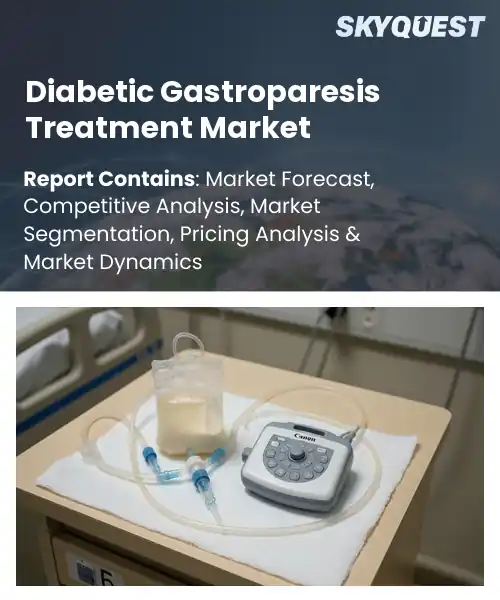
Diabetic Gastroparesis Treatment Market
Report ID: SQMIG35I2785
Report ID: SQMIG35I2785
[email protected]
USA +1 351-333-4748
Report ID:
SQMIG35I2785 |
Region:
Global |
Published Date: June, 2026
Pages:
157
|Tables:
118
|Figures:
77


Global Diabetic Gastroparesis Treatment Market size was valued at USD 3.03 Billion in 2024 and is poised to grow from USD 3.14 Billion in 2025 to USD 4.15 Billion by 2033, growing at a CAGR of 3.57% during the forecast period (2026-2033).
The primary driver of the diabetic gastroparesis treatment market is the rising prevalence of diabetes and an unmet need for effective therapies. Diabetic gastroparesis is a chronic gastric emptying disorder that produces nausea, vomiting and nutritional compromise, and it matters because it increases healthcare utilization and diminishes quality of life. Over time the market shifted from reliance on off label prokinetics and symptomatic care toward targeted pharmacologic agents, device therapies and endoscopic interventions. Regulatory limits on longstanding drugs and improved diagnostics such as gastric emptying scintigraphy and wireless motility capsules, exemplified by Enterra stimulation and emerging ghrelin agonists, illustrate evolution.
A key trend driving the global diabetic gastroparesis treatment sector is innovation in diagnostics and therapeutics that converts unmet need into commercial opportunity, because better diagnostic tools lead clinicians to identify more cases and justify intervention. As gastric emptying testing becomes routine, prescription of targeted prokinetics rises and referral for procedures increases, prompting hospitals to invest in gastric stimulation and GPOEM training in tertiary centers. Simultaneously clinical pipelines and strategic licensing deals attract capital, enabling phase three trials of ghrelin agonists and novel neuromodulators. The diabetes epidemic is on the rise across Asia Pacific and the increasing globalization of reimbursement policies will lead to a greater number of people receiving care for their diabetes.
How is AI Improving Clinical Outcomes in the Diabetic Gastroparesis Treatment Market?
By using AI, clinical results in patients with diabetic gastroparesis have improved through enhanced accuracy of diagnosis, continuous monitoring of symptoms, and individualised treatment plans. Key aspects that have contributed to these improved outcomes are, automated analysis of gastric emptying studies using machine learning algorithms, ongoing symptom assessments based on data from wearable and ingestible sensors, AI-assisted tuning of neuromodulation devices, and the use of predictive analytics to identify imminent symptom flare-ups. The marketplace is evolving towards a data driven model of care where diagnostic information informs decision making regarding therapy. For example AI analysis of motility signals can reveal patterns that guide medication choice or adjust stimulation settings to reduce nausea and vomiting and improve daily functioning.
In June 2025, AnX Robotica received FDA clearance for a next generation GI motility capsule that measures gastric emptying across the gut. AI driven analytics applied to that richer data can personalize therapy selection and optimize device programming, speeding appropriate treatment and supporting market efficiency and growth.
Market snapshot - (2026-2033)
Global Market Size
USD 3.03 Billion
Largest Segment
Calcium-Zinc Based Stabilizers
Fastest Growth
Calcium-Zinc Based Stabilizers
Growth Rate
3.57% CAGR
To get more insights on this market click here to Request a Free Sample Report
Global diabetic gastroparesis treatment market is segmented by stabilizer chemistry type, pvc material state, end-use industry, distribution channel and region. Based on stabilizer chemistry type, the market is segmented into calcium-zinc based stabilizers, organotin based stabilizers, lead based stabilizers, barium-zinc based stabilizers and others. Based on pvc material state, the market is segmented into rigid PVC formulations and flexible PVC formulations. Based on end-use industry, the market is segmented into building & construction, electrical & electronics wire cables, automotive components and healthcare & medical tubing. Based on distribution channel, the market is segmented into direct and indirect. Based on region, the market is segmented into North America, Europe, Asia Pacific, Latin America and Middle East & Africa.
Based on the global diabetic gastroparesis treatment market growth, flexible PVC formulations segment dominates because medical devices for diabetic gastroparesis rely on soft, compliant tubing that supports enteral feeding, ambulatory infusion and wearable delivery systems, enabling patient comfort and reduced mucosal trauma. Their material adaptability allows drug compatibility, ease of sterilization and customization for pump connectors, which drives clinician preference and procurement choices, creating a reinforcing cycle of adoption by device makers and integrators seeking reliable, patient centric delivery components.
However, rigid PVC formulations are emerging as the most rapidly expanding area due to demand for durable, shape stable components in implantable housings and external pump casings, offering improved device integrity and simplified manufacturing workflows. Improvements in the formulation have improved biocompatibility and sterilisation resistance, leading to new uses for durable drug delivery systems and inexpensive manufacturing methods.
Healthcare & medical tubing segment dominates because it directly interfaces with therapeutic delivery for diabetic gastroparesis, encompassing feeding tubes, enteral connectors and specialized conduits used in gastric stimulation systems, which mandates strict regulatory compliance and trusted performance. Due to clinical preference for known tubing types, established providers and the requirement for length and connector customization's, procurement is driven toward medical tubing solutions that enable safe and effective management of gastric emptying therapy over the long-term.
On the other hand, electrical & electronics wire cables are witnessing the strongest growth as device makers integrate sensors and telemetry into gastric stimulators and wearable monitors, creating demand for miniaturized, high reliability cabling. Improvements in thermal insulation and signal quality contribute to closed loop therapies and remote monitors, allowing for new options for connected models and for aftermarket upgrading of devices to provide expanded functionality.
To get detailed segments analysis, Request a Free Sample Report
Based on the global diabetic gastroparesis treatment market share, North America dominates due to a convergence of advanced healthcare infrastructure, concentrated pharmaceutical and device industry presence, and a regulatory environment that supports timely clinical development and commercialization. An established set of specialist networks with strong diagnostic capacity allow for the early recognition of complex cases and better overall management of those patients. A well developed reimbursement framework and payer support for new therapies also aids market access, while ongoing research produces local evidence to assist with adoption; these factors also contribute to awareness via patient advocacy groups and medical organizations who generate guidelines through these processes. Ultimately, integrated care models improve multidisciplinary manageability of patients, creating an environment that speeds up how quickly providers adopt, as well as maintaining a leading position regarding treatment innovations.
Diabetic gastroparesis treatment market in United States benefits from concentrated pharmaceutical investment, extensive specialist networks, and advanced diagnostic capabilities. Established reimbursement pathways and commercial infrastructure support rapid adoption of novel therapies. A high volume of clinical research activity along with good collaboration will promote innovation between industry (companies) and academic institutions. Patient advocates, along with societies for specialists, will allow for greater awareness and development of guidelines to facilitate the efficient use of new therapies in the clinic and make it easier for patients to gain access to them.
Diabetic gastroparesis treatment market in Canada is characterized by integrated public healthcare systems, emphasis on equitable access, and investment in specialist services. The process of how health technology is adopted by providing the appropriate pathways through technology assessment and regional centers of excellence assists in providing multidisciplinary care to patients. Evidence from patient support networks and education of clinicians enhances the use of appropriate treatment options by providing more accurate diagnoses and better methods to manage patients.
Based on global diabetic gastroparesis treatment regional forecast, rapid expansion in Europe is driven by strengthened clinical awareness, evolving reimbursement approaches, and increasing collaboration across industry, academia, and healthcare systems. Harmonizing regulations & proactive guideline creation allows for quicker evaluation & approval of new treatments into clinical pathways. Investing in specialty centers & expanding the diagnostic capacity at those centers will assist with the identification & management of patients while academic research provides evidence based upon local/regional level. Cross-border relationships as well as pilot programs to develop new models of care delivery via multi-disciplinary teams will facilitate real-life implementation. The development of national programs to promote clinicians' education & patient advocacy will enhance the receptivity of markets, positioning the regions for continued & diverse growth.
Diabetic gastroparesis treatment market in Germany benefits from strong hospital networks, high clinical expertise in gastroenterology, and established collaboration between industry and university centers. Advancing therapies are supported by a solid reimbursement model and centralized specialist clinics that facilitate their evaluation and adoption within healthcare systems. Also, coordinated patient advocacy groups and multidisciplinary patient care teams strengthen the continuity of care throughout the continuum of an individual’s treatment through reference centers by helping to increase diagnosis rates.
Diabetic gastroparesis treatment market in United Kingdom is experiencing accelerated expansion driven by proactive adoption of clinical innovations, strong academic clinical networks, and increasing integration of digital health in patient management. Collaborative initiatives between healthcare providers and industry enable evaluations and implementation. Focused training programs and centralized referral pathways for specialists within the field of gastroenterology facilitate continuity of care throughout the continuum of service and will improve diagnostic accuracy.
Diabetic gastroparesis treatment market in France is emerging as policymakers and clinicians prioritize improved diagnosis and patient pathways. Providing specialists with training and growing referral network systems will improve access to multi-centric care. Supporting partnerships between academic institutions and industry partners will result in clinical research and evidence development. Changing reimbursement options and making it easier for health professionals to integrate their care pathways will support greater adoption of therapeutic alternatives.
As per global diabetic gastroparesis treatment regional outlook, Asia Pacific is strengthening its position through expanding clinical capacity, maturing regulatory frameworks, and growing collaboration between domestic manufacturers and global innovators. Supporting diagnostic and sophisticated management of complex cases can be made easier by increasing the number of tertiary hospitals and specialty outpatient clinics. Clinical research supports the development of local evidence that will eventually lead to the expanded use of new therapies or equipment in practice. There are changes to regulatory processes to increase the ease of introducing new therapies and equipment; and public and private insurers are increasingly willing to consider using value-based reimbursement methods. Partnerships across borders, technology transfer, and digital health will facilitate remote monitoring and multi-disciplinary approaches to care, which helps the region leverage global advancements into the implementation of clinically appropriate acute care practices on a regional level.
Diabetic gastroparesis treatment market in Japan is supported by advanced clinical research infrastructure, strong ties between industry and academic hospitals, and a regulatory environment that values rigorous evidence. The capacity of specialty centers and diagnostic facilities to diagnose in a timely manner allows for better treatment. Development and localization of therapies by domestic pharmaceutical companies and medical device manufacturers is accomplished by involvement in coordinated reimbursement pathways and education programmes for clinicians to help implement newer therapies.
Diabetic gastroparesis treatment market in South Korea benefits from a medical technology sector, high adoption of digital health solutions, and organized hospital networks that support specialized care. Strong public private partnerships accelerate clinical evaluations and market entry for innovative therapies and devices. Focused training programs and active patient advocacy contribute to greater disease awareness and improved referral pathways, enabling faster clinical adoption and enhanced continuity of care across specialist centers.
To know more about the market opportunities by region and country, click here to
Buy The Complete Report
Growing Diabetes Patient Population
Advancements In Therapeutic Options
Limited Therapeutic Efficacy Profiles
Reimbursement and Access Challenges
Request Free Customization of this report to help us to meet your business objectives.
The competitive landscape for global diabetic gastroparesis treatment market outlook is shifting from commoditized oral options toward targeted prokinetics and device based neuromodulation, driven by strategic M&A, licensing deals and commercialization partnerships that speed access and clinical development. Real examples include Allergan’s acquisition of Motus Therapeutics for relamorelin, Processa’s licensing term sheet with Intact to advance PCS12852, and device stewardship transfers to Enterra Medical.
Top Player’s Company Profile
Recent Developments
SkyQuest’s ABIRAW (Advanced Business Intelligence, Research & Analysis Wing) is our Business Information Services team that Collects, Collates, Correlates, and Analyses the Data collected by means of Primary Exploratory Research backed by robust Secondary Desk research.
As per SkyQuest analysis, the global diabetic gastroparesis treatment industry is driven primarily by the rising prevalence of diabetes and an unmet need for effective therapies, while advancements in diagnostics and therapeutics further accelerate diagnosis and uptake of targeted treatments and devices. Growth is tempered by limited therapeutic efficacy profiles that create variability in patient response and slow clinician adoption. North America remains the dominating region thanks to advanced healthcare infrastructure, robust research activity and favorable reimbursement pathways. The demand for flexible PVC formulations will drive the market as feeding tube and wearable system manufacturers accelerate the development of soft, compliant components used to deliver medicine to patients. Physicians also prefer these products.
| Report Metric | Details |
|---|---|
| Market size value in 2024 | USD 3.03 Billion |
| Market size value in 2033 | USD 4.15 Billion |
| Growth Rate | 3.57% |
| Base year | 2024 |
| Forecast period | (2026-2033) |
| Forecast Unit (Value) | USD Billion |
| Segments covered |
|
| Regions covered | North America (US, Canada), Europe (Germany, France, United Kingdom, Italy, Spain, Rest of Europe), Asia Pacific (China, India, Japan, Rest of Asia-Pacific), Latin America (Brazil, Rest of Latin America), Middle East & Africa (South Africa, GCC Countries, Rest of MEA) |
| Companies covered |
|
| Customization scope | Free report customization with purchase. Customization includes:-
|
To get a free trial access to our platform which is a one stop solution for all your data requirements for quicker decision making. This platform allows you to compare markets, competitors who are prominent in the market, and mega trends that are influencing the dynamics in the market. Also, get access to detailed SkyQuest exclusive matrix.
Table Of Content
Executive Summary
Market overview
Parent Market Analysis
Market overview
Market size
KEY MARKET INSIGHTS
COVID IMPACT
MARKET DYNAMICS & OUTLOOK
Market Size by Region
KEY COMPANY PROFILES
Methodology
For the Diabetic Gastroparesis Treatment Market, our research methodology involved a mixture of primary and secondary data sources. Key steps involved in the research process are listed below:
1. Information Procurement: This stage involved the procurement of Market data or related information via primary and secondary sources. The various secondary sources used included various company websites, annual reports, trade databases, and paid databases such as Hoover's, Bloomberg Business, Factiva, and Avention. Our team did 45 primary interactions Globally which included several stakeholders such as manufacturers, customers, key opinion leaders, etc. Overall, information procurement was one of the most extensive stages in our research process.
2. Information Analysis: This step involved triangulation of data through bottom-up and top-down approaches to estimate and validate the total size and future estimate of the Diabetic Gastroparesis Treatment Market.
3. Report Formulation: The final step entailed the placement of data points in appropriate Market spaces in an attempt to deduce viable conclusions.
4. Validation & Publishing: Validation is the most important step in the process. Validation & re-validation via an intricately designed process helped us finalize data points to be used for final calculations. The final Market estimates and forecasts were then aligned and sent to our panel of industry experts for validation of data. Once the validation was done the report was sent to our Quality Assurance team to ensure adherence to style guides, consistency & design.
Analyst Support
Customization Options
With the given market data, our dedicated team of analysts can offer you the following customization options are available for the Diabetic Gastroparesis Treatment Market:
Product Analysis: Product matrix, which offers a detailed comparison of the product portfolio of companies.
Regional Analysis: Further analysis of the Diabetic Gastroparesis Treatment Market for additional countries.
Competitive Analysis: Detailed analysis and profiling of additional Market players & comparative analysis of competitive products.
Go to Market Strategy: Find the high-growth channels to invest your marketing efforts and increase your customer base.
Innovation Mapping: Identify racial solutions and innovation, connected to deep ecosystems of innovators, start-ups, academics, and strategic partners.
Category Intelligence: Customized intelligence that is relevant to their supply Markets will enable them to make smarter sourcing decisions and improve their category management.
Public Company Transcript Analysis: To improve the investment performance by generating new alpha and making better-informed decisions.
Social Media Listening: To analyze the conversations and trends happening not just around your brand, but around your industry as a whole, and use those insights to make better Marketing decisions.
REQUEST FOR SAMPLE
 REQUEST FREE CUSTOMIZATION
Global Diabetic Gastroparesis Treatment Market size was valued at USD 3.03 Billion in 2024 and is poised to grow from USD 3.14 Billion in 2025 to USD 4.15 Billion by 2033, growing at a CAGR of 3.57% during the forecast period (2026-2033).
The competitive landscape for global diabetic gastroparesis treatment is shifting from commoditized oral options toward targeted prokinetics and device based neuromodulation, driven by strategic M&A, licensing deals and commercialization partnerships that speed access and clinical development. Real examples include Allergan’s acquisition of Motus Therapeutics for relamorelin, Processa’s licensing term sheet with Intact to advance PCS12852, and device stewardship transfers to Enterra Medical. 'Takeda Pharmaceutical', 'Evoke Pharma', 'Johnson & Johnson', 'AstraZeneca', 'Bausch Health Companies', 'Allergan', 'Viatris', 'Teva Pharmaceutical Industries', 'Sun Pharmaceutical Industries', 'Cipla', 'Dr. Reddy's Laboratories', 'Lupin', 'Aurobindo Pharma', 'Zydus Lifesciences', 'Hikma Pharmaceuticals', 'Sanofi', 'GlaxoSmithKline', 'Pfizer', 'Novartis', 'Boehringer Ingelheim'
The growing number of individuals living with diabetes increases clinical need for effective management of gastroparesis, prompting healthcare providers to prioritize diagnosis and treatment pathways. This heightened patient pool motivates pharmaceutical and device manufacturers to expand research, optimize formulations, and pursue targeted therapies to address symptom burden and improve glycemic control. Increased clinical demand also encourages payers and healthcare systems to adopt treatment guidelines and support access initiatives, thereby creating a supportive environment for product development, commercialization, and broader market uptake.
Personalized Therapeutic Strategies: Clinical practice and industry are shifting toward individualized treatment plans that integrate symptom profiling, comorbidity management, and patient reported outcomes to improve care continuity. Emerging focus on tailoring pharmacologic regimens, combining targeted prokinetics with adjunctive therapies, and aligning dietary and behavioral interventions enhances patient adherence and value. Payers and providers increasingly prioritize treatment pathways that demonstrate improved quality of life and care coordination, driving collaboration across multidisciplinary teams and stimulating demand for patient centric solutions across the therapeutic landscape globally.
Why does North America Dominate the Global Diabetic Gastroparesis Treatment Market? |@12


Want to customize this report? This report can be personalized according to your needs. Our analysts and industry experts will work directly with you to understand your requirements and provide you with customized data in a short amount of time. We offer $1000 worth of FREE customization at the time of purchase.
Feedback From Our Clients


 USA (+1) 351-333-4748

