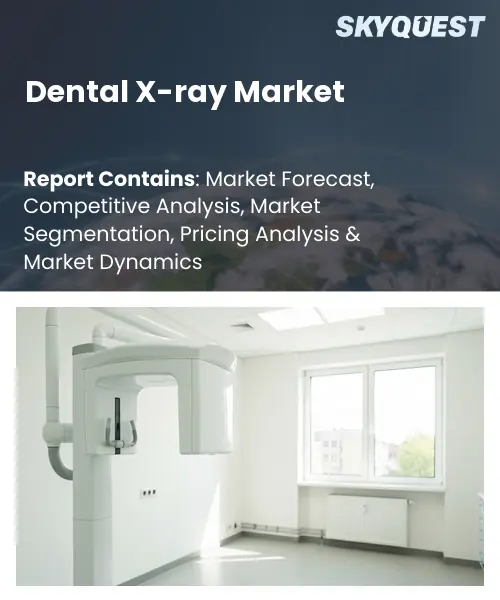
Dental X-ray Market
Report ID: SQMIG35A4015
Report ID: SQMIG35A4015
[email protected]
USA +1 351-333-4748
Report ID:
SQMIG35A4015 |
Region:
Global |
Published Date: June, 2026
Pages:
157
|Tables:
146
|Figures:
78


Global Dental X-Ray Market size was valued at USD 3.0 Billion in 2024 and is poised to grow from USD 3.25 Billion in 2025 to USD 6.25 Billion by 2033, growing at a CAGR of 8.5% during the forecast period (2026-2033).
The leading driver of the dental x-ray market is the technological advancement to digital and three-dimensional imaging, which has transformed diagnostic workflows and clinical results. It matters as a sector providing intraoral sensors, panoramic units and cone beam computed tomography (CBCT) systems to dental practices, imaging underpins treatment planning, preventive care and complex procedures such as implant placement and endodontics. Over time, the market moved from film radiography to digital sensors and software platforms, with better image quality and lower radiation exposure. Early adopters in orthodontic chains and specialty clinics saw higher throughput and better patient outcomes, which led to wider global adoption.
Advances in imaging hardware along with cloud and artificial intelligence are a significant force in the growth of the global dental x-ray market, offering real clinical and economic reasons to adopt. With AI algorithms automating caries detection and CBCT segmentation dentists can diagnose faster and plan implants with more precision, meaning less chair time and complications, which is a justification for capital investment in the higher-end units. This technology synergy creates growth potential in the field of teledentistry, where clinics send standardized radiographs for remote consultation, and in emerging markets, where lower-cost digital sensors and leasing models drive uptake among expanding dental workforces, further boosting market expansion.
How is AI improving diagnostic accuracy in the dental x-ray market?
By using AI for dental X-ray diagnosis, you can combine automated image interpretation, clinical decision support, and workflow integration to improve diagnostic accuracy. Key features include uniform detection of lesions, consistent bone level assessment and flagging of subtle anomalies for clinician review. AI is increasingly being integrated into imaging and practice software, giving dentists clearer, more reproducible reads and faster case triage. This evolution helps to reduce variability between clinicians and to facilitate tracking of findings over time. Providers and dental service organizations are using these tools to enhance the reliability of diagnostics and actionability of treatment planning.
Overjet April 2026 announced a rollout with Sonrava Health to deploy its clinical AI across hundreds of practices, demonstrating how real time radiograph analysis and automated documentation accelerates workflows and supports consistent diagnoses while enabling practices to scale care quality.
Market snapshot - (2026-2033)
Global Market Size
USD 3.0 Billion
Largest Segment
Digital X-ray Systems
Fastest Growth
Digital X-ray Systems
Growth Rate
8.5% CAGR
To get more insights on this market click here to Request a Free Sample Report
Global dental x-ray market is segmented by product, type, portability, application, end user and region. Based on product, the market is segmented into Digital X-ray Systems, Analog X-ray Systems and Hybrid X-ray Systems. Based on type, the market is segmented into Intraoral X-ray, Extraoral X-ray and Cone Beam Computed Tomography (CBCT). Based on portability, the market is segmented into Wall-Mounted Systems, Portable Systems and Handheld Systems. Based on application, the market is segmented into Diagnostic, Cosmetic Dentistry, Forensic Dentistry and Others. Based on end user, the market is segmented into Dental Clinics, Hospitals & Diagnostic Centers, Academic & Research Institutes and Others. Based on region, the market is segmented into North America, Europe, Asia Pacific, Latin America and Middle East & Africa.
What role do intraoral X-ray systems play in advancing dental diagnostics?
Intraoral systems offer direct high resolution imaging of individual teeth and adjacent structures, enabling rapid detection of caries, periapical pathology and restorative needs, thus, Intraoral X-ray segment is dominating. Clinician preference is fueled in routine diagnostic and preventive care settings by their small footprint and integration with digital sensors and practice management systems that streamlines chairside workflows, improves patient throughput and reduces diagnostic uncertainty.
However, cone-beam computed tomography (CBCT) is the fastest growing field in dental imaging as the three dimensional visualization helps in implant planning and complex surgical and endodontic care. The adoption of compact CBCT units and sophisticated image software are powering innovations that are creating new opportunities in advanced restorative and surgical workflows.
How are digital x-ray systems transforming dental imaging workflows?
The Digital X-ray Systems segment is expected to hold the largest market share during the forecast period due to the advantages of digital platforms such as instant image acquisition, easy integration with practice management and imaging software, and improved image manipulation leading to faster and more accurate diagnoses. Clinics are adopting digital solutions because of the reduced film processing workload, lower long term operating costs and compatibility with telehealth and analytics tools. This increases efficiency and results in more consistent clinical decision making across procedures.
Hybrid x-ray systems are becoming the major high growth area with analog based foundations and optional digital upgrades that permit practices to upgrade without replacing everything. Retrofit kits, modular designs and vendor upgrade services meet the needs of practices that want to invest in upgrades in phases, and provide opportunities for recurring upgrades and services, and to kick-start wider equipment refresh cycles.
To get detailed segments analysis, Request a Free Sample Report
The North American region dominates the global dental X-ray market, driven by a robust healthcare infrastructure, widespread clinical adoption of advanced imaging technologies, and the presence of major manufacturers. A supportive reimbursement environment and high patient awareness drive routine diagnostic imaging and preventive care, supporting clinic investments in new intraoral and extraoral systems. Strong distribution channels, maintenance and training of clinicians enable fast adoption of technology. The region continues to be a hub for product introduction and ongoing market leadership, with research collaborations and ongoing product development driving innovation, and the integration of imaging with practice management systems streamlining workflow and enhancing diagnostic confidence.
In the United States dental X-ray market, the use of advanced imaging platforms has been high. The presence of private dental enterprises and extensive clinical training further supports the use of advanced intraoral and extraoral systems. The regional headquarters of major suppliers and their distribution networks are situated here, ensuring rapid product introduction and complete service. Investment in digital radiography and integrated imaging solutions across care settings is also driven by reimbursement frameworks and patient desire for precision in diagnostics.
The Dental X-ray Market in Canada is structured around a combination of universal healthcare elements and the work of private dental practices that fuel the need for dependable diagnostic imaging. Patient safety and radiation dose optimization drives the transition to digital detectors and modern intraoral units. Dental clinics typically purchase from a small number of regional suppliers and partner with other clinics to determine what to purchase . Suppliers tend to emphasize service responsiveness and clinician education to promote uptake across care settings .
Europe dental X-ray market expansion is driven by technology modernization, harmonization of regulatory standards and growing emphasis on the quality of oral healthcare. The broad digitization of dental practices and the integration of imaging with electronic patient records underpin the need for versatile radiography solutions. Cross-border collaboration between manufacturers, research institutions and clinical networks accelerates the dissemination of best practices and training. Intraoral and extraoral systems are being bought thanks to clinician confidence in optimized imaging protocols and public and private efforts to improve preventive dental care. Investment in clinician education and targeted service agreements further reduce barriers to upgrade, while localised product customisation meets diverse clinical preferences across member states.
The German dental X-ray market enjoys a robust healthcare infrastructure, high clinical standards and a concentrated demand in specialist clinics. Manufacturers emphasize product certification and solid service networks, guaranteeing equipment reliability and adherence to safety protocols. Collaborative research and training with universities encourages the clinical adoption of advanced imaging. In procurement, systems tend to be long-lasting and upgradeable offering a stable environment for suppliers who are looking at long-term performance and professional engagement relationships.
The United Kingdom Dental X-ray Market is observing a rapid uptake of innovative imaging solutions owing to progressive clinical adoption and investment in private dental services. The emphasis on workflow efficiency and patient communication favors digital radiography and integrated imaging platforms. Clinician training and pilot programs speed the conversion of legacy equipment, while competitive supplier activity and flexible financing lower acquisition barriers, allowing for rapid modernization of dental practices and specialty centers.
The dental x-ray market in France is gaining traction with modernization in dental clinics and regional initiatives for preventive care. There is a growing use of digital intraoral and panoramic imaging by clinicians to enhance diagnostics. Local suppliers and distributors focus on flexible product offerings and clinician training to meet the needs of diverse practices. Focus on radiation safety and joint pilot programs help build clinical confidence and encourage investments into upgraded imaging systems in private practices and specialty clinics.
In the dental X-ray market, Asia Pacific is putting more emphasis on investments in advanced imaging capabilities, expanded manufacturing competencies and growing clinical expertise. Modernization of dental clinics in urban centers and growing patient awareness regarding diagnostic care are the key drivers behind the demand for digital intraoral and extraoral systems. Local manufacturers are expanding product portfolios to match regional clinical preferences, while global suppliers are seeking partnerships and local service models. Government and institutional initiatives that support clinician training and technology adoption can remove barriers. Cross-border cooperation in research, distribution and after-sales service makes for a more resilient supply ecosystem, while better access to financing and tailored service agreements supports uptake outside metropolitan areas, fostering incremental innovation from local vendors.
Japan›s Dental X-ray Market is characterized by early adoption of high-precision imaging technologies and strong domestic manufacturing. Demand for advanced intraoral and panoramic systems with sophisticated ergonomics is being fuelled by a focus on diagnostic accuracy and patient comfort. Manufacturers are focused on high quality detectors and integration with practice software. Robust service networks and clinician training help extend equipment life and procedural confidence, supporting demand in private clinics, specialty dental facilities and research ventures.
South Korea Dental X-ray Market is driven by strong electronics expertise, presence of active local manufacturers and receptive clinical community for digital imaging. The demand is driven by compact high-performance systems suitable for space-conscious practices and a focus on patient-centered care. The collaboration between manufacturers and dental schools facilitates clinical validation and the development of proficiency in clinicians. Vendors stress fast after-sale service and software interoperability to meet workflow requirements, helping speed up the modernization of city clinics.
To know more about the market opportunities by region and country, click here to
Buy The Complete Report
Rising Adoption Of Digital Systems
Integration With Practice Management Software
High Initial Equipment Costs
Regulatory Compliance Complexity
Request Free Customization of this report to help us to meet your business objectives.
The global dental X-ray market is characterized by competitive intensity through rapid AI-enabled innovation in diagnostics, distribution tie-ups, and strategic consolidation. Vendors look to M&A for channel access, partner with AI startups for embedded analytics, e.g. Henry Schein One platform partnerships and regulatory-backed moves such as Overjet FDA clearance and Pearl funding will help to sharpen product differentiation and speed up adoption.
SkyQuest’s ABIRAW (Advanced Business Intelligence, Research & Analysis Wing) is our Business Information Services team that Collects, Collates, Correlates, and Analyses the Data collected by means of Primary Exploratory Research backed by robust Secondary Desk research. As per SkyQuest analysis, the global dental x-ray market is being driven primarily by the adoption of digital and AI-enabled imaging as a key driver, while high initial equipment costs act as a major restraint. North America remains the dominating region and intraoral X-ray systems are the dominating segment, reflecting clinician preference for high-resolution, chairside diagnostics. A second driver is tighter integration of imaging with practice management software and cloud platforms, which improves workflow efficiency and enables teledentistry. Overall market expansion balances strong technology and software-led adoption with affordability and regulatory hurdles that will shape upgrade cycles and vendor strategies.
| Report Metric | Details |
|---|---|
| Market size value in 2024 | USD 3.0 Billion |
| Market size value in 2033 | USD 6.25 Billion |
| Growth Rate | 8.5% |
| Base year | 2024 |
| Forecast period | (2026-2033) |
| Forecast Unit (Value) | USD Billion |
| Segments covered |
|
| Regions covered | North America (US, Canada), Europe (Germany, France, United Kingdom, Italy, Spain, Rest of Europe), Asia Pacific (China, India, Japan, Rest of Asia-Pacific), Latin America (Brazil, Rest of Latin America), Middle East & Africa (South Africa, GCC Countries, Rest of MEA) |
| Companies covered |
|
| Customization scope | Free report customization with purchase. Customization includes:-
|
To get a free trial access to our platform which is a one stop solution for all your data requirements for quicker decision making. This platform allows you to compare markets, competitors who are prominent in the market, and mega trends that are influencing the dynamics in the market. Also, get access to detailed SkyQuest exclusive matrix.
Table Of Content
Executive Summary
Market overview
Parent Market Analysis
Market overview
Market size
KEY MARKET INSIGHTS
COVID IMPACT
MARKET DYNAMICS & OUTLOOK
Market Size by Region
KEY COMPANY PROFILES
Methodology
For the Dental X-ray Market, our research methodology involved a mixture of primary and secondary data sources. Key steps involved in the research process are listed below:
1. Information Procurement: This stage involved the procurement of Market data or related information via primary and secondary sources. The various secondary sources used included various company websites, annual reports, trade databases, and paid databases such as Hoover's, Bloomberg Business, Factiva, and Avention. Our team did 45 primary interactions Globally which included several stakeholders such as manufacturers, customers, key opinion leaders, etc. Overall, information procurement was one of the most extensive stages in our research process.
2. Information Analysis: This step involved triangulation of data through bottom-up and top-down approaches to estimate and validate the total size and future estimate of the Dental X-ray Market.
3. Report Formulation: The final step entailed the placement of data points in appropriate Market spaces in an attempt to deduce viable conclusions.
4. Validation & Publishing: Validation is the most important step in the process. Validation & re-validation via an intricately designed process helped us finalize data points to be used for final calculations. The final Market estimates and forecasts were then aligned and sent to our panel of industry experts for validation of data. Once the validation was done the report was sent to our Quality Assurance team to ensure adherence to style guides, consistency & design.
Analyst Support
Customization Options
With the given market data, our dedicated team of analysts can offer you the following customization options are available for the Dental X-ray Market:
Product Analysis: Product matrix, which offers a detailed comparison of the product portfolio of companies.
Regional Analysis: Further analysis of the Dental X-ray Market for additional countries.
Competitive Analysis: Detailed analysis and profiling of additional Market players & comparative analysis of competitive products.
Go to Market Strategy: Find the high-growth channels to invest your marketing efforts and increase your customer base.
Innovation Mapping: Identify racial solutions and innovation, connected to deep ecosystems of innovators, start-ups, academics, and strategic partners.
Category Intelligence: Customized intelligence that is relevant to their supply Markets will enable them to make smarter sourcing decisions and improve their category management.
Public Company Transcript Analysis: To improve the investment performance by generating new alpha and making better-informed decisions.
Social Media Listening: To analyze the conversations and trends happening not just around your brand, but around your industry as a whole, and use those insights to make better Marketing decisions.
REQUEST FOR SAMPLE
 REQUEST FREE CUSTOMIZATION
Global Dental X-Ray Market size was valued at USD 3.0 Billion in 2024 and is poised to grow from USD 3.25 Billion in 2025 to USD 6.25 Billion by 2033, growing at a CAGR of 8.5% during the forecast period (2026-2033).
Competitive intensity in the global dental X-ray market is driven by rapid AI-enabled diagnostic innovation, distribution tie-ups, and strategic consolidation. Vendors pursue M&A to secure channel access while partnering with AI startups for embedded analytics, for example Henry Schein One platform partnerships and regulatory-backed moves such as Overjet FDA clearance and Pearl funding, which sharpen product differentiation and speed adoption. 'Dentsply Sirona Inc.', 'Envista Holdings Corporation', 'Planmeca Oy', 'Carestream Dental LLC', 'Vatech Co., Ltd.', 'Midmark Corporation', 'Acteon Group', 'J. Morita Corporation', 'Cefla S.C.', 'Yoshida Dental Mfg. Co., Ltd.', 'Air Techniques, Inc.', 'Genoray Co., Ltd.', 'Owandy Radiology', 'Asahi Roentgen Industry Co., Ltd.', 'Trident S.r.l.', 'FONA Dental, s.r.o.', 'NewTom', 'PreXion Corporation', 'CurveBeam AI Ltd.', 'Shimadzu Corporation'
Digital X-ray adoption improves diagnostic workflow, image clarity, and record integration, encouraging dental practices to upgrade equipment and expand services. As clinicians recognize clearer imaging and faster acquisitions, practices prioritize modern systems to enhance patient communication and treatment planning, which supports procurement decisions. Vendors respond with solutions emphasizing compatibility and ease of use, reducing perceived implementation barriers. This cumulative effect fosters steady replacement of analog equipment with digital alternatives, expanding demand for both intraoral and extraoral X-ray units and related software within general and specialist dental settings.
Ai Enabled Diagnostics: Adoption of artificial intelligence and machine learning algorithms in dental imaging is reshaping diagnostics and practice workflows. Vendors emphasize software that automates image enhancement, anomaly detection, and standardized reporting to support clinical decision making and reduce interpretation variability. Integration with practice management systems and cloud platforms facilitates remote consultations and multidisciplinary review. This trend drives product differentiation, services based revenue models, and partnerships between imaging manufacturers and software developers, while encouraging ongoing investment in training, validation and clinician acceptance initiatives.
Why does North America Dominate the Global Dental X-ray Market? |@12


Want to customize this report? This report can be personalized according to your needs. Our analysts and industry experts will work directly with you to understand your requirements and provide you with customized data in a short amount of time. We offer $1000 worth of FREE customization at the time of purchase.
Feedback From Our Clients


 USA (+1) 351-333-4748

