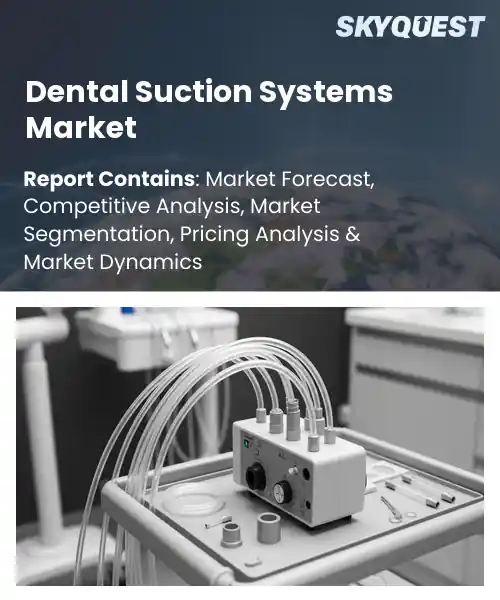
Dental Suction Systems Market
Report ID: SQMIG35A3617
Report ID: SQMIG35A3617
[email protected]
USA +1 351-333-4748
Report ID:
SQMIG35A3617 |
Region:
Global |
Published Date: May, 2026
Pages:
157
|Tables:
153
|Figures:
78


Global Dental Suction Systems Market size was valued at USD 521.2 Million in 2024 and is poised to grow from USD 542.99 Million in 2025 to USD 753.47 Million by 2033, growing at a CAGR of 4.18% during the forecast period (2026-2033).
Dental suction systems are devices and consumables used to remove saliva, blood and aerosols to help maintain infection control and improve chair side efficiency during Dental surgeries/Procedures. The main driving force for this market has been the increased standard for infection control and the awareness of aerosol transmission due to the COVID-19 Pandemic which caused dental clinics and institutions to make rapid upgrades. The evolution of the dental suction systems have been from the basic mechanical saliva ejector to high-volume evacuation (HVE) systems with filtration, sound dampening, and a plethora of HVE suction and filtration systems, such as procedural air compression systems for suctioning through the walls of dental clinics, and HEPA filtered central suction systems installed in hospitals, as well as HVE suction systems for individual dental practices around the globe.
Technological innovation is the primary trend driving growth in this market, as new technologies developed to improve suction capability and filtration will decrease the potential for cross-contamination (which increases procedural efficiency) through a reduction in aerosol generation. As such, is being re-invested into the dental suction systems market towards the purchase of HVE and integrated central suction systems, decreasing chair turnaround time (in high-volume dental practices), and increasing patient throughput (in public hospitals and high-volume chain dental practices).
Regulatory mandates and procurement policies further accelerate adoption because compliance requires certified filtration and traceability, creating opportunities for manufacturers to offer retrofit kits, service contracts and bundled consumables for use in implant surgeries, aerosol-generating restorative care and community outreach programs across emerging markets.
How is IoT-enabled Automation Improving Efficiency In The Dental Suction Systems Market?
An Internet of Things enabled automation in dental suction systems combines sensors and networked controls together with vacuum units, enabling real-time monitoring predictive maintenance and adaptive suction control. Nowadays clinics are moving from manual checks to systems that generate alerts optimize flow and coordinate with chairside equipment. This reduces unplanned downtime improves infection control and streamlines staff workflows. Manufacturers are putting smart mechanical room control and Cloud dashboards in place to enable technicians to diagnose problems remotely. Examples are automatically balancing loads between pumps and alerting when filters need maintenance, resulting in successful procedures and less downtime for routine maintenance.
Midmark February 2026, introduced connected operatory and smart mechanical room systems that utilize IoT telemetry for suction performance monitoring and automated pump cycles. This innovation reduces interruptions by predicting maintenance needs and adjusting vacuum delivery automatically, positively influencing patient throughput and supporting market growth through practice efficiency.
Market snapshot - (2026-2033)
Global Market Size
USD 521.2 Million
Largest Segment
Wet Dental Suction Systems
Fastest Growth
Dry Dental Suction Systems
Growth Rate
4.18% CAGR
To get more insights on this market click here to Request a Free Sample Report
Global dental suction systems market is segmented by product type, component, system capacity, application, end user and region. Based on product type, the market is segmented into Wet Dental Suction Systems, Dry Dental Suction Systems, Semi-Dry Dental Suction Systems, Portable Dental Suction Systems and Centralized Dental Suction Systems. Based on component, the market is segmented into Vacuum Pumps, Suction Motors, Separators & Filtration Units, Valves & Regulators, Suction Hoses & Accessories and Others. Based on system capacity, the market is segmented into Single-Operatory Systems and Multi-Operatory Systems. Based on application, the market is segmented into General Dentistry, Oral & Maxillofacial Surgery, Orthodontics, Periodontics, Endodontics, Implant Dentistry, Pediatric Dentistry and Others. Based on end user, the market is segmented into Dental Clinics, Dental Hospitals and Academic & Research Institutes. Based on region, the market is segmented into North America, Europe, Asia Pacific, Latin America and Middle East & Africa.
Due to the preferences of large clinics and hospitals, the centralized dental suction system segment of the industry continues to dominate due to the existence of integrated suction systems that provide waste removal for multiple operatories with minimal interruption and complexity of maintenance. The centralized design allows for consistent vacuum performance, easy serviceability, and compatibility with advanced separators contributing to the purchasing preference of customers. Furthermore, the systemic reliability and capacity to support multiple procedures simultaneously create efficiencies in operations, decrease the per-op cost, and simplify infection control workflows which continue to provide institutional settings with their stronghold.
On the other hand, the portable dental suction system is becoming the most rapidly growing category of the market due to the favorable environment created by increasing demand for flexible points of care and mobile dental services. The benefits of portable dental suction systems further provide convenience through compact size, ease of installation, improved battery life and reduced noise levels which encourage use by solo practitioners and outreach programs creating new sales opportunities for manufacturers and accelerating product innovation.
The Separate and Filtration Units segment is leading because increased attention on infection prevention has driven purchasers to seek integrated filtration systems that eliminate aerosols, amalgam, biohazards, etc. from being released into the atmosphere upon vacuum exhaust. The use of new technologies to filter out these contaminants will also enhance air quality and assist in complying with regulatory standards, so dental offices will focus their purchases on filtration units that will limit their impact on the environment and help with waste segregation. Being able to retrofit the existing suction systems into the new high-performance suction units will further help promote these units as an essential component to consider when procuring the entire suction system.
However, manufacturers are focused on developing newer, quieter, energy efficient, and variable speed vacuum pumps, creating momentum in the market for these devices. This will allow manufacturers to meet the expectations of modern dental offices with regard to affordability. The fact that these pumps require minimal maintenance, support low operating costs, and are compatible with multiple operatories will help to position them as the primary impetus for system upgrades and market growth.
To get detailed segments analysis, Request a Free Sample Report
In North America, a variety of structural factors unite to provide support for new products and technologies to be adopted. The combination of a well organized health care delivery structure (primary, secondary and tertiary levels of service) and availability of large private dental practice networks means that there will always be a need for reliable sources of suction. The regional manufacturers' strong R&D capabilities provide continual improvement of product design through integration of quieter, more efficient devices, as well as, improvements to infection control systems. The establishment of appropriate regulations and reimbursement practices creates an environment that is conducive to encourage the purchase of high-quality devices. The existence of an adequate service and distribution infrastructure ensures that devices are readily available and that support can be provided when necessary. The collaboration of manufacturers, dental associations and educational institutions accelerates the validation of products through clinical practice, leading to a greater acceptance of product use by practitioners. The ongoing emphasis placed on patient safety, ergonomic design for operators, and operational efficiency further enhances preference for the use of these modern suction devices within the dental practice, as well as, in institutions.
The Dental Suction Systems Market in the United States is influenced by high criteria for clinical performance, and stringent standards of infection control. The high concentration of both private and group practices, as well as educational institutions, has created a demand for products with reliability, low noise, and low maintenance. The presence of many manufacturers and established distribution networks contributes significantly to product availability and after-sale support; while professional associations, and continuing education provide direction via clinical guidelines and training for new products.
The Dental Suction Systems Market in Canada reflects priorities regarding patient safety and quality of care. Urban and community clinics were included in this mix. Decision-making was based on long-term serviceability and compatibility with current dental equipment, as well as regional procurement processes and central purchasing by some institutions. Local suppliers collaborated with clinical stakeholders to create tailored solutions according to their workflow needs. In addition, there was a strong emphasis on infection control and environmental issues that have driven a demand for new, energy efficient systems.
Expansion in Europe is propelled by a combination of regulatory focus, modernization of clinical infrastructure, and rising emphasis on infection prevention across dental services. Markets with concentrated clinical excellence and strong medical device ecosystems prioritize integration of advanced suction solutions that improve procedural efficiency and patient experience. Increasing investment in dental facility upgrades and digital dentistry initiatives encourages replacement of legacy equipment with systems that offer compatibility with contemporary operative workflows. Local manufacturers and multinational suppliers both play roles in widening product availability, while professional guidelines and cross country collaborations support best practice dissemination. Market dynamics also reflect differentiated adoption rates across regions, where economic and healthcare delivery models influence purchase cycles and preferences for service driven partnerships.
Dental Suction Systems Market in Germany is anchored by a strong clinical infrastructure and a reputation for engineering quality that influences buyer expectations. Procurement often targets precision, durability, and serviceability, with clinics favoring systems that align with rigorous hygiene standards and technical integration requirements. Local manufacturers and specialist distributors provide tailored maintenance and training services, reinforcing long term relationships and gradual technology renewal across practices and institutions.
Dental Suction Systems Market in United Kingdom is characterized by dynamic adoption patterns influenced by evolving practice models and emphasis on clinical safety. A diverse mix of private practices, group clinics, and public dental services creates varied procurement pathways, encouraging suppliers to offer flexible purchasing, leasing, and service packages. Focus on practitioner workflow optimization and patient comfort drives interest in lower noise, compact, and easy to service suction systems, while professional guidance shapes uptake and clinical standardization.
Dental Suction Systems industry in France is emerging around targeted investments in practice modernization and infection control improvements. Clinical stakeholders show growing interest in systems that balance operational performance with ergonomic design, supported by local distributors offering tailored service agreements. Adoption reflects a cautious but steady shift from legacy units toward equipment that enhances clinical efficiency and aligns with evolving hygiene expectations across private and institutional dental settings.
Asia Pacific is fortifying its role through a mixture of domestic manufacturing capacity expansion, technology transfer, and increased clinical infrastructure development. Regional suppliers are enhancing product portfolios to meet local market needs, focusing on cost effective designs without sacrificing performance and hygiene standards. Adoption is being supported by growth in private dental care, rising patient expectations, and investments in facility upgrades that create demand for reliable suction systems. Cross border partnerships and distribution networks accelerate product availability, while localized service capabilities and training help overcome operational barriers. Emphasis on energy efficiency, compact footprints for urban clinics, and compatibility with digital dental workflows further positions the region as an increasingly important contributor to global market evolution.
Dental Suction Systems sector in Japan emphasizes precision engineering and integration with advanced clinical workflows, reflecting local expectations for high quality and reliability. Suppliers often differentiate through technological refinement, quiet operation, and compact designs suited to space constrained clinics. Strong aftersales service and preventive maintenance offerings support long term equipment performance, while professional acceptance is guided by clinical standards and established training channels.
Dental Suction Systems Market in South Korea advances through rapid clinical modernization and close collaboration between manufacturers and dental professionals. Focus on innovation results in interest for features that enhance ergonomics and infection control, and the local industry supports swift commercialization of adapted solutions. Robust distributor networks and service infrastructures facilitate uptake across urban clinics and specialist practices, aligning product offerings with practitioner expectations and efficiency goals.
To know more about the market opportunities by region and country, click here to
Buy The Complete Report
Rising Demand For Infection Control
Increased Preference For Portable Units
High Initial Equipment Costs
Restricted Insurance Reimbursement Policies
Request Free Customization of this report to help us to meet your business objectives.
Competition in the global dental suction systems market is driven by consolidation among large equipment vendors, targeted acquisitions and portfolio reshaping, and partnerships to add aerosol management and digital integration capabilities. Examples include Envista’s post spin off positioning, Planmeca’s acquisition of KaVo treatment unit assets in 2021, and Dentsply Sirona’s product line expansions such as PUREVAC and SANI-TIP that tie suction to infection control and chairside workflows. Most innovation in suction and aerosol control has come from established dental equipment manufacturers, air purification firms, or mobile dental operators adopting portable suction.
SkyQuest’s ABIRAW (Advanced Business Intelligence, Research & Analysis Wing) is our Business Information Services team that Collects, Collates, Correlates, and Analyses the Data collected by means of Primary Exploratory Research backed by robust Secondary Desk research.
As per SkyQuest analysis, the global dental suction systems market is being driven primarily by heightened infection control standards that pushed clinics to upgrade toward high-volume evacuation and advanced filtration, while a second driver is rapid technological innovation including IoT-enabled automation that improves uptime and workflow efficiency. A restraint is the high initial equipment costs that limit adoption among smaller practices and budget-constrained facilities. North America remains the dominating region given strong R&D, regulatory emphasis and established private practice networks. The dominating segment is Centralized Dental Suction Systems, favored by hospitals and large clinics for consistent performance and simplified maintenance. Overall market growth reflects safety and efficiency priorities balanced against cost barriers.
| Report Metric | Details |
|---|---|
| Market size value in 2024 | USD 521.2 Million |
| Market size value in 2033 | USD 753.47 Million |
| Growth Rate | 4.18% |
| Base year | 2024 |
| Forecast period | (2026-2033) |
| Forecast Unit (Value) | USD Million |
| Segments covered |
|
| Regions covered | North America (US, Canada), Europe (Germany, France, United Kingdom, Italy, Spain, Rest of Europe), Asia Pacific (China, India, Japan, Rest of Asia-Pacific), Latin America (Brazil, Rest of Latin America), Middle East & Africa (South Africa, GCC Countries, Rest of MEA) |
| Companies covered |
|
| Customization scope | Free report customization with purchase. Customization includes:-
|
To get a free trial access to our platform which is a one stop solution for all your data requirements for quicker decision making. This platform allows you to compare markets, competitors who are prominent in the market, and mega trends that are influencing the dynamics in the market. Also, get access to detailed SkyQuest exclusive matrix.
Table Of Content
Executive Summary
Market overview
Parent Market Analysis
Market overview
Market size
KEY MARKET INSIGHTS
COVID IMPACT
MARKET DYNAMICS & OUTLOOK
Market Size by Region
KEY COMPANY PROFILES
Methodology
For the Dental Suction Systems Market, our research methodology involved a mixture of primary and secondary data sources. Key steps involved in the research process are listed below:
1. Information Procurement: This stage involved the procurement of Market data or related information via primary and secondary sources. The various secondary sources used included various company websites, annual reports, trade databases, and paid databases such as Hoover's, Bloomberg Business, Factiva, and Avention. Our team did 45 primary interactions Globally which included several stakeholders such as manufacturers, customers, key opinion leaders, etc. Overall, information procurement was one of the most extensive stages in our research process.
2. Information Analysis: This step involved triangulation of data through bottom-up and top-down approaches to estimate and validate the total size and future estimate of the Dental Suction Systems Market.
3. Report Formulation: The final step entailed the placement of data points in appropriate Market spaces in an attempt to deduce viable conclusions.
4. Validation & Publishing: Validation is the most important step in the process. Validation & re-validation via an intricately designed process helped us finalize data points to be used for final calculations. The final Market estimates and forecasts were then aligned and sent to our panel of industry experts for validation of data. Once the validation was done the report was sent to our Quality Assurance team to ensure adherence to style guides, consistency & design.
Analyst Support
Customization Options
With the given market data, our dedicated team of analysts can offer you the following customization options are available for the Dental Suction Systems Market:
Product Analysis: Product matrix, which offers a detailed comparison of the product portfolio of companies.
Regional Analysis: Further analysis of the Dental Suction Systems Market for additional countries.
Competitive Analysis: Detailed analysis and profiling of additional Market players & comparative analysis of competitive products.
Go to Market Strategy: Find the high-growth channels to invest your marketing efforts and increase your customer base.
Innovation Mapping: Identify racial solutions and innovation, connected to deep ecosystems of innovators, start-ups, academics, and strategic partners.
Category Intelligence: Customized intelligence that is relevant to their supply Markets will enable them to make smarter sourcing decisions and improve their category management.
Public Company Transcript Analysis: To improve the investment performance by generating new alpha and making better-informed decisions.
Social Media Listening: To analyze the conversations and trends happening not just around your brand, but around your industry as a whole, and use those insights to make better Marketing decisions.
REQUEST FOR SAMPLE
 REQUEST FREE CUSTOMIZATION
Global Dental Suction Systems Market size was valued at USD 521.2 Million in 2024 and is poised to grow from USD 542.99 Million in 2025 to USD 753.47 Million by 2033, growing at a CAGR of 4.18% during the forecast period (2026-2033).
Competition in the global dental suction systems market is driven by consolidation among large equipment vendors, targeted acquisitions and portfolio reshaping, and partnerships to add aerosol management and digital integration capabilities. Examples include Envista’s post spin off positioning, Planmeca’s acquisition of KaVo treatment unit assets in 2021, and Dentsply Sirona’s product line expansions such as PUREVAC and SANI-TIP that tie suction to infection control and chairside workflows. Note on startup coverage: comprehensive searches found few verified startups founded in or after 2019 that focus exclusively on dedicated dental suction systems; most innovation in suction and aerosol control has come from established dental equipment manufacturers, air purification firms, or mobile dental operators adopting portable suction. The two startups listed above are verified recent entrants in dental technology and mobile delivery with clear relevance to suction demand, but they are not pureplay suction manufacturers. 'Dentsply Sirona', 'A-dec', 'Planmeca', 'Midmark Corporation', 'DentalEZ', 'Cattani S.p.A.', 'Dürr Dental', 'Metasys Medizintechnik', 'Air Techniques', 'MELAG Medizintechnik', 'Gnatus', 'Tech West', 'Quatro Air Technologies', 'Ivoclar Vivadent', 'Belmont Equipment', 'Sinol Dental', 'Foshan Anle Medical Apparatus', 'AJAX Dental', 'Flight Dental Systems', 'TPC Advanced Technology'
Enhanced emphasis on infection control in dental settings has encouraged clinics and practitioners to adopt advanced suction systems that reduce aerosol spread and surface contamination. Improved clinical protocols prioritize hygienic patient care, and suction units that offer superior aerosol capture are seen as integral to safe practice. Manufacturers respond with targeted designs and practitioners prefer equipment that aligns with sterilization workflows, thereby increasing purchases. This alignment between safety priorities and product capability fosters steady uptake across private practices and institutional providers seeking to minimize infection risk.
Digital Integration In Dentistry: Dental suction systems are increasingly integrated with digital practice ecosystems to streamline workflows and enhance patient care. Connectivity with imaging devices, intraoral scanners, and chairside software enables coordinated procedure timing, automated diagnostics, and predictive maintenance alerts. Manufacturers focus on interoperable interfaces and cloud based monitoring that support remote service, data driven performance optimization, and reduced downtime. Clinicians benefit from simplified documentation and improved ergonomics, while practices gain operational efficiency and compliance with clinical protocols through unified digital platforms and insights.
Why does North America Dominate the Global Dental Suction Systems Market? |@12


Want to customize this report? This report can be personalized according to your needs. Our analysts and industry experts will work directly with you to understand your requirements and provide you with customized data in a short amount of time. We offer $1000 worth of FREE customization at the time of purchase.
Feedback From Our Clients


 USA (+1) 351-333-4748

