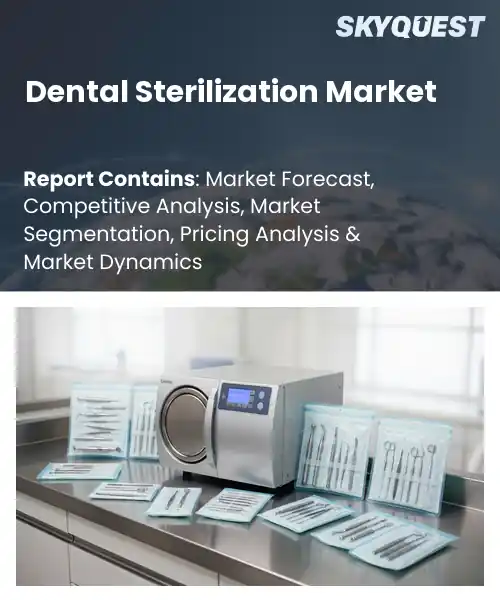
Dental Sterilization Market
Report ID: SQMIG35A3781
Report ID: SQMIG35A3781
[email protected]
USA +1 351-333-4748
Report ID:
SQMIG35A3781 |
Region:
Global |
Published Date: June, 2026
Pages:
157
|Tables:
149
|Figures:
78


Global Dental Sterilization Market size was valued at USD 1.63 Billion in 2024 and is poised to grow from USD 1.77 Billion in 2025 to USD 3.48 Billion by 2033, growing at a CAGR of 8.8% during the forecast period (2026-2033).
Compliance with stricter infection-control regulations is the primary driver shaping the dental sterilization market, compelling clinics to upgrade to validated autoclaves, chemical indicators, and single-use disposables. The market encompasses devices, consumables, and services that prevent cross-contamination in dental procedures, and it matters because patient safety, legal liability, and practice reputation hinge on effective sterilization. Historically, the sector evolved from basic boiling and manual disinfection toward steam sterilization and instrument tracking systems as outbreaks and regulatory audits highlighted risks; for example, several publicized cross-contamination incidents prompted national guideline revisions that accelerated adoption of integrated sterilization workflows and improved patient trust metrics.The proliferation of minimally invasive and implant procedures has created greater instrument complexity, which increases sterilization demands and consequently fuels market growth for advanced autoclaves and validation software. As practices expand services, case volume rises, producing higher turnover of instruments and driving demand for rapid-cycle sterilizers and automated packaging solutions; for example, multi-specialty clinics adopting same-day restorations implement instrument tracking to avoid delays and reduce costs. Furthermore, aging dental infrastructure in emerging markets causes retrofit opportunities, so manufacturers supplying affordable, portable sterilization units and training services gain market share while regulators and insurers incentivize certified sterilization protocols and improve compliance.
How is IoT improving compliance and traceability in the dental sterilization market?
IoT is improving compliance and traceability in dental sterilization by connecting sterilizers and instrument workflows to centralized cloud systems. Real time sensor logs capture cycle conditions and machine status while automated records remove the risk of manual charting errors. Tagging instruments with RFID or QR codes links specific trays to sterilization histories and patient procedures which strengthens chain of custody and simplifies audits. Remote alerts and analytics help clinics spot deviations and prepare faster service responses which reduces downtime and supports consistent adherence to protocols. These shifts make compliance easier for single offices and attractive for multi site groups seeking uniform quality and operational visibility.Midmark March 2026, Midmark launched a smarter hybrid real time locating and sensor network that extends connectivity across operatories and sterilization areas. This advancement helps practices track assets and integrate location data with sterilization workflows which boosts efficiency and supports broader adoption of connected sterilization solutions.
Market snapshot - (2026-2033)
Global Market Size
USD 1.63 Billion
Largest Segment
Sterilization Equipment
Fastest Growth
Consumables and Accessories
Growth Rate
8.8% CAGR
To get more insights on this market click here to Request a Free Sample Report
Global dental sterilization market is segmented by product, method, application, end-user, sales channel and region. Based on product, the market is segmented into Sterilization Equipment, Cleaning and Disinfectant Equipment, Packaging Equipment, Consumables and Accessories and Others. Based on method, the market is segmented into Heat Based Sterilization, Chemical Based Sterilization, Radiation Based Sterilization and Others. Based on application, the market is segmented into Instrument Decontamination, Surface Disinfection and Others. Based on end-user, the market is segmented into Dental Clinics, Hospitals, Dental Laboratories and Others. Based on sales channel, the market is segmented into Direct Sales, Dental Supply Distributors, Online Healthcare Portals and Others. Based on region, the market is segmented into North America, Europe, Asia Pacific, Latin America and Middle East & Africa.
Sterilization Equipment segment dominates because it provides the core machinery that enables validated infection control workflows across dental settings. Clinics and laboratories prioritize reliable autoclaves and advanced sterilizers to meet stringent reprocessing standards, driving procurement of durable units with integrated monitoring. The centrality of equipment to operational continuity, staff training paradigms, compliance audits, and service networks creates sustained demand and shapes purchasing priorities toward robust capital products.
However, Consumables and Accessories is witnessing the strongest growth momentum as clinics shift toward single-use instruments and disposable barriers to reduce cross-contamination risk. Rising demand for convenient, compliant supplies, coupled with product innovation in sterilization-compatible disposables and recurring purchasing patterns, drives rapid market expansion and recurring revenue opportunities for suppliers.
Chemical Based Sterilization segment dominates because it offers flexible, low-heat options that suit diverse dental instruments and surfaces, enabling clinics to process heat-sensitive devices without damage. The variety of chemistries and delivery formats supports rapid turnaround and targeted disinfection, aligning with stringent infection control guidelines. Ease of integration into existing workflows, portability of systems, and regulatory backing encourage widespread adoption among dental practitioners and sterilization service providers across settings.
Meanwhile, Heat Based Sterilization is the most rapidly expanding approach because compact autoclave innovations, faster cycles, and improved validation meet clinician demands for reliable reprocessing. Rising preference for heat sterilization in busy practices and simplified workflows drives equipment upgrades and service growth, creating new revenue streams and broader adoption across dental providers.
To get detailed segments analysis, Request a Free Sample Report
North America dominates the global dental sterilization market due to a confluence of structural strengths and market dynamics. Robust healthcare infrastructure and rigorous regulatory standards encourage early adoption of advanced sterilization technologies and comprehensive infection control protocols across private and institutional dental settings. A concentration of leading manufacturers and service providers fosters innovation, extensive product availability, and reliable aftersales support. High patient awareness and established dental care delivery models drive consistent demand for sterilization solutions. Well developed distribution networks and professional training ecosystems enable rapid deployment and maintenance of sterilization equipment. Collaboration between academic institutions, clinical practitioners, and industry further accelerates diffusion of best practices and standards across the region.
Dental Sterilization Market in United States is defined by high adoption of advanced autoclaves, chemical sterilants, and workflow integration across dental practices and institutional settings. Clinician emphasis on patient safety, broad access to training, and established procurement frameworks support consistent investment in sterilization equipment. Strong manufacturer presence and comprehensive maintenance networks ensure operational reliability, while ongoing professional education sustains adherence to rigorous sterilization protocols and quality standards across care settings.
Dental Sterilization Market in Canada reflects a coordinated approach to infection control with emphasis on compliance, staff training, and equipment standardization across regional practices. Practitioners prioritize validated sterilization workflows and supplier relationships that deliver dependable service and support. Public awareness and guidance encourage consistent implementation of sterilization best practices. The market benefits from collaborative initiatives among associations, educational institutions, vendors that promote quality assurance and continuous improvement in sterilization procedures.
Europe is experiencing rapid expansion in dental sterilization driven by heightened regulatory focus on infection prevention, coordinated professional guidelines, and growing emphasis on clinical safety across member countries. Harmonized standards and active professional bodies promote widespread adoption of validated sterilization technologies and standardized workflows within diverse practice settings. Market momentum is supported by a mix of established manufacturers and innovative suppliers that tailor products to regional compliance expectations and operational needs. Increasing procurement by dental groups and clinics, together with rising practitioner training and awareness, reinforces demand for reliable sterilization solutions. Attention to lifecycle management, service networks, and environmental considerations also shapes market preferences, encouraging suppliers to offer comprehensive packages that combine equipment performance with maintenance and training support. These combined factors elevate Europe to a dynamic marketplace where compliance and operational efficiency are key purchasing criteria.
Dental Sterilization Market in Germany is characterized by a strong manufacturing base that supplies robust, high quality sterilization equipment and validated processes. Regulatory rigor and professional training foster meticulous adherence to sterilization standards across private practices and institutional settings. Well established service networks and aftersales support ensure equipment reliability and uptime. German market dynamics favor technological refinement, collaboration between manufacturers and clinical users, and investment in quality driven sterilization solutions.
Dental Sterilization Market in United Kingdom is propelled by modernization across private practices and expanding clinic networks that prioritize streamlined sterilization workflows. Practitioners increasingly seek integrated solutions combining reliable equipment with service and training. Regulatory guidance and professional advocacy strengthen adoption of validated sterilization protocols. Market momentum is supported by agile suppliers that customize offerings for practice sizes, enabling upgrade cycles and operational consistency in sterilization practices across the country.
Dental Sterilization Market in France is emerging through intensified professional guidance, modernization of dental facilities aiming for enhanced infection control. Practitioners emphasize validated sterilization protocols and supplier partnerships offering equipment, service, and training. Market uptake is influenced by practitioner networks, regional health directives, and focus on operational efficiency and sustainability in sterilization processes. Vendors aligning solutions with French clinical workflows and providing support gain traction among private practices and institutions.
Asia Pacific is strengthening its position in the dental sterilization market through a combination of technology adoption, capacity building, and localized manufacturing capabilities. Markets in the region are modernizing clinical workflows and prioritizing validated sterilization practices within both private clinics and hospital dental departments. Local suppliers and international vendors collaborate to adapt solutions to regional practice patterns and space constraints, while service networks expand to support maintenance and training. Regulatory attention to infection control and quality assurance, along with rising clinical demand and increasing practitioner awareness, encourage broader deployment of advanced sterilization equipment. Strategic partnerships, product localization, and growth in professional education further accelerate the region's ability to offer competitive, contextually appropriate sterilization solutions. Investment in local research and development and expansion of distribution and technical support networks position major markets to meet both domestic needs and export opportunities.
Dental Sterilization Market in Japan is driven by advanced technological integration, meticulous clinical standards, and strong manufacturing emphasizing precision and reliability. Dental providers favor validated sterilization systems complemented by comprehensive aftersales service and maintenance. Professional training and strict regulatory expectations promote consistent sterilization practices across private clinics and hospital dental units. Suppliers combining compact, efficient designs with dependable support and customization to Japanese clinical workflows achieve broad acceptance among practitioners.
Dental Sterilization Market in South Korea is marked by swift adoption of innovative sterilization technologies integrated with digital workflows. Clinics and hospital departments favor compact, efficient sterilization solutions tailored to space and throughput requirements. Local manufacturers and service providers supply equipment and service offerings. Training and regulatory focus on infection control support consistent sterilization practices. Suppliers that facilitate workflow integration and provide dependable technical service secure adoption across care settings.
To know more about the market opportunities by region and country, click here to
Buy The Complete Report
Increasing Focus On Infection Control
Technological Advancements In Sterilizers
High Cost Of Advanced Equipment
Complex Regulatory and Compliance Burden
Request Free Customization of this report to help us to meet your business objectives.
Competitive landscape is driven by consolidation through M&A and strategic technological partnerships, for example STERIS acquiring Cantel and Getinge partnering with Google Cloud, and by rapid product innovation in low temperature sterilization. Buyers press vendors for validated compliance ready solutions, prompting entrants to pursue regulatory clearances, co development agreements with hospital systems, and product differentiation via plasma and vapor sterilization technologies.
Top Player’s Company Profile
Recent Developments
SkyQuest’s ABIRAW (Advanced Business Intelligence, Research & Analysis Wing) is our Business Information Services team that Collects, Collates, Correlates, and Analyses the Data collected by means of Primary Exploratory Research backed by robust Secondary Desk research. As per SkyQuest analysis, the global dental sterilization market is propelled by increasing focus on infection control as a key driver, and further boosted by technological advancements such as IoT-enabled traceability and faster, compact autoclaves as a second driver. A restraint is the high upfront cost of advanced sterilization systems and ongoing validation and maintenance expenses that limit adoption among smaller practices. North America remains the dominating region due to stringent regulations, strong supplier presence and extensive aftersales support, while the Sterilization Equipment segment dominates the product landscape as the core enabler of validated instrument reprocessing workflows. Emerging markets present retrofit and training opportunities for cost-sensitive providers and vendors offering bundled solutions.
| Report Metric | Details |
|---|---|
| Market size value in 2024 | USD 1.63 Billion |
| Market size value in 2033 | USD 3.48 Billion |
| Growth Rate | 8.8% |
| Base year | 2024 |
| Forecast period | (2026-2033) |
| Forecast Unit (Value) | USD Billion |
| Segments covered |
|
| Regions covered | North America (US, Canada), Europe (Germany, France, United Kingdom, Italy, Spain, Rest of Europe), Asia Pacific (China, India, Japan, Rest of Asia-Pacific), Latin America (Brazil, Rest of Latin America), Middle East & Africa (South Africa, GCC Countries, Rest of MEA) |
| Companies covered |
|
| Customization scope | Free report customization with purchase. Customization includes:-
|
To get a free trial access to our platform which is a one stop solution for all your data requirements for quicker decision making. This platform allows you to compare markets, competitors who are prominent in the market, and mega trends that are influencing the dynamics in the market. Also, get access to detailed SkyQuest exclusive matrix.
Table Of Content
Executive Summary
Market overview
Parent Market Analysis
Market overview
Market size
KEY MARKET INSIGHTS
COVID IMPACT
MARKET DYNAMICS & OUTLOOK
Market Size by Region
KEY COMPANY PROFILES
Methodology
For the Dental Sterilization Market, our research methodology involved a mixture of primary and secondary data sources. Key steps involved in the research process are listed below:
1. Information Procurement: This stage involved the procurement of Market data or related information via primary and secondary sources. The various secondary sources used included various company websites, annual reports, trade databases, and paid databases such as Hoover's, Bloomberg Business, Factiva, and Avention. Our team did 45 primary interactions Globally which included several stakeholders such as manufacturers, customers, key opinion leaders, etc. Overall, information procurement was one of the most extensive stages in our research process.
2. Information Analysis: This step involved triangulation of data through bottom-up and top-down approaches to estimate and validate the total size and future estimate of the Dental Sterilization Market.
3. Report Formulation: The final step entailed the placement of data points in appropriate Market spaces in an attempt to deduce viable conclusions.
4. Validation & Publishing: Validation is the most important step in the process. Validation & re-validation via an intricately designed process helped us finalize data points to be used for final calculations. The final Market estimates and forecasts were then aligned and sent to our panel of industry experts for validation of data. Once the validation was done the report was sent to our Quality Assurance team to ensure adherence to style guides, consistency & design.
Analyst Support
Customization Options
With the given market data, our dedicated team of analysts can offer you the following customization options are available for the Dental Sterilization Market:
Product Analysis: Product matrix, which offers a detailed comparison of the product portfolio of companies.
Regional Analysis: Further analysis of the Dental Sterilization Market for additional countries.
Competitive Analysis: Detailed analysis and profiling of additional Market players & comparative analysis of competitive products.
Go to Market Strategy: Find the high-growth channels to invest your marketing efforts and increase your customer base.
Innovation Mapping: Identify racial solutions and innovation, connected to deep ecosystems of innovators, start-ups, academics, and strategic partners.
Category Intelligence: Customized intelligence that is relevant to their supply Markets will enable them to make smarter sourcing decisions and improve their category management.
Public Company Transcript Analysis: To improve the investment performance by generating new alpha and making better-informed decisions.
Social Media Listening: To analyze the conversations and trends happening not just around your brand, but around your industry as a whole, and use those insights to make better Marketing decisions.
REQUEST FOR SAMPLE
 REQUEST FREE CUSTOMIZATION


Want to customize this report? This report can be personalized according to your needs. Our analysts and industry experts will work directly with you to understand your requirements and provide you with customized data in a short amount of time. We offer $1000 worth of FREE customization at the time of purchase.
Feedback From Our Clients


 USA (+1) 351-333-4748

