Dental Rapid Prototyping Systems Market
Report ID: SQMIG35A3947
Report ID: SQMIG35A3947
[email protected]
USA +1 351-333-4748
Report ID:
SQMIG35A3947 |
Region:
Global |
Published Date: June, 2026
Pages:
157
|Tables:
181
|Figures:
79


Global Dental Rapid Prototyping Systems Market size was valued at USD 2.21 Billion in 2024 and is poised to grow from USD 2.46 Billion in 2025 to USD 5.89 Billion by 2033, growing at a CAGR of 11.51% during the forecast period (2026-2033).
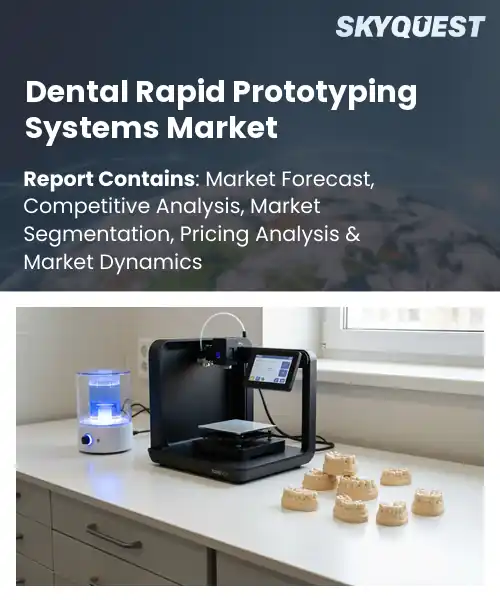
The Dental rapid prototyping systems market is about tech that takes designs of mouth structures and turns them into real, physical restorations using additive manufacturing, like stereolithography, light processing, and selective laser sintering. It matters because it helps deliver custom crowns, bridges, aligners, and surgical guides in just a few hours, so treatment cycles get shorter and lab costs tend to drop a bit. A big push behind this growth is the adoption of digital dentistry, which started leaning on CAD/CAM in the 2000s and then sped up when intra-oral scanners started giving consistent 3D data. For instance, some well known orthodontic brands now make SLA-printed aligners right from scanned models, so shift away from outsourced milling to more in office printing, or at least faster local production can be seen.
Another factor shaping the dental rapid prototyping systems market outlook is how printable dental materials are advancing, plus how regulatory pathways are evolving, which opens up newer clinical uses. As resins and ceramic composites get stronger and shrink less, clinicians can fabricate crowns, implant guides, and pediatric appliances, effectively widening what a practice can offer. There’s also an example from Brazil, where a clinic used a DLP printer, paired it with a resin, and began delivering permanent crowns in a single visit. They reported that appointments dropped by around 40 percent, and revenue per hour improved noticeably. Altogether, these changes reduce production costs, support insurer reimbursement, and bring investment too, making a loop of adoption and ongoing innovation.
AI driven automation is changing the whole way dental rapid prototyping systems design and manufacture restorations, like it adds a new layer of “thinking” in the background. Machine learning models can review intraoral scans in near real time, then choose the best printing settings while also flagging potential anomalies before a build starts. That cuts down on manual fine tuning, speeds up turnaround, and helps keep the fit more consistent for crowns, bridges, and aligners. On top of that, integrated workflow platforms link imaging devices, design software, and printers together, so clinicians can place an order with something close to a single click, instead of bouncing between tools. The approach also improves over time since the system can learn from each case, refining material choices and support structures, which tends to raise productivity and patient comfort, while lowering the amount of labor needed.
Market snapshot - (2026-2033)
Global Market Size
USD 2.21 Billion
Largest Segment
Dental 3D Printers
Fastest Growth
Hybrid CAD/CAM Prototyping Systems
Growth Rate
11.51% CAGR
To get more insights on this market click here to Request a Free Sample Report
The global dental rapid prototyping systems market is segmented based on product type, technology, application, end user, material type, distribution channel, and region. By product type, the market is categorized into dental 3D printers, dental milling-based prototyping systems, hybrid CAD/CAM prototyping systems, rapid prototyping workstations, and others. Based on technology, the market is segmented into stereolithography (SLA), digital light processing (DLP), material jetting, fused deposition modeling (FDM), and other technologies. Based on application, the market is divided into dental crowns & bridges, orthodontic models & aligners, surgical guides, dentures, and others. By end user, the market comprises dental laboratories, dental clinics, academic & research institutes, dental service organizations (DSOs), and others. Based on material type, the market is segmented into photopolymer resins, ceramic materials, metal materials, wax materials, and others. By distribution channel, the market is classified into direct sales, dental equipment distributors, and e-commerce. Geographically, the market is analyzed across North America, Europe, Asia Pacific, Latin America, and the Middle East & Africa.
As per the dental rapid prototyping systems market analysis, the Dental 3D printers lead the market because they hit the real pain points, high precision , fast turnaround, the modern dental flow. They can form those detailed shapes from biocompatible resins, which fits the push for same day restorations, and also it reduces the dependency on outside labs. Plus the integrated software ecosystems help a lot with the design to production path, fewer mishaps, less manual labor. So basically this mix of accuracy, speed, and smoother workflow makes clinics prefer them across most of the market.
However, Hybrid CAD/CAM prototyping systems are pulling stronger growth lately. Clinics want equipment that can shift between additive and subtractive routines without a big hassle. Newer software updates make it easier to swap materials smoothly, so the use cases widen beyond just one restoration type. That versatility brings in more users, it widens market reach, and it also creates extra revenue opportunities for manufacturers.
According to the dental rapid prototyping systems market forecast, the Digital Light Processing category is taking the lead, mainly because it performs rapid layer curing, and that cuts down build times while keeping the fine details that dental restorations need. It also supports a broad set of photopolymer formulations, so it can serve different clinical requirements, from crowns right through to surgical guides. On top of that, lower material waste and repeatability that stays consistent makes it line up with cost conscious practices that still want efficient output during every step.
Meanwhile, Material Jetting category is predicted to have the largest dental rapid prototyping systems market share as manufacturers push multi material printers that deposit both soft and hard resins in one build. That opens up things like graded occlusal surfaces and models that mimic tissue , so more research labs and prosthetic service providers are getting interested. With the application range expanding, the market seems to move faster, too.
To get detailed segments analysis, Request a Free Sample Report
As per the dental rapid prototyping systems market regional forecast, North America is leading the market due to a convergence of advanced manufacturing infrastructure, plus strong research collaborations between academic institutions and industry, and then a mature regulatory environment that basically helps speed up product introduction. Also the region gets a deep pool of skilled engineers and dental professionals, who keep pushing continuous innovation for materials and printing technologies, like they never stop. There is robust investment in digital dentistry, and there’s this culture where people adopt early in dental laboratories, it strengthens the competitive edge, even when things get complicated. At the same time well‑established supply chains make sure components are available without drama and that service support happens quickly across the whole market.
United States Dental Rapid Prototyping Systems Market
The Dental Rapid Prototyping Systems market penetration in the United States is thriving on a culture of technological entrepreneurship, and a lot of collaboration between major dental schools and equipment manufacturers. This ecosystem supports quick iteration of design software, which builds high‑resolution printing capabilities, that can actually satisfy exacting clinical standards. Strong intellectual property protection also nudges more investment into novel materials, and there is an extensive network of specialized service providers that helps implementation move smoothly across different practice settings and sizes.
Canada Dental Rapid Prototyping Systems Market
The Dental Rapid Prototyping Systems sector in Canada benefits from a supportive innovation framework, and it also rides on close ties between research centers and commercial partners. There is a big emphasis on precision engineering, and material science pushes development of customized solutions, especially for complex dental restorations. Collaborative initiatives with healthcare providers help rapid prototyping feel natural inside routine workflows, and the focus on sustainable manufacturing practices gives the market longer‑term resilience, even when demand shifts.
The European dental rapid prototyping systems market growth is pushed forward by a strong emphasis on clinical excellence, stringent quality standards, and a collaborative regulatory landscape that harmonizes product approvals across member states. The region has a long history in dental research, so advancements in biocompatible materials and multi‑axis printing technologies keep coming. There’s also a rising demand for personalized dental solutions, and supportive funding mechanisms for digital health initiatives, which accelerates adoption among dental clinics, as well as laboratories. Plus integration of cross‑border supply networks improves market agility, and makes access easier for more players.
Germany Dental Rapid Prototyping Systems Market
The Dental Rapid Prototyping Systems industry in Germany is anchored by a robust engineering tradition, along with a dense network of specialized manufacturers. The market stresses precision and reliability, which then supports high‑performance printers built for intricate dental uses. Close collaboration between technical universities and industry speeds up material innovations, and there’s a well‑structured certification process that helps keep product quality consistent across the broader European market, not just locally.
United Kingdom Dental Rapid Prototyping Systems Market
The Dental Rapid Prototyping Systems Market in the United Kingdom is seeing fast growth through aggressive adoption of digital dentistry initiatives, plus strong government support for technology‑driven healthcare. Leading dental academies partner with equipment suppliers, and they tweak workflow efficiencies, so rapid prototyping gets used widely for restorative procedures. The market also gets a boost from an active professional community, which champions continuous education and shares best‑practice ideas, often in real time.
France Dental Rapid Prototyping Systems Market
The Dental Rapid Prototyping Systems Market in France is emerging as a fertile ground for innovative material research, and for customized orthodontic solutions that are tailored to real clinical needs. Collaborative projects between dental clinics and boutique technology firms create niche applications, and these efforts target specific patient situations, without being one‑size‑fits‑all. Government incentives for digital health transformation stimulate investment in advanced printing platforms, so France is positioning itself as an influential contributor to the broader European market evolution.
Asia Pacific is pushing forward its presence by mixing quick tech takeup, more dental service outlets, and maturing production know-how that ends up lowering the “get in” threshold for advanced equipment. In the region, there’s a big push on education and hands-on skill building, so dental experts are better able to put into practice complicated, rapid prototyping workflows. On top of that, strategic collaborations between big global equipment brands and local distributors help with technology transfer, and as consumer interest grows toward more personal dental care, demand rises for top-tier restorations that are customized for lots of different markets.
Japan Dental Rapid Prototyping Systems Market
Japan’s dental rapid prototyping systems market is supported by a long-standing habit of precision manufacturing, plus a solid emphasis on research excellence. Tight relationships between dental universities and high tech companies make it easier to develop advanced printers and bio compatible materials, especially those suited for delicate oral structures. Across the country, programs encourage digital integration inside dental clinics, helping build one connected environment that supports the quick rollout of rapid prototyping solutions.
South Korea Dental Rapid Prototyping Systems Market
In South Korea, the dental rapid prototyping systems market is helped along by a lively startup culture and fairly bold spending on next generation printing methods. When top universities pair up with tech incubators, they speed up the arrival of compact, high resolution systems for use in clinic work and in laboratory settings too. Government backing for digital healthcare modernization also plays a role, it leads to broad implementation and keeps South Korea moving at a quick pace within the regional market scene.
To know more about the market opportunities by region and country, click here to
Buy The Complete Report
Increasing Adoption of Digital Workflow
Advancements In Material Science
High Initial Capital Expenditure
Limited Technical Expertise Availability
Request Free Customization of this report to help us to meet your business objectives.
The dental rapid prototyping systems market is being shaped by heavy competition, between hardware innovators , software AI providers, and those integrated service platforms too. Most of the companies now seem to be leaning on strategic M&A, like hardware firms taking on AI startups, plus partnerships with dental laboratories so they can cut down on time‑to‑market. In the end, it’s technology innovation that keeps showing up as the big differentiator, especially robotic automation and AI‑driven design.
Top Player’s Company Profile
Recent Developments in the Dental Rapid Prototyping Systems Market
SkyQuest’s ABIRAW (Advanced Business Intelligence, Research & Analysis Wing) is our Business Information Services team that Collects, Collates, Correlates, and Analyses the Data collected by means of Primary Exploratory Research backed by robust Secondary Desk research.
As per SkyQuest analysis, the global dental rapid prototyping systems market is being pushed mainly by the rising adoption of digital workflows that blend intra-oral scanning, CAD modeling, and on-site printing. This shortens the turnaround and generally boosts patient satisfaction. Another big driver is how quickly printable dental materials are advancing, for example high strength resins and ceramics, which expands clinical use cases and improves restoration quality. North America is still the leading region, largely because it has a more mature regulatory setup, a strong R&D ecosystem, and well established supply chains. Dental 3D printers dominate the product landscape as well, because they deliver the precision and speed needed for same day restorations. Even so, the high up-front capex remains a hurdle and slows adoption, especially for smaller practices that dont have much budget.
| Report Metric | Details |
|---|---|
| Market size value in 2024 | USD 2.21 Billion |
| Market size value in 2033 | USD 5.89 Billion |
| Growth Rate | 11.51% |
| Base year | 2024 |
| Forecast period | (2026-2033) |
| Forecast Unit (Value) | USD Billion |
| Segments covered |
|
| Regions covered | North America (US, Canada), Europe (Germany, France, United Kingdom, Italy, Spain, Rest of Europe), Asia Pacific (China, India, Japan, Rest of Asia-Pacific), Latin America (Brazil, Rest of Latin America), Middle East & Africa (South Africa, GCC Countries, Rest of MEA) |
| Companies covered |
|
| Customization scope | Free report customization with purchase. Customization includes:-
|
To get a free trial access to our platform which is a one stop solution for all your data requirements for quicker decision making. This platform allows you to compare markets, competitors who are prominent in the market, and mega trends that are influencing the dynamics in the market. Also, get access to detailed SkyQuest exclusive matrix.
Table Of Content
Executive Summary
Market overview
Parent Market Analysis
Market overview
Market size
KEY MARKET INSIGHTS
COVID IMPACT
MARKET DYNAMICS & OUTLOOK
Market Size by Region
KEY COMPANY PROFILES
Methodology
For the Dental Rapid Prototyping Systems Market, our research methodology involved a mixture of primary and secondary data sources. Key steps involved in the research process are listed below:
1. Information Procurement: This stage involved the procurement of Market data or related information via primary and secondary sources. The various secondary sources used included various company websites, annual reports, trade databases, and paid databases such as Hoover's, Bloomberg Business, Factiva, and Avention. Our team did 45 primary interactions Globally which included several stakeholders such as manufacturers, customers, key opinion leaders, etc. Overall, information procurement was one of the most extensive stages in our research process.
2. Information Analysis: This step involved triangulation of data through bottom-up and top-down approaches to estimate and validate the total size and future estimate of the Dental Rapid Prototyping Systems Market.
3. Report Formulation: The final step entailed the placement of data points in appropriate Market spaces in an attempt to deduce viable conclusions.
4. Validation & Publishing: Validation is the most important step in the process. Validation & re-validation via an intricately designed process helped us finalize data points to be used for final calculations. The final Market estimates and forecasts were then aligned and sent to our panel of industry experts for validation of data. Once the validation was done the report was sent to our Quality Assurance team to ensure adherence to style guides, consistency & design.
Analyst Support
Customization Options
With the given market data, our dedicated team of analysts can offer you the following customization options are available for the Dental Rapid Prototyping Systems Market:
Product Analysis: Product matrix, which offers a detailed comparison of the product portfolio of companies.
Regional Analysis: Further analysis of the Dental Rapid Prototyping Systems Market for additional countries.
Competitive Analysis: Detailed analysis and profiling of additional Market players & comparative analysis of competitive products.
Go to Market Strategy: Find the high-growth channels to invest your marketing efforts and increase your customer base.
Innovation Mapping: Identify racial solutions and innovation, connected to deep ecosystems of innovators, start-ups, academics, and strategic partners.
Category Intelligence: Customized intelligence that is relevant to their supply Markets will enable them to make smarter sourcing decisions and improve their category management.
Public Company Transcript Analysis: To improve the investment performance by generating new alpha and making better-informed decisions.
Social Media Listening: To analyze the conversations and trends happening not just around your brand, but around your industry as a whole, and use those insights to make better Marketing decisions.
REQUEST FOR SAMPLE
 REQUEST FREE CUSTOMIZATION
Global Dental Rapid Prototyping Systems Market size was valued at USD 2.21 Billion in 2024 and is poised to grow from USD 2.46 Billion in 2025 to USD 5.89 Billion by 2033, growing at a CAGR of 11.51% during the forecast period (2026-2033).
The dental rapid prototyping systems market is shaped by intense competition among hardware innovators, software AI providers, and integrated service platforms. Companies are leveraging strategic M&A, such as hardware firms acquiring AI startups, and forming partnerships with dental laboratories to accelerate time‑to‑market. Technology innovation, especially in robotic automation and AI‑driven design, is the primary driver differentiating rivals. '3D Systems Corporation', 'Stratasys Ltd.', 'Formlabs Inc.', 'Desktop Metal, Inc.', 'SprintRay Inc.', 'Roland DG Corporation', 'Dentsply Sirona Inc.', 'Planmeca Oy', 'Ivoclar Vivadent AG', 'Asiga Pty Ltd.', 'Ackuretta Technologies Pvt. Ltd.', 'Prodways Group', 'Rapid Shape GmbH', 'EnvisionTEC GmbH', 'Shining 3D Tech Co., Ltd.', 'BEGO GmbH & Co. KG', 'Zirkonzahn GmbH', 'Amann Girrbach AG', 'GC Corporation', 'Straumann Group'
Dental laboratories and clinics increasingly prefer digital workflows that integrate intraoral scanning, CAD design, and rapid prototyping, reducing manual steps and turnaround time. This seamless process enhances accuracy of prosthetic components, minimizes material waste, and improves patient satisfaction by delivering faster restorations. Consequently, manufacturers experience heightened demand for rapid prototyping systems that support these integrated workflows, prompting investments in advanced hardware and software solutions. The overall market expands as providers seek efficient, reliable technologies to maintain competitive service standards clinical.
Ai-Enhanced Design Automation: Manufacturers are increasingly embedding artificial intelligence into CAD and slicing software, enabling rapid generation of optimal prosthetic geometries with minimal human intervention. The AI engines evaluate anatomical data, material constraints, and functional requirements to propose design variations that reduce print time and post‑processing steps. This automation accelerates turnaround for patient‑specific restorations, lowers labor costs, and improves consistency across production runs, positioning AI‑enhanced design as a strategic differentiator for market leaders seeking to scale digital dentistry services globally in today’s market.
Why does North America Dominate the Global Dental Rapid Prototyping Systems Market? |@12


Want to customize this report? This report can be personalized according to your needs. Our analysts and industry experts will work directly with you to understand your requirements and provide you with customized data in a short amount of time. We offer $1000 worth of FREE customization at the time of purchase.
Feedback From Our Clients


 USA (+1) 351-333-4748

