
Dental Practice Management Software Market
Report ID: SQMIG45F2215
Report ID: SQMIG45F2215
[email protected]
USA +1 351-333-4748
Report ID:
SQMIG45F2215 |
Region:
Global |
Published Date: June, 2025
Pages:
189
|Tables:
97
|Figures:
80


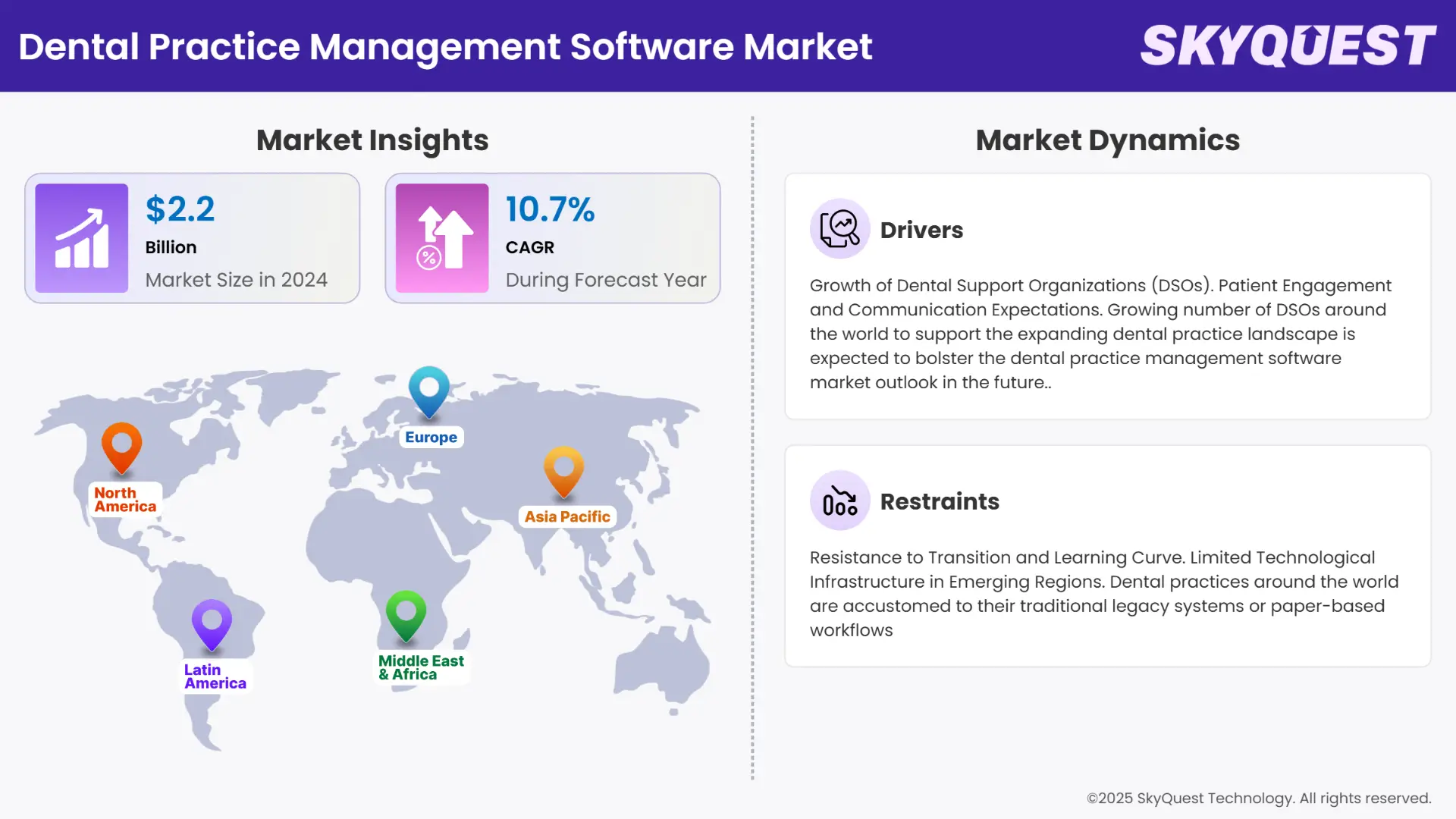
Dental Practice Management Software Market size was valued at USD 2.2 Billion in 2024 and is poised to grow from USD 2.44 Billion in 2025 to USD USD 5.5 Billion by 2033, growing at a CAGR of 10.7% during the forecast period (2026–2033).
Surge in prevalence of dental diseases, high demand for workflow optimization in dental practices, regulatory compliance requirements, and growing emphasis on improving patient engagement and communication are promoting the adoption of dental practice management software.
Rising incidence of oral health issues such as cavities, periodontal disease, edentulism, and cosmetic dentistry are expected to primarily support the demand for dental practice management software in the future. Innovations in dental practice management software and emphasis on efficient management of scheduling, billing, insurance claims, and patient communications are also driving dental practice management software market growth. Imposition of stringent data protection and patient privacy regulations are helping bolster the deployment of dental practice management software in dental clinics to utilize secure electronic health information management. Growing dental patient volumes around the world is also forecasted to help bolster the adoption of advanced dental practice management software in the long run.
On the contrary, high costs of implementation, resistance to transition, steep learning curve, data security and privacy concerns, and limited technological infrastructure in developing regions are estimated to hamper the dental practice management software market penetration around the world through 2032 and beyond.
What is the Role of AI in Promoting Dental Practice Management Software Adoption?
Artificial Intelligence (AI) and automation are transforming dental practice management by enabling predictive analytics, smarter scheduling, automated billing, and enhanced diagnostics. AI tools can identify patient patterns, suggest optimal appointment times, and send intelligent reminders to reduce no-shows. Natural Language Processing (NLP) supports automated charting and transcription, saving administrative time. Machine learning helps detect anomalies in x-rays or patient records, aiding diagnosis. Integration with smart imaging systems and insurance platforms accelerates claims and billing processes. As AI becomes more accessible and accurate, dental software vendors are embedding these tools to boost efficiency, reduce costs, and offer a futuristic patient-care experience.
To get more insights on this market click here to Request a Free Sample Report
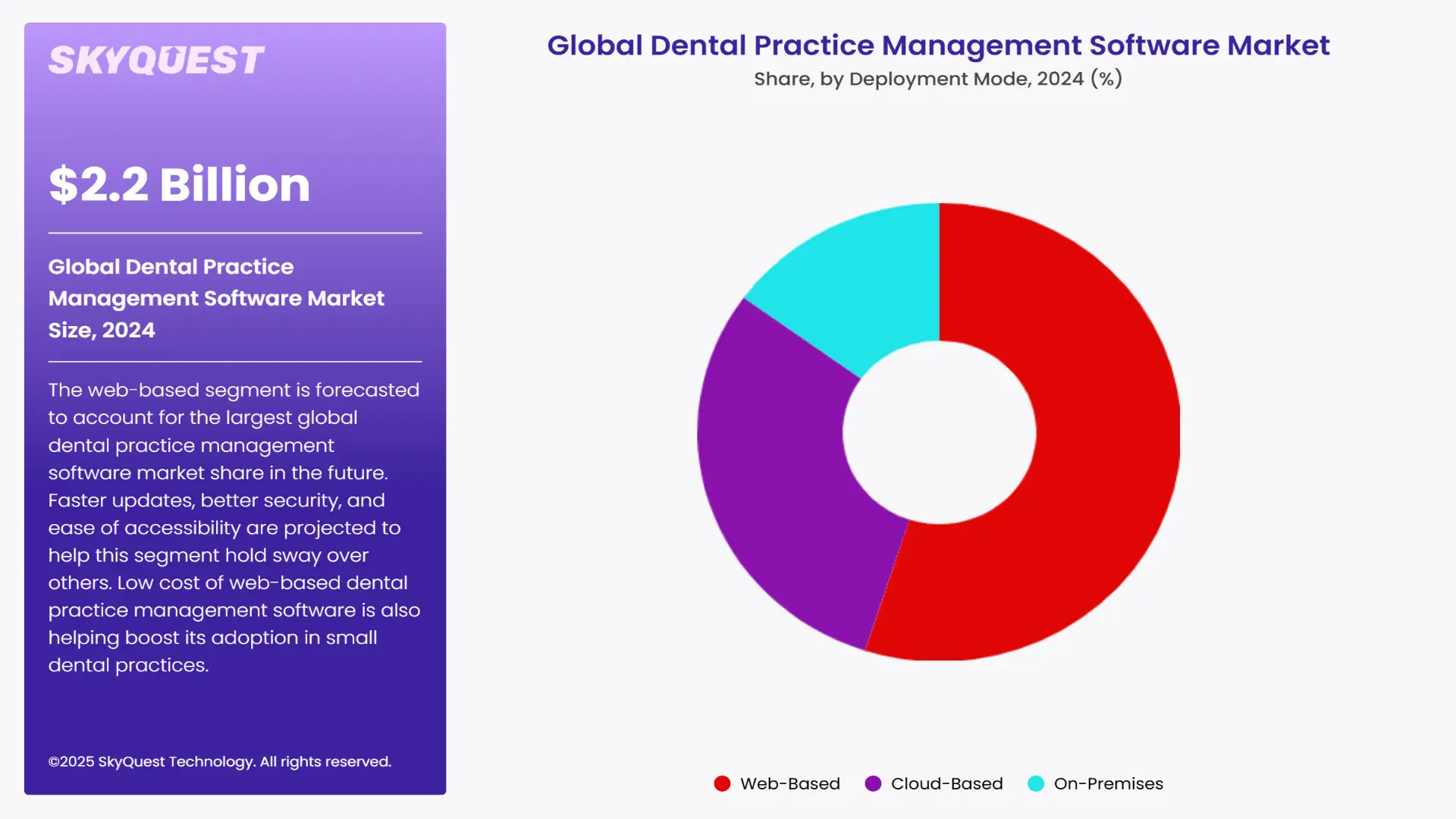
The Global Dental Practice Management Software Market is segmented into type, deployment mode, end use, and region. By type, the market is bifurcated into pureplay PMS, dental PMS Add-ons. Depending on deployment mode, it is classified into web-based, cloud-based, and on-premises. According to end use, it is categorized into dental clinics, hospitals, and others. Region wise, the market is analyzed across North America, Europe, Asia-Pacific, Latin America, and Middle East & Africa.
The web-based segment is forecasted to account for the largest global dental practice management software market share in the future. Faster updates, better security, and ease of accessibility are projected to help this segment hold sway over others. Low cost of web-based dental practice management software is also helping boost its adoption in small dental practices.
Meanwhile, the cloud-based segment is slated to emerge as the fastest-growing segment as per this global dental practice management software industry analysis. Advancements in cloud technologies and growing migration towards cloud-based solutions are helping this segment generate new opportunities in the long run.
The patient communication segment is projected to lead the global dental practice management software market revenue generation over the coming years. Increasing patient expectations for better engagement and emphasis on opting for patient-centric care in dental practices are also cementing the dominance of this segment. Demand for personalized patient experiences is also creating new opportunities via this segment.
On the other hand, insurance management is slated to expand at a notable pace going forward. The growing complexity of dental insurance policies and emphasis on improving claims management are helping expand the business scope for dental practice management software providers through this application.
To get detailed segments analysis, Request a Free Sample Report
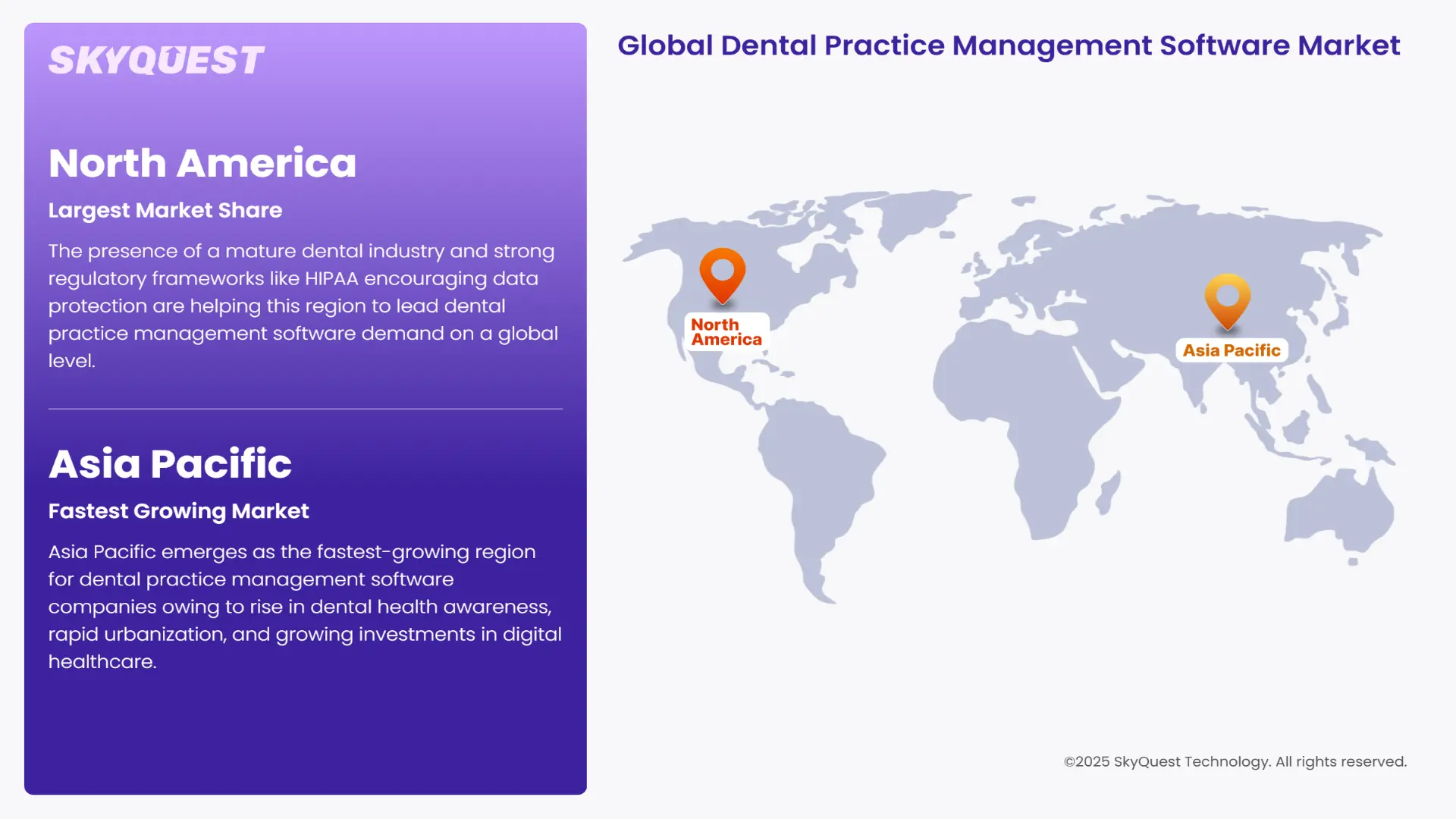
The presence of a mature dental industry and strong regulatory frameworks like HIPAA encouraging data protection are helping this region to lead dental practice management software demand on a global level. High dental care spending and the presence of a large number of private dental clinics and DSOs in the region are also expected to further boost revenue generation via this region. Government initiatives to digitize health records and the presence of key dental practice management software vendors are also expected to position North America as a major stronghold on a global level.
High dental care expenditure, widespread private practice, and early adoption of digital health technologies make this country a global leader in dental practice management software demand. Presence of a massive network of Dental Support Organizations and leading dental practice management software vendors are also helping cement the dominance of the United States in this region. Patient expectations for online scheduling and communication, strong IT infrastructure, and government support for digitization are all contributing to the high revenue generation potential of this country.
A robust public-private dental care system is primarily influencing the adoption of dental practice management software in the country. Cloud-based and AI-enabled dental practice management software is expected to be highly popular among dental professionals in Canada. Government emphasis on electronic medical record integration and cybersecurity compliance is also favoring dental practice management software integration. Though rural adoption remains slower, increasing broadband access and mobile-based solutions are helping bridge this urban-rural digital gap across Canada.
Asia Pacific emerges as the fastest-growing region for dental practice management software companies owing to rise in dental health awareness, rapid urbanization, and growing investments in digital healthcare. Rising medical tourism activity, growth in number of dental clinics, and the presence of young, tech-adaptive dental professionals are also helping create new business scope in the region. Despite infrastructural gaps in rural regions, growing middle-class populations and foreign software vendor entry are accelerating the demand for dental practice management software in Asian countries.
Demand for dental practice management software in Japan is slated to rise at a steady pace over the coming years. Surge in demand for oral healthcare services backed by a massive geriatric population are slated to indirectly benefit dental practice management software adoption in the country. Traditional workflows and conservative adoption attitudes slow widespread digitization thereby hurting market growth potential as well. Dental practice management software vendors offering Japanese-language platforms, secure data hosting, and customizable workflows are expected to be popular in the future.
High internet penetration, advanced dental technology, and a dense network of private dental clinics make this country a key market for dental practice management software companies. Government initiatives to enhance digital healthcare and interoperability standards are also creating new business scope for dental practice management software providers. Competitive dental tourism of South Korea is driving the demand for dental practice management software with multilingual, user-friendly interfaces. South Korea’s digitally native population and progressive clinical environment make it one of Asia’s most promising DPMS growth markets.
A well-established healthcare system, stringent regulatory mandates (like GDPR), and increasing digitization of medical records are driving smooth adoption of dental practice management software in Europe. Emphasis on preventive dental care in European countries, the rise of multi-clinic networks, expanding dental insurance coverage, and favorable reimbursement policies are also helping promote the uptake of novel dental practice management software. Language and compliance customization by local vendors will also play a crucial role in shaping the demand for dental practice management software in Europe.
The launch of digital health policies under the NHS and rapid private healthcare sector expansion are helping promote the demand for dental practice management software in this country. Private practices and mixed-model clinics are leading the adoption of dental practice management software to manage appointments, NHS coding, billing, and digital records. Large practice chains, especially in England, use multi-location systems with centralized data management wherein use of dental practice management software becomes essential. Changes in data regulations after Brexit are also expected to create new business opportunities.
Growing digitization of the highly regulated and mature dental market of the country is anticipated to boost dental practice management software adoption. Practices seek integrated platforms that combine scheduling, electronic records, imaging, and insurance processing. Vendors offering German-language software with local compliance features are more likely to succeed and make a mark in this country. While some smaller practices remain paper-based, larger dental chains and tech-savvy clinics are leading adoption, especially in Berlin, Munich, and Hamburg, creating a growing need for innovation.
Modernization of the dental sector to comply with evolving healthcare IT standards is primarily driving dental practice management software demand in France. High emphasis on public-private collaboration and strong insurance reimbursement models is also creating new opportunities. Paris and Lyon are top cities wherein the adoption of dental practice management software is highest. Local dental practice management software vendors dominate due to language preferences and legal compliance needs.
To know more about the market opportunities by region and country, click here to
Buy The Complete Report
Growth of Dental Support Organizations (DSOs)
Patient Engagement and Communication Expectations
Resistance to Transition and Learning Curve
Limited Technological Infrastructure in Emerging Regions
Request Free Customization of this report to help us to meet your business objectives.
Dental practice management software providers should focus on integrating advanced technologies to stand out from the competition. Offering affordable yet effective software for small dental clinics is also a key opportunity for companies as per this global dental practice management software market analysis.
Startups are expected to focus on developing cloud-based software to help improve their application scope in the long run. Providing automation through dental practice management software is also helping new companies boost their business potential.
SkyQuest’s ABIRAW (Advanced Business Intelligence, Research & Analysis Wing) is our Business Information Services team that Collects, Collates, Correlates, and Analyses the Data collected by means of Primary Exploratory Research backed by robust Secondary Desk research.
As per SkyQuest analysis, the rising number of dental support organizations and emphasis on improving operations of dental practices are slated to primarily drive the demand for dental practice management software going forward. However, limited technological infrastructure in developing countries and resistance to change among dental professionals are anticipated to slow down the sales of dental practice management software in the future. North America is anticipated to spearhead the demand for dental practice management software owing to the presence of a mature dental industry and the growing digitization of the healthcare sector. Development of cloud-based and mobile-first platforms is slated to be a key trend driving the dental practice management software sector in the long run.
| Report Metric | Details |
|---|---|
| Market size value in 2024 | USD 2.2 Billion |
| Market size value in 2033 | USD USD 5.5 |
| Growth Rate | 10.7% |
| Base year | 2024 |
| Forecast period | 2026-2033 |
| Forecast Unit (Value) | USD 5.5 |
| Segments covered |
|
| Regions covered | North America (US, Canada), Europe (Germany, France, United Kingdom, Italy, Spain, Rest of Europe), Asia Pacific (China, India, Japan, Rest of Asia-Pacific), Latin America (Brazil, Rest of Latin America), Middle East & Africa (South Africa, GCC Countries, Rest of MEA) |
| Companies covered |
|
| Customization scope | Free report customization with purchase. Customization includes:-
|
To get a free trial access to our platform which is a one stop solution for all your data requirements for quicker decision making. This platform allows you to compare markets, competitors who are prominent in the market, and mega trends that are influencing the dynamics in the market. Also, get access to detailed SkyQuest exclusive matrix.
Table Of Content
Executive Summary
Market overview
Parent Market Analysis
Market overview
Market size
KEY MARKET INSIGHTS
COVID IMPACT
MARKET DYNAMICS & OUTLOOK
Market Size by Region
KEY COMPANY PROFILES
Methodology
For the Dental Practice Management Software Market, our research methodology involved a mixture of primary and secondary data sources. Key steps involved in the research process are listed below:
1. Information Procurement: This stage involved the procurement of Market data or related information via primary and secondary sources. The various secondary sources used included various company websites, annual reports, trade databases, and paid databases such as Hoover's, Bloomberg Business, Factiva, and Avention. Our team did 45 primary interactions Globally which included several stakeholders such as manufacturers, customers, key opinion leaders, etc. Overall, information procurement was one of the most extensive stages in our research process.
2. Information Analysis: This step involved triangulation of data through bottom-up and top-down approaches to estimate and validate the total size and future estimate of the Dental Practice Management Software Market.
3. Report Formulation: The final step entailed the placement of data points in appropriate Market spaces in an attempt to deduce viable conclusions.
4. Validation & Publishing: Validation is the most important step in the process. Validation & re-validation via an intricately designed process helped us finalize data points to be used for final calculations. The final Market estimates and forecasts were then aligned and sent to our panel of industry experts for validation of data. Once the validation was done the report was sent to our Quality Assurance team to ensure adherence to style guides, consistency & design.
Analyst Support
Customization Options
With the given market data, our dedicated team of analysts can offer you the following customization options are available for the Dental Practice Management Software Market:
Product Analysis: Product matrix, which offers a detailed comparison of the product portfolio of companies.
Regional Analysis: Further analysis of the Dental Practice Management Software Market for additional countries.
Competitive Analysis: Detailed analysis and profiling of additional Market players & comparative analysis of competitive products.
Go to Market Strategy: Find the high-growth channels to invest your marketing efforts and increase your customer base.
Innovation Mapping: Identify racial solutions and innovation, connected to deep ecosystems of innovators, start-ups, academics, and strategic partners.
Category Intelligence: Customized intelligence that is relevant to their supply Markets will enable them to make smarter sourcing decisions and improve their category management.
Public Company Transcript Analysis: To improve the investment performance by generating new alpha and making better-informed decisions.
Social Media Listening: To analyze the conversations and trends happening not just around your brand, but around your industry as a whole, and use those insights to make better Marketing decisions.
REQUEST FOR SAMPLE
 REQUEST FREE CUSTOMIZATION


Want to customize this report? This report can be personalized according to your needs. Our analysts and industry experts will work directly with you to understand your requirements and provide you with customized data in a short amount of time. We offer $1000 worth of FREE customization at the time of purchase.
Feedback From Our Clients


 USA (+1) 351-333-4748

