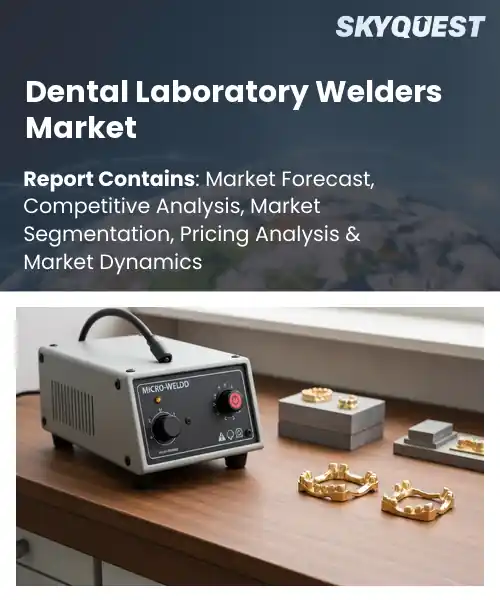
Dental Laboratory Welders Market
Report ID: SQMIG35A3475
Report ID: SQMIG35A3475
[email protected]
USA +1 351-333-4748
Report ID:
SQMIG35A3475 |
Region:
Global |
Published Date: May, 2026
Pages:
157
|Tables:
120
|Figures:
77


Global Dental Laboratory Welders Market size was valued at USD 185.0 Million in 2024 and is poised to grow from USD 200.72 Million in 2025 to USD 385.51 Million by 2033, growing at a CAGR of 8.5% during the forecast period (2026-2033).
Surge in demand for restorative and implant dentistry, increasing adoption of digital dental workflows, rising use of CAD/CAM fabrication technologies, advancements in precision welding systems, and growing focus on faster dental prosthetic production are boosting sales of dental laboratory welders.
Rising demand for aftermarket maintenance services, technician training programs, and digital prosthetic manufacturing solutions is creating new opportunities for dental laboratory welders vendors. Increasing usage of computer-aided design and manufacturing software and technology in addition to digital fabrication techniques is also set to drive the demand for dental laboratory welders. Growing adoption of dental welding machines in alloy bonding, prosthesis repair, and framework fabrication of crowns, bridges, and implant bars is another factor that is contributing to high adoption of dental laboratory welders. Dental labs and manufacturers have been increasingly adopting compact laser welding machines, automated welding workstations, and advanced repair systems to minimize errors and achieve accurate results in one go. Growing need for highly precise and durable dental restorations around the world coupled with increasing adoption of implant-supported prosthetics and restorative dental procedures are expected to primarily drive dental laboratory welders market growth.
On the contrary, high equipment acquisition and maintenance costs, requirement for skilled dental technicians, limited affordability among smaller dental laboratories, and competition from alternative prosthetic fabrication technologies are predicted to impede dental laboratory welders market penetration across the study period.
How is AI Improving Precision and Efficiency of Dental Laboratory Welders?
Due to the implementation of AI technology, the efficiency and precision in dental laboratory welders have been achieved with the combination of intelligent control systems and effective welding machinery along with dental designs. With the use of AI-based CAD systems in addition to robots in the welding process, quality joints are being maintained in complex dental work as well. The field of dentistry will be relying on a more efficient approach using data instead of trying different combinations randomly for welders.
Market snapshot - (2026-2033)
Global Market Size
USD 185.0 Million
Largest Segment
Automatic
Fastest Growth
Automatic
Growth Rate
8.5% CAGR
To get more insights on this market click here to Request a Free Sample Report
Global dental laboratory welders market is segmented by type, technology, application, end use, and region. Based on type, the market is segmented into manual and automatic. Based on technology, the market is segmented into laser welding and argon welding. Based on application, the market is segmented into cast repairs, new clasp assembly, loops & posts for implants, wrought wire single-arm clasping, crown & bridge cases, implant restorations, and others. Based on end use, the market is segmented into hospitals, clinics, dental laboratories, and others. Based on region, the market is segmented into North America, Europe, Asia Pacific, Latin America, and Middle East & Africa.
The laser welding segment is projected to lead the global dental laboratory welders market revenue generation over the coming years. This technology offers the accuracy needed in current dental restoration techniques, as it allows for precise spot welds in nonferrous materials and thin components without causing distortions due to excessive heating. As a result, it decreases the need for corrections and creates predictable results in assembling clasps, posts, and crowns, thus gaining favor from laboratory supervisors.
Nevertheless, argon welding is expected to emerge as the segment expanding at a rapid CAGR as it requires less expensive and easier maintenance equipment, making it affordable even to small labs, whereas better shielding procedures increase the range of metals that can be welded together. In addition, the process’s convenience and mobility ensure fast patch-up work in situ.
The automatic segment is anticipated to account for the highest global dental laboratory welders market share in the future. Fully automatic welders ensure consistency in parameter setting and faster cycles that match the throughput rate of high-volume dental laboratories. Through automation, technicians become less dependent on variability, and therefore quality can be guaranteed for complicated crowns and bridge constructions as well as for implant frameworks. In addition, integration into digital job scheduling systems plays an important role in the decision-making process for laboratory managers.
Meanwhile, manual segment is witnessing the strongest growth momentum as per this dental laboratory welders industry analysis. Small labs and craft technicians prefer inexpensive, multipurpose portable welders for unique applications and customized clasp manufacturing. Simple upkeep, easy assembly and direct manipulation provide an advantage for specialist restoration methods, allowing personal craftsmanship to create distinction while reducing entry into the field, hence broadening the customer base.
To get detailed segments analysis, Request a Free Sample Report
Presence of multiple dental laboratories, strong manufacturing capabilities, and rapid adoption of digital dentistry are helping this region hold sway over others. With a strong focus on R&D, and material science and the integration of CAD/CAM into dental workflows, regional manufacturers can improve their products to be more relevant to clinical and laboratory practices. Developing manufacturers in the region continue to create productive qualifications of their products and resilient supply chains to meet the rapid increase in global and domestic demand for dental products. Furthermore, vocational education programs develop technicians who have the knowledge and skills necessary to perform the welding processes associated with new technology, allowing regional companies to maintain the momentum of the market. favorability of the cost structure for production, along with a strong supplier network, allows for greater scalability and update ability of machines by regional companies also cement Asia Pacific’s dominance.
Dental laboratory welder demand in Japan is characterized by advanced manufacturing precision, strong integration of digital workflows, and close collaboration between equipment makers and dental laboratories. A culture of continuous improvement and material science expertise supports development of compact, high-precision welding solutions suited to complex prosthetic work. Robust aftercare networks and skilled laboratory technicians encourage adoption of innovative welding systems, while emphasis on quality and reliability maintains steady demand within clinical and laboratory channels.
Dental laboratory welder adoption in South Korea benefits from a strong electronics manufacturing base and rapid integration of precision welding into dental production. Collaboration between technology firms and dental laboratories accelerates deployment of compact, high-efficiency welding equipment tailored for metal frameworks and implant components. Emphasis on process automation and skilled technical training enhances laboratory throughput, and proactive service networks provide maintenance and upgrades that support long term operational reliability and user confidence among dental technicians.
A mature clinical ecosystem, coupled with the high procedural requirements for fixed and removable prosthetics, as well as the large investments in laboratory automation, contribute to shaping an appropriate environment in the region. The presence of a well-established aftermarket ecosystem guarantees that there is no need to worry about maintenance and spare parts, as any downtime will be avoided. Given the predictability of the demand signal thanks to the clarity of the regulations and established reimbursement process, the laboratory needs to acquire a new set of welding tools to satisfy ever-increasing expectations.. The abundance of OEMs and local technical support enables quick provision and customization of welding machines. Industry meetings and professional organizations serve as platforms for exchanging knowledge of best practices and promoting new technological innovations among laboratory networks. Collaboration between producers of dental instruments and schools ensures proper validation of new technology and training a labor force able to utilize these innovations.
Adoption of dental laboratory welders in the United States is shaped by a large network of commercial laboratories, strong demand for complex restorative procedures, and rapid uptake of digital production workflows. Collaborations between welding equipment manufacturers and laboratory franchises ensure the creation of products that satisfy clinician demands. Precision, consistency, and compatibility with CAD/CAM systems are the key characteristics valued by laboratories. Aftermarket support, as well as training opportunities, plays an important role in promoting the use of modern welding techniques.
Emphasis on quality, technician training, and strong regulatory alignment with clinical standards helps shape sales of dental laboratory welders in Canada. The need for robust prosthetics drives laboratories to prefer versatile and maintenance-friendly welding machines. Laboratory practices depend on accurate machinery and support from suppliers that minimize disruptions regardless of where the practice is located. Cooperative training programs with universities of dentistry and technical institutions help develop necessary skills for precise welding.
Deep material science expertise, rigorous clinical standards, and a tradition of precision laboratory craftsmanship are helping create new business scope in Europe. Cross-border collaborations facilitate the sharing of knowledge and establish standardized protocols that can reduce the friction associated with adopting advanced welding techniques into many diverse markets throughout Europe. Investment in vocational training and strong ties between academic research facilities and the industry accelerate the refinement of new technologies. Sustainability considerations and demands for durable, serviceable products continue to shape product development; meanwhile, well-developed distribution and service networks are helping to modernize laboratories across the west European market. Additionally, the regulatory frameworks that focus on safety and efficacy provide clear paths to product acceptance, and local OEMs can provide custom-engineered solutions to help laboratories meet their specific needs. Professional associations and trade shows are acting as catalysts for new developments by allowing labs to evaluate new technologies and implement best practices in the most efficient manner.
Dental laboratory welders market in Germany is governed by precision engineering, strong links between manufacturers and research institutions, and a culture of high-quality craftsmanship. Laboratories favor robust, serviceable welding equipment that integrates with established CAD/CAM workflows and material systems. Emphasis on technical training and vocational excellence ensures technicians are skilled in advanced welding techniques. Local OEM presence and reliable aftersales support reinforce laboratory confidence in adopting complex welding platforms for demanding restorative work.
Strong clinical demand with emphasis on innovation and regulatory compliance are helping boost the adoption of dental laboratory welders in the United Kingdom. Existing supply networks and service providers can contribute to the maintenance and adaptability of the welding systems. The laboratories look for a system of welding that will facilitate tailor-made fabrication of prosthetics as well as allow for efficient throughput. Modular and maintainable welding systems are preferred to enable the laboratories to achieve both precision and efficiency. Joint efforts between dental schools, industry associations, and manufacturers encourage skills development and innovation dissemination.
Demand for dental laboratory welders in France reflects a blend of artisanal laboratory traditions and growing adoption of digital fabrication methods. Labs prefer machines, which offer precise control when working on complex prosthetic constructs and yet are compliant to material properties and clinical guidelines. Training of technicians and collaborations with material suppliers ensure effective utilization of welding technology. Reliable local service networks and emphasis on quality assurance encourage laboratories to integrate sophisticated welding systems into established restorative workflows.
To know more about the market opportunities by region and country, click here to
Buy The Complete Report
Increasing Adoption Of Advanced Welding
Rising Demand For Cosmetic Restorations
High Equipment Acquisition Costs
Limited Skilled Workforce Availability
Request Free Customization of this report to help us to meet your business objectives.
Competitive landscape is defined by consolidation, partnerships, and rapid product innovation that shift purchasing toward compact laser and cobot-integrated welders and push distributors to form alliances. Recent concrete moves include IPG Photonics launching LightWELD, Cobot Systems partnering with IPG and Universal Robots before being acquired, and Laser Welder Company expanding from Australia into the United States to challenge incumbents on price and service.
SkyQuest’s ABIRAW (Advanced Business Intelligence, Research & Analysis Wing) is our Business Information Services team that Collects, Collates, Correlates, and Analyses the Data collected by means of Primary Exploratory Research backed by robust Secondary Desk research.
As per SkyQuest analysis, high demand for restorative and implant dentistry and increasing adoption of digital dental workflows are anticipated to drive the demand for dental laboratory welders going forward. However, high equipment acquisition costs and requirement for skilled dental technicians are slated to slow down the adoption of dental laboratory welders in the future. North America is slated to spearhead the demand for dental laboratory welders owing to advanced dental healthcare infrastructure and high adoption of CAD/CAM and digital prosthetic technologies. Development of AI-enabled welding automation systems and increasing integration of laser welding technologies with digital dental design workflows are anticipated to be key trends driving the dental laboratory welders sector in the long run.
| Report Metric | Details |
|---|---|
| Market size value in 2024 | USD 185.0 Million |
| Market size value in 2033 | USD 385.51 Million |
| Growth Rate | 8.5% |
| Base year | 2024 |
| Forecast period | (2026-2033) |
| Forecast Unit (Value) | USD Million |
| Segments covered |
|
| Regions covered | North America (US, Canada), Europe (Germany, France, United Kingdom, Italy, Spain, Rest of Europe), Asia Pacific (China, India, Japan, Rest of Asia-Pacific), Latin America (Brazil, Rest of Latin America), Middle East & Africa (South Africa, GCC Countries, Rest of MEA) |
| Companies covered |
|
| Customization scope | Free report customization with purchase. Customization includes:-
|
To get a free trial access to our platform which is a one stop solution for all your data requirements for quicker decision making. This platform allows you to compare markets, competitors who are prominent in the market, and mega trends that are influencing the dynamics in the market. Also, get access to detailed SkyQuest exclusive matrix.
Table Of Content
Executive Summary
Market overview
Parent Market Analysis
Market overview
Market size
KEY MARKET INSIGHTS
COVID IMPACT
MARKET DYNAMICS & OUTLOOK
Market Size by Region
KEY COMPANY PROFILES
Methodology
For the Dental Laboratory Welders Market, our research methodology involved a mixture of primary and secondary data sources. Key steps involved in the research process are listed below:
1. Information Procurement: This stage involved the procurement of Market data or related information via primary and secondary sources. The various secondary sources used included various company websites, annual reports, trade databases, and paid databases such as Hoover's, Bloomberg Business, Factiva, and Avention. Our team did 45 primary interactions Globally which included several stakeholders such as manufacturers, customers, key opinion leaders, etc. Overall, information procurement was one of the most extensive stages in our research process.
2. Information Analysis: This step involved triangulation of data through bottom-up and top-down approaches to estimate and validate the total size and future estimate of the Dental Laboratory Welders Market.
3. Report Formulation: The final step entailed the placement of data points in appropriate Market spaces in an attempt to deduce viable conclusions.
4. Validation & Publishing: Validation is the most important step in the process. Validation & re-validation via an intricately designed process helped us finalize data points to be used for final calculations. The final Market estimates and forecasts were then aligned and sent to our panel of industry experts for validation of data. Once the validation was done the report was sent to our Quality Assurance team to ensure adherence to style guides, consistency & design.
Analyst Support
Customization Options
With the given market data, our dedicated team of analysts can offer you the following customization options are available for the Dental Laboratory Welders Market:
Product Analysis: Product matrix, which offers a detailed comparison of the product portfolio of companies.
Regional Analysis: Further analysis of the Dental Laboratory Welders Market for additional countries.
Competitive Analysis: Detailed analysis and profiling of additional Market players & comparative analysis of competitive products.
Go to Market Strategy: Find the high-growth channels to invest your marketing efforts and increase your customer base.
Innovation Mapping: Identify racial solutions and innovation, connected to deep ecosystems of innovators, start-ups, academics, and strategic partners.
Category Intelligence: Customized intelligence that is relevant to their supply Markets will enable them to make smarter sourcing decisions and improve their category management.
Public Company Transcript Analysis: To improve the investment performance by generating new alpha and making better-informed decisions.
Social Media Listening: To analyze the conversations and trends happening not just around your brand, but around your industry as a whole, and use those insights to make better Marketing decisions.
REQUEST FOR SAMPLE
 REQUEST FREE CUSTOMIZATION
Global Dental Laboratory Welders Market size was valued at USD 185.0 Million in 2024 and is poised to grow from USD 200.72 Million in 2025 to USD 385.51 Million by 2033, growing at a CAGR of 8.5% during the forecast period (2026-2033).
Competitive landscape is defined by consolidation, partnerships and rapid product innovation that shift purchasing toward compact laser and cobot integrated welders and push distributors to form alliances. Recent concrete moves include IPG Photonics launching LightWELD, Cobot Systems partnering with IPG and Universal Robots before being acquired, and Laser Welder Company expanding from Australia into the United States to challenge incumbents on price and service. 'LaserStar Technologies Corporation', 'Sunstone Engineering LLC', 'IPG Photonics Corporation', 'Maxphotonics Co., Ltd.', 'ALPHA LASER GmbH', 'Elettrolaser S.r.l.', 'Primotec USA', 'Orion Dental Welders', 'Lampert Werktechnik GmbH', 'Dentaurum GmbH & Co. KG', 'BEGO GmbH & Co. KG', 'Dentsply Sirona Inc.', 'Institut Straumann AG', '3M Company', 'Kulzer GmbH', 'GC Corporation', 'Ivoclar Vivadent AG', 'Planmeca Oy', 'Coltene Holding AG', 'Shofu Inc.'
Advances in welding technologies tailored to dental laboratory applications enhance precision, repeatability, and process control, enabling laboratories to produce complex prosthetics with improved fit and durability. Such technological refinement reduces manual rework and broadens the range of treatable materials, encouraging laboratories to invest in modern welding equipment. The perceived improvement in service quality and consistency fosters adoption among established and emerging labs, supporting market expansion as providers seek capability enhancements that align with rising expectations for restorative outcomes and operational efficiency.
Cad/Cam Integration Acceleration: Dental laboratories are increasingly adopting digital workflows that integrate CAD/CAM design with welding processes, enabling seamless transition from virtual design to assembly. This trend drives demand for welders compatible with digitally produced frameworks, promotes interoperability with scanning and software systems, and encourages suppliers to offer software-assisted welding features. As a result, labs prioritize equipment that supports customization, repeatability, and streamlined production cycles, fostering collaboration between technicians, software vendors, and OEMs to optimize lab throughput and prosthetic quality.
Why does Asia Pacific Dominate the Global Dental Laboratory Welders Market? |@12


Want to customize this report? This report can be personalized according to your needs. Our analysts and industry experts will work directly with you to understand your requirements and provide you with customized data in a short amount of time. We offer $1000 worth of FREE customization at the time of purchase.
Feedback From Our Clients


 USA (+1) 351-333-4748

