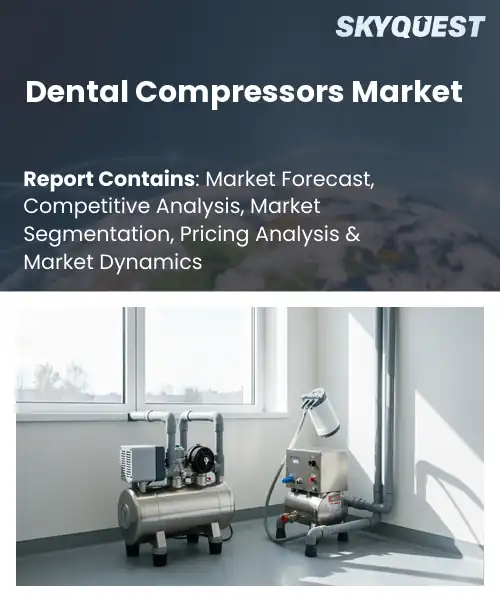
Dental Compressors Market
Report ID: SQMIG35A3478
Report ID: SQMIG35A3478
[email protected]
USA +1 351-333-4748
Report ID:
SQMIG35A3478 |
Region:
Global |
Published Date: May, 2026
Pages:
157
|Tables:
226
|Figures:
81


Global Dental Compressors Market size was valued at USD 420.8 Million in 2024 and is poised to grow from USD 436.79 Million in 2025 to USD 588.64 Million by 2033, growing at a CAGR of 3.8% during the forecast period (2026-2033).
The reason for the high demand in dental compressor systems is due to the need for reliable oil-free compressed air that is capable of operating the dental instruments while meeting strict infection control regulations. The dental compressor market includes equipment manufacturers, dental clinics, and distributors who provide compressor units that power handpieces, suction systems, and laboratory tools, as the air quality from these compressors directly impacts clinical outcomes, patient safety, and compliance with regulations. With the modernization of dental clinics and increased concern about cross-contamination in countries like the United States and Germany, the industry has transitioned from large, oil-lubricated reciprocating compressors to smaller, quieter rotary screw and rotary scroll compression technology.
These factors, as well as increasing pressure from regulations and the demand for energy-efficient, oil-free systems to reduce cross-contamination and lower the cost of operation, are the primary drivers of the global dental compressor market growth. As stringent standards and patient expectations continue to rise, dental clinics must replace their old compressor units, which is leading to an increased demand for small, quiet rotary and scroll compressors in private practices and laboratories. Energy efficiency improvements are reducing the total cost of ownership and encouraging multi-practice and mobile dental offices to upgrade equipment for outreach dental care and school-based screening efforts. Additionally integration of IoT for predictive maintenance reduces downtime and service costs, creating aftermarket revenue streams and leasing opportunities for manufacturers entering emerging markets globally.
How is IoT-enabled Monitoring Improving Reliability Of Dental Compressors?
Through the use of the internet of things (IOT) enabled monitoring, the reliability of dental compressors is being enhanced with continuous sensing and a cloud based telemetry system that make the previously isolated machines visible assets. These include vibration and pressure sensors, runtime analytics, and automated alerts that allow the user to perform predictive maintenance and detect faults faster than ever before. The current trend shows that both vendors and service providers are increasingly moving in the direction of connected offerings to provide practices with the ability to provide uninterrupted patient care and significantly reduce the burden of maintaining their equipment. The changing marketplace has pushed manufacturers to begin to incorporate sensor technology into their mechanical room equipment, while third party platforms offer fleet level monitoring of all devices. Because of the advantages of remote diagnostic capabilities, condition based scheduled servicing, and energy aware control, the overall reliability of dental compressors is becoming more predictable, which will ultimately result in less unexpected downtime.
In February 2026, Midmark introduced a smart air compressor and supporting mechanical room solution that uses embedded sensors and cloud based monitoring to provide preventive maintenance through remote diagnostics, increase the efficiency of the dental practice, and accelerate the adoption of connected compressor systems within the dental marketplace.
Market snapshot - (2026-2033)
Global Market Size
USD 420.8 Million
Largest Segment
Oil-Free Dental Compressors
Fastest Growth
Oil-Free Dental Compressors
Growth Rate
3.8% CAGR
To get more insights on this market click here to Request a Free Sample Report
Global dental compressors market is segmented by product type, technology, mobility, capacity, pressure range, application, end user, distribution channel and region. Based on product type, the market is segmented into Oil-Free Dental Compressors and Oil-Lubricated Dental Compressors. Based on technology, the market is segmented into Reciprocating Compressors, Scroll Compressors and Rotary Screw Compressors. Based on mobility, the market is segmented into Stationary Dental Compressors and Portable Dental Compressors. Based on capacity, the market is segmented into Up to 2 HP, 2 HP to 5 HP and Above 5 HP. Based on pressure range, the market is segmented into Up to 8 Bar, 8 Bar to 10 Bar and Above 10 Bar. Based on application, the market is segmented into General Dentistry, Orthodontics, Oral Surgery, Implantology and Dental Laboratories. Based on end user, the market is segmented into Dental Clinics, Dental Hospitals, Dental Laboratories and Academic & Research Institutes. Based on distribution channel, the market is segmented into Direct Sales, Distributors & Dealers and Online Sales. Based on region, the market is segmented into North America, Europe, Asia Pacific, Latin America and Middle East & Africa.
As per dental compressors market analysis, Oil-Free Dental Compressors segment dominates because clinics and laboratories prioritize contamination control, equipment compatibility, and predictable maintenance profiles that align with clinical infection protocols. Their lack of oil contamination reduces instrument downtime and protects sensitive dental tools, which drives procurement preference among practice managers. Proven reliability and compatibility with dry-air dental devices also lower long-term operating risks, creating strong demand from institutions focused on patient safety and streamlined workflows.
As per dental compressors market forecast, Oil-Lubricated Dental Compressors are growing fastest due to lower upfront costs, robust performance for high-capacity practices, and maintenance familiarity. Their durability under continuous loads and easier access to replacement parts accelerate adoption in equipment upgrade projects, enabling suppliers to expand through retrofit offerings and extended service agreements.
Stationary Dental Compressors segment dominates because permanent installations deliver stable pressure, ample capacity, and uninterrupted air supply essential for multi-chair clinics and hospital environments. Their centralized placement reduces acoustic disturbance and simplifies maintenance, which lowers operational complexity for administrators. Compatibility with multi-point distribution and integration with existing plumbing and filtration systems drives procurement decisions where continuous, high-reliability compressed air is a core clinical utility.
As per dental compressors market outlook, Portable Dental Compressors are emerging as the key high-growth area as mobile dentistry and flexible clinic designs expand. Compact, low-noise designs and minimal installation complexity enable rapid deployment in offsite care and satellite practices. This trend opens new commercial models for manufacturers, including rentals, bundled kits, and service subscriptions that broaden market reach.
To get detailed segments analysis, Request a Free Sample Report
As per dental compressors market regional analysis, the mature ecosystem in North America for dentistry has created a strong basis for the early adoption of advanced equipment and maintenance services. The high standards of care and infection control requirements of our dental community drive the demand for reliable, low-noise, oil-free compressors designed specifically for dental applications. The large number of private clinics and multi-site dental practices in North America create continual cycles of replacement and repair, while the already established procurement systems and trained biomedical technicians ensure these facilities have the best possible uptime and after-sale service support. Being located in close proximity to many of the world's leading OEMs and component manufacturers allows for innovation and fast product delivery. The consolidation of service providers and emphasis on improving patient comfort and operational efficiency also helps promote the leadership position of this region, which has become the epicenter of product development and commercialization. Strong aftermarket support systems and specialist distributors provide fast and efficient service in the form of custom financing programs to reduce the barriers to capital investment in these products.
The US dental compressors market is an expansive network of private clinics and dental service organizations that want a dependable, low-noise, oil-free compressor to minimize noise. There is also a strong presence of local distributors and original equipment manufacturers that provide rapid access to products and technical support. The requirement for consistent infection control and performance drives the investment in these products, while established service amenities, and ongoing specialist training drive ongoing demand for maintenance and service needs.
The Canadian dental compressors market consists of a combination of private dental practices and public dental programs that prefer to use a compressor that is dependable and hygienic. The preference for energy efficient and low vibration compressors meet the comfort and sustainability objectives of clinics providing dental care. Distributor networks and regional service partners help ensure the various regions are well covered and offer solutions to their support needs. Emphasis on serviceability, quick technical assistance, and procurement through established healthcare channels in the dental business help support the purchase and ongoing demand for installation and maintenance.
As per dental compressors market regional forecast, Europe market is growing because of a variety of reasons, including modern health care systems, more people wanting aesthetics and preventive dentistry, and through coordinated regulatory bodies that support high equipment standards. The investment in upgrading clinics and using quiter and oilless compressor technologies responds to both practitioners' and patients' preference for comfort and infection control. Manufacturing capacity and engineering in important markets fosters localized innovation, while cross-border distribution networks and service partners encourage broad market penetration. Consolidation among dental groups and centralized purchasing channels streamline the purchase and maintenance of capital equipment, facilitating a quicker turnover of capital equipment. Sustainability and operational efficiency also push clinics to retire legacy systems and install new compressors that fit with clinic operations and how clinics do maintenance, further driving growth in the area. The development of supportive training programmes and partnerships with dental labs speed up the implementation process.
Germany Dental Compressors market benefits from a vast manufacturing and engineering foundation that drives product quality and creativity. Clinic purchasers prefer to buy durable, reliable dental compressor units which can meet their high hygiene standards and high levels of performance. Rapid installation and maintenance are possible because of the multiple distributors and service companies located across the country. Manufacturers collaborate with dental institutions to provide customized solutions, and there is a strong emphasis on energy efficiency and long-term durability, which encourages the replacement of older compressor units with more modern designs adapted to the specific workflow of each clinic.
As the UK Dental Compressors Market is undergoing rapid clinic modernization and the emergence of multi-practice dental chains requiring quieter, more hygienic compressor solutions, there is an increasing trend toward alternative purchasing/financing models to support the more frequent turnover of compressor equipment. In addition, there is a growing focus on improving the patient experience and optimizing the workflow and processes of the dental practice, resulting in increased demand for compact compressors. The available financing options and technical training to support the aftermarket will further accelerate the replacement of older compressor systems with the uptake of newer compressor products.
Dental Compressors Market in France is evolving as clinics invest in modernization and prioritize patient comfort and hygiene. Growing interest in aesthetic dentistry and clinic refurbishment supports demand for compact, low vibration compressors. Local distributors and service partners play a key role in education and installation, while financing options lower barriers for smaller practices. Emphasis on regulatory compliance and energy efficiency stimulates replacement of outdated equipment with modern, serviceable solutions.
Asia-Pacific is enhancing its market position through better manufacturing processes, developing new products, and modernizing their clinics. Investment in lower noise, compact, and energy-efficient compressors aligns with the regional need for quieter clinics. Integration with digital workflows and compatibility with modern dental devices increases product attractiveness for clinics focused on efficient workflow. Local manufacturers and suppliers help provide customized and cost effective solutions and expanded distribution and support networks enhance reliability after the sale. Strategic partnerships between manufacturers and dental schools promote training and field testing to improve time to market for new models. The increased emphasis on practitioner comfort and clinic productivity is establishing Asia-Pacific as a developing leader in dental compressor innovation and supply.
In Japan, the dental compressors market has a prominent focus on creating compact clinic layouts that provide optimal performance, durability, and quality with minimal noise through precision engineering work. The manufacturers of compressing equipment offer small footprint, high reliability, and are integrated into sophisticated dental systems. The existence of strong established service networks, technician training, and organizations ensures consistent maintenance for long periods of time and fast repairs if necessary. Rigorous product quality and energy efficiency standards foster the acceptance of premium brands of compressor equipment by both clinics and patients in a professional dental environment.
In South Korea, the dental compressors market benefit from having a very advanced field of manufacturing products, with close working relationships between manufacturers and clinics that utilize their equipment. The demand for compressor products is directed towards compact, low-noise compressor designs suitable for digital workflows used for dental treatment chairs for patients. The distribution channels supporting the sale of compressors to the clinics are well organized and timely, allowing for rapid installation and minimal equipment downtime. The emphasis on design and integration of equipment, as well as energy efficiency, drives more clinics to incorporate modern compressor solutions in their practice in order to enhance patient comfort while providing an efficient use of their offices.
To know more about the market opportunities by region and country, click here to
Buy The Complete Report
Increased Adoption Of Oil Free Compressors
Due to the increasing trend toward oil-free compressor technology in dental offices, improvements in equipment reliability and maintenance simplification have motivated many clinics to upgrade their existing compressors with new technologies. Additionally, enhanced hygiene and decreased risk of contamination in compliance with clinical requirements have been major factors in deciding whether or not to buy an oil-free compressor. Compressor manufacturers are emphasizing compressor durability and quiet operation, which helps provide acceptance for both dentists and patients alike. The end result of these factors is a growing demand from dental clinics looking for long-term operational efficiencies and decreased downtime, resulting in a favorable environment for market growth and supplier innovation.
Expansion Of Dental Service Providers
High Initial Equipment Costs
Costs associated with acquiring some of the most cost-effective compressors especially for small practices will remain high (or even rise) as older units continue to be replaced at slower rates than new units will enter into use. With limited capital budgets for investment in new technology committed to other clinical needs, administrators will delay purchasing new compressors and/or purchase lower specification/compressors instead (indirectly contributing to slowing adoption rates for these new technologies and limited frequency of upgrade or renewal purchases). Because of this, the availability of new units and the associated revenue opportunities for compressor manufacturers will be adversely affected. Demand for new compressors will also be negatively impacted as purchase decisions experience a lag period due to the time and situations needed to implement the supplier and obtain financing in some cases (i.e., provides a hesitancy in the marketplace to expend capital for the purchase of new compressors causing slow overall growth of the marketplace).
Complexity Of Regulatory Compliance
Request Free Customization of this report to help us to meet your business objectives.
The global market for compressor manufacturers is increasingly competitive due to the rise in popularity of oil-free and ultra-low noise products coupled with IoT-enabled technology, which is leading to increases in both technology partnerships and consolidation activity throughout this sector. To build their oil-free product lines, compressor companies are engaging in a significant amount of M&A activity, along with launching new connected compressor products with remote monitoring and service agreements, in order to tie up future clinic spending on compressors. As these companies continue to make such tangible business decisions, the overall focus of compressor buyers will switch to purchasing integrated serviceable equipment.
SkyQuest’s ABIRAW (Advanced Business Intelligence, Research & Analysis Wing) is our Business Information Services team that Collects, Collates, Correlates, and Analyses the Data collected by means of Primary Exploratory Research backed by robust Secondary Desk research.
As per SkyQuest analysis, a key driver is expanding demand for reliable oil-free compressed air that supports infection control and instrument performance, while a second driver is growing adoption of IoT-enabled monitoring for predictive maintenance and reduced downtime. A restraint is the high initial equipment cost that delays upgrades in smaller practices. North America remains the dominating region thanks to a mature dental ecosystem, strong aftermarket support and strict clinical standards. The dominating segment is oil-free dental compressors as clinics prioritize contamination control and compatibility with sensitive instruments. Overall market momentum is underpinned by energy efficiency improvements and service-based commercial models.
| Report Metric | Details |
|---|---|
| Market size value in 2024 | USD 420.8 Million |
| Market size value in 2033 | USD 588.64 Million |
| Growth Rate | 3.8% |
| Base year | 2024 |
| Forecast period | (2026-2033) |
| Forecast Unit (Value) | USD Million |
| Segments covered |
|
| Regions covered | North America (US, Canada), Europe (Germany, France, United Kingdom, Italy, Spain, Rest of Europe), Asia Pacific (China, India, Japan, Rest of Asia-Pacific), Latin America (Brazil, Rest of Latin America), Middle East & Africa (South Africa, GCC Countries, Rest of MEA) |
| Companies covered |
|
| Customization scope | Free report customization with purchase. Customization includes:-
|
To get a free trial access to our platform which is a one stop solution for all your data requirements for quicker decision making. This platform allows you to compare markets, competitors who are prominent in the market, and mega trends that are influencing the dynamics in the market. Also, get access to detailed SkyQuest exclusive matrix.
Table Of Content
Executive Summary
Market overview
Parent Market Analysis
Market overview
Market size
KEY MARKET INSIGHTS
COVID IMPACT
MARKET DYNAMICS & OUTLOOK
Market Size by Region
KEY COMPANY PROFILES
Methodology
For the Dental Compressors Market, our research methodology involved a mixture of primary and secondary data sources. Key steps involved in the research process are listed below:
1. Information Procurement: This stage involved the procurement of Market data or related information via primary and secondary sources. The various secondary sources used included various company websites, annual reports, trade databases, and paid databases such as Hoover's, Bloomberg Business, Factiva, and Avention. Our team did 45 primary interactions Globally which included several stakeholders such as manufacturers, customers, key opinion leaders, etc. Overall, information procurement was one of the most extensive stages in our research process.
2. Information Analysis: This step involved triangulation of data through bottom-up and top-down approaches to estimate and validate the total size and future estimate of the Dental Compressors Market.
3. Report Formulation: The final step entailed the placement of data points in appropriate Market spaces in an attempt to deduce viable conclusions.
4. Validation & Publishing: Validation is the most important step in the process. Validation & re-validation via an intricately designed process helped us finalize data points to be used for final calculations. The final Market estimates and forecasts were then aligned and sent to our panel of industry experts for validation of data. Once the validation was done the report was sent to our Quality Assurance team to ensure adherence to style guides, consistency & design.
Analyst Support
Customization Options
With the given market data, our dedicated team of analysts can offer you the following customization options are available for the Dental Compressors Market:
Product Analysis: Product matrix, which offers a detailed comparison of the product portfolio of companies.
Regional Analysis: Further analysis of the Dental Compressors Market for additional countries.
Competitive Analysis: Detailed analysis and profiling of additional Market players & comparative analysis of competitive products.
Go to Market Strategy: Find the high-growth channels to invest your marketing efforts and increase your customer base.
Innovation Mapping: Identify racial solutions and innovation, connected to deep ecosystems of innovators, start-ups, academics, and strategic partners.
Category Intelligence: Customized intelligence that is relevant to their supply Markets will enable them to make smarter sourcing decisions and improve their category management.
Public Company Transcript Analysis: To improve the investment performance by generating new alpha and making better-informed decisions.
Social Media Listening: To analyze the conversations and trends happening not just around your brand, but around your industry as a whole, and use those insights to make better Marketing decisions.
REQUEST FOR SAMPLE
 REQUEST FREE CUSTOMIZATION
Global Dental Compressors Market size was valued at USD 420.8 Million in 2024 and is poised to grow from USD 436.79 Million in 2025 to USD 588.64 Million by 2033, growing at a CAGR of 3.8% during the forecast period (2026-2033).
Competition in the global dental compressors market centers on oil free, ultra low noise and IoT enabled systems, driving consolidation and technology partnerships. Manufacturers are executing M&A to broaden oil free portfolios and launching connected compressors with remote monitoring and service contracts to lock in clinic spend. These concrete moves, not generic growth efforts, are shifting purchasing toward integrated, serviceable equipment. 'Atlas Copco AB', 'Dürr Dental SE', 'Midmark Corporation', 'Air Techniques, Inc.', 'A-dec, Inc.', 'Cattani S.p.A.', 'EKOM spol. s r.o.', 'Jun-Air International A/S', 'Kaeser Kompressoren SE', 'Gentilin S.r.l.', 'Gnatus Equipamentos Médico-Odontológicos Ltda.', 'Tech West Inc.', 'MGF Compressors S.r.l.', 'Metasys Medizintechnik GmbH', 'Werther International S.p.A.', 'Shenzhen Anya Medical Technology Co., Ltd.', 'Foshan Gladent Medical Instrument Co., Ltd.', 'General Air Products, Inc.', 'Quincy Compressor LLC', 'Bambi Air Compressors Ltd.'
The growing preference for oil free compressor technology in dental practices improves equipment reliability and reduces maintenance complexity, encouraging clinics to replace older units and invest in modern systems. Enhanced hygiene and lower risk of contamination align with clinical standards, prompting procurement decisions favoring these compressors. Manufacturers emphasize durability and quieter operation, which supports acceptance among practitioners and patients. As a result, demand rises because clinics seek long term operational efficiency and reduced downtime, creating a favorable environment for market expansion and supplier innovation.
Energy Efficient Compressor Adoption: Dental practices and manufacturers are prioritizing compressors that minimize energy consumption and environmental impact, driven by sustainability initiatives and demand for quieter, low-emission equipment. Suppliers emphasize designs that reduce operational footprints and routine maintenance while maintaining performance and air quality standards essential for clinical use. Clinics value products that support green procurement policies and enhance patient comfort through noise reduction. This trend encourages ongoing product innovation, lifecycle-focused service models, and partnerships that highlight long-term operational value over initial purchase price.
Why does North America Dominate the Global Dental Compressors Market? |@12


Want to customize this report? This report can be personalized according to your needs. Our analysts and industry experts will work directly with you to understand your requirements and provide you with customized data in a short amount of time. We offer $1000 worth of FREE customization at the time of purchase.
Feedback From Our Clients


 USA (+1) 351-333-4748

