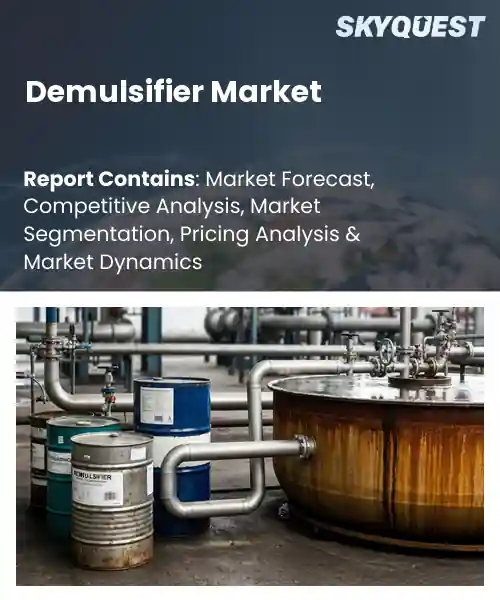
Demulsifier Market
Report ID: SQMIG15E3946
Report ID: SQMIG15E3946
[email protected]
USA +1 351-333-4748
Report ID:
SQMIG15E3946 |
Region:
Global |
Published Date: July, 2026
Pages:
157
|Tables:
88
|Figures:
76


Global Demulsifier Market size was valued at USD 2.5 Billion in 2024 and is poised to grow from USD 2.59 Billion in 2025 to USD 3.44 Billion by 2033, growing at a CAGR of 3.6% during the forecast period (2026-2033).
The demulsifier industry supplies chemicals that break water‑in‑oil emulsions, allowing producers to separate crude and refined liquids efficiently. Its importance derives from the cost of emulsion handling and stricter regulations that limit water content in petroleum streams. The primary driver is the ongoing expansion of oil and gas exploration, particularly in offshore and shale fields, where reservoirs create emulsions that can damage pipelines.
Growing legislation is a catalyst because it forces refineries to lower residual water and sulfur levels, which raises reliance on demulsifiers. When a plant implements discharge limits, the cost of non‑compliance escalates, prompting managers to replace legacy surfactants with polymeric systems that achieve water content below 10 ppm.
How is AI impacting the demulsifier market?
Artificial intelligence is reshaping the demulsifier market by turning chemistry design into a data driven process. Machine learning models analyze thousands of molecular structures and field performance data to predict the most effective surfactant blends for separating water from oil. This speeds up research cycles, cuts trial and error testing, and enables producers to tailor formulations to specific reservoir conditions. Sensors linked to AI algorithms adjust dosages on the fly, lowering chemical consumption and waste. Operators report faster phase separation and more stable emulsions, which translates into lower operating costs and an incentive for adopting new chemicals. The approach is now being adopted across oilfields worldwide.
Schlumberger in May 2023 introduced an AI driven demulsifier formulation platform that predicts optimal surfactant mixes for each well, reducing chemical inventory and shortening deployment time. The technology demonstrates how AI can boost efficiency and drive growth in demulsifier market by enabling faster response to changing reservoir conditions and lowering environmental impact.
Market snapshot - (2026-2033)
Global Market Size
USD 2.5 Billion
Largest Segment
Oil-Soluble Demulsifiers
Fastest Growth
Water-Soluble Demulsifiers
Growth Rate
3.6% CAGR
To get more insights on this market click here to Request a Free Sample Report
Global demulsifier market is segmented by chemical base chemistry, end-use industry, distribution channel and region. Based on chemical base chemistry, the market is segmented into Oil-Soluble Demulsifiers and Water-Soluble Demulsifiers. Based on end-use industry, the market is segmented into Oil & Gas Crude Production, Industrial Wastewater Treatment and Lubricant Processing & Sludge Treatment. Based on distribution channel, the market is segmented into Direct and Indirect. Based on region, the market is segmented into North America, Europe, Asia Pacific, Latin America and Middle East & Africa.
Oil soluble demulsifiers segment dominates with large demulsifier market share because they directly interact with dispersed oil droplets, breaking the emulsions efficiently in high salinity crude streams. Their affinity for the oil phase enables rapid migration to the interface, facilitating coalescence and water release. This chemical compatibility aligns with operational priorities of refineries seeking reliable water removal, thus driving sustained preference for oil soluble formulations under varying temperature conditions and enhancing overall plant throughput.
As per demulsifier market outlook, water soluble demulsifiers segment is witnessing the strongest growth momentum as producers target offshore platforms where high water cut and low oil viscosity demand gentle separation. Innovations in polymeric carriers improve solubility and environmental compliance, expanding adoption in environmentally stringent projects and creating new market avenues for future.
As per demulsifier market forecast, industrial wastewater treatment segment dominates because municipal and industrial facilities require reliable demulsification to meet strict discharge standards. The complexity of mixed effluents drives preference for formulations that quickly break oil water emulsions, reducing treatment costs and enabling compliance. Continuous pressure to lower environmental impact reinforces its central role in market volume as regulators enforce tighter limits, operators invest in advanced chemistries that integrate with biological stages, further solidifying its market leadership.
Meanwhile, lubricant processing & sludge treatment segment is emerging as the key high growth area refineries recycle increasingly complex oil based sludges. New low toxicity demulsifiers enable efficient oil recovery and waste minimization, aligning with circular economy initiatives. This drives expanding demand and positions the segment as a catalyst for broader market expansion.
To get detailed segments analysis, Request a Free Sample Report
Asia Pacific commands leadership in the demulsifier market through a combination of expansive refining infrastructure, deep integration with petrochemical value chains, and a tradition of chemical innovation. Nations in the region benefit from abundant hydrocarbon resources that drive continuous demand for efficient oil‑water separation solutions. Robust research ecosystems and strong collaborations between academic institutions and industry accelerate the development of high‑performance, cost‑effective demulsifiers. Favorable policy frameworks encourage investment in downstream processing technologies, while the proximity to emerging offshore production hubs creates a reliable customer base. Together, these factors forge a competitive advantage that sustains the region’s dominant position. The region also leverages its extensive logistics networks and a skilled workforce to ensure rapid product deployment and after‑sales support, reinforcing client confidence. Moreover, ongoing efforts to adopt greener chemistry and bio‑based additives align with global sustainability trends, further enhancing the appeal of Asia Pacific offerings to international operators.
As per demulsifier market regional outlook, Japan benefits from a mature refining sector that prioritizes high efficiency and stringent quality standards. Domestic producers emphasize advanced formulation techniques that address complex emulsions typical of imported crude blends. Close collaboration between chemical manufacturers and major oil processors fosters rapid adoption of innovative additives, while strong regulatory oversight ensures consistent performance and environmental compliance. This ecosystem sustains Japan’s reputation for reliable, technology‑driven demulsifier solutions.
As per demulsifier market regional forecast, South Korea is propelled by a dynamic petrochemical base and increasing focus on refining upgrades. Local chemical firms leverage sophisticated research facilities to tailor additives for the region’s diverse crude slate, emphasizing stability and low toxicity. Strategic partnerships with international oil majors accelerate technology transfer, while government incentives support the scaling of environmentally friendly production methods. The combined emphasis on innovation and compliance positions South Korea as a key contributor to regional demulsifier advancement.
North America experiences rapid expansion of the demulsifier market due to a convergence of advanced extraction techniques, stringent environmental mandates, and a diversified energy portfolio. The widespread adoption of unconventional drilling methods creates complex emulsion challenges that demand specialized additives, prompting significant investment in research and development. Regulatory frameworks emphasize reduced water usage and lower discharge toxicity, encouraging producers to seek high‑efficiency demulsifiers. Additionally, strong collaboration between major oil corporations and leading chemical innovators accelerates the introduction of next‑generation formulations. The region’s extensive logistics infrastructure and emphasis on operational reliability further reinforce demand, establishing North America as a vigorous growth engine for demulsifier technologies. The focus on integrated refinery upgrades also fuels demand, as operators seek to improve oil‑water separation efficiency across both upstream and downstream processes, reinforcing the market’s momentum.
As per demulsifier industry analysis, United States is shaped by a large offshore drilling sector and extensive refining capacity that demand high‑performance separation solutions. Industry leaders prioritize innovation in formulation to address the wide range of crude qualities processed across the country. Close ties between chemical manufacturers and energy producers enable rapid testing and deployment of new additives, while regulatory scrutiny pushes continuous improvement in environmental performance. This environment sustains a dynamic and resilient market landscape.
Canada benefits from a strong emphasis on sustainable resource development and a growing bitumen processing industry. Canadian chemical firms focus on creating additives that operate effectively under cold climate conditions while meeting strict environmental guidelines. Partnerships with major oil sands operators accelerate the adoption of advanced demulsifiers designed for high water‑cut streams. The supportive regulatory climate and investment in clean technology research reinforce Canada’s capacity to supply tailored, eco‑conscious separation solutions.
Europe reinforces its position in the demulsifier market through a blend of regulatory leadership, advanced chemical engineering capabilities, and a commitment to sustainability. The region’s stringent environmental directives drive the development of low‑toxicity, bio‑based additives that meet high performance criteria while reducing ecological impact. Collaborative research networks linking universities, specialized chemical firms, and major oil processors accelerate innovation cycles and facilitate rapid scale‑up of novel formulations. Strong intellectual property frameworks protect breakthroughs, encouraging continued investment. Additionally, Europe’s extensive refinery infrastructure and focus on circular economy principles promote the integration of efficient demulsifiers into existing processes, enhancing overall operational resilience and market competitiveness. The emphasis on regulatory harmonization across member states further streamlines market entry for innovative products, while strategic export initiatives expand Europe’s influence in global demulsifier supply chains.
Germany is characterized by a strong engineering tradition and high emphasis on precision formulation. German chemical companies leverage state‑of‑the‑art laboratories to develop additives that address the complex emulsions encountered in both conventional and unconventional refining streams. Close collaboration with leading automotive and industrial firms promotes cross‑sector technology transfer, enhancing additive robustness. Rigorous environmental standards drive the adoption of low‑impact solutions, cementing Germany’s reputation for quality‑centric demulsifier offerings.
United Kingdom benefits from a vibrant research ecosystem and a strategic focus on offshore energy production. British chemical specialists prioritize adaptable formulations that perform reliably under variable sea‑weed and high‑pressure conditions typical of North Sea operations. Partnerships with global oil majors and academic institutes facilitate rapid prototyping and field validation. The regulatory environment emphasizes environmental stewardship, encouraging the development of biodegradable additives that meet strict discharge criteria.
France is driven by a blend of deep chemical expertise and a proactive approach to green innovation. French firms focus on creating bio‑based additives that combine high separation efficiency with low ecological footprint, aligning with national sustainability agendas. Close ties with major refining clusters in the southern and north‑central regions enable tailored solutions for diverse crude blends. Government incentives for low‑impact technologies further accelerate research, positioning France as a notable contributor to the European demulsifier landscape.
To know more about the market opportunities by region and country, click here to
Buy The Complete Report
Increasing Oil Production Activities
Stringent Environmental Regulations
High Cost of Advanced Formulations
Technical Challenges With Complex Emulsions
Request Free Customization of this report to help us to meet your business objectives.
The competitive landscape is shaped by intense rivalry among chemical manufacturers and oil‑service firms, each leveraging strategic M&A, joint‑venture partnerships, and advanced surfactant technology to enhance demulsifier performance and cost efficiency. Recent collaborations focus on integrating nano‑engineered additives and digital monitoring platforms, while acquisitions target niche specialty chemistries to broaden product portfolios and capture emerging market segments.
SkyQuest’s ABIRAW (Advanced Business Intelligence, Research & Analysis Wing) is our Business Information Services team that Collects, Collates, Correlates, and Analyses the Data collected by means of Primary Exploratory Research backed by robust Secondary Desk research.
As per SkyQuest analysis the global demulsifier market growth driven primarily by rising oil production activities that create complex water‑in‑oil emulsions and push operators toward more efficient chemical breakers. A second catalyst is the shift toward sustainable formulations where bio‑based and low‑toxicity additives meet tightening environmental rules and client demand for greener operations. The oil‑soluble demulsifier segment leads the market because its affinity for crude streams enables rapid water release, while Asia Pacific dominates in volume due to its extensive refining capacity and strong chemical‑innovation ecosystem. However, the high cost of advanced formulations restrains adoption, especially in marginal fields where budget constraints favor cheaper legacy surfactants. The global demulsifier market trend driven by increasing crude oil exploration, enhanced oil recovery (EOR) projects, and rising investments in upstream and downstream oil & gas infrastructure.
| Report Metric | Details |
|---|---|
| Market size value in 2024 | USD 2.5 Billion |
| Market size value in 2033 | USD 3.44 Billion |
| Growth Rate | 3.6% |
| Base year | 2024 |
| Forecast period | (2026-2033) |
| Forecast Unit (Value) | USD Billion |
| Segments covered |
|
| Regions covered | North America (US, Canada), Europe (Germany, France, United Kingdom, Italy, Spain, Rest of Europe), Asia Pacific (China, India, Japan, Rest of Asia-Pacific), Latin America (Brazil, Rest of Latin America), Middle East & Africa (South Africa, GCC Countries, Rest of MEA) |
| Companies covered |
|
| Customization scope | Free report customization with purchase. Customization includes:-
|
To get a free trial access to our platform which is a one stop solution for all your data requirements for quicker decision making. This platform allows you to compare markets, competitors who are prominent in the market, and mega trends that are influencing the dynamics in the market. Also, get access to detailed SkyQuest exclusive matrix.
Table Of Content
Executive Summary
Market overview
Parent Market Analysis
Market overview
Market size
KEY MARKET INSIGHTS
COVID IMPACT
MARKET DYNAMICS & OUTLOOK
Market Size by Region
KEY COMPANY PROFILES
Methodology
For the Demulsifier Market, our research methodology involved a mixture of primary and secondary data sources. Key steps involved in the research process are listed below:
1. Information Procurement: This stage involved the procurement of Market data or related information via primary and secondary sources. The various secondary sources used included various company websites, annual reports, trade databases, and paid databases such as Hoover's, Bloomberg Business, Factiva, and Avention. Our team did 45 primary interactions Globally which included several stakeholders such as manufacturers, customers, key opinion leaders, etc. Overall, information procurement was one of the most extensive stages in our research process.
2. Information Analysis: This step involved triangulation of data through bottom-up and top-down approaches to estimate and validate the total size and future estimate of the Demulsifier Market.
3. Report Formulation: The final step entailed the placement of data points in appropriate Market spaces in an attempt to deduce viable conclusions.
4. Validation & Publishing: Validation is the most important step in the process. Validation & re-validation via an intricately designed process helped us finalize data points to be used for final calculations. The final Market estimates and forecasts were then aligned and sent to our panel of industry experts for validation of data. Once the validation was done the report was sent to our Quality Assurance team to ensure adherence to style guides, consistency & design.
Analyst Support
Customization Options
With the given market data, our dedicated team of analysts can offer you the following customization options are available for the Demulsifier Market:
Product Analysis: Product matrix, which offers a detailed comparison of the product portfolio of companies.
Regional Analysis: Further analysis of the Demulsifier Market for additional countries.
Competitive Analysis: Detailed analysis and profiling of additional Market players & comparative analysis of competitive products.
Go to Market Strategy: Find the high-growth channels to invest your marketing efforts and increase your customer base.
Innovation Mapping: Identify racial solutions and innovation, connected to deep ecosystems of innovators, start-ups, academics, and strategic partners.
Category Intelligence: Customized intelligence that is relevant to their supply Markets will enable them to make smarter sourcing decisions and improve their category management.
Public Company Transcript Analysis: To improve the investment performance by generating new alpha and making better-informed decisions.
Social Media Listening: To analyze the conversations and trends happening not just around your brand, but around your industry as a whole, and use those insights to make better Marketing decisions.
REQUEST FOR SAMPLE
 REQUEST FREE CUSTOMIZATION
Global Demulsifier Market size was valued at USD 2.5 Billion in 2024 and is poised to grow from USD 2.59 Billion in 2025 to USD 3.44 Billion by 2033, growing at a CAGR of 3.6% during the forecast period (2026-2033).
The competitive landscape is shaped by intense rivalry among chemical manufacturers and oil‑service firms, each leveraging strategic M&A, joint‑venture partnerships, and advanced surfactant technology to enhance demulsifier performance and cost efficiency. Recent collaborations focus on integrating nano‑engineered additives and digital monitoring platforms, while acquisitions target niche specialty chemistries to broaden product portfolios and capture emerging market segments. 'BASF SE', 'Dow Inc', 'Evonik Industries', 'Clariant', 'Solvay', 'Nouryon', 'Croda International', 'Huntsman Corporation', 'Stepan Company', 'Ingevity Corporation', 'Lubrizol Corporation', 'Baker Hughes', 'SLB', 'Halliburton', 'Weatherford International', 'ChampionX', 'Ecolab', 'Suez SA', 'Veolia Environnement', 'Ineos Group'
The surge in global oil production activities creates a heightened need for efficient separation of water from crude streams, prompting operators to adopt advanced demulsifier formulations. These chemicals enhance phase separation, reduce processing time, and improve product quality, thereby supporting higher throughput in refineries. As extraction projects expand into more challenging reservoirs, the complexity of emulsions rises, making reliable demulsification essential for operational continuity and cost containment, which collectively drives market expansion. Moreover, regulatory pressure to minimize environmental discharge further incentivizes the use of high‑performance demulsifiers across the value chain.
Sustainable Formulation Shift: Manufacturers are increasingly prioritizing environmentally benign demulsifiers, driven by stricter regulatory expectations and growing client demand for greener production. This shift encourages the adoption of bio‑based surfactants and low‑toxicity additives, prompting R&D teams to redesign formulations that reduce hazardous by‑products while maintaining separation efficiency. Companies that embed sustainability into product portfolios gain competitive advantage, as downstream users seek to lower their ecological footprints and comply with emerging circular‑economy guidelines across oil‑and‑gas, petrochemical, and waste‑water sectors through proactive industry collaborations globally.
Why does Asia Pacific Dominate the Global Demulsifier Market? |@12


Want to customize this report? This report can be personalized according to your needs. Our analysts and industry experts will work directly with you to understand your requirements and provide you with customized data in a short amount of time. We offer $1000 worth of FREE customization at the time of purchase.
Feedback From Our Clients


 USA (+1) 351-333-4748

