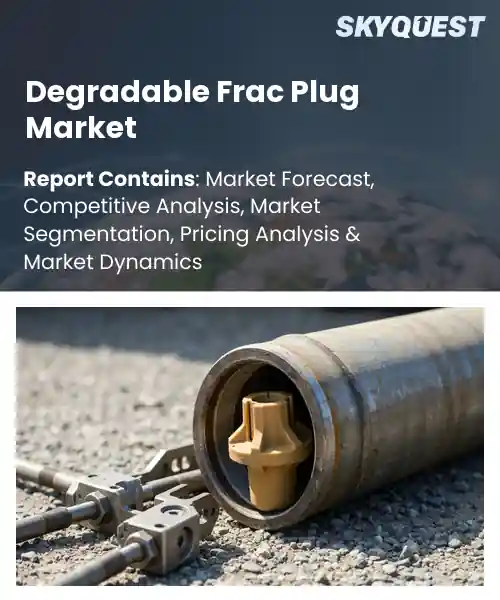
Degradable Frac Plug Market
Report ID: SQMIG10B2155
Report ID: SQMIG10B2155
[email protected]
USA +1 351-333-4748
Report ID:
SQMIG10B2155 |
Region:
Global |
Published Date: February, 2026
Pages:
157
|Tables:
114
|Figures:
77


Global Degradable Frac Plug Market size was valued at USD 326.42 Million in 2024 and is poised to grow from USD 357.43 Million in 2025 to USD 738.76 Million by 2033, growing at a CAGR of 9.5% during the forecast period (2026-2033).
The market has grown rapidly due to the demand for lower completion costs and faster turnaround times in completion activities from Operators. As very low-cost/unconventional plays continue to grow in North America, Latin America and Asia-Pacific, the utilization of degradable frac plugs has grown through early use of polymer to reduce rig time and later through improvements in materials science that produced predictable dissolution rates and increased temperature ranges for more opportunities for use. As a result manufacturers expanded portfolios and service companies incorporated dissolvable plugs into staged fracture designs, significantly reducing non-productive time and environmental footprints.
Building on those cost and time savings, the key trend driving the global degradable frac plug sector growth has been advances in polymer chemistry that yield predictable degradation rates and greater pressure and temperature resilience. As plugs now dissolve reliably in weeks rather than months, operators can design more aggressive multi-stage completions, which increases recovery and reduces well intervention costs; for example Permian operators report faster stage turns and fewer milling runs. Regulatory pressure to minimize downhole debris and surface waste accelerates adoption, creating opportunities for vendors to supply tailored compositions for high-temperature wells and for service firms to bundle materials with completion execution.
How is AI Improving Degradation Prediction in the Degradable Frac Plug Market?
AI is improving degradation prediction in the degradable frac plug market by combining sensor data, materials modeling and machine learning into a single workflow. Key aspects include downhole telemetry and fiber sensors that feed real time pressure and temperature data into predictive models. Current practice uses supervised learning and physics informed simulations to map how chemistry and temperature drive dissolution. The market context is demand for lower downtime and more reliable self removing plugs, so AI enables operators to choose formulations and run parameters with greater confidence. Examples include sensor enabled plug trials and alloy design projects that use digital twins to reduce uncertainty.
Market snapshot - 2026-2033
Global Market Size
USD 326.42 Million
Largest Segment
Partially Degradable Frac Plugs
Fastest Growth
Fully Degradable Frac Plugs
Growth Rate
9.5% CAGR
To get more insights on this market click here to Request a Free Sample Report
Global degradable frac plug market is segmented by plug type, material, application, end user and region. Based on plug type, the market is segmented into fully degradable frac plugs and partially degradable frac plugs. Based on material, the market is segmented into biodegradable, bioresorbable and hybrid. Based on application, the market is segmented into onshore and offshore. Based on end user, the market is segmented into oilfield service companies and exploration & production (E&P) companies. Based on region, the market is segmented into North America, Europe, Asia Pacific, Latin America and Middle East & Africa.
Based on the global degradable frac plug market forecast, fully degradable frac plugs segment dominates because easier wellbore clearance and elimination of pull out operations reduce intervention cycles and operational complexity, enabling service providers to plan completions with fewer recovery tools. Their predictable dissolution behavior reduces downtime, aligns with environmental stewardship expectations, and simplifies logistics by removing retrieval equipment needs, causing quicker job turnarounds and lower coordination burdens across completion crews, which drives operator and service company preference.
However, Partially Degradable Frac Plugs are rapidly expanding as they offer durable isolation with controlled dissolution, suiting complex zonal completions. The increase in operator preference for adaptable retrieval shapes due to process advancements has led to many unique completion options, which generates new service income, stimulating additional creativity and market launch.
Bioresorbable segment dominates because its chemistry enables predictable tuned dissolution for specific applications that minimizes residual debris and reduces the need for mechanical cleanup, improving operational turnaround. This managed disintegration increases dependability when working with reservoir conditions, which gives the operator added confidence in the completion schedule and regulations that favor the integration of materials designed to degrade safely in situ have led to an increase in the number of service companies whose focused product development and deployment safeguards bioresorbable materials while increasing their ability to improve logistics concerning completions.
Meanwhile, Hybrid materials are emerging as the most rapidly expanding area by combining mechanical strength with controlled degradation, allowing plugs to withstand demanding loads while dissolving predictably. Changing business conditions, developing materials and working together as an industry have led to quicker adoption of existing products as well as new uses for those products and the development of different ways to sell custom plug-in solutions.
To get detailed segments analysis, Request a Free Sample Report
As per the global degradable frac plug market analysis, North America dominates because it combines extensive unconventional resource development with a mature oilfield services ecosystem and deep technical expertise. Integrated supply chains, co-located operators and advanced manufacturers, and a performance-driven culture of adopting new varieties of completion technologies benefit the region. Operators work to minimize risk associated with interventions while increasing well productivity which creates the demand for degradable solutions. Together, the interactions between service providers, research institutions, and operators help to validate and economically tweak products quickly. Due to strong aftermarket support and product testing infrastructure, both the scale-up process and confidence in operational execution can occur quickly. A collaborative supplier ecosystem enhances the pace of innovation with new material types and designs for plugs that are well-suited for intricate and complex well configurations.
Degradable Frac Plug Market in United States is characterized by widespread operator engagement and a dense network of service providers and testing facilities. Operators have shown support for lower complexity and shorter cycle times, increasing their interest in reliable degradable components. Strong field team/research organization collaboration allows for continued iterative design improvements and stringent qualifying processes. The existence of local manufacturing facilities and logistics networks enables fast deployment in many different basins while also creating competitive pressures for continued material and design innovation.
Degradable Frac Plug Market in Canada is shaped by activity in resource rich provinces and a focus on minimizing surface intervention in environmentally sensitive areas. Operators and service providers collaborate to adapt degradable chemistries for cold climate conditions and extended lateral wells. Regional fabrication and service hubs support logistical resilience, and pilot initiatives inform specification refinement. Pragmatic regulatory engagement and an industry emphasis on reducing operational footprint further encourage adoption of degradable completion components.
The rapid expansion in Asia Pacific is driven by growing subsurface complexity, increased offshore and tight resource development, and rising emphasis on environmental performance and operational efficiency. The regional operators are searching for ways to lower the frequency of interventions and simplify the management of wells in remote locations or in deep water which is creating a demand for technologies that can degrade over time. The strong capabilities (material science) and manufacturing capabilities in the regional economy allow for localized development & customization. Technologies can be transferred from global providers, strategic partnerships, and targeted pilots will help expedite market entry. Regulatory and commercial incentives will encourage wider adoption. The availability of skilled service companies and a continually improving supply chain integration will provide further evidence of wide spread deployment across many different types of reservoirs.
Degradable Frac Plug Market in Japan is driven by advanced engineering expertise and a focus on offshore and complex reservoir environments that demand high reliability. Material performance along with precision fabricating detail are the main focuses of collaboration between manufacturers located domestically and technology providers located internationally. In addition, operators can have complete confidence in being able to fabricate degradable-based solutions because of the existence of stringent testing requirements and quality assurance practices. The market generally prefers designs to accommodate operating pressures and temperatures above the normal operating range.
Degradable Frac Plug Market in South Korea benefits from strong petrochemical and polymer industries and a manufacturing base accustomed to high quality standards. Local service companies leverage material science know how to develop and qualify degradable components optimized for regional needs. Knowledge transfer and product development are made possible by global suppliers in the international supply chain, as well as strong patents and strategies used by the technology manufacturers to develop their products. This market is characterized by a focus on having reliable, stable sources of supply.
Europe is strengthening its position through a combination of sustainability driven demand, stringent environmental and decommissioning requirements, and concentrated engineering expertise. Service companies and operators will prioritize solutions that allow them to minimize environmental footprint and eliminate well intervention. Therefore, a positive impact on the development of degradable-based technologies will occur. Cross-border collaboration along with standardisation initiatives, in addition to the partnership between research and the industry, will accelerate material qualification and in-field verification processes. The historical success of precision manufacturing of polymer-based products and associated research into polymers drives product innovation, as well. Implementation of degradable-based solutions in decommissioning and reuse strategies enables the application of degradable-based solutions across additional applications.
Degradable Frac Plug Market in Germany draws on a strong engineering tradition and advanced materials research that supports high precision manufacturing. Suppliers are developing new polymer compositions and processes to satisfy demanding global quality and safety standards. Suppliers are now working together with research institutes to quickly test and approve new materials for use. The supplier's industry is focusing on establishing performance metrics for The Environment and Lifecycle impacts of their products that encourage developing degradable products as they pertain to the energy transition. The commercial marketplace has emphasized the importance of technical rigor and being ultimately traceable as a qualification process.
Degradable Frac Plug Market in United Kingdom is influenced by legacy activity in offshore basins and emphasis on decommissioning and environmental compliance. The operator’s experience with complicated completions and strict regulation encourages technology developments that will simplify the intervention process and reduce the amount of remaining well equipment. Collaborative field tests and innovations from suppliers have influenced the development of specifications for these technologies. Companies that have been in the North Sea have also helped facilitate integrating operations through their knowledge of operations.
Degradable Frac Plug Market in France benefits from strong research capability in polymer science and close cooperation between industry and academic institutions. Suppliers are focused on adapting their degradable chemical products to various operating conditions, ensuring that their products meet environmental requirements. Testing and validating local sources of supply are done by both offshore and onshore projects in order to promote operator confidence. The desire to reduce and integrate sustainable practices within the completion process has resulted in an increasing number of operators interested in degradable plug options.
To know more about the market opportunities by region and country, click here to
Buy The Complete Report
Focus on Wellbore Efficiency
With the ability to dissolve or degrade in situ, degradable frac plugs can make the operation easier since they do not require mechanical retrieval, and can simplify the intervention(s) needed after a fracturing operation. This technology allows the operator to perform fewer downhole interventions, which also reduces the amount of logistics associated with those interventions therefore allowing for a more streamlined completion plan. The reduced requirement for coiled tubing or milling services lowers procedural complexity and supports faster stage sequencing, which in turn encourages adoption as operators seek methods that simplify field execution, reduce manpower coordination, and decrease exposure to procedural delays and operational bottlenecks.
Stricter Environmental Regulations Encouraging Adoption
Heightened environmental standards and growing corporate sustainability commitments favor degradable frac plugs because they reduce long term environmental liabilities associated with leaving foreign materials in the subsurface. Regulatory emphasis on minimizing persistent solid waste and lowering surface handling of recovered equipment creates operational incentives to adopt degradable alternatives that are compatible with environmental objectives. Operators view these products as a means of bridging the gap between what they do in the field and what regulators expect, and also what will enable them to respond to stakeholder scrutiny by demonstrating how responsibly they have developed resources while also simplifying any compliance requirements and needing to extensively manage waste.
Performance Variability Under Reservoir Conditions
Variability in downhole temperature, pressure, and fluid chemistry can affect the degradation behavior and mechanical integrity of degradable frac plugs, creating uncertainty for completion engineers. Because reservoirs present diverse conditions, operators may be concerned about unpredictable dissolution timing or loss of sealing capacity before operations are complete, which can compromise stage isolation. Because there is a perceived reliability risk associated with using degradable materials in sensitive or high value wells, operators tend to lean toward using conventional retrievable plugs until such time as degradable materials do consistently perform (across a larger range of field conditions/degradation methodologies).
Higher Upfront Material Costs
Perceptions of higher initial material and procurement costs for degradable frac plugs can limit their uptake, as operators evaluate total project economics and budget priorities. Though finding operational advantages is beneficial, it can lead some procurement teams to see specialized degradable products as a premium cost in relation to established products which typically results in cautious trailing instead of nationwide deployment. Various issues such as supply chain availability, warranty coverage, or long-term reliability have also resulted in conservative buying behaviour and companies typically delay switching until there are noticeable or clearer cost structures that provide better performance advantages.
Request Free Customization of this report to help us to meet your business objectives.
Competitive landscape in the global degradable frac plug market outlook shows rapid differentiation between large service companies, material suppliers, and specialist manufacturers as M&A, licensing, and joint development reshape access to degradable materials and deployment know how. Examples include strategic roll ups and product rollouts by completion contractors, collaborative material development between service majors and polymer producers, and commercial dissolvable plug launches that push operators toward interventionless completions.
SkyQuest’s ABIRAW (Advanced Business Intelligence, Research & Analysis Wing) is our Business Information Services team that Collects, Collates, Correlates, and Analyses the Data collected by means of Primary Exploratory Research backed by robust Secondary Desk research.
As per SkyQuest analysis, the global degradable frac plug industry is propelled primarily by advances in polymer chemistry that deliver predictable, faster dissolution and lower completion costs, while stricter environmental regulations encouraging reduced downhole debris act as a secondary growth driver. Adoption is still limited because of significant differences in downhole temperature, pressure, and fluid chemistry (due to differing conditions at different wells), creating reliability issues with high-value wells. North America leads the market due to deep unconventional activity, robust service ecosystems and rapid field validation, and fully degradable frac plugs constitute the dominant product segment because they simplify multistage workflows and eliminate retrieval operations. Continued material innovation and digital integration should support broader deployment as validation expands.
| Report Metric | Details |
|---|---|
| Market size value in 2024 | USD 326.42 Million |
| Market size value in 2033 | USD 738.76 Million |
| Growth Rate | 9.5% |
| Base year | 2024 |
| Forecast period | 2026-2033 |
| Forecast Unit (Value) | USD Million |
| Segments covered |
|
| Regions covered | North America (US, Canada), Europe (Germany, France, United Kingdom, Italy, Spain, Rest of Europe), Asia Pacific (China, India, Japan, Rest of Asia-Pacific), Latin America (Brazil, Rest of Latin America), Middle East & Africa (South Africa, GCC Countries, Rest of MEA) |
| Companies covered |
|
| Customization scope | Free report customization with purchase. Customization includes:-
|
To get a free trial access to our platform which is a one stop solution for all your data requirements for quicker decision making. This platform allows you to compare markets, competitors who are prominent in the market, and mega trends that are influencing the dynamics in the market. Also, get access to detailed SkyQuest exclusive matrix.
Table Of Content
Executive Summary
Market overview
Parent Market Analysis
Market overview
Market size
KEY MARKET INSIGHTS
COVID IMPACT
MARKET DYNAMICS & OUTLOOK
Market Size by Region
KEY COMPANY PROFILES
Methodology
For the Degradable Frac Plug Market, our research methodology involved a mixture of primary and secondary data sources. Key steps involved in the research process are listed below:
1. Information Procurement: This stage involved the procurement of Market data or related information via primary and secondary sources. The various secondary sources used included various company websites, annual reports, trade databases, and paid databases such as Hoover's, Bloomberg Business, Factiva, and Avention. Our team did 45 primary interactions Globally which included several stakeholders such as manufacturers, customers, key opinion leaders, etc. Overall, information procurement was one of the most extensive stages in our research process.
2. Information Analysis: This step involved triangulation of data through bottom-up and top-down approaches to estimate and validate the total size and future estimate of the Degradable Frac Plug Market.
3. Report Formulation: The final step entailed the placement of data points in appropriate Market spaces in an attempt to deduce viable conclusions.
4. Validation & Publishing: Validation is the most important step in the process. Validation & re-validation via an intricately designed process helped us finalize data points to be used for final calculations. The final Market estimates and forecasts were then aligned and sent to our panel of industry experts for validation of data. Once the validation was done the report was sent to our Quality Assurance team to ensure adherence to style guides, consistency & design.
Analyst Support
Customization Options
With the given market data, our dedicated team of analysts can offer you the following customization options are available for the Degradable Frac Plug Market:
Product Analysis: Product matrix, which offers a detailed comparison of the product portfolio of companies.
Regional Analysis: Further analysis of the Degradable Frac Plug Market for additional countries.
Competitive Analysis: Detailed analysis and profiling of additional Market players & comparative analysis of competitive products.
Go to Market Strategy: Find the high-growth channels to invest your marketing efforts and increase your customer base.
Innovation Mapping: Identify racial solutions and innovation, connected to deep ecosystems of innovators, start-ups, academics, and strategic partners.
Category Intelligence: Customized intelligence that is relevant to their supply Markets will enable them to make smarter sourcing decisions and improve their category management.
Public Company Transcript Analysis: To improve the investment performance by generating new alpha and making better-informed decisions.
Social Media Listening: To analyze the conversations and trends happening not just around your brand, but around your industry as a whole, and use those insights to make better Marketing decisions.
REQUEST FOR SAMPLE
 REQUEST FREE CUSTOMIZATION
Global Degradable Frac Plug Market size was valued at USD 326.42 Million in 2024 and is poised to grow from USD 357.43 Million in 2025 to USD 738.76 Million by 2033, growing at a CAGR of 9.5% during the forecast period (2026-2033).
Competitive landscape shows rapid differentiation between large service companies, material suppliers, and specialist manufacturers as M&A, licensing, and joint development reshape access to degradable materials and deployment know how. Examples include strategic roll ups and product rollouts by completion contractors, collaborative material development between service majors and polymer producers, and commercial dissolvable plug launches that push operators toward interventionless completions. 'Schlumberger', 'Halliburton', 'Baker Hughes', 'Nine Energy Service', 'Pyramid Oil Tools', 'Innovex Inc.', 'NOV Inc. (National Oilwell Varco)', 'CNPC (China National Petroleum Corporation)', 'Sinopec', 'KLX Energy Services', 'Expro', 'Peak Completion Technologies', 'Weatherford International', 'Rubicon Oilfield International', 'SPT Energy', 'Downhole Technology LLC', 'Magnum Oil Tools International', 'Resource Well Completion Technologies', 'NCS Multistage Holdings', 'Packers Plus Energy Services'
Degradable frac plugs enhance operational simplicity by eliminating the need for mechanical retrieval and minimizing intervention complexity after fracturing operations. By dissolving or degrading in situ, these plugs reduce the number of downhole interventions and associated logistics, enabling operators to plan more streamlined completions. The reduced requirement for coiled tubing or milling services lowers procedural complexity and supports faster stage sequencing, which in turn encourages adoption as operators seek methods that simplify field execution, reduce manpower coordination, and decrease exposure to procedural delays and operational bottlenecks.
Digital Integration With Well Planning: Operators increasingly integrate degradable frac plugs with digital well planning tools and downhole monitoring systems to optimize placement and degradation timing. This trend emphasizes collaboration between service providers and software firms to enable predictive planning, reduce uncertainty during completions, and align material behavior with reservoir models. Improved data exchange and field-proven workflows help streamline operations, shorten cycle times, and reduce non-productive interventions, creating value through greater predictability and smoother handoffs among engineering, procurement and operations stakeholders and enhance asset longevity.
North America Dominate the Global Degradable Frac Plug Market?


Want to customize this report? This report can be personalized according to your needs. Our analysts and industry experts will work directly with you to understand your requirements and provide you with customized data in a short amount of time. We offer $1000 worth of FREE customization at the time of purchase.
Feedback From Our Clients


 USA (+1) 351-333-4748

