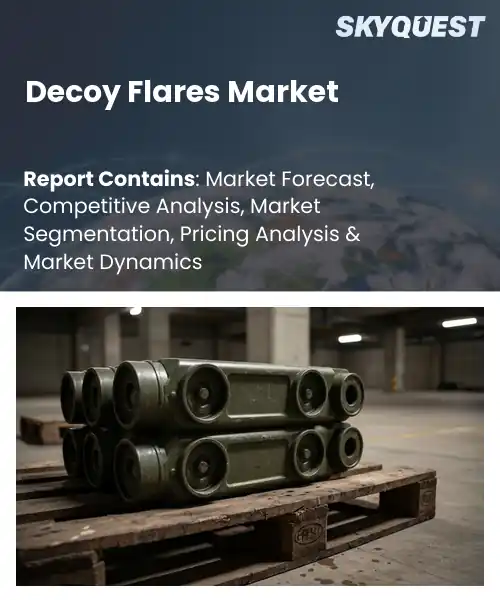
Decoy Flares Market
Report ID: SQMIG20A2760
Report ID: SQMIG20A2760
[email protected]
USA +1 351-333-4748
Report ID:
SQMIG20A2760 |
Region:
Global |
Published Date: July, 2026
Pages:
157
|Tables:
88
|Figures:
76


Global Decoy Flares Market size was valued at USD 3.98 Billion in 2024 and is poised to grow from USD 4.28 Billion in 2025 to USD 7.71 Billion by 2033, growing at a CAGR of 7.63% during the forecast period (2026-2033).
Launch of new defense modernization programs, rising procurement of military aircraft, increasing threat from infrared-guided missiles, integration of advanced countermeasure systems, and rising investments in indigenous defense technologies are driving demand for decoy flares.
The increasing use of highly sophisticated decoy flare systems in fighter planes, helicopters, transport planes, and UAVs is fueling the market growth owing to the growing demand for increased defense against infrared guided missile threats from armed forces. The constant development in multispectral flares technology, programmable dispensing systems, and lightweight countermeasures is contributing towards increased efficiency and compatibility. Defense modernization programs, fleet upgradation of military units, and the strengthening of defense industry within a nation are anticipated to support market growth in the coming years. Growing geopolitical tensions and increasing focus on aircraft survivability are expected to primarily drive decoy flares market growth.
In contrast, stringent export regulations, high development and procurement costs, complex certification requirements, and geopolitical restrictions on defense technology transfers are anticipated to slow down decoy flares market penetration going forward.
Market snapshot - (2026-2033)
Global Market Size
USD 3.98 Billion
Largest Segment
Pyrotechnic Magnesium-Teflon-Viton (MTV) Flares
Fastest Growth
Spectral & Multi-Spectral Flares
Growth Rate
7.63% CAGR
To get more insights on this market click here to Request a Free Sample Report
Global decoy flares market is segmented by product chemistry type, platform application, distribution channel, and region. Based on product chemistry type, the market is segmented into pyrotechnic magnesium-teflon-viton (MTV) flares, pyrophoric metal flares, and spectral & multi-spectral flares. Based on platform application, the market is segmented into fixed-wing aircraft, rotary-wing aircraft, and naval surface vessels. Based on distribution channel, the market is segmented into direct and indirect. Based on region, the market is segmented into North America, Europe, Asia Pacific, Latin America, and Middle East & Africa.
The Pyrotechnic magnesium teflon viton (MTV) flares segment is slated to account for the highest global decoy flares market share going forward. They have high heat output and good ignition capability, providing a solid infrared signal that helps to mislead heat-seeking missiles. They burn steadily, thus allowing an exact timing, which matches modern threats and challenging missions. This is why they are used by many defense contractors because of their reliability in various combat zones and throughout long sorties.
However, spectral and multi spectral flares are witnessing the strongest growth momentum as per this decoy flares market forecast, due to the requirement of wider range of wavelength for emerging missile threats. Development in coating technology ensures that such flares have signatures in several spectrums, making them effective in deceiving enemy radar systems. This feature makes them more attractive for next generation systems.
The fixed wing aircraft platform segment is estimated to spearhead the global decoy flares market revenue generation across the study period. These aircraft fly at higher speeds and altitudes and are thus exposed to more advanced radar and infrared systems that demand immediate and efficient measures. Fixed-wing aircraft have the capability to carry larger loads and can thus mount several flare dispensers on board. This is why producers tend to focus on developing superior flares for use by fixed-wing aircraft, making them an integral part of market dynamics.
On the other hand, rotary wing aircraft are emerging as a high growth segment as they tend to fly at a very low altitude where they are easily targeted by heat-seeking missiles which take advantage of the agility of flares. Innovations in the field of dispenser systems for smaller sizes make it easier to integrate them, thus more purchases and innovations.
To get detailed segments analysis, Request a Free Sample Report
Advanced defense procurement frameworks, extensive research and development ecosystems, and integrated supply chain networks that support rapid innovation are helping cement the dominance of this region. A strong partnership between governmental organizations and private manufacturers guarantees the continuous development of flare technology in response to changing threat landscapes. Well-equipped testing centers, along with adherence to high safety and performance standards, help build trust in the end users. Additionally, the area is well versed in aerospace and maritime fields, thus ensuring a smooth flow of knowledge across industries. These factors together ensure the development of an environment that keeps North America on top of the global scene for decoy flares.
Decoy flares market in the United States is driven by extensive defense spending and a proactive approach to modernizing countermeasure inventories across air, naval, and ground platforms. The presence of leading manufacturers supports a pipeline of innovative designs that address emerging missile threats, while close coordination with defense research institutions accelerates technology transfer. Established testing ranges and rigorous certification processes ensure that new flare systems meet stringent performance criteria, reinforcing the United States position as a benchmark for reliability and effectiveness worldwide.
Decoy flare demand in Canada benefits from strong defense collaboration with allied nations and a focus on interoperability across joint operations. Indigenous research programs place an accent on capacity building, whereas procurement activities focus on resilience and adaptability of countermeasure systems. Canadian aerospace industry is a source of high-quality materials and manufacturing processes that improve performance characteristics of flares systems in general.
Heightened security imperatives, a cohesive regulatory environment, and significant investment in defense technology research are expected to boost innovation in decoy flares across Europe. Innovation cycles will become faster due to collaborative defense efforts in European Union countries that contribute to common standards and development programs. A solid aerospace legacy of the region is an excellent basis for complex production technologies. Increased attention to detection and mitigation of threats is a driver of increased demand for flares. Strategic collaboration between government organizations and particular firms is also a factor contributing to Europe's position as a hub for flare development.
Decoy flares market in Germany is anchored by a robust industrial base and a tradition of precision engineering that drives high‑quality countermeasure production. Collaboration between defense departments and scientific organizations is responsible for ongoing improvements in flare effectiveness, and strict certification procedures guarantee conformity to both national and international demands. Cooperative programs within the framework of European defense efforts further promote technology transfer, making Germany one of the major providers of dependable flare systems for different platforms.
Decoy flares market in the United Kingdom experiences accelerated growth through targeted defense modernization programs and an agile procurement approach that embraces emerging technologies. Strong ties with domestic aerospace firms accelerate the integration of novel materials and smart deployment mechanisms, while participation in multinational exercises refines operational effectiveness. The United Kingdom’s emphasis on rapid fielding of adaptable countermeasure systems ensures that flare offerings remain at the cutting edge of threat response, supporting both national security objectives and export opportunities.
Decoy flares market in France is emerging as a vibrant segment supported by focused investment in defense innovation and a proactive stance on collaborative research. Integration of advanced sensor technologies with flare deployment systems enhances detection and response capabilities across multiple domains. Partnerships with European partners and participation in joint development initiatives expand access to cutting‑edge designs, while a commitment to sustainable manufacturing practices adds strategic value to French flare solutions in the global marketplace.
Rising defense modernization efforts, expanding manufacturing capabilities, and fostering regional collaboration are expected to boost the demand for decoy flares in the region. The nations in the region emphasize self-reliant approach to the development of countermeasures, and as a result, spend money on building R&D centers within their own territory and setting up advanced testing facilities complying with international norms. Increased maritime and aerospace activity necessitates more elaborate systems of flares, whereas trade agreements in the region allow developing supply chains across borders.
Decoy flares market in Japan is characterized by a disciplined approach to quality assurance and a deep integration of advanced materials science into flare design. Close cooperation between defense agencies and leading electronics firms yields intelligent deployment systems that enhance operational precision. Robust testing infrastructure ensures compliance with stringent performance criteria, while strategic export initiatives broaden the reach of Japanese flare technologies across the Asia Pacific region and beyond.
Decoy flares market in South Korea benefits from a dynamic defense industry that emphasizes rapid prototyping and seamless integration of digital technologies. Close collaboration between military research establishments and private manufacturers accelerates the adoption of smart flare mechanisms, improving responsiveness to evolving missile threats. Government incentives support domestic production capacity, reinforcing South Korea’s emerging role as a key supplier of innovative decoy flare solutions within the regional defense ecosystem.
To know more about the market opportunities by region and country, click here to
Buy The Complete Report
Increasing Demand for Unmanned Aircraft
Integration of Multi‑Spectral Countermeasure Systems
Stringent Export Control Regulations
High Development Costs for New Flares
Request Free Customization of this report to help us to meet your business objectives.
The competitive landscape is shaped by intense rivalry among established defense contractors and emerging innovators, driving rapid adoption of advanced infrared‑signature management solutions. Companies are leveraging strategic acquisitions, such as Lockheed Martin’s purchase of a niche countermeasure firm, and forming joint ventures with aircraft manufacturers to embed flares directly into new platforms. Continuous technology innovation, including smart‑fuse flares and multi‑spectral decoys, is a key market driver as rivals race to meet evolving threat environments.
SkyQuest’s ABIRAW (Advanced Business Intelligence, Research & Analysis Wing) is our Business Information Services team that Collects, Collates, Correlates, and Analyses the Data collected by means of Primary Exploratory Research backed by robust Secondary Desk research.
As per SkyQuest analysis, rise in defense modernization programs, rising procurement of military aircraft, increasing threat from infrared-guided missiles, and integration of advanced countermeasure systems are anticipated to drive the demand for decoy flares going forward. However, stringent export regulations and high development and procurement costs are slated to slow down the adoption of decoy flares in the future. North America is slated to spearhead the demand for decoy flares owing to high defense spending, continuous military aircraft modernization programs, the presence of leading defense manufacturers, and strong investments in advanced countermeasure technologies. AI-driven threat detection and intelligent flare sequencing systems are anticipated to be key trends driving the decoy flares sector in the future.
| Report Metric | Details |
|---|---|
| Market size value in 2024 | USD 3.98 Billion |
| Market size value in 2033 | USD 7.71 Billion |
| Growth Rate | 7.63% |
| Base year | 2024 |
| Forecast period | (2026-2033) |
| Forecast Unit (Value) | USD Billion |
| Segments covered |
|
| Regions covered | North America (US, Canada), Europe (Germany, France, United Kingdom, Italy, Spain, Rest of Europe), Asia Pacific (China, India, Japan, Rest of Asia-Pacific), Latin America (Brazil, Rest of Latin America), Middle East & Africa (South Africa, GCC Countries, Rest of MEA) |
| Companies covered |
|
| Customization scope | Free report customization with purchase. Customization includes:-
|
To get a free trial access to our platform which is a one stop solution for all your data requirements for quicker decision making. This platform allows you to compare markets, competitors who are prominent in the market, and mega trends that are influencing the dynamics in the market. Also, get access to detailed SkyQuest exclusive matrix.
Table Of Content
Executive Summary
Market overview
Parent Market Analysis
Market overview
Market size
KEY MARKET INSIGHTS
COVID IMPACT
MARKET DYNAMICS & OUTLOOK
Market Size by Region
KEY COMPANY PROFILES
Methodology
For the Decoy Flares Market, our research methodology involved a mixture of primary and secondary data sources. Key steps involved in the research process are listed below:
1. Information Procurement: This stage involved the procurement of Market data or related information via primary and secondary sources. The various secondary sources used included various company websites, annual reports, trade databases, and paid databases such as Hoover's, Bloomberg Business, Factiva, and Avention. Our team did 45 primary interactions Globally which included several stakeholders such as manufacturers, customers, key opinion leaders, etc. Overall, information procurement was one of the most extensive stages in our research process.
2. Information Analysis: This step involved triangulation of data through bottom-up and top-down approaches to estimate and validate the total size and future estimate of the Decoy Flares Market.
3. Report Formulation: The final step entailed the placement of data points in appropriate Market spaces in an attempt to deduce viable conclusions.
4. Validation & Publishing: Validation is the most important step in the process. Validation & re-validation via an intricately designed process helped us finalize data points to be used for final calculations. The final Market estimates and forecasts were then aligned and sent to our panel of industry experts for validation of data. Once the validation was done the report was sent to our Quality Assurance team to ensure adherence to style guides, consistency & design.
Analyst Support
Customization Options
With the given market data, our dedicated team of analysts can offer you the following customization options are available for the Decoy Flares Market:
Product Analysis: Product matrix, which offers a detailed comparison of the product portfolio of companies.
Regional Analysis: Further analysis of the Decoy Flares Market for additional countries.
Competitive Analysis: Detailed analysis and profiling of additional Market players & comparative analysis of competitive products.
Go to Market Strategy: Find the high-growth channels to invest your marketing efforts and increase your customer base.
Innovation Mapping: Identify racial solutions and innovation, connected to deep ecosystems of innovators, start-ups, academics, and strategic partners.
Category Intelligence: Customized intelligence that is relevant to their supply Markets will enable them to make smarter sourcing decisions and improve their category management.
Public Company Transcript Analysis: To improve the investment performance by generating new alpha and making better-informed decisions.
Social Media Listening: To analyze the conversations and trends happening not just around your brand, but around your industry as a whole, and use those insights to make better Marketing decisions.
REQUEST FOR SAMPLE
 REQUEST FREE CUSTOMIZATION
Global Decoy Flares Market size was valued at USD 3.98 Billion in 2024 and is poised to grow from USD 4.28 Billion in 2025 to USD 7.71 Billion by 2033, growing at a CAGR of 7.63% during the forecast period (2026-2033).
The competitive landscape is shaped by intense rivalry among established defense contractors and emerging innovators, driving rapid adoption of advanced infrared‑signature management solutions. Companies are leveraging strategic acquisitions, such as Lockheed Martin’s purchase of a niche countermeasure firm, and forming joint ventures with aircraft manufacturers to embed flares directly into new platforms. Continuous technology innovation, including smart‑fuse flares and multi‑spectral decoys, is a key market driver as rivals race to meet evolving threat environments. 'Lockheed Martin Corporation', 'RTX Corporation', 'Northrop Grumman Corporation', 'BAE Systems', 'Rheinmetall AG', 'Thales Group', 'Leonardo S.p.A.', 'Saab AB', 'Elbit Systems', 'Israel Aerospace Industries', 'Chemring Group', 'Estherline Technologies', 'Kilgore Flares Company', 'Alloy Surfaces Company', 'Armtec Defense Products', 'Lacroix Defense', 'Wallop Defence Systems', 'Diehl Stiftung', 'Hanwha Aerospace', 'Poongsan Corporation'
Manufacturers are responding to heightened reliance on unmanned aerial platforms by incorporating decoy flares that can autonomously engage infrared threats, thereby extending mission endurance and reducing aircraft vulnerability. This capability supports operators seeking to conduct prolonged surveillance or strike missions without risking crew safety, prompting procurement programs to prioritize advanced flare technologies that align with autonomous flight profiles. Additionally, defense agencies are integrating these systems into broader electronic warfare suites, encouraging vendors to innovate for compatibility and multi‑threat engagement, which further fuels market expansion.
Advanced Pyrotechnic Formulations Rise: Manufacturers are increasingly integrating nanostructured energetic materials into decoy flares, delivering brighter, longer‑lasting infrared signatures that more effectively mimic aircraft heat sources. This evolution enhances survivability against next‑generation infrared seekers, prompting defense contractors to prioritize research on safer, lower‑toxicity compounds while maintaining performance. As operational theaters demand higher reliability across diverse climates, these advanced formulations address legacy concerns about premature burnout and environmental impact, positioning them as a pivotal differentiator for suppliers seeking to secure long‑term contracts in future engagements.
Why does North America Dominate the Global Decoy Flares Market? |@12


Want to customize this report? This report can be personalized according to your needs. Our analysts and industry experts will work directly with you to understand your requirements and provide you with customized data in a short amount of time. We offer $1000 worth of FREE customization at the time of purchase.
Feedback From Our Clients


 USA (+1) 351-333-4748

