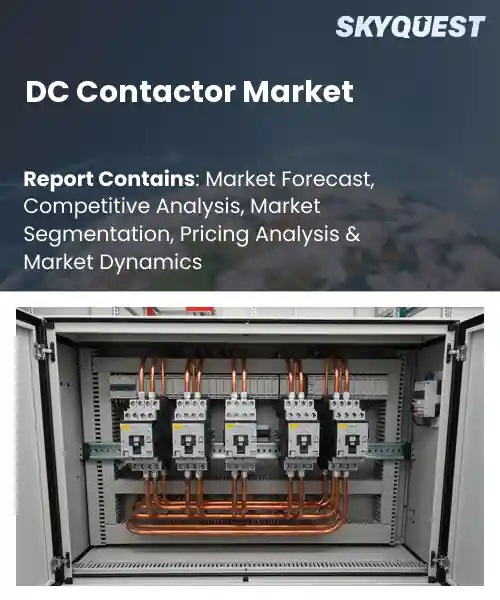
DC Contactor Market
Report ID: SQMIG20D2774
Report ID: SQMIG20D2774
[email protected]
USA +1 351-333-4748
Report ID:
SQMIG20D2774 |
Region:
Global |
Published Date: July, 2026
Pages:
157
|Tables:
181
|Figures:
79


Global DC Contactor Market size was valued at USD 481.2 Million in 2024 and is poised to grow from USD 523.06 Million in 2025 to USD 1019.51 Million by 2033, growing at a CAGR of 8.7% during the forecast period (2026-2033).
High adoption of electric vehicles, increasing deployment of renewable energy systems, rising investments in energy storage infrastructure, expansion of DC power distribution networks, and advancements in intelligent power management technologies are driving demand for DC contactors.
Increasing adoption of electric vehicles and renewable energy systems around the world coupled with increasing deployment of battery energy storage solutions are expected to primarily drive DC contactor market growth. The rising demand for reliable switching and protection devices in high-power DC applications is also supporting market expansion across transportation, industrial, and utility sectors. Continuous advancements in compact, high-performance DC contactors with improved current-handling capabilities and lower power losses are enhancing system safety and operational efficiency. Growing integration of battery management systems, IoT-enabled diagnostics, and intelligent power monitoring is further improving fault detection, predictive maintenance, and asset reliability. Increasing adoption of DC power distribution in data centers, expansion of DC microgrids, and investments in advanced magnetic materials and manufacturing capacity are also expected to create new growth opportunities for DC contactor manufacturers worldwide.
In contrast, high manufacturing costs, complex design requirements for high-voltage applications, volatility in raw material prices, and stringent safety and certification standards are anticipated to slow down DC contactor market penetration over the coming years.
How is AI-driven Automation Influencing Performance And Adoption of DC Contactors In Renewable Energy Systems?
Through artificial intelligence (AI), the DC contactor market is seeing a change in how it operates due to an increase in system reliability, efficiency, and maintenance. The AI algorithm helps in analyzing operating data and using this information to predict load change, optimize the switching function and decrease contactor wear. Through this process, product life is extended, and there is less need for downtime. Solar energy and battery storage become more efficient.
Market snapshot - (2026-2033)
Global Market Size
USD 481.2 Million
Largest Segment
General Purpose DC Contactors
Fastest Growth
Reversing DC Contactors
Growth Rate
8.7% CAGR
To get more insights on this market click here to Request a Free Sample Report
Global DC contactor market is segmented by product type, voltage range, current rating, mounting type, application, end-use industry, and region. Based on product type, the market is segmented into Definite Purpose DC Contactors, General Purpose DC Contactors, Reversing DC Contactors, Latching DC Contactors, and others. Based on voltage range, the market is segmented into Low Voltage DC Contactors, Medium Voltage DC Contactors, and High Voltage DC Contactors. Based on by current rating, the market is segmented into Below 100 A, 100 A to 500 A, and Above 500 A. Based on by mounting type, the market is segmented into Panel-mounted, DIN Rail-mounted, PCB-mounted, and others. Based on application, the market is segmented into electric vehicles, renewable energy systems, industrial equipment, railways & transportation, aerospace & defense, and others. Based on end-use industry, the market is segmented into automotive, energy & utilities, industrial manufacturing, transportation, aerospace & defense, marine, and others. Based on region, the market is segmented into North America, Europe, Asia Pacific, Latin America, and Middle East & Africa.
The electric vehicles application is forecasted to lead the global DC contactor market revenue generation in the long run. The transition to electric mobility leads to constant need for efficient power-switching technologies. DC contactors ensure quick charging, regeneration braking and battery control, and all of them are key to successful operations of an electric vehicle. Automotive manufacturers focus on the components that have passed rigorous reliability tests, ensuring the use of the application and its role as the driving force of the market.
Meanwhile, renewable energy systems application emerges as the key high‑growth segment as per this DC contactor industry analysis, as large scale solar and storage systems are turning to DC based designs that need contactors. Their installation is made easy through the inverter connection and increases reliability of the system which has made these systems popular among those developers who want modular and maintenance free system.
The definite purpose DC contactors segment is estimated to hold the highest global DC contactor market share in the future. They are made with exact load control and reliability in mind, which is very important for power-intensive applications. This purpose-made design lowers the possibility of failures and ensures easy integration, thus making them the ideal option for manufacturers that seek stable operation. As a result, engineers always pay particular attention to these products, thereby guaranteeing continued demand and strengthening their market leadership within the field of DC Contactor.
However, reversing DC contactors are witnessing the strongest growth momentum since the installation of renewable energy sources and micro-grid systems demands the transfer of power in both directions. The capability of changing the direction of the power makes their system design simpler and more attractive for those who are looking for flexibility.
To get detailed segments analysis, Request a Free Sample Report
The Asia Pacific region dominates the DC contactor market due to a combination of advanced manufacturing systems, technical know-how, and fast-paced acceptance of electric transportation and energy generation technologies. The region gains from the availability of an integrated supply chain that speeds up development and cost savings processes. Favorable government incentives for clean energy infrastructure and ambitious goals related to electric mobility provide consistent demand for efficient contactors. At the same time, a culture of innovation in semiconductors and power electronics encourages the development of reliable and miniaturized products, thereby boosting the competitive advantages of local vendors. Joint research efforts at leading universities and industrial consortiums contribute to the dominance of the Asia Pacific region in this segment of technology.
DC contactor market in Japan thrives on a legacy of precision engineering and a robust automotive sector that increasingly embraces electric vehicles. Domestic manufacturers leverage sophisticated production techniques to deliver high‑quality, reliability‑focused contactors tailored for demanding applications. Close collaboration between component suppliers and end‑users accelerates customization, while strong regulatory frameworks promote adoption of efficient power conversion solutions across industrial and transportation domains.
DC contactor market in South Korea is propelled by a vibrant electronics industry and aggressive investment in smart grid development. The nation’s focus on high‑tech manufacturing enables rapid scaling of contactor production with an emphasis on miniaturization and performance. Strategic partnerships between conglomerates and renewable energy firms foster integration of DC contactors into large‑scale solar and energy storage projects, reinforcing the country’s role as a key growth engine within the region.
The quick expansion of the DC contactor market in Europe is facilitated by the presence of a combination of decarbonization targets, large-scale integration of renewable energy sources, and an engineering culture that is known to be highly successful. Efficiency regulations in the areas of transport, industrial automation, and power distribution create demand for advanced contactors. The well-established automotive industry, which is making a shift to electricity, provides a continuous supply of products requiring high reliability. Besides, joint R&D activities and cross-border cooperation accelerate technology innovation in power electronics, thus creating conditions in which new product designs can easily enter the market.
DC contactor market in Germany benefits from a deep industrial base and leading automotive manufacturers that prioritize precision and durability. German engineering firms focus on delivering contactors that meet exacting standards for efficiency and safety, supporting extensive renewable integration and high‑performance manufacturing processes. Close alignment with research institutes accelerates the development of advanced materials and smart diagnostics, enhancing product reliability across diverse sectors.
DC contactor demand in United Kingdom is characterized by swift adoption of electric vehicle infrastructure and aggressive renewable energy projects. The market leverages a strong fintech and technology ecosystem to introduce innovative contactor designs that improve grid responsiveness and energy storage efficiency. Collaborative pilots between utilities and technology providers drive rapid refinement of solutions, positioning the United Kingdom as a leading growth catalyst within Europe.
DC contactor market in France is emerging through focused government incentives and a growing emphasis on offshore wind and solar installations. French manufacturers emphasize modularity and ease of integration, catering to both utility‑scale and distributed generation projects. Partnerships with research laboratories foster advancements in thermal management and predictive maintenance, supporting the market’s expanding role in national energy transition strategies.
Sales of DC contactors in North America are strengthened through tapping into the rapid development of renewable energy, transport electrification, and a technology-driven ecosystem. Favorable conditions for investments create a conducive environment for the private sector to take the lead in the development of contactors that combine high efficiency and miniaturization and adhere to strict reliability standards. Effective cooperation of research institutions, start-ups, and established producers speeds up the development of intelligent contactors that integrate Internet of Things (IoT) capabilities and improve the flexibility and resilience of the grid. Moreover, advanced industrial bases and appropriate regulations encourage the application of sophisticated power conversion technologies in different industries, including data centers and heavy industry.
DC contactor market in United States is propelled by dynamic renewable energy deployment and a rapidly expanding electric vehicle charging network. Industry leaders focus on delivering high‑performance contactors that address the scalability needs of large‑scale solar farms and battery storage facilities. Integration with advanced monitoring platforms enables real‑time performance analytics, supporting reliability and efficiency objectives across diverse applications.
DC contactor market in Canada benefits from a strong commitment to clean energy and significant investments in hydroelectric and wind projects. Canadian manufacturers emphasize rugged design and cold‑climate performance, ensuring reliable operation in diverse environmental conditions. Collaborative initiatives with research institutions drive innovations in material science and predictive maintenance, strengthening the market’s contribution to the nation’s sustainable power infrastructure.
To know more about the market opportunities by region and country, click here to
Buy The Complete Report
Increasing Renewable Energy Integration
Growing Electric Vehicle Adoption
High Initial Capital Expenditure
Stringent Safety and Regulatory Standards
Request Free Customization of this report to help us to meet your business objectives.
The DC contactor market is shaped by intense competition among established manufacturers and emerging innovators, with recent M&A activity such as Siemens’ acquisition of a niche power‑electronics firm and ABB’s partnership with a battery‑storage specialist accelerating technology integration and expanding product portfolios. Companies are investing in solid‑state contactor designs and modular solutions to meet the growing demand for renewable‑energy storage and electric‑vehicle charging infrastructure, intensifying competitive pressures and driving rapid product differentiation.
SkyQuest’s ABIRAW (Advanced Business Intelligence, Research & Analysis Wing) is our Business Information Services team that Collects, Collates, Correlates, and Analyses the Data collected by means of Primary Exploratory Research backed by robust Secondary Desk research.
As per SkyQuest analysis, growing adoption of electric vehicles, increasing deployment of renewable energy systems, and rising investments in energy storage infrastructure are anticipated to drive the demand for DC contactors going forward. However, high manufacturing costs, complex design requirements for high-voltage applications, and stringent safety and certification standards are slated to slow down the adoption of DC contactors in the future. North America is slated to spearhead the demand for DC contactors owing to rapid investments in electric vehicle infrastructure, expanding renewable energy projects, and the presence of advanced power electronics manufacturers. Development of AI-enabled switching systems, IoT-integrated contactors, and DC power distribution technologies for battery storage and data centers are anticipated to be key trends driving the DC contactor sector in the future.
| Report Metric | Details |
|---|---|
| Market size value in 2024 | USD 481.2 Million |
| Market size value in 2033 | USD 1019.51 Million |
| Growth Rate | 8.7% |
| Base year | 2024 |
| Forecast period | (2026-2033) |
| Forecast Unit (Value) | USD Million |
| Segments covered |
|
| Regions covered | North America (US, Canada), Europe (Germany, France, United Kingdom, Italy, Spain, Rest of Europe), Asia Pacific (China, India, Japan, Rest of Asia-Pacific), Latin America (Brazil, Rest of Latin America), Middle East & Africa (South Africa, GCC Countries, Rest of MEA) |
| Companies covered |
|
| Customization scope | Free report customization with purchase. Customization includes:-
|
To get a free trial access to our platform which is a one stop solution for all your data requirements for quicker decision making. This platform allows you to compare markets, competitors who are prominent in the market, and mega trends that are influencing the dynamics in the market. Also, get access to detailed SkyQuest exclusive matrix.
Table Of Content
Executive Summary
Market overview
Parent Market Analysis
Market overview
Market size
KEY MARKET INSIGHTS
COVID IMPACT
MARKET DYNAMICS & OUTLOOK
Market Size by Region
KEY COMPANY PROFILES
Methodology
For the DC Contactor Market, our research methodology involved a mixture of primary and secondary data sources. Key steps involved in the research process are listed below:
1. Information Procurement: This stage involved the procurement of Market data or related information via primary and secondary sources. The various secondary sources used included various company websites, annual reports, trade databases, and paid databases such as Hoover's, Bloomberg Business, Factiva, and Avention. Our team did 45 primary interactions Globally which included several stakeholders such as manufacturers, customers, key opinion leaders, etc. Overall, information procurement was one of the most extensive stages in our research process.
2. Information Analysis: This step involved triangulation of data through bottom-up and top-down approaches to estimate and validate the total size and future estimate of the DC Contactor Market.
3. Report Formulation: The final step entailed the placement of data points in appropriate Market spaces in an attempt to deduce viable conclusions.
4. Validation & Publishing: Validation is the most important step in the process. Validation & re-validation via an intricately designed process helped us finalize data points to be used for final calculations. The final Market estimates and forecasts were then aligned and sent to our panel of industry experts for validation of data. Once the validation was done the report was sent to our Quality Assurance team to ensure adherence to style guides, consistency & design.
Analyst Support
Customization Options
With the given market data, our dedicated team of analysts can offer you the following customization options are available for the DC Contactor Market:
Product Analysis: Product matrix, which offers a detailed comparison of the product portfolio of companies.
Regional Analysis: Further analysis of the DC Contactor Market for additional countries.
Competitive Analysis: Detailed analysis and profiling of additional Market players & comparative analysis of competitive products.
Go to Market Strategy: Find the high-growth channels to invest your marketing efforts and increase your customer base.
Innovation Mapping: Identify racial solutions and innovation, connected to deep ecosystems of innovators, start-ups, academics, and strategic partners.
Category Intelligence: Customized intelligence that is relevant to their supply Markets will enable them to make smarter sourcing decisions and improve their category management.
Public Company Transcript Analysis: To improve the investment performance by generating new alpha and making better-informed decisions.
Social Media Listening: To analyze the conversations and trends happening not just around your brand, but around your industry as a whole, and use those insights to make better Marketing decisions.
REQUEST FOR SAMPLE
 REQUEST FREE CUSTOMIZATION
Global Dc Contactor Market size was valued at USD 481.2 Million in 2024 and is poised to grow from USD 523.06 Million in 2025 to USD 1019.51 Million by 2033, growing at a CAGR of 8.7% during the forecast period (2026-2033).
The DC contactor market is shaped by intense competition among established manufacturers and emerging innovators, with recent M&A activity such as Siemens’ acquisition of a niche power‑electronics firm and ABB’s partnership with a battery‑storage specialist accelerating technology integration and expanding product portfolios. Companies are investing in solid‑state contactor designs and modular solutions to meet the growing demand for renewable‑energy storage and electric‑vehicle charging infrastructure, intensifying competitive pressures and driving rapid product differentiation. 'TE Connectivity Ltd.', 'Sensata Technologies Holding plc', 'Schaltbau Holding AG', 'Eaton Corporation plc', 'ABB Ltd.', 'Siemens AG', 'Mitsubishi Electric Corporation', 'Panasonic Holdings Corporation', 'Rockwell Automation Inc.', 'Fuji Electric Co. Ltd.', 'LS Electric Co. Ltd.', 'Albright International Ltd.', 'Trombetta Inc.', 'Gigavac LLC', 'Durakool Controls Ltd.', 'Zhejiang Dongya Electronic Co. Ltd.', 'Song Chuan Precision Co. Ltd.', 'Hongfa Technology Co. Ltd.', 'Tianshui 213 Electrical Apparatus Group Co. Ltd.', 'Littelfuse Inc.'
The rapid expansion of solar and wind installations creates a strong need for efficient DC power switching solutions, and manufacturers are developing contactors that can handle higher voltage levels with improved reliability. This demand encourages investment in advanced materials and designs, fostering product innovation and expanding the addressable market. As project developers prioritize system uptime and performance, the preference for robust DC contactors grows, directly supporting market expansion through increased adoption across utilities and independent power producers globally, and strengthening supply chains.
Renewable Integration Surge: The global shift toward renewable energy sources is driving utilities and industrial operators to adopt high‑performance DC contactors for solar farms, wind‑to‑grid converters, and battery storage systems. As grid architectures become more decentralized, the need for reliable, fast‑acting isolation devices that can handle variable power flows intensifies. Manufacturers are responding with contactors designed for higher voltage ratings, enhanced thermal management, and modular designs that simplify installation and maintenance, positioning the DC contactor market as a critical enabler of clean energy transition.
Why does Asia Pacific Dominate the Global DC Contactor Market? |@12


Want to customize this report? This report can be personalized according to your needs. Our analysts and industry experts will work directly with you to understand your requirements and provide you with customized data in a short amount of time. We offer $1000 worth of FREE customization at the time of purchase.
Feedback From Our Clients


 USA (+1) 351-333-4748

