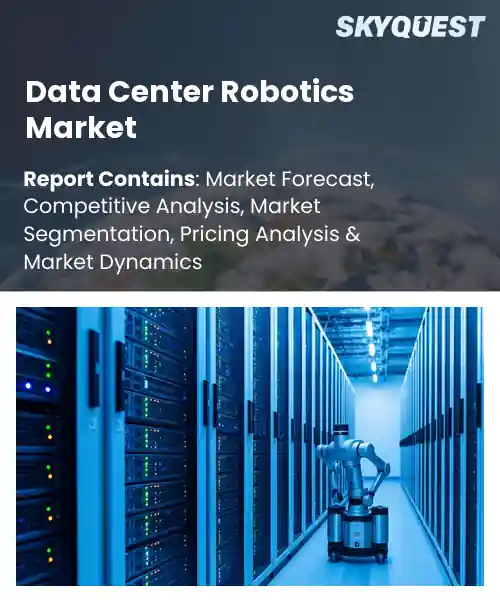
Data Center Robotics Market
Report ID: SQMIG45I2410
Report ID: SQMIG45I2410
[email protected]
USA +1 351-333-4748
Report ID:
SQMIG45I2410 |
Region:
Global |
Published Date: June, 2026
Pages:
157
|Tables:
173
|Figures:
79


Global Data Center Robotics Market size was valued at USD 13.5 Billion in 2024 and is poised to grow from USD 16.4 Billion in 2025 to USD 77.9 Billion by 2033, growing at a CAGR of 21.5% during the forecast period (2026-2033).
As global hyperscale operators and enterprises contend with rapidly expanding compute demand, the primary driver of the data center robotics market is the imperative to improve operational efficiency and reliability in facility management. The market comprises robotic platforms, inspection drones, automated guided vehicles, robotic server handling systems integrated with orchestration software, and it matters because human labor and manual workflows cannot scale to maintain racks and cooling systems without increasing risk and cost. Historically data centers moved from manual maintenance to automation, borrowing lessons from warehouse robotics pioneered by firms like Amazon, and robotic solutions enable deployments and safer maintenance.Building on those pressures, the key growth factor is the convergence of AI orchestration and fleet robotics that moves automation from pilots to production. As machine learning workloads raise rack density and thermal variability, operators deploy thermal imaging drones and predictive analytics to detect hotspots and automated guided vehicles with robotic arms to swap server modules faster than human crews. Because these systems lower mean time to repair and reduce labor costs, operators pursue robotics services and retrofit legacy halls, creating revenue for integrators and software vendors while enabling denser, energy efficient facilities and resilience to satisfy escalating compute demand.
How is AI enhancing operational efficiency in the data center robotics market?
AI is enhancing operational efficiency in the data center robotics market by enabling smarter sensing planning and decision making for autonomous systems. Key aspects include AI powered visual inspection for rapid fault detection predictive maintenance that flags likely failures and intelligent fleet coordination that sequences tasks to minimize interference. The current state shows broader adoption in security patrols inventory handling and infrastructure checks as operators face higher compute density and tighter uptime expectations. Real cases range from robot dogs doing perimeter rounds to AI agents orchestrating inspection routes which reduces manual labor and shortens response times.NVIDIA 06/2026, announced an expanded partnership with LG to develop humanoid robots and next generation data centers highlighting how AI driven perception planning and local agent control speed inspections reduce manual intervention and support more scalable efficient operations.
Market snapshot - (2026-2033)
Global Market Size
USD 13.5 Billion
Largest Segment
Mobile Robots (AGVs / AMRs)
Fastest Growth
Mobile Robots (AGVs / AMRs)
Growth Rate
21.5% CAGR
To get more insights on this market click here to Request a Free Sample Report
Global data center robotics market is segmented by robot type, function, component, deployment type, data centre type, application and region. Based on robot type, the market is segmented into Articulated Robots, Collaborative Robots (Cobots) and Mobile Robots (AGVs / AMRs). Based on function, the market is segmented into Inspection & Monitoring, Maintenance & Repair, Security & Surveillance and Inventory Management. Based on component, the market is segmented into Hardware, Software and Services. Based on deployment type, the market is segmented into On-Premises and Cloud-Based. Based on data centre type, the market is segmented into Enterprise Data Centres, Colocation Data Centres and Hyperscale Data Centres. Based on application, the market is segmented into IT & Telecommunications, BFSI, Healthcare, Government & Defense and Others. Based on region, the market is segmented into North America, Europe, Asia Pacific, Latin America and Middle East & Africa.
Collaborative robots segment leads because their safe, flexible interaction with technicians reduces labor constraints and accelerates routine tasks in data center environments. Their adaptable payloads and simple programming enable rapid integration with rack level operations and maintenance workflows, lowering entry barriers for automation. This human robot partnership drives adoption by improving serviceability and uptime while minimizing disruption to live systems, creating sustained demand among operators seeking incremental efficiency gains.
However, mobile robots segment is witnessing rapid growth as autonomous guided vehicles and mobile platforms scale to handle equipment transport and provisioning. Advances in navigation and fleet orchestration enable dynamic load movement and aisle level inventory transport, creating new operational models and broadening opportunities for robot enabled logistics and material handling within data centers.
Inspection and monitoring segment dominates because continuous environmental and asset surveillance is foundational to data center reliability and uptime. Automated visual inspections, thermal scanning, and sensor networks delivered by robotic platforms provide real-time anomaly detection that prevents cascading failures. This proactive visibility reduces emergency interventions and integrates with management systems to prioritize remediation, driving operator investment in monitoring capabilities as the primary entry point for robotics deployment in critical facilities.
However, maintenance and repair is emerging as the fastest growing area as robotic tooling and teleoperation enable remote corrective work on servers and infrastructure. Improvements in modular end effectors and condition based scheduling make robotic servicing viable, reducing on site labor needs and extending asset lifecycles, thereby creating demand for specialized maintenance robotics and associated service offerings.
To get detailed segments analysis, Request a Free Sample Report
North America commands the global data center robotics landscape through a confluence of technological leadership, concentrated hyperscale operations, and a mature ecosystem that accelerates innovation. Proximity to large cloud and colocation providers fosters early adoption and scale testing, while abundant venture and corporate investment supports rapid product development. A deep talent pool in robotics, artificial intelligence and systems engineering enables sophisticated solutions that integrate hardware and software. Collaborative networks among research institutions, vendors, and operators promote standards and interoperability. Favorable regulatory and business environments reduce barriers to deployment, and a market emphasis on operational efficiency and energy optimization drives sustained uptake of robotic automation across facilities of varied sizes. Investment in edge infrastructure and specialized logistics further amplifies practical use cases, while partnerships between suppliers and operators shorten commercialization cycles and foster continuous improvement.
Data Center Robotics Market United States emphasizes deployment by hyperscale cloud operators and a rich supplier ecosystem enabling rapid prototyping. Operators seek automation for materials movement, inspection and facility maintenance to improve efficiency and resilience. Collaborations among vendors, integrators and research centers accelerate pilots and operational scale. Investment availability and a skilled technical workforce support commercialization and iterative innovation across varied data center footprints while regulatory clarity aids deployments nationwide.
Data Center Robotics Market Canada benefits from a strong services sector and close integration with global operators, fostering pragmatic adoption of robotic logistics and monitoring solutions. Regional operators prioritize energy efficiency and operational resilience, driving interest in autonomous material handling and predictive maintenance. Collaboration between technology vendors, researchers and service providers enables tailored deployments that reflect local infrastructure and workforce strengths. Supportive policy discourse and industry partnerships accelerate roll out across market segments.
Asia Pacific is experiencing rapid expansion in data center robotics driven by escalating data traffic, strategic investments in edge infrastructure and a strong emphasis on automation within technology and manufacturing sectors. Regional operators and cloud providers seek compact, efficient and autonomous solutions to manage constrained sites and complex logistics, prompting local adaptation of robotics platforms. Government support for advanced manufacturing and digital infrastructure, combined with robust research capabilities in robotics and electronics, accelerates commercialization. Cross border partnerships and technology transfers enable speedy localization and service models that reflect varied regulatory and operational needs. The prevalence of dense urban deployments and the push for energy conscious operations further stimulate demand for inspection, materials handling and intelligent maintenance robots tailored to regional climates and facility types.
Data Center Robotics Market Japan leverages a deep robotics industry and precision engineering heritage to tailor automation solutions for dense urban facilities. Operators prioritize compact, reliable energy efficient systems for inspection, materials movement and predictive maintenance, adapting designs to constrained footprints. Strong ties between vendors and enterprise users accelerate pilots and help translate laboratory advances into operational deployments across site types. Local supply chains support customization and swift integration nationwide.
Data Center Robotics Market South Korea leverages advanced manufacturing and systems integration to produce practical automation solutions. Operators select robust, responsive robots for materials handling, inspection and preventive maintenance in compact, high performance facilities. Partnerships among equipment vendors, carriers and cloud providers speed localization and deployment of tailored systems. Emphasis on energy efficiency and interoperability supports integration into wider facility management frameworks, while skilled engineers enable continuous optimization of solutions.
Europe is strengthening its position in the data center robotics market through a strategic focus on sustainability, interoperable standards and collaborative innovation across national boundaries. Emphasis on energy efficient operations and lifecycle management encourages adoption of robots that reduce manual labor and optimize maintenance cycles, especially in retrofit and modular deployments. Public and private partnerships foster trials and shared learning, while a strong base of industrial automation vendors and systems integrators adapts advanced robotics for data center contexts. Attention to regulatory alignment, data protection and safety norms smooths deployments across markets. The region also prioritizes integration of robotics with building management and energy systems, ensuring solutions contribute to decarbonization objectives while meeting diverse facility architectures and service models. Growing networks of service providers and retrofit specialists accelerate market adoption across countries.
Data Center Robotics Market Germany benefits from a deep industrial automation tradition and strong engineering capabilities that translate into robust, scalable solutions. Operators and integrators work closely to adapt factory grade robotics for inspection, materials handling and maintenance in diverse facility types. A focus on energy optimization and lifecycle services supports operational efficiency and facilitates retrofit of sites. Collaboration between equipment makers and data center operators accelerates deployment at scale.
Data Center Robotics Market United Kingdom is influenced by a dynamic services sector and proximity to major cloud and enterprise users that drive pragmatic automation. Operators seek versatile robots for logistics, inspection and predictive maintenance to improve uptime and optimize energy use across urban campuses. Strong systems integrators, specialist service providers and policy focus on efficiency encourage pilots and wider roll out across market segments while collaboration with research centers.
Data Center Robotics Market France is shaped by a strong emphasis on energy efficiency, cooling innovation and sustainable operations that align with operator priorities. Demand focuses on robots for inspection, materials handling and facility maintenance that support green objectives and reduce manual interventions. Collaborations among integrators, equipment manufacturers and public sector initiatives facilitate pilots and adaptation to diverse facility architectures. Service providers and local engineering expertise help scale proven solutions.
To know more about the market opportunities by region and country, click here to
Buy The Complete Report
Automation and Operational Efficiency
Energy Management and Sustainability
Complex Integration and Legacy Systems
Regulatory Compliance and Data Privacy
Request Free Customization of this report to help us to meet your business objectives.
Competition in the global data center robotics market is driven by platform innovation, strategic partnerships and selective consolidation as operators seek to reduce manual rack work and improve uptime. Vendors pursue concrete moves such as licensing and platform partnerships and targeted acquisitions to scale offerings. Examples include Skild AI’s industry integrations with NVIDIA and ABB and Robust.AI’s productization of an autonomous cart plus fleet software.
Top Player’s Company Profile
Recent Developments
SkyQuest’s ABIRAW (Advanced Business Intelligence, Research & Analysis Wing) is our Business Information Services team that Collects, Collates, Correlates, and Analyses the Data collected by means of Primary Exploratory Research backed by robust Secondary Desk research. As per SkyQuest analysis, the global data center robotics market is driven by the imperative to improve operational efficiency and reliability in facility management, and a second major driver is the convergence of AI orchestration and fleet robotics that moves automation from pilots to production. Growth is restrained by complex integration with legacy systems that increases customization, validation time and deployment risk. North America remains the dominant region due to hyperscale operators, investment and a mature robotics ecosystem, while inspection and monitoring is the leading segment as automated visual and thermal surveillance provides real time anomaly detection and reduces mean time to repair. Vendors should prioritize scalable orchestration and retrofit services to capture demand.
| Report Metric | Details |
|---|---|
| Market size value in 2024 | USD 13.5 Billion |
| Market size value in 2033 | USD 77.9 Billion |
| Growth Rate | 21.5% |
| Base year | 2024 |
| Forecast period | (2026-2033) |
| Forecast Unit (Value) | USD Billion |
| Segments covered |
|
| Regions covered | North America (US, Canada), Europe (Germany, France, United Kingdom, Italy, Spain, Rest of Europe), Asia Pacific (China, India, Japan, Rest of Asia-Pacific), Latin America (Brazil, Rest of Latin America), Middle East & Africa (South Africa, GCC Countries, Rest of MEA) |
| Companies covered |
|
| Customization scope | Free report customization with purchase. Customization includes:-
|
To get a free trial access to our platform which is a one stop solution for all your data requirements for quicker decision making. This platform allows you to compare markets, competitors who are prominent in the market, and mega trends that are influencing the dynamics in the market. Also, get access to detailed SkyQuest exclusive matrix.
Table Of Content
Executive Summary
Market overview
Parent Market Analysis
Market overview
Market size
KEY MARKET INSIGHTS
COVID IMPACT
MARKET DYNAMICS & OUTLOOK
Market Size by Region
KEY COMPANY PROFILES
Methodology
For the Data Center Robotics Market, our research methodology involved a mixture of primary and secondary data sources. Key steps involved in the research process are listed below:
1. Information Procurement: This stage involved the procurement of Market data or related information via primary and secondary sources. The various secondary sources used included various company websites, annual reports, trade databases, and paid databases such as Hoover's, Bloomberg Business, Factiva, and Avention. Our team did 45 primary interactions Globally which included several stakeholders such as manufacturers, customers, key opinion leaders, etc. Overall, information procurement was one of the most extensive stages in our research process.
2. Information Analysis: This step involved triangulation of data through bottom-up and top-down approaches to estimate and validate the total size and future estimate of the Data Center Robotics Market.
3. Report Formulation: The final step entailed the placement of data points in appropriate Market spaces in an attempt to deduce viable conclusions.
4. Validation & Publishing: Validation is the most important step in the process. Validation & re-validation via an intricately designed process helped us finalize data points to be used for final calculations. The final Market estimates and forecasts were then aligned and sent to our panel of industry experts for validation of data. Once the validation was done the report was sent to our Quality Assurance team to ensure adherence to style guides, consistency & design.
Analyst Support
Customization Options
With the given market data, our dedicated team of analysts can offer you the following customization options are available for the Data Center Robotics Market:
Product Analysis: Product matrix, which offers a detailed comparison of the product portfolio of companies.
Regional Analysis: Further analysis of the Data Center Robotics Market for additional countries.
Competitive Analysis: Detailed analysis and profiling of additional Market players & comparative analysis of competitive products.
Go to Market Strategy: Find the high-growth channels to invest your marketing efforts and increase your customer base.
Innovation Mapping: Identify racial solutions and innovation, connected to deep ecosystems of innovators, start-ups, academics, and strategic partners.
Category Intelligence: Customized intelligence that is relevant to their supply Markets will enable them to make smarter sourcing decisions and improve their category management.
Public Company Transcript Analysis: To improve the investment performance by generating new alpha and making better-informed decisions.
Social Media Listening: To analyze the conversations and trends happening not just around your brand, but around your industry as a whole, and use those insights to make better Marketing decisions.
REQUEST FOR SAMPLE
 REQUEST FREE CUSTOMIZATION


Want to customize this report? This report can be personalized according to your needs. Our analysts and industry experts will work directly with you to understand your requirements and provide you with customized data in a short amount of time. We offer $1000 worth of FREE customization at the time of purchase.
Feedback From Our Clients


 USA (+1) 351-333-4748

